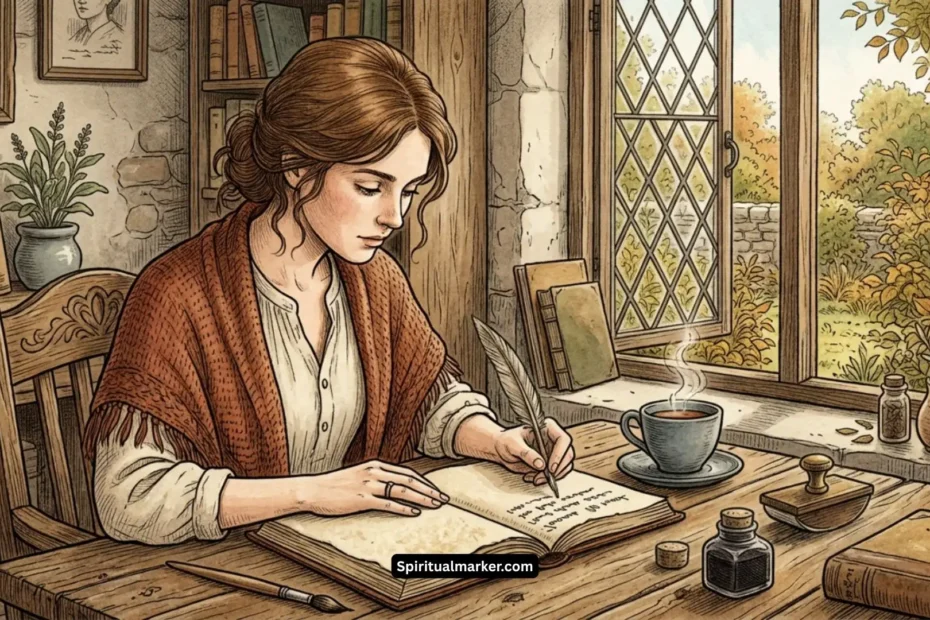
You have always used your left hand. You write with it, reach with it, and feel most natural when the world bends to your left side. But have you ever wondered whether that preference carries a deeper meaning? Across thousands of years of human history, being left-handed has been wrapped in spiritual symbolism, mystical reverence, and cultural tension. Ancient societies watched left-handed people with wide eyes. Some called them gifted. Others called them cursed. Very few stayed neutral.
The word “sinister” literally comes from the Latin word for “left.” Yet many of history’s most spiritually powerful figures, from prophets to seers to healers, were said to favor their left hand. This contradiction is not accidental. It reflects something much deeper about how humanity has always understood the left side of the body as a gateway to the unseen, the intuitive, and the divine feminine. The left has always stood apart, and so have the people who lead with it.
This post takes a full, in-depth look at the spiritual meaning of being left-handed. You will read about what different world religions say, what ancient mythologies believed, and what the seven most significant spiritual meanings truly are. Whether you are left-handed yourself, or you love someone who is, what follows may permanently change how you see this rare, remarkable trait.
Key Takeaways
- Left-handedness has carried spiritual meaning for thousands of years, with cultures around the world associating it with mystery, intuition, and sacred wisdom.
- Many spiritual traditions connect the left hand with receiving energy, inner guidance, and heightened intuition, making it a symbol of awareness and spiritual sensitivity.
- Religious views on left-handedness vary widely. Some sacred texts associate the left hand with warning, while others highlight its role in divine purpose and balance.
- Left-handed people are often linked with creativity, originality, and unconventional thinking, reflecting long-standing beliefs that they perceive the world from a unique perspective.
- The spiritual meaning of being left-handed is not about good or bad luck. Instead, it represents duality, balance, personal authenticity, and the courage to walk a different path.
What Is Left-Handedness and Why Has It Always Felt Different?
Scientists estimate that roughly 10 to 12 percent of the global population is left-handed. That number has remained strikingly consistent across human history and across every known culture. This consistency is not random. Researchers believe handedness is partly determined by genetics, but also influenced by prenatal hormone exposure, neurological development, and factors still not fully understood. The brain of a left-handed person is often organized differently, with language and spatial processing distributed across hemispheres in ways that differ from right-handers.
That neurological difference matters spiritually. Many ancient traditions linked the right hemisphere of the brain, which controls the left hand, to creativity, intuition, dreaming, and spiritual awareness. The right side of the brain processes holistic patterns. It reads the emotional texture of a room. It accesses what cannot be spoken in words. When you naturally favor your left hand, you may be wired to access those deeper channels more readily.
Throughout history, left-handed people were seen as anomalies in a right-handed world. That outsider status itself carries spiritual weight. Many shamanic traditions taught that those who exist outside the norm are often chosen to walk between worlds. The person who does not fit easily into the dominant pattern may be the one most equipped to perceive what the dominant pattern cannot see. That is precisely where left-handers have always sat: at the threshold between the ordinary and the extraordinary.
What Does Being Left-Handed Symbolize?
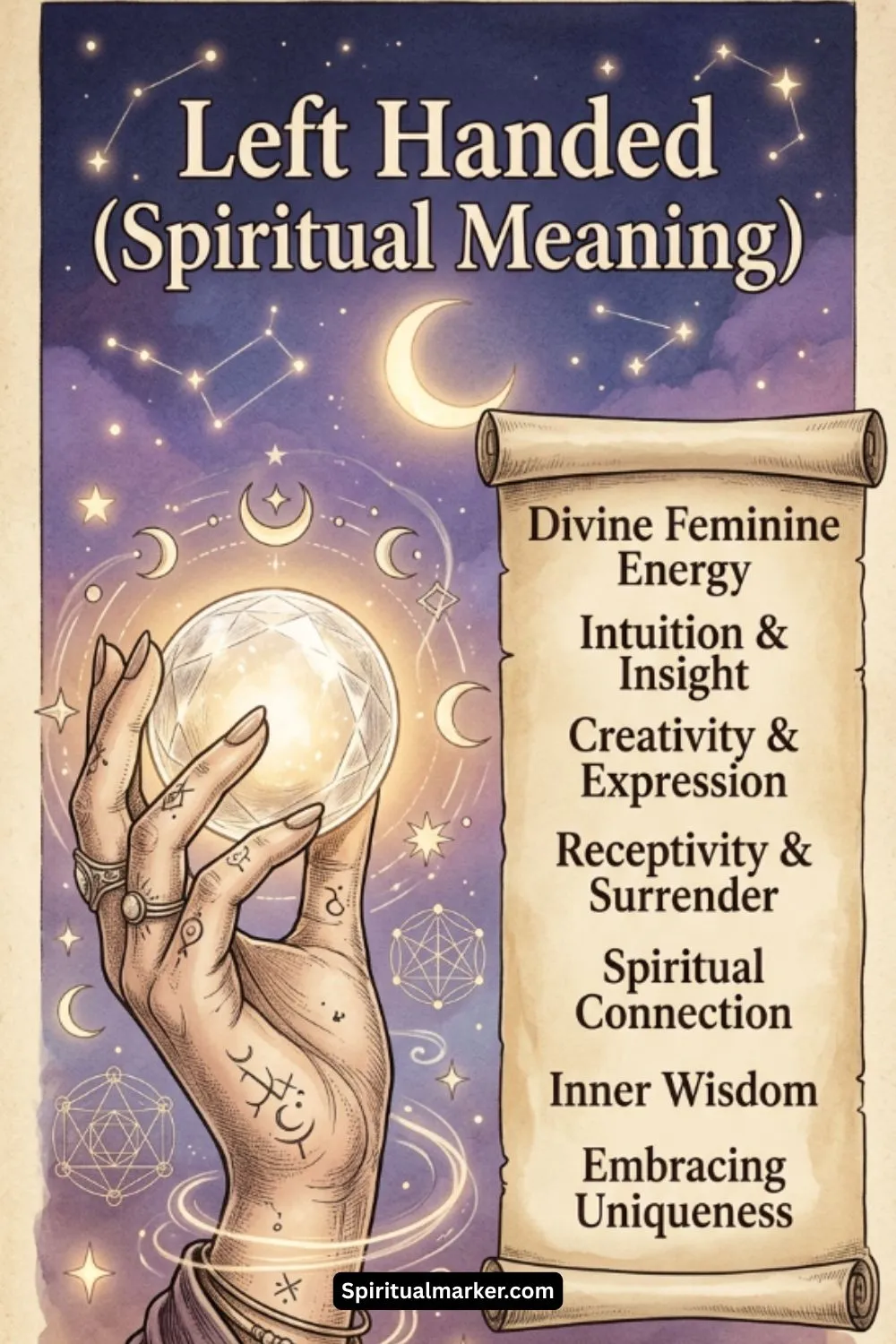
At its most fundamental level, left-handedness symbolizes the path less taken. The left has always represented the road that diverges from convention, the unconventional choice, and the wisdom that comes from walking apart from the crowd. In nearly every ancient symbol system, the left and right sides of the body represent a fundamental duality: passive and active, feminine and masculine, receiving and giving, inner and outer.
The left hand specifically symbolizes receptivity and spiritual intake. In palmistry, a practice with roots stretching back to ancient India and recorded in ancient Greek texts, the left hand shows what you were born with. It reveals your soul’s original blueprint, your karmic inheritance, and your innate spiritual gifts. The right hand, by contrast, shows what you do with those gifts. For left-handed people, the dominant hand is also the hand of spiritual inheritance, suggesting a direct and powerful connection to their soul’s deeper nature.
Symbolically, the left also connects to the moon, water, the subconscious mind, and the yin principle. These are the forces of depth, reflection, and inner knowing. A person who leads with the left hand is, in symbolic terms, someone who leads with those very qualities. They navigate the world from a place of feeling first and thinking second, of sensing before analyzing, of perceiving the undercurrent before they name the surface wave.
7 Spiritual Meanings of Being Left-Handed
1. You Carry Heightened Psychic and Intuitive Gifts
Perhaps the most consistent spiritual belief about left-handed people across world traditions is that they possess heightened psychic sensitivity. This belief appears in Celtic folk traditions, in West African spiritual practices, and in many Indigenous American cosmologies. The left side of the body was seen as the side that faces the spirit world. It was the side through which invisible information entered the physical body.
In modern neurological research, left-handed individuals do show differences in brain lateralization that may correlate with stronger cross-hemispheric communication. Some researchers have hypothesized that this enhanced neural connectivity may underlie the higher rates of creativity and pattern recognition observed in left-handers. Spiritually, this translates as an innate ability to perceive connections that others miss, to read the unspoken emotion in a room, and to sense shifts in energy before those shifts become visible.
Many cultures taught that left-handed people could sense illness, danger, or spiritual imbalance simply by touch or presence. This was not superstition for its own sake. It reflected a deeply held belief that some people are built as receivers of subtle information. If you are left-handed and have always felt things deeply, sensed what others could not articulate, or known something was wrong before any evidence appeared, this spiritual meaning speaks directly to your experience.
The receptive quality of the left hand in energy healing practices like Reiki reinforces this meaning. Healers are taught that the left hand receives energy and the right hand sends it. Leading with the left hand may mean you are spiritually designed first to receive, to absorb, and to understand before you act or transmit.
2. You Walk the Path of the Spiritual Nonconformist
Every major spiritual tradition has a figure who breaks with convention and, in doing so, opens a new door for everyone else. Left-handedness is the embodiment of that archetype. In a world built entirely for the right-handed majority, simply existing as a left-hander requires constant adaptation, creative problem-solving, and a willingness to do things your own way. That is not a small thing. That is a spiritual training ground.
Ancient Vedic traditions used the term vama marga, often translated as the “left-hand path,” to describe a form of spiritual practice that operated outside conventional religious structures. Practitioners of this path worked with energies and techniques that mainstream tradition avoided. They were not considered evil. They were considered advanced, willing to engage with the full spectrum of reality rather than only its comfortable portions.
Being left-handed spiritually positions you as someone who does not default to the dominant pattern. You think differently, process differently, and often arrive at truths by routes that others have not taken. This is the gift of the spiritual nonconformist: you see what the crowd misses precisely because you are not standing where the crowd stands. Your natural orientation challenges assumption, and that challenge is a form of spiritual service.
The great mystical poet Rumi wrote of the necessity of walking an unusual path to reach the divine. Many Sufi teachers operated outside mainstream religious norms. The nonconformist is not always comfortable, but they are often the one who carries the light into territory that has never been illuminated. That role belongs naturally to left-handed individuals in the spiritual framework of dozens of traditions.
3. You Channel the Power of the Sacred Feminine
In virtually every ancient cosmological framework, the left side of the body corresponds to feminine energy. This is not about gender. It is about the quality of energy: receptive, nurturing, deeply perceptive, and connected to cycles, mystery, and the moon. The left side corresponds to yin in Chinese philosophy, to the shakti in Hindu tantra, and to the lunar principle in Western esoteric systems. Left-handed people, regardless of their gender, are seen as carriers of this sacred feminine current.
Taoist philosophy teaches that yin and yang must remain in balance for harmony to exist. The world has long been structured around yang dominance: action, assertion, outward expression. Left-handers bring yin force into that landscape. They bring depth over speed, intuition over analysis, and receptivity over projection. That is not a weakness. In a world out of balance, it is precisely what is needed.
Ancient goddess traditions, including those of Isis in Egypt and Durga in India, emphasized the power of the left hand as the hand of divine feminine action. Durga herself is often depicted with her left hand positioned in a gesture of spiritual protection and blessing. In Celtic traditions, the goddess energy moved through the left side of sacred spaces. Participants entering stone circles from the left were said to be moving in the direction of the goddess, of the moon, and of ancestral wisdom.
If you are left-handed, you may find that you have a natural affinity for cycles, emotional depth, creative expression, and the wisdom of the body. These are all qualities that the sacred feminine embodies. You carry that current in your dominant hand, which means you carry it into everything you do, everything you make, and every person you touch.
4. You Hold a Special Connection to Ancestral and Spirit Realms
In West African spiritual traditions, including Vodou and Ifá, the left hand is the hand of the ancestors. It is the hand through which ancestral blessing, guidance, and spiritual memory flow into the living. To receive something with the left hand in these traditions is to receive it with your full spiritual being, including your lineage. Left-handed people in these cultures were often identified as natural mediums, people through whom ancestral wisdom could speak more freely.
This belief echoes through Indigenous traditions across the Americas, Africa, and Oceania. The left-hander was often the one chosen to communicate with the dead, to perform funeral rites, or to interpret dreams sent by departed spirits. This role was not feared. It was honored, because the ability to hear the ancestors is a profound gift that keeps the community connected to its roots and its wisdom.
Modern spiritual practitioners working within ancestral healing frameworks often note that left-handed clients seem to carry their ancestral wounds and blessings in unusually accessible ways. The patterns of the lineage feel closer to the surface. This makes healing both more intense and more transformative. You may notice that family themes, recurring dreams, and inherited emotional patterns feel particularly vivid or urgent in your life. That is the ancestral current moving through your left-handed channel.
Across many traditions, the left hand also serves as the hand of the dead in ritual contexts. Funerary objects were placed to the left. Offerings to ancestors were made with the left hand extended. This positions left-handed people as natural guardians of sacred memory, people who carry the past not as a burden but as a living inheritance that continues to shape the present.
5. You Embody the Energy of Creative and Visionary Power
The connection between left-handedness and creative genius is well documented. The left-handers are overrepresented among architects, musicians, artists, and those who work in highly creative fields. Leonardo da Vinci was left-handed. So were Michelangelo, Nikola Tesla, and Ludwig van Beethoven. This is not coincidence from a spiritual perspective. It reflects the truth that the left-handed mind operates closer to the source of creative vision.
Many ancient traditions explicitly linked the left hand to the muse, to divine inspiration, and to the creative fire that comes from beyond ordinary consciousness. The Greek notion of the daemon, the guiding creative spirit that whispers inspiration to the artist, was often associated with approaches from the left side. A left-handed artist was seen as one whose creative channel was wide open, whose hand moved in direct response to the invisible forces of inspiration without the filtering interference of pure logic.
In numerology and sacred geometry traditions, the left hand was associated with the number two, which governs duality, imagination, and the gap between what is and what could be. That gap is precisely where creative vision lives. Left-handers are spiritually equipped to inhabit the space of possibility more naturally than those who lead with the hand of action and execution. They see the potential before the product. They sense the form before the form exists.
This meaning speaks most powerfully to left-handed people who have always felt an inner urgency to make, express, or create. You are not just a person with a hobby. You carry a sacred creative charge that many ancient traditions would have recognized immediately and honored accordingly.
6. You Bear the Mark of the Spiritual Challenger and Transformer
Throughout history, left-handed people have been perceived as disruptive, unconventional, or outside the norm. In medieval Europe, left-handed children were forced to write with their right hands. Some were accused of witchcraft. Others were simply treated as anomalies to be corrected. This systematic suppression tells a spiritual story: the dominant power structure has always sensed that left-handed people carry energy that challenges established order.
In spiritual terms, the challenger is not a negative figure. The transformer archetype is essential. Every tradition has one. Shiva in Hinduism destroys so that new creation can arise. Loki in Norse mythology disrupts the divine order and, in doing so, forces evolution. The trickster figures of Indigenous traditions expose the blind spots of the community. Left-handed people carry this transformer energy in their very physical orientation. They approach the world from a direction that the dominant system does not anticipate, and in doing so, they reveal what the system cannot see about itself.
This does not mean left-handed people are destined for conflict. It means they are equipped for necessary disruption. They ask the questions others avoid. They find the solutions that conventional thinking bypasses. They push boundaries not because they enjoy chaos, but because their spiritual wiring is tuned to transformation. Where others see a closed door, they find a window. Where others accept a fixed pattern, they see a possible evolution.
If you have always felt like a catalyst in your relationships, your communities, or your creative work, this meaning affirms that experience. You are not causing problems. You are fulfilling a spiritual function that the world genuinely needs, even when it does not immediately recognize that need.
7. You Possess a Natural Gift for Healing and Energetic Sensitivity
The left hand’s role as the receiving hand in energy healing positions left-handed people as natural healers in multiple spiritual traditions. In Reiki, practitioners are taught that healing energy flows in through the left hand and out through the right. A left-handed practitioner, by leading naturally with their receiving hand, may have an instinctive ability to sense energy blockages, emotional pain, and physical imbalance before they consciously direct healing intention.
Traditional Chinese medicine associates the left side of the body with yang in some contexts and with specific meridian channels that govern the heart and the emotional body. The body’s energetic system is not symmetrical, and the different sides carry different qualities of life force. Left-handed people, who engage the world primarily through these channels, may process emotional and energetic information in ways that make them exceptionally attuned healers, counselors, and spiritual guides.
Many shamanic and folk healing traditions identified their healers precisely by their left-handedness. The left-handed healer was seen as someone who could receive the illness from a patient through the left hand, process it, and release it. This required a particular kind of energetic resilience combined with extraordinary sensitivity, qualities that many left-handed people report experiencing throughout their lives, often without understanding why they feel so much of what others around them feel.
If you are left-handed and have always been the person others turn to in crisis, the one who instinctively knows how to comfort, or the one who can walk into a room and immediately sense what is wrong, this spiritual meaning is your explanation. Your left hand is not just your writing hand. It is your healing instrument, and that is a sacred responsibility carried by very few.
Left-Handedness Meaning and Symbolism Across Cultures and Religions
The cultural and religious meaning of the left hand varies widely, but certain themes appear consistently across traditions separated by thousands of miles and centuries of time. That consistency is itself spiritually significant. When unconnected civilizations arrive at similar symbolic frameworks independently, those frameworks tend to reflect something real about human experience and the structure of the universe.
In ancient Egypt, the left eye was the Eye of Horus, associated with the moon, healing, and protection. The left side of the body was associated with the goddess Isis and with the west, the direction of the setting sun and the realm of the dead. Left-handed priests performed specific rites that required contact with the invisible world. They were not marginalized. They were specialists in sacred thresholds.
In traditional Chinese culture, the symbolic meaning of left and right shifts depending on context. In some Taoist frameworks, the left is associated with yang and the east, the direction of growth and spring. In other contexts, particularly those related to death and mourning, the left holds yin associations. Chinese symbolic tradition treats left-handedness as a marker of distinction, though not uniformly positive or negative. The left in Chinese cosmology is the side of the dragon, a profoundly powerful spiritual symbol.
In many Indigenous North American traditions, including several Plains cultures, the left hand was associated with spiritual power and vision. Left-handed warriors and hunters were often respected as people who moved contrary to the expected pattern, and that contrariness was understood as a sign of spiritual election rather than deficiency. The “Contrary” figure in some traditions was a sacred person who did everything backwards, precisely because that reversal was a form of spiritual medicine for the community.
In Islamic tradition, the left hand carries specific ritual significance. The Prophet Muhammad taught that the right hand should be used for honorable actions such as eating and greeting, while the left is used for cleaning. This is often interpreted as a hierarchy, but Islamic scholars note that it reflects a sacred dualism rather than a condemnation. The left hand performs the necessary work of purification, which is itself a sacred function in Islamic practice.
Left-Hand Symbolism in World Mythologies
World mythologies offer some of the richest material for understanding the spiritual symbolism of left-handedness. These stories encode the deepest beliefs of their cultures, and the left hand appears in them with remarkable frequency and specificity.
In Hindu mythology, the god Shiva is sometimes depicted as Ardhanarishvara, the half-male, half-female form where the left side of the body represents the goddess Parvati. The left half of this divine being embodies shakti, the feminine creative power of the universe. Left-handedness in this context is not a flaw. It is an alignment with the divine feminine half of reality, a blessing of creative and transformative power.
In Norse mythology, the god Tyr sacrificed his right hand to the great wolf Fenrir, an act of enormous spiritual significance. After losing the right hand, Tyr was associated with his remaining left hand as a symbol of sacrifice and of maintaining order through unconventional means. The left hand in this context becomes the hand of sacred sacrifice and spiritual courage, the hand that remains when everything conventional has been offered up.
In Greek mythology, the left side was associated with bad omens for those traveling, but with prophetic power for those who could interpret signs. The word for “left” in Greek, aristeros, shares a root with aristos, meaning “best” or “noble,” a linguistic trace of an older tradition that honored the left as superior in spiritual sight. Greek augurs, the priests who interpreted bird omens, received favorable omens from birds appearing on the right during certain rituals, but the left was the side of the gods’ perspective, seen from facing humans.
In Celtic mythology, the left hand was used in sacred oaths and in the handfasting ceremony, where couples bound their left hands together to symbolize the joining of their spiritual bodies. This tradition gave rise to the modern phrase “tying the knot.” The left hand in Celtic spiritual practice was the hand of the soul’s commitment, the hand of deepest promise and spiritual covenant.
Left-Handedness in the Bible: Biblical Meanings and Significance
The Bible contains numerous references to the left hand, and they reveal a complex and layered symbolic tradition. Many people assume the Bible uniformly favors the right hand over the left. The reality is considerably more nuanced.
In the book of Judges, the hero Ehud is explicitly identified as left-handed. He uses his left-handed advantage to conceal a sword on the unexpected side of his body and assassinate the oppressive king Eglon of Moab, liberating the Israelites. Far from being presented as a weakness, Ehud’s left-handedness is the key to his God-given victory. It is the specific, unusual gift that makes him the right person for the mission no one else could accomplish.
The tribe of Benjamin in the Old Testament produced a fighting force of 700 left-handed warriors who were renowned for their extraordinary skill. First Chronicles describes Benjaminite warriors who could throw stones with either hand, implying that their ambidexterity and left-hand strength were assets rather than liabilities. These warriors were chosen for their skills, not despite their left-handedness but partly because of the unusual abilities it gave them.
The New Testament parable of the sheep and the goats in Matthew 25 places the blessed at the right hand of God and those being judged at the left. This passage has been interpreted as a condemnation of the left hand. However, biblical scholars note that the passage is about direction and division in the context of final judgment, not about the inherent spiritual quality of left-handedness itself. The cultural context of first-century Judaism included complex honor codes around right and left that do not translate directly into a judgment on left-handed people.
Ecclesiastes 10:2 states that “a wise man’s heart is at his right hand, but a fool’s heart is at his left.” This verse reflects the cultural biases of its time rather than a theological condemnation of left-handedness. Biblical scholars consistently point out that Hebrew scripture was written within a cultural framework where right and left carried social connotations, not absolute moral judgments about individuals whose dominant hand happened to be the left.
Being Left-Handed in Hinduism, Buddhism, and Eastern Spiritual Traditions
Eastern spiritual traditions offer some of the most sophisticated frameworks for understanding the spiritual meaning of the left hand. In Hindu tantra, the vama marga or left-hand path is a legitimate and advanced spiritual discipline. Practitioners of this path engage directly with the forces of creation and dissolution, working with energies that mainstream Hinduism considers too potent for ordinary practitioners. The left-hand path is not for beginners. It is for those who have developed sufficient spiritual maturity to work with the full spectrum of divine energy.
In the chakra system used in both Hindu and Buddhist tantric practices, energy flows through the body along channels called nadis. The ida nadi, which carries lunar, feminine, and cooling energy, flows primarily through the left side of the body. Left-handed people may have a naturally stronger or more accessible ida current, which would explain their heightened emotional sensitivity, intuitive capacity, and creative energy. The ida connects to the left nostril, the right hemisphere of the brain, and the qualities of introspection, receptivity, and spiritual depth.
In Buddhist iconography, the left hand of the Buddha holds different symbolic objects depending on the tradition. In many depictions, the left hand rests in the lap in the gesture of meditation, while the right hand touches the earth. The left hand’s meditative position symbolizes the inner stillness and receptive awareness that underlies all spiritual practice. The left hand is the hand of the interior journey, the hand that holds the space of silence from which wisdom emerges.
In Japanese Shinto tradition, the left side is considered superior to the right in ceremonial contexts. Guests of honor sit to the left of the host. The left side of the shrine is the side associated with greater spiritual proximity. This reflects an older stratum of East Asian spiritual thought in which the left was not sinister but sacred, elevated, and closer to the divine. Left-handed people in traditional Japanese spiritual contexts would have been seen as naturally aligned with the sacred dimension of existence.
The Left-Hand Path in Western Esotericism and Mysticism
In Western esoteric tradition, the term “left-hand path” has a specific and important meaning. It refers to spiritual practices that emphasize individual sovereignty, direct experience of the divine, and the integration of shadow energies, as opposed to the right-hand path, which emphasizes devotion, moral purity, and surrender to divine authority. Both paths are considered legitimate within esoteric frameworks, though the left-hand path is often misunderstood by those outside it.
Western esoteric traditions including Hermeticism, Kabbalah, and ceremonial magic all contain teachings about the left side of the Tree of Life, known as the Pillar of Severity or the side of Geburah. This pillar represents the principle of divine judgment, strength, and the necessary limitation that gives form to creation. It is not an evil pillar. It is a necessary and powerful pillar that balances the mercy of the right side. Left-handed people in these frameworks are often seen as naturally resonating with the qualities of Geburah: strength, discernment, and the courage to set necessary limits.
Aleister Crowley, whose influence on Western esotericism remains enormous regardless of the controversy he courted, wrote extensively about the left-hand path as a path of spiritual self-actualization and magical power. His framework, while extreme in many ways, reflected a genuine tradition within Western mysticism that honored the left as the side of the magician, the one who works directly with primal forces rather than petitioning a higher authority to do so.
In Wicca and modern paganism, the left-hand path has been rehabilitated as a valid spiritual orientation focused on personal sovereignty and shadow integration. Many Wiccan traditions teach that the left hand governs the witch’s relationship with the unseen world, with ancestors, and with the moon. Left-handed Wiccans are sometimes considered especially well-suited to spirit communication, lunar magic, and the deep inner work of shadow healing.
What Does It Mean to Dream of Being Left-Handed or Using the Left Hand?
Dreams involving the left hand or left-handedness carry specific spiritual significance across multiple interpretive traditions. If you dream of writing or working with your left hand when you are normally right-handed, it often signals that your intuitive, creative, or spiritual self is asking for more attention. The dream may be pointing to a part of you that has been suppressed or underused in waking life.
For left-handed dreamers, dreaming of the left hand specifically, of its strength, its skill, or its special power, is often interpreted as a confirmation of spiritual gifts and a call to trust them. Dream traditions rooted in Jungian psychology, as explored in analytical psychology, view the left hand as a symbol of the unconscious, of the shadow, and of the hidden self. Dreaming of it reaching out, grasping something, or performing a task suggests that the unconscious mind is actively working to integrate its gifts into conscious life.
Dreams in which the left hand is injured or constrained often indicate that your intuitive or creative capacities feel blocked in waking life. Something is preventing you from accessing or expressing the gifts associated with the left side of your nature. These dreams serve as spiritual wake-up calls, invitations to examine what beliefs, relationships, or structures are limiting your natural spiritual expression.
Dreaming of someone else’s left hand reaching toward you typically signals help arriving from the spiritual realm, from an ancestor, a guide, or a protective presence. The left hand extended in a dream is the hand of spiritual offering, of connection between the seen and unseen worlds. Receive it without fear. It is a sign of genuine spiritual care moving toward you from beyond ordinary perception.
Is Being Left-Handed a Sign of Special Spiritual Election?
Many left-handed people have grown up feeling different in ways they could never fully explain. The world was not built for them. Scissors did not work. Desks were designed wrong. Even the spiral binding of a notebook worked against them. That persistent experience of misfit has a spiritual dimension worth examining honestly. Spiritual election does not mean superiority. It means a specific assignment, a particular kind of service, and a unique way of perceiving that the world genuinely needs.
Across the traditions examined in this post, left-handed people appear consistently as threshold keepers, bridges between worlds, and carriers of unusual gifts. They are the healers, the seers, the creative visionaries, and the spiritual challengers. That is not an accident of anatomy. It reflects a deep and cross-cultural recognition that some people are oriented toward the invisible dimensions of life in ways that others are not, and that this orientation serves a vital function.
Research has noted that left-handed individuals show higher rates of divergent thinking, the ability to generate multiple solutions to a single problem. Spiritually, divergent thinking is the cognitive signature of the mystic and the prophet, people who perceive multiple dimensions of a single reality simultaneously. That capacity, rooted in your left-handed neurology, is also a spiritual tool of extraordinary power.
You do not need to accept every tradition’s framework about left-handedness. But the consistency of the spiritual recognition across such diverse and independent cultures suggests that something real is being pointed to. You carry a specific energy. You perceive in a specific way. And that specificity is not an error to be corrected but a gift to be honored, developed, and shared.
Left-Handedness and Energy Healing: What Practitioners Need to Know
If you are a left-handed energy healer, bodyworker, therapist, or spiritual practitioner, your dominant hand’s spiritual properties matter for your practice. In standard Reiki training, practitioners are taught that the left hand receives and the right hand sends. A left-handed practitioner may find that their natural energetic flow is already optimized for receiving patient energy, which can make diagnosis and sensing exceptionally refined.
Many left-handed healers report that they pick up on energetic imprints more quickly and intensely than their right-handed colleagues. This is consistent with the spiritual meaning of the left hand as the primary receiving channel. The practical implication is that left-handed healers may need to develop stronger energetic boundaries and clearing practices to prevent absorbing too much of what they sense from their clients.
Traditional Chinese medicine practitioners who are left-handed may find that their left-hand pulse reading, a key diagnostic technique in TCM, feels more natural and yields more nuanced information. The heightened sensitivity of the dominant left hand translates directly into more refined tactile and energetic perception when working with the body’s subtle systems. This is a clinical advantage that also reflects the deeper spiritual truth of the left hand’s receptive nature.
A Final Note
Being left-handed is not a quirk or an inconvenience. It is a spiritual orientation, a physical expression of an inner way of being that countless traditions across time have recognized, honored, and called upon. You lead with the hand of intuition, of the ancestors, of sacred feminine power, of creative vision, and of healing. That is a remarkable inheritance to carry in your dominant hand.
The traditions are worth taking seriously, not as rigid doctrine, but as a vast, cross-cultural recognition that your left-handed nature carries genuine gifts. Read more about the psychology of handedness if you want the scientific dimension. Study the chakra system if the energy-body framework resonates. Revisit the biblical accounts of Ehud and the Benjaminites with new eyes. Sit with the Celtic handfasting tradition and feel what it means that the left hand was chosen for the most sacred of human commitments.
Most importantly, stop apologizing for the hand you write with. Stop adapting, contorting, and compensating. Your left hand is your spiritual instrument. It is the hand through which invisible wisdom enters your life, through which ancestral blessing flows, and through which your unique creative vision reaches the world. Trust it. Honor it. Use it fully. The world needs what only your left hand can offer.