Lights turning on and off by themselves is a spooky and unsettling event. The sudden flicker or full illumination can feel like a presence. Beyond electrical issues, many people sense a spiritual message.
The lights turning on and off by themselves spiritual meaning often involves spiritual presence, warning, or communication. In many traditions, flickering lights signal a spirit nearby. A spiritual meaning of flickering lights with biblical explanation shares that light-flicker focus, though the biblical context adds depth.
Some superstitions say lights turning on mean a spirit is trying to communicate. Others see it as a reminder to pay attention. The frequency and pattern can add detail.
If lights turn on and off around you, it may be a message. A spiritual meaning of a candle popping also deals with light phenomena, though candles carry a more ceremonial energy.
Key Takeaways
Before diving into the full depth of this topic, here are five important points to keep in mind as you read.
- Lights flickering or switching on and off by themselves are widely regarded as spiritual communication. Across many belief systems, these events are seen as messages from the spiritual realm, not random malfunctions.
- The most common interpretation is a visit or message from a deceased loved one. Many people report lights acting strangely right after the death of someone close, especially on significant dates or in meaningful locations.
- Lights turning on can signal spiritual awakening, divine guidance, or a reminder to pay attention. The universe may be using light as a symbol to draw your focus toward something important happening in your life.
- Lights turning off can mean endings, transitions, or protection from negative energy. Not every spiritual sign is a warning. Sometimes a light going off signals completion, rest, or the clearing of a space.
- Cultural and religious interpretations vary widely, but the core theme is consistent. Whether in Christianity, Islam, Hinduism, or indigenous traditions, light is universally connected to the divine, and its mysterious behavior carries meaning.
Why Do Lights Turn On and Off by Themselves? The Spiritual Perspective
From a purely physical standpoint, lights can flicker or switch on and off due to loose wiring, faulty bulbs, power surges, or smart home device glitches. These explanations are real and worth checking. But the spiritual perspective takes a completely different angle. It does not dismiss the physical cause. It asks what the event means beyond the physical.
In many spiritual frameworks, the material world is seen as a reflection of the spiritual one. Events that seem coincidental or unexplainable are often viewed as deliberate signs from a higher intelligence, spirit guides, angels, or the souls of those who have passed. Light, specifically, is one of the most common vehicles for this kind of spiritual communication. Why? Because light is visible. It grabs your attention instantly. It carries emotional weight. It is hard to ignore.
Many mediums, spiritual teachers, and energy workers point out that electricity and electromagnetic energy are uniquely susceptible to spiritual influence. Spirits are believed to exist in a vibrational frequency that can interact with electrical fields. This is why paranormal investigators often carry EMF detectors alongside cameras. The idea is that spiritual entities can manipulate electrical currents, causing lights to behave in ways that defy normal explanation.
When you notice lights turning on and off by themselves, the spiritual invitation is simple. Pay attention. Something is trying to reach you. The meaning depends on context, timing, and what is happening in your life at that moment. That context is exactly what the rest of this post helps you decode.
What Does a Light Symbolize Spiritually?
Before interpreting what it means when lights behave strangely, it helps to understand what light itself represents in spiritual traditions. Light is one of the oldest and most universal spiritual symbols in human history. It appears at the heart of nearly every religion, mythology, and philosophical tradition on earth.
In Christianity, God’s first act of creation was light. “Let there be light” (Genesis 1:3) is not just a physical event in the biblical narrative. It represents divine order, clarity, and the separation of truth from chaos. Jesus refers to himself as “the light of the world” in John 8:12, making light a direct symbol of divine presence and salvation. Candles in churches, the halo around saints, and the concept of the Holy Spirit as fire all reinforce this connection.
In Hinduism, light is central to the festival of Diwali, where lamps are lit to symbolize the victory of knowledge over ignorance and good over evil. The Sanskrit term “jyoti” means both light and the divine flame of consciousness. In Buddhism, light is associated with enlightenment itself. The Buddha is often depicted surrounded by radiant light, representing the mind freed from the darkness of ignorance and desire.
In Islam, the famous Verse of Light (Ayat al-Nur, Quran 24:35) describes Allah as “the Light of the heavens and the earth.” The metaphor is one of the most studied passages in Islamic theology. Light represents divine truth, guidance, and knowledge. Across indigenous traditions, from Native American to African spiritual systems, fire and light are treated as living forces that bridge the human and spirit worlds.
Given this rich symbolic history, it makes complete sense that lights behaving unexpectedly would carry spiritual weight. When a light switches on by itself, it is not just electricity. It is a deeply loaded symbol activating in a way you did not control or predict.
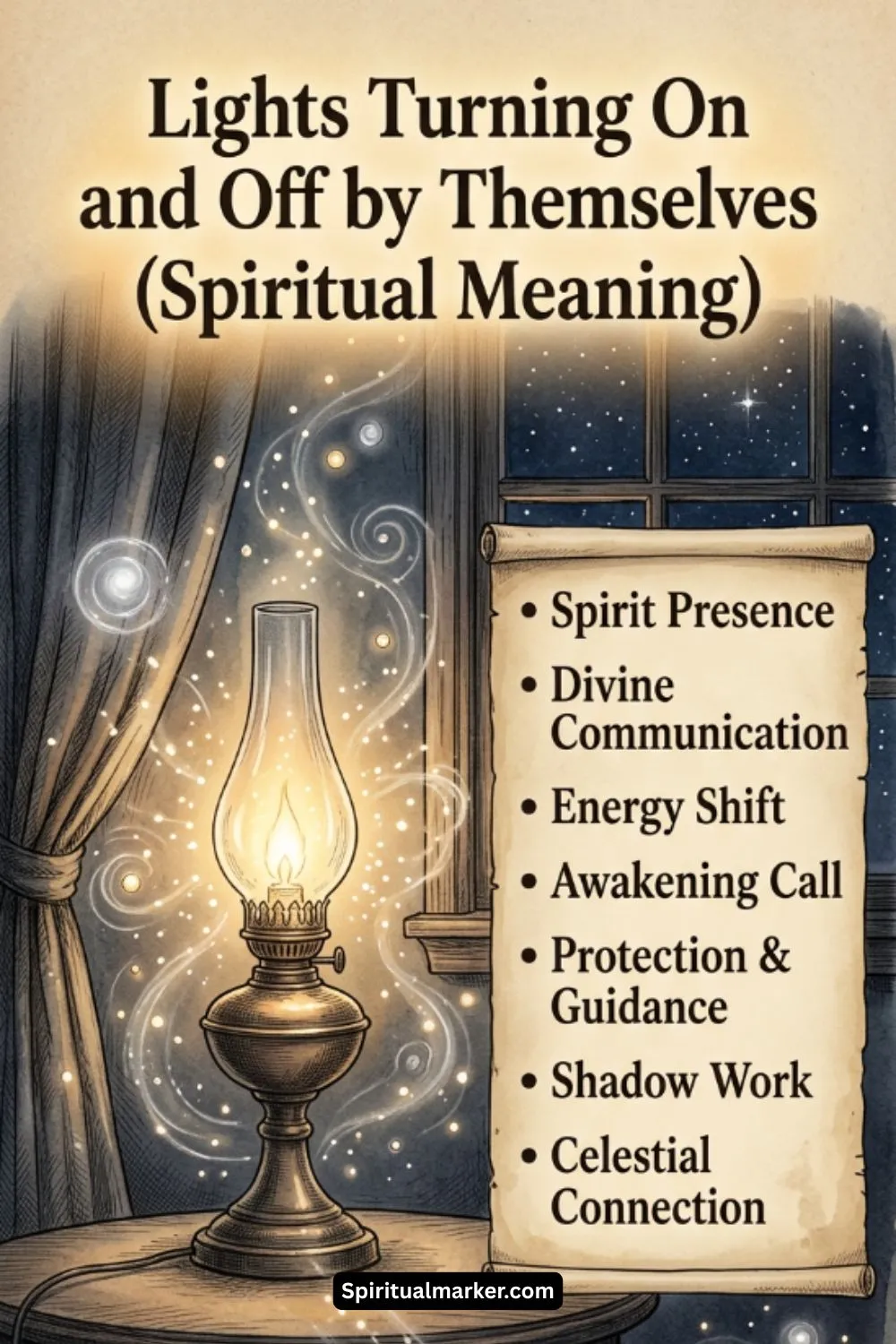
7 Spiritual Meanings of Lights Turning On and Off by Themselves
1. A Deceased Loved One Is Reaching Out
This is the most widely reported and emotionally resonant interpretation of lights flickering or switching on and off without explanation. Across grief communities, spiritual counseling sessions, and paranormal research, the pattern is strikingly consistent. A person loses someone they love, and within days or weeks, lights start behaving oddly, often in the home they shared, near objects that belonged to the deceased, or on significant dates like birthdays or anniversaries.
Many spiritual traditions teach that the soul does not simply vanish after physical death. It transitions into a different frequency or dimension of existence. From that place, the soul may try to communicate with those left behind. Because spirits are believed to operate at a vibrational level that interacts with electromagnetic energy, manipulating a light switch or causing a bulb to flicker becomes one of the most accessible ways to make contact.
Grief counselors who work within spiritual frameworks often hear this story. A widow sees a lamp turn on at the exact time her husband used to come home from work. A grieving son notices the porch light flickering the morning of his mother’s funeral. These are not always coincidences. They may be the soul’s way of saying, “I am still here. I am watching. I love you.” The emotional comfort this brings to bereaved individuals is itself a form of spiritual healing.
If you have recently lost someone and lights are behaving strangely in your home, pay attention to the timing and location. If it happens near something meaningful, such as a photo, a chair, or a favorite room, the connection becomes even more significant. The soul uses what it knows. It returns to the places and objects that held meaning in life.
2. A Message from Your Spirit Guides or Angels
Not every spiritual signal comes from the deceased. Many spiritual traditions teach that each person has spirit guides, guardian angels, or protective beings that walk alongside them throughout their life. These beings communicate in subtle ways, and manipulating light is one of their preferred methods because it is impossible to ignore.
When a light turns on by itself, particularly during a moment of prayer, meditation, or deep personal reflection, many spiritual practitioners interpret it as confirmation or affirmation. You asked a question in your heart. The light answered. You were doubting a decision. The room suddenly brightened. This kind of sign is meant to say: you are seen, you are heard, and you are not alone in whatever you are facing.
In angel numerology and spiritual discernment practices, lights are often connected to specific angelic frequencies. The sudden illumination of a space is sometimes read as the presence of the Archangel Uriel, who is associated with light, wisdom, and divine illumination in Christian mysticism and Kabbalistic traditions. When light activates without cause, it may be a guide drawing your attention to something you are overlooking or reminding you that spiritual protection is present.
Pay attention to what you were thinking or feeling right before the light came on or went off. That emotional and mental context is usually the message itself. Guides speak through pattern and timing. The moment the light changes is the moment you are meant to notice what is happening inside you.
3. A Sign of Spiritual Awakening
Lights turning on by themselves can symbolize a spiritual awakening beginning to emerge in your life. Many people who go through a spiritual awakening report unusual electrical phenomena in their environment. Lights flicker. Devices act up. Bulbs burn out faster than normal. These disruptions are often explained through the concept of vibrational frequency shifts.
During a spiritual awakening, your energetic field goes through significant changes. Your personal vibration rises. This elevated frequency can interact with the electromagnetic systems in your environment, causing disruptions that seem physically inexplicable. In this context, a light turning on by itself is not a spirit from outside you. It is your own expanding spiritual energy making itself visible in the physical world.
This interpretation aligns with the metaphor of light itself. Awakening is the classic metaphor for moving from darkness to light, from unawareness to consciousness. When the lights in your environment begin turning on by themselves during a period of personal transformation, the universe may be mirroring your inner journey back to you in the most literal way possible. You are waking up, and the world around you is reflecting that illumination.
If you are currently experiencing a period of deep personal growth, questioning long-held beliefs, or feeling a heightened sensitivity to energy, synchronicities, and meaning, unusual light behavior may be part of that broader pattern. Notice whether it correlates with significant realizations, breakthroughs, or pivotal moments in your awakening process.
4. A Warning or Alert to Pay Attention
Not every spiritual sign is comfortable or reassuring. Sometimes lights turning on and off by themselves serve as a warning. The universe, spirit guides, or protective ancestors may be trying to get your attention before something significant happens. This interpretation is common across many cultural and spiritual traditions, where unusual environmental behavior signals that something important requires your focus.
In many African spiritual systems, including Yoruba traditions, unusual behavior from fire and light sources is taken very seriously. Practitioners and elders interpret such events as messages from the Orishas or ancestral spirits calling the person to stop, reflect, and take action. Ignoring these signs is considered spiritually risky. The message is in the disruption itself: your current path may need to be reconsidered.
This warning interpretation becomes particularly significant when the light phenomenon is accompanied by a sense of unease, a sudden thought about someone you care about, or a feeling that something is “off.” Your body and intuition often register the spiritual communication before your mind catches up. If a light switches off abruptly during a moment of decision-making, consider it an invitation to pause and reconsider your next step.
The warning is not necessarily about danger. It may be about missed opportunities, relationships that need attention, or decisions that deserve more thought. Light going out can mean you are moving in a direction that takes you further from clarity, and the universe is gently but unmistakably prompting you to find your way back to it.
5. The Presence of a Negative or Restless Spirit
While many spiritual signals involving light are positive, some traditions warn that not all spiritual presences are benevolent. Lights turning on and off repeatedly, especially in an erratic or aggressive pattern, can indicate the presence of a restless, confused, or negative spirit in the space. This interpretation is most common in paranormal investigation, folk traditions, and certain spiritual deliverance ministries.
In many folk superstitions, a restless spirit is one that has not yet fully transitioned from the physical world. It may be attached to a location, an object, or unresolved emotional business. This kind of presence can disrupt electrical systems, cause lights to flicker violently, or make lights switch on and off in ways that feel threatening rather than comforting. The emotional atmosphere of the space often shifts too, with people feeling cold, uneasy, or watched.
In Christian spiritual practice, unexplained disturbances like these are sometimes viewed through the lens of spiritual oppression and may prompt prayer, cleansing of the space, or anointing. In many indigenous and folk traditions, a ritual cleanse using smoke, herbs, salt, or sound is performed to clear the space and invite protective energy back in. The emotional quality of the experience matters deeply here. Comfort suggests a benevolent presence. Unease or fear suggests the opposite.
It is worth noting that distinguishing between a loving spiritual presence and a disruptive one often comes down to your own gut feeling and the pattern of the events. A single light turning on gently at a meaningful moment feels different from lights constantly flickering in an erratic and disturbing way. Trust what your instincts tell you about the nature of what you are experiencing.
6. Divine Confirmation and Answered Prayer
Many people of faith report lights turning on by themselves during or immediately after moments of sincere prayer, worship, or spiritual surrender. This experience is interpreted across many traditions as direct confirmation from the divine. You prayed, and the answer came in a form you could not manufacture or explain.
This type of experience holds particular significance in Pentecostal and charismatic Christian communities, where believers expect the Holy Spirit to manifest in tangible, physical ways. A light switching on during a prayer meeting or a lamp flickering as a name is spoken in intercession is treated as a sign of God’s presence and movement. The physical world is seen as responding to the spiritual activity taking place.
In other traditions, such as Sufism within Islam, the mystic path is saturated with imagery of divine light. Spiritual masters like Rumi wrote extensively about the soul moving toward the light of God. When a person in deep spiritual devotion witnesses unexplained light behavior, the tradition interprets it as the divine meeting the seeker halfway. Your intention and sincerity created a bridge, and the response crossed it.
If lights turn on or behave unusually during a moment of heartfelt prayer, gratitude, or surrender, do not dismiss it. Many of the most profound spiritual encounters in history are described through the language of sudden illumination. Yours may be smaller in scale, but no less real. The divine speaks in the language the seeker can hear, and sometimes that language is a lamp switching on in a quiet room.
7. A Marker of Spiritual Transition or Life Change
Lights turning on and off by themselves often appear during significant life transitions. Births, deaths, marriages, divorces, major moves, career shifts, and other threshold moments are times when the veil between the physical and spiritual worlds is believed to be thinner. During these liminal periods, spiritual activity in the environment often increases.
The concept of liminality comes from anthropology and refers to the threshold state between what was and what will be. Spiritually, these threshold moments are considered times of heightened access to the unseen world. Many cultures build rituals around these transitions precisely because they recognize that something sacred is happening. Unusual light phenomena during these times are often interpreted as spiritual markers of the transition itself.
A light turning on at the moment of a baby’s birth could signal the arrival of an ancestral spirit coming to bless the new life. A light going off at the moment someone passes away could mark the soul’s departure from the body. A light flickering at the start of a new chapter, whether a new home or a new relationship, could be a spiritual acknowledgment that the change carries sacred significance.
If you are in the middle of a major life transition and noticing unusual electrical activity around you, take a moment to acknowledge the spiritual weight of what you are going through. You are not just changing your circumstances. You are crossing a threshold, and the spiritual world appears to be marking that crossing with light.
Lights Flickering Spiritual Meaning: What the Pattern Tells You
The way a light behaves matters just as much as the fact that it behaves unusually. A single steady turn-on carries a different energy than a rapid, erratic flicker. Understanding the pattern can help you interpret the message more accurately.
A light that turns on slowly and stays on is often interpreted as a calm, reassuring presence. It suggests a gentle arrival, confirmation, or peaceful communication. A light that flickers rapidly or turns on and off multiple times in quick succession can signal urgency, confusion in the communicating spirit, or a heightened level of energy trying to break through a denser physical barrier.
A light that turns off suddenly in a previously illuminated space often signals a departure, ending, or the need to stop and rest. It could mean that a phase of your life is completing. It could mean a spirit that was present has moved on. It could be a prompt to stop what you are doing and sit in stillness. Darkness, in spiritual traditions, is not always negative. It is often the space where the deepest inner work takes place.
Lights that respond to your words or emotions, such as brightening when you express gratitude or flickering when you speak a particular name, carry a very personal quality. These responsive lights suggest an intelligent presence that is listening and engaging. This pattern is frequently reported by grieving individuals and is often what convinces them, beyond doubt, that the contact they are experiencing is real.
Lights Turning On and Off by Themselves: Superstitions Around the World
Long before electric lights existed, fire and flame served the same symbolic purpose. Candles that suddenly extinguished, flames that danced without wind, and torches that refused to stay lit were all seen as supernatural signs. When electric lighting arrived in the late 19th and early 20th centuries, the ancient superstitions simply transferred to the new technology.
In many Latin American traditions, a light turning on by itself in a home where someone has recently died is considered the soul of the departed returning for one last visit. Families leave a lamp lit for several nights after a death to welcome the soul back and give it light for its journey. A light going out prematurely is considered a bad omen, possibly signaling that the soul is struggling to cross over.
In Eastern European folk traditions, particularly in Slavic countries, lights flickering at midnight are associated with the spirits of the dead who walk between worlds during liminal hours. The midnight hour, sometimes called the “witching hour,” is considered a time when spiritual activity peaks. A light turning on during this window is taken very seriously as a sign of ghostly communication.
In Japanese culture, which has a rich tradition of spirit lore, unexplained electrical disturbances are sometimes attributed to “yurei,” or restless ghosts. These are spirits of people who died with unresolved emotions, particularly grief, rage, or longing. A light turning on by itself in a space associated with tragedy or unresolved conflict may be interpreted as a yurei making its presence known. The cultural response is often ritual cleansing or prayer to help the spirit find peace.
In West African and Afro-Caribbean traditions such as Vodou and Candomblé, lights and flames are closely linked to the Loa and the Orishas, spiritual beings that interact directly with the physical world. Candle flames and electric lights both serve as portals for spiritual communication. When a light behaves unusually during a ritual or prayer, it is interpreted as the presence of a specific Loa or Orisha responding to the invocation.
In South Asian cultures, particularly in Hindu households, a light turning on by itself near a puja (prayer) altar is seen as deeply auspicious. It signals the presence of the deity or a blessed ancestor who has arrived to receive the offerings and prayers being made. The home is considered spiritually charged in a positive way.
Lights Turning On and Off: Biblical Meaning and Christian Perspective
The Bible is saturated with light symbolism, and Christians who experience unexplained light phenomena often turn to scripture to make sense of what they witnessed. The relationship between God and light in the Bible is not metaphorical in the abstract sense. It is presented as a literal spiritual reality.
Psalm 119:105 says, “Your word is a lamp to my feet and a light to my path.” Light in this verse is connected to divine guidance. When a light turns on unexpectedly at a moment of confusion or crossroads, many Christians interpret it as God’s gentle reminder that guidance is available. The light is a prompt to return to prayer, to seek wisdom, and to trust that the path ahead is illuminated even when it feels dark.
In Exodus 13:21, God leads the Israelites through the wilderness as “a pillar of fire by night to give them light.” This is one of the most striking examples in scripture of God using physical light to communicate presence and direction. The idea that God can use a physical light source to communicate with his people is deeply embedded in the biblical narrative. A light turning on by itself, in a Christian framework, can be received as a modern echo of this ancient reality: God is still in the business of leading through light.
The Holy Spirit is described in Acts 2:3 as appearing in “tongues of fire” at Pentecost. The disciples experienced a sudden, unexplainable light phenomenon that marked the arrival of the Spirit. Christians who believe in the ongoing work of the Holy Spirit see unusual light events as potentially connected to this same divine presence moving in their environment. It is not a superstition for them. It is theology made tangible.
It is also worth noting that Christian theology does warn against attributing spiritual significance to all unusual phenomena without discernment. 1 John 4:1 instructs believers to “test the spirits to see whether they are from God.” This caution does not dismiss the possibility of divine light signs. It simply asks that they be received with wisdom, prayer, and careful spiritual discernment rather than assumed meaning without reflection.
Lights Turning On and Off in Different Rooms: Does Location Matter?
Where the light event happens adds another layer of meaning to the experience. Spiritual communication often uses the familiar and the specific. The location of the light can carry its own symbolic weight.
A bedroom light turning on by itself, particularly in the middle of the night, is one of the most reported and most unsettling experiences. Bedrooms are intimate, vulnerable spaces. A light activating in this space is often interpreted as a deceased loved one watching over you during your most vulnerable hours. Many people find this deeply comforting once the initial fear subsides. The protective quality of the message outweighs the strangeness of the event.
A kitchen or dining room light turning on by itself often connects to family. These are the rooms where meals were shared, conversations happened, and family memories were built. A light activating here is frequently linked to ancestral presence or a departed family member returning to a space that held great meaning in their lifetime.
A light in a hallway or doorway turning on is particularly symbolic. Hallways are transitional spaces. They connect rooms. Spiritually, they represent thresholds and in-between places. A light in a hallway turning on may signal a transition coming in your life. It may mark the crossing point between one phase and another, with the light serving as a spiritual lantern for the passage ahead.
A porch or exterior light turning on by itself has been interpreted in many traditions as a welcoming signal, either welcoming a spirit that has come to visit or a sign that protection is being extended over the home from the outside. In some folk traditions, a porch light turning on without cause means a visitor, seen or unseen, is approaching.
Dreaming About Lights Turning On and Off: Spiritual and Psychological Meanings
Dreams that feature lights turning on and off carry their own set of spiritual and psychological meanings. In the dream state, the unconscious mind communicates through symbols, and light is one of the most powerful symbols available to it.
A dream in which lights keep turning off suggests a feeling of powerlessness or loss of clarity in your waking life. You may be struggling to see the way forward in a situation. You may feel that your sense of direction or confidence is being extinguished. This dream is often a signal from your deeper self that you need to address a source of fear or confusion that you have been avoiding.
A dream in which a light turns on unexpectedly often represents an insight arriving. Something that was hidden is becoming visible. A truth you have been circling around is finally ready to be seen. Carl Jung, who studied symbolism deeply, noted that light in dreams consistently represents consciousness, awareness, and the illumination of what was previously in the shadow. When a light turns on in your dream, part of your psyche is waking up.
From a purely spiritual standpoint, dreams of lights flickering or turning on and off may reflect contact happening at the soul level. Many spiritual traditions teach that the dream state is one of the easiest moments for spiritual beings to make contact, because the critical, doubting mind is relaxed. A deceased loved one or spirit guide reaching you through a dream involving light is considered especially significant. The message travels through the dream because the door was open.
A dream in which you are trying to turn on a light that will not work is one of the most common anxiety dreams. Psychologically, it reflects frustration, helplessness, or blocked potential. Spiritually, it may suggest that you are trying to force clarity in an area where patience and surrender are actually required. The light will come when it is ready, and your job is to stop fighting the darkness and trust the timing.
How to Respond When Lights Turn On and Off by Themselves
Knowing the possible spiritual meanings is only part of the equation. How you respond to the experience matters too. Your reaction shapes the relationship between you and whatever is communicating with you.
The first step is to stay calm and observe. Note the time of day, the room, what you were thinking or feeling beforehand, and any recent events in your life that might provide context. Write it down. The more detail you capture, the clearer the pattern becomes over time.
The second step is to speak aloud if you feel it is a loved one. Many people find that simply saying the name of the person they believe is communicating, or speaking a message of love and acknowledgment out loud, completes the exchange. You do not have to perform a ritual to engage with spiritual communication. Genuine, sincere verbal acknowledgment is enough in most traditions.
The third step is to pray or meditate if the experience feels significant. Whether you pray to God, a deity, your ancestors, or simply the universe, bringing spiritual intention to the experience elevates it from mere observation to conscious engagement. Ask for clarity. Ask for protection if you feel uneasy. Ask for the message to become clear.
If the experience feels threatening or deeply uncomfortable, consider spiritually cleansing your space. This might mean opening windows, burning sage or incense, praying a blessing over each room, or using salt near doorways and windows, all of which are practices from various traditions used to clear negative energy and invite protective presence in.
A Final Note
Lights turning on and off by themselves occupy a space where the explainable and the unexplainable meet. The electrical cause may be real. The spiritual meaning can be just as real. These two things do not cancel each other out. A loose wire does not erase the possibility that something sacred is happening at the same moment.
What matters most is the context of your own life. Are you grieving? Are you at a crossroads? Are you searching for meaning or direction? The universe speaks in the language of your specific moment. If you have been noticing lights behaving strangely, you are likely being invited to pay closer attention to your inner world, your relationships, your spiritual life, or a transition you are walking through.
You might consider keeping a spiritual journal to track when the light events happen and what is occurring in your life at the time. Patterns often emerge over days or weeks that make the message unmistakably clear. You might also benefit from speaking to a spiritual counselor, pastor, priest, or trusted elder in your tradition who can help you discern the nature and meaning of what you are experiencing.
Above all, approach these moments with openness rather than fear. Light is one of the oldest symbols of hope, divine presence, and truth in human experience. When it moves in ways you cannot explain, it may simply be reminding you that you live in a world far larger, far more connected, and far more alive than everyday life usually lets you see.