Finding a dead moth in your home, on your doorstep, or tucked inside an old book can feel strangely personal. You pause. You wonder if it means something. Across centuries, moths have carried weight far beyond their fragile wings, and a lifeless one often feels like a message rather than an accident.
The dead moth spiritual meaning touches on transformation, endings, ancestral contact, and quiet warnings from the universe. Moths already symbolize the soul’s pull toward light and change. When you find one dead, that symbolism shifts into something sharper. It speaks of a cycle closing, a chapter finishing, or a spirit trying to reach you one last time.
This piece walks through what a dead moth symbolizes spiritually, psychologically, and culturally. You will see how different religions, mythologies, and dream traditions interpret this small but meaningful encounter, and how to make sense of it in your own life.
Key Takeaways
- A dead moth often symbolizes transformation, the end of one phase before a new one begins.
- Many cultures view a dead moth as a sign of ancestral or spirit contact, especially soon after a loss.
- The color and species of the moth can shift its spiritual message, from luck to grief to release.
- In dreams, a dead moth usually reflects unresolved emotions or a fear that has finally lost its grip on you.
- Biblical interpretations connect moths to decay, impermanence, and the fragility of earthly things.
What Is a Dead Moth and Does It Hold Spiritual Power?
A moth lives a short, intense life. It hatches, transforms, flies toward light, and dies, often within weeks. Biologically, finding one dead is unremarkable. Spiritually, though, many traditions treat this small creature as a messenger between worlds. Its short lifespan mirrors the impermanence of human experience, and that mirroring is exactly why people pay attention when they find one lifeless.
Moths are drawn to light, even when it harms them. This instinct has made them a long-standing symbol of seeking truth despite the cost. A dead moth, then, is not just an insect that lost its battle with a porch lamp. Many spiritual practitioners see it as a sign that a search, a struggle, or a desire has reached its natural end. Folklore from various regions treats moths as soul carriers, creatures believed to transport the spirits of the deceased or deliver quiet warnings to the living.
You do not need to believe in literal messengers to feel the weight of this symbol. Even from a psychological lens, encountering death in nature triggers reflection. A dead moth becomes a small mirror, reminding you that endings are woven into every living thing, including your own circumstances.
What Does Finding a Dead Moth Symbolize?
Context shapes meaning. Finding a moth dead on your windowsill carries a different weight than finding one inside a gift, a car, or near a photograph of someone you lost. Generally, this encounter symbolizes closure. Something in your life has run its course, whether that is a relationship, a job, a belief, or a version of yourself you have outgrown.
Some interpret it as a release of fear. Moths represent vulnerability to light and change, so their death can suggest that whatever once frightened you no longer holds power. Others read it as a visitation, particularly if the moth appears shortly after someone close has passed away. Grief researchers note that people frequently report meaningful encounters with insects and birds after bereavement, and a dead moth often becomes part of that pattern.
There is also a quieter reading tied to self-reflection. A moth chases artificial light instead of the moon, and its death can symbolize chasing the wrong goals or the wrong version of success. Finding one dead nudges you to ask whether your current direction still serves you, or whether it is time to redirect your energy toward something more aligned with your truth.
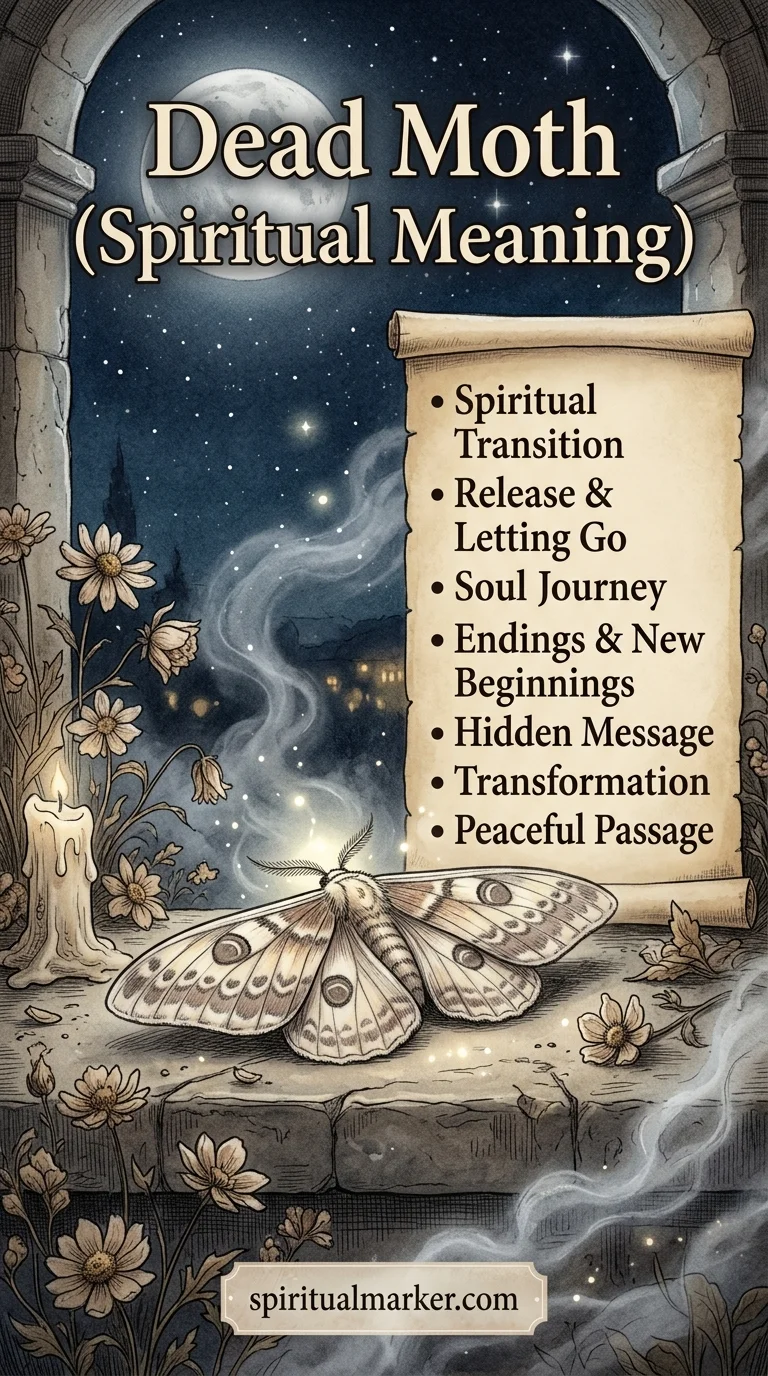
7 Spiritual Meanings of a Dead Moth
1. The End of a Difficult Cycle
Finding a dead moth often catches people off guard. While the sight may initially feel unsettling, many spiritual traditions interpret it as a meaningful symbol rather than a negative omen. One of the most common interpretations is that it marks the end of a difficult cycle, signaling that a challenging chapter of life has finally reached its natural conclusion.
The moth itself represents transformation. Throughout its life, it passes through several stages before becoming the delicate winged creature we recognize. This journey mirrors our own personal growth. We often move through seasons of uncertainty, emotional pain, disappointment, or deep learning before emerging with greater wisdom and resilience. When the moth’s life comes to an end, the symbolism shifts from becoming to completion. It suggests that the lesson has already been learned.
Many people encounter this symbol after periods of grief, financial hardship, relationship struggles, or emotional exhaustion. Although external circumstances may not change overnight, the appearance of a dead moth can reflect an inner transformation that has already taken place. You may have become stronger, wiser, or more emotionally grounded without fully realizing it.
In many spiritual beliefs, endings are not viewed as failures. Instead, they create space for something new to begin. A dead moth can therefore represent the closing of an old chapter that has served its purpose. Rather than focusing on what was lost, the symbol gently points toward what has been gained through experience.
For those walking a spiritual path, this meaning also reminds us that growth often happens quietly. We may not notice the moment we become a different person, yet one day we realize we no longer carry the same fears, habits, or burdens that once defined us. The dead moth becomes a silent witness to that completed journey.
2. A Message From a Departed Loved One
Across many cultures and spiritual traditions, moths have long been associated with the soul and the unseen world. Their quiet movements in darkness and their attraction to light have inspired the belief that they serve as messengers between the physical and spiritual realms. When someone finds a dead moth, especially during a meaningful moment, it can feel deeply personal.
This interpretation becomes especially significant if the moth appears shortly after the loss of a loved one or around an anniversary, birthday, or family gathering connected to someone who has passed away. Many people describe finding a dead moth near cherished photographs, treasured belongings, or places filled with memories. While there is no scientific evidence proving such encounters carry supernatural meaning, countless personal stories have shaped this enduring spiritual belief.
Some traditions view the dead moth not as a sign of death itself but as a completed message. The appearance may symbolize a final goodbye, a quiet reassurance, or a reminder that love continues beyond physical separation. Instead of inspiring fear, it often brings unexpected comfort during periods of grief.
Psychologically, symbols connected to loved ones can also help people process loss. The human mind naturally seeks meaningful connections during times of mourning, and nature often provides powerful reminders that life continues through changing seasons. Whether viewed as a spiritual sign or a deeply emotional coincidence, the experience can create a profound sense of peace.
Many people choose to receive the moment with gratitude rather than certainty. They recognize that the meaning lies less in proving the experience and more in the comfort, healing, and hope it offers their heart.
3. A Warning to Slow Down
One of the most recognizable traits of moths is their attraction to light. They instinctively fly toward sources of brightness, even when doing so places them in danger. Spiritually, this behavior has become a powerful metaphor for human life. We, too, can become so focused on chasing success, recognition, perfection, or ambition that we overlook the cost to our physical, emotional, and spiritual well-being.
Finding a dead moth may therefore symbolize the consequences of moving through life without balance. It serves as a quiet reminder that constant motion is not always the same as meaningful progress. Many people spend months or even years pushing themselves beyond healthy limits, believing that rest can wait until everything is finished. In reality, the finish line often keeps moving.
This symbolism can apply to many areas of life. It may reflect career burnout, emotional exhaustion, strained relationships, or even spiritual fatigue caused by constantly seeking answers without allowing space for reflection. The dead moth illustrates what can happen when instinct overrides awareness.
Several spiritual traditions teach that periods of stillness are just as valuable as periods of action. Growth rarely happens through nonstop effort alone. Reflection, healing, and renewal also shape our journey. The appearance of a dead moth can therefore symbolize the importance of slowing down before life itself forces a pause.
Rather than predicting misfortune, this meaning encourages awareness. It invites us to examine whether our current pace supports long-term well-being or whether we have become consumed by goals that no longer nourish our spirit.
4. Release From Fear and Anxiety
Moths naturally thrive in darkness while continually searching for light. Because of this unique behavior, they have become symbols of hope, persistence, and the desire to move beyond fear. When a moth dies, many spiritual interpretations view it as representing the end of fear’s influence rather than the end of hope itself.
Life often places us in situations where anxiety becomes a constant companion. We worry about uncertain futures, difficult conversations, financial security, health concerns, or major life decisions. These fears can quietly shape our choices long before reality ever catches up with them. A dead moth symbolizes the possibility that this emotional burden is beginning to lose its power.
In spiritual symbolism, death frequently represents transformation rather than destruction. Something old passes away so something healthier can emerge. In this case, what dies may be chronic worry, limiting beliefs, or emotional patterns that have kept you trapped for a long time.
This interpretation does not suggest that life’s problems instantly disappear. Instead, it points toward an internal shift. You may begin responding to uncertainty with greater trust, resilience, or emotional stability than before. The circumstances may remain challenging, but your relationship with fear changes.
Many spiritual teachers describe courage not as the absence of fear but as the willingness to continue despite it. The dead moth reflects this transition beautifully. It symbolizes the quiet moment when fear no longer controls every decision, allowing wisdom and inner peace to take its place.
5. A Call to Release Old Identities
Human beings constantly evolve, yet many people continue carrying identities that no longer match who they have become. A dead moth can symbolize the need to release outdated versions of ourselves so personal growth can continue without unnecessary resistance.
This symbolism connects closely with the moth’s remarkable life cycle. Before becoming a winged insect, it undergoes a complete transformation that permanently changes its form. Spiritually, this reminds us that growth often requires leaving something behind. Sometimes what must be released is not a physical possession but an old belief, role, expectation, or self-image.
You may have spent years identifying yourself through a career, a relationship, a family responsibility, or even past mistakes. Although these experiences helped shape your journey, they may no longer define your present reality. Holding onto outdated identities can quietly limit future possibilities because they keep us attached to versions of ourselves that have already completed their purpose.
Many spiritual traditions describe personal transformation as a continuous process rather than a single event. Every stage of life asks us to release certain identities while accepting new ones. The dead moth symbolizes this natural cycle of renewal, reminding us that personal evolution often involves letting go before moving forward.
This meaning also carries a message of freedom. Growth does not require abandoning your past. Instead, it asks you to honor everything that brought you to this point while recognizing that your future does not have to remain limited by yesterday’s definition of who you were.
6. A Sign of Spiritual Protection
Among various folk traditions and spiritual belief systems, a dead moth is sometimes interpreted as a sign that unseen protection has been working quietly in the background. Rather than representing misfortune, the moth symbolizes harmful energy that has already been intercepted before reaching you.
Many cultures believe that living creatures can absorb or redirect negative spiritual influences. In this interpretation, the moth becomes a symbolic guardian whose life reflects the completion of that protective role. The focus is not on sacrifice in a literal sense but on the idea that destructive energy has lost its power before affecting your emotional or spiritual well-being.
People often notice this symbol during periods of heightened stress, major life transitions, or after resolving ongoing conflicts. Looking back, they sometimes realize that situations which once seemed overwhelming ended far better than expected. The dead moth becomes a reminder that not every challenge reaches its worst possible outcome.
From a psychological perspective, this interpretation can also represent resilience. Protection does not always arrive through supernatural intervention. Sometimes it appears through supportive relationships, wise decisions, unexpected opportunities, or inner strength developed over time. The symbolism encourages appreciation for the many visible and invisible ways we are supported throughout life.
Across spiritual traditions, protection rarely means avoiding every hardship. Instead, it often means receiving the strength, guidance, or timing needed to move safely through life’s difficulties. The dead moth reflects that quiet form of protection that often becomes visible only in hindsight.
7. A Reminder of Life’s Fragility
Perhaps the most universal spiritual meaning of a dead moth is its reminder that life is temporary. Moths live relatively short lives, and their delicate bodies reflect how quickly beauty, opportunity, and even ordinary moments can pass. This symbolism encourages reflection rather than fear.
Throughout history, many philosophical and spiritual traditions have taught that remembering life’s impermanence helps people appreciate the present more fully. Rather than dwelling on loss, these teachings encourage gratitude for the time we do have with the people, experiences, and dreams that matter most.
A dead moth can prompt us to pause amid busy routines and consider what truly deserves our attention. Daily responsibilities often consume our focus, yet meaningful conversations, acts of kindness, and moments of genuine connection frequently become our most lasting memories. The symbol quietly reminds us that time remains one of life’s most valuable gifts.
This meaning also carries hope. Because life is finite, every season holds unique value. Difficult times eventually pass, joyful moments become treasured memories, and personal growth continues through every stage of the journey. Recognizing life’s fragility can deepen our appreciation for both ordinary and extraordinary experiences.
Dead Moth Meaning and Symbolism Across Cultures and Religions
In parts of East Asia, moths and butterflies are treated similarly, often viewed as visiting souls. A white moth, dead or alive, found inside a home is sometimes seen as an ancestor checking in on the family. Chinese folklore in particular ties white moths to deceased relatives, and a dead one can be read as a final, gentle farewell rather than a frightening omen.
In several Native American traditions, moths are linked to transformation and the spirit world, similar to how butterflies are honored. A dead moth in this context is not feared. It is respected as a creature that has completed its journey between the physical and spiritual realms, having delivered whatever message it carried.
European folklore takes a more cautionary tone. In parts of the United Kingdom and Ireland, certain moths, especially dark-colored ones, were historically associated with death omens, particularly when found indoors. This belief likely grew from moths being nocturnal creatures linked to the unseen, paired with a cultural tendency to associate dark wings with mourning.
Hindu and Buddhist symbolism leans toward impermanence. Both traditions emphasize that all living things are temporary, and a moth’s short life and quick death reflect the concept of anicca, or constant change. Rather than dread, this lens treats a dead moth as a teaching tool, a small lesson in detachment from things that were never meant to last.
Dead Moth Symbolism in World Mythology
Greek mythology does not feature moths prominently, but the closely related figure of Psyche, whose name means soul, ties insect symbolism to the human spirit. Moths, like Psyche’s eventual butterfly form, are often folded into this broader mythological link between winged insects and the soul’s journey after death.
In Slavic folklore, moths were sometimes believed to be the souls of witches or wandering spirits traveling at night. A dead moth found near a home was treated with caution, often swept outside with specific rituals to ensure no lingering spirit remained attached to the household.
Mesoamerican traditions, including some Aztec beliefs, connected moths and night-flying insects to the underworld and the realm of the dead. The black witch moth specifically carries a reputation across Mexico and the southern United States as a sign tied to death, though many modern interpretations soften this into a message of transformation rather than doom.
Moth Colors and Species: What They Mean When Found Dead
A white moth found dead is widely interpreted as a sign of peace and spiritual visitation. White carries connotations of purity across most cultures, and this color often softens the symbolism of death into something closer to closure or farewell.
A black moth, by contrast, leans toward themes of mystery, hidden truths, or a warning to pay closer attention to your surroundings. This does not automatically mean misfortune. It more often signals that something concealed is about to surface.
A brown moth ties closely to grounding and practicality. Finding one dead can suggest it is time to return to stability after a period of emotional turbulence. Earth tones in spiritual symbolism consistently point back to the body, the home, and daily responsibilities.
The luna moth, pale green and large, is associated with rebirth and intuition because of its short adult lifespan and striking transformation. A dead luna moth often symbolizes that an intuitive insight has fully landed, and it is time to act on it rather than keep waiting.
The black witch moth, one of the largest moths in the Americas, carries the heaviest folklore. Depending on the region, it is read either as a death omen or as a sign of incoming luck, since some Caribbean and Mexican traditions associate it with money and unexpected fortune rather than loss.
Dead Moth Biblical Meaning and Significance
The Bible references moths several times, almost always in connection with decay and the temporary nature of earthly possessions. Matthew 6:19-20 instructs believers not to store up treasures on earth, where moth and rust destroy, but to focus on treasures in heaven instead. Here, the moth is not evil. It is a natural force that exposes how fragile material wealth truly is.
Job 4:19 describes humans as those who dwell in houses of clay, crushed more readily than a moth, emphasizing human frailty rather than the insect itself. The moth in this verse becomes a unit of measurement for fragility, a reminder that life is brief for everyone, not just for small winged creatures.
Isaiah 50:9 and 51:8 both use moths as a symbol of how quickly the wicked or their schemes will be consumed, comparing their downfall to garments eaten by moths. Across these passages, the consistent biblical thread treats the moth as a symbol of impermanence and quiet, gradual destruction, rather than a sign of evil or punishment. A dead moth, read through this lens, becomes a scriptural nudge to focus less on fragile, temporary things and more on what truly lasts.
Dreaming About a Dead Moth: Spiritual and Psychological Meanings
Dreams about a dead moth tend to surface during periods of emotional transition. Spiritually, this dream often suggests that a fear, habit, or relationship pattern has finally lost its grip on you, even if you have not consciously noticed the shift yet. The subconscious frequently processes endings before the waking mind catches up.
Psychologically, moths in dreams are linked to the parts of yourself drawn toward something risky or self-destructive, much like the literal insect drawn to flame. A dead moth in a dream can represent the resolution of an inner conflict, a sign that you have stopped chasing something that was quietly harming you. Dream researchers often note that insects in dreams reflect small but persistent anxieties, and their death within the dream typically marks relief rather than further worry.
If the dream felt distressing rather than peaceful, it may point to unprocessed grief or anxiety that still needs attention, rather than a resolved issue. Pay attention to the emotional tone you woke up with. A calm dream usually points toward closure, while an unsettling one suggests there is still inner work left to do.
A Final Note
A dead moth is small, fragile, and easy to overlook, yet its presence carries weight across cultures, scripture, and personal experience. Whether you read it as a visiting spirit, a closing chapter, or a gentle warning to slow down, the message tends to point in one direction: something has ended so that something else can begin.
If you found one recently, take a quiet moment to notice what has been shifting in your life lately. You might consider journaling about any recent losses, fears, or decisions that feel unresolved. If the moth appeared near a memory of someone you lost, allow yourself to sit with that connection rather than dismiss it. And if the moment felt more like a warning, treat it as permission to slow down before burnout catches up with you.