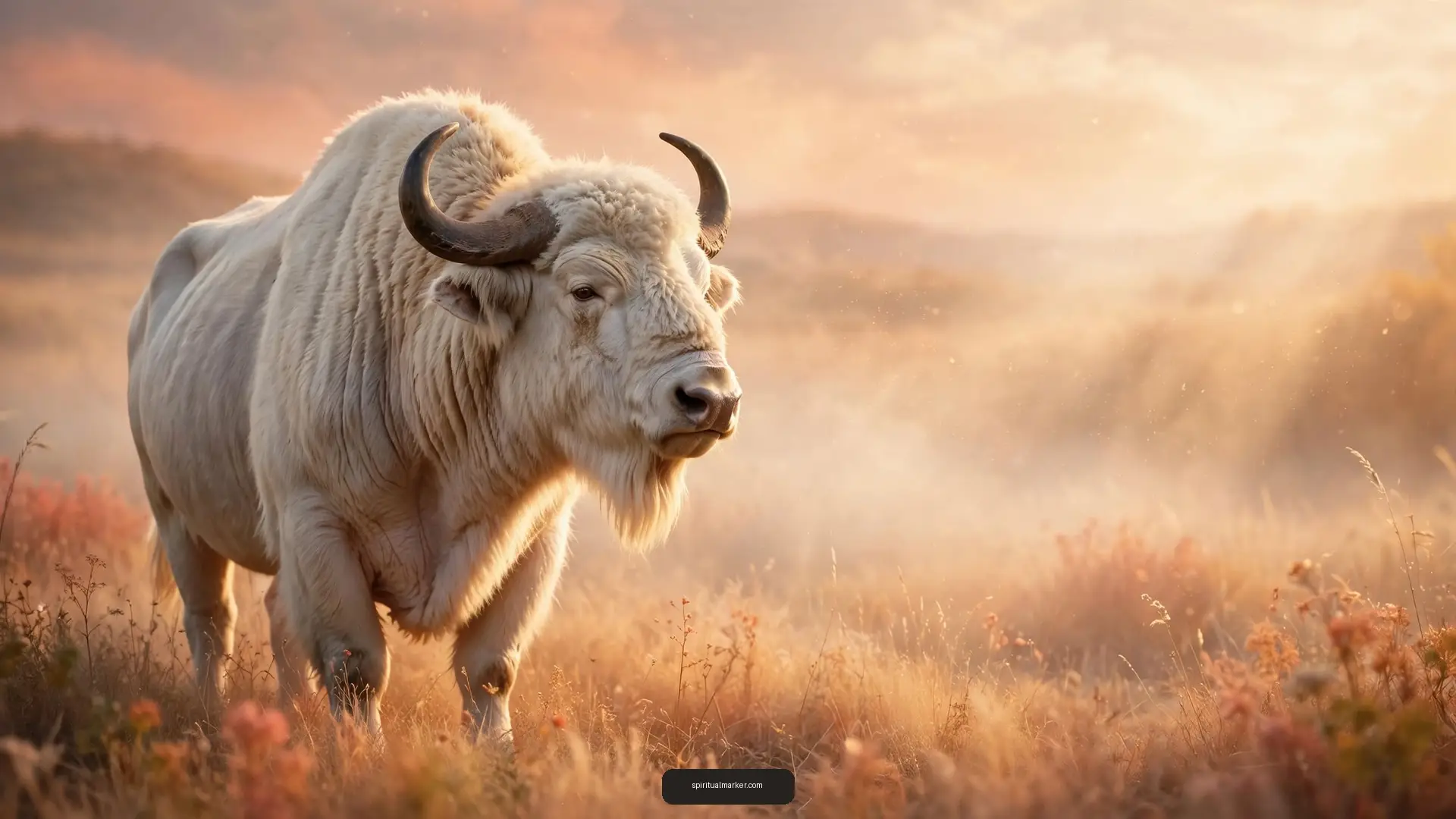
You feel a strange hush settle over the land the moment a white buffalo steps into view. Ranchers drop their tools. Elders begin to pray. Children stand still, sensing something larger than themselves. This rare creature has stirred awe across generations, and its presence rarely goes unnoticed. The white buffalo spiritual meaning reaches far beyond biology. It touches prophecy, renewal, and the sacred bond between humanity and the earth.
Many people search for answers when they encounter a white buffalo in a vision, a dream, or even a photograph shared online. You may wonder why this animal carries such heavy symbolism. You may also wonder what it means for your own life path. This article walks through the spiritual symbolism of the white buffalo, its cultural roots, its mythological power, and its biblical undertones. By the end, you will understand why this creature is treated as one of the most sacred symbols across Native American tradition and beyond.
Few animals on the continent have inspired this level of reverence across so many generations. A single birth can draw thousands of visitors, reshape ceremony schedules, and prompt elders to revisit prophecy passed down through centuries of oral teaching. The depth of this reaction tells you something important about how seriously communities take the white buffalo meaning. It is not a passing curiosity. It is a living thread connecting ancestors, present-day communities, and future generations through one extraordinary animal.
Key Takeaways
- The white buffalo is widely regarded as a sign of prophecy, hope, and spiritual renewal among Native American nations.
- Its white coloring symbolizes purity, sacred feminine energy, and divine intervention in many traditions.
- The Lakota legend of the White Buffalo Calf Woman remains the most influential origin story behind this symbolism.
- Seeing a white buffalo, whether physically or in a dream, often signals a major spiritual shift or awakening.
- Across cultures, the white buffalo connects themes of unity, abundance, and the restoration of balance on earth.
What Is a White Buffalo and Does It Hold Spiritual Power?
A white buffalo is an extraordinarily rare bison born with white fur instead of the typical brown or black coat. This coloring can result from albinism, leucism, or a recessive genetic trait, yet the rarity itself is staggering. Experts estimate that only one in several million bison births produces a white calf. This scarcity alone explains why the animal has become a living symbol of the miraculous.
Spiritual power is not something science can measure, but cultural memory tells a different story. For centuries, Native American nations, particularly the Lakota, Cheyenne, and other Plains tribes, have treated the white buffalo as a living messenger. Its birth is seen as confirmation that ancient prophecies are unfolding. Tribal communities often travel great distances to witness a white buffalo calf, treating the sighting as a once-in-a-lifetime blessing.
This reverence is not symbolic decoration. It reflects a worldview where animals serve as bridges between the physical and spiritual realms. The buffalo itself was already sacred long before any white calf appeared, since it provided food, shelter, tools, and clothing to entire nations. A white version of this already-holy animal naturally became the highest expression of divine favor. The spiritual power attributed to the white buffalo, therefore, grows out of both rarity and deep ancestral respect for the species as a whole.
What Does Seeing a White Buffalo Symbolize or Represent?
Seeing a white buffalo, whether in person, in a photograph, or in a vision, often represents a turning point. Many cultures interpret the sighting as a call toward spiritual awakening. You might feel an unexplainable shift in perspective after witnessing one, almost as if old patterns no longer fit your life. This experience aligns with how tribal elders describe the animal: a herald of change that arrives precisely when it is needed most.
The white buffalo also represents hope during difficult times. Throughout history, white buffalo calves have appeared during periods of hardship, drought, or social upheaval, and each appearance was read as reassurance that balance would return. This pattern continues today. Modern sightings often coincide with environmental concerns or global uncertainty, reinforcing the belief that the animal arrives to remind humanity of its responsibility toward the earth.
On a personal level, encountering this symbol may represent purification and a fresh start. The color white carries associations with cleansing across nearly every belief system. If a white buffalo crosses your path in waking life or dream, it may be urging you to release old burdens and approach the future with a clearer heart.
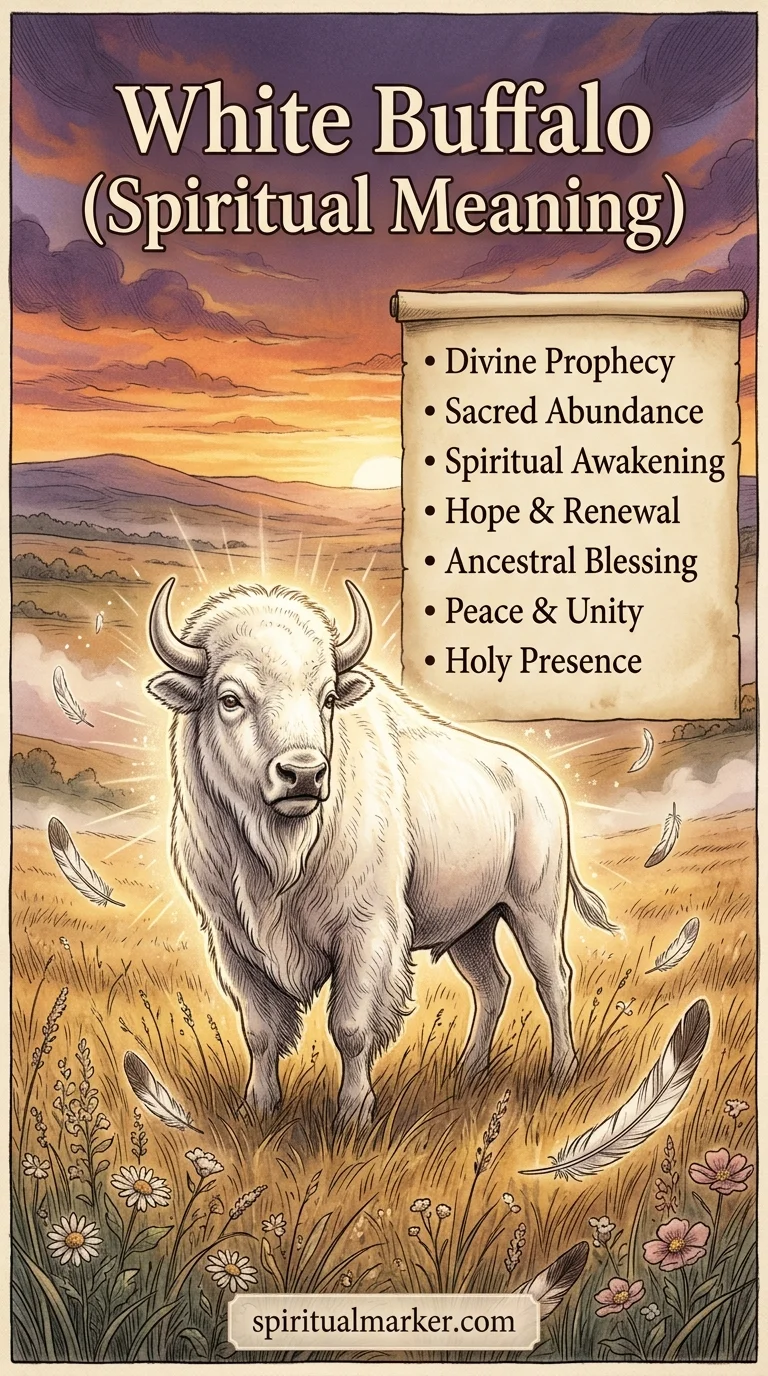
7 Spiritual Meanings of the White Buffalo
1. Prophecy and Divine Timing
One of the most significant spiritual meanings of the white buffalo is prophecy and sacred timing. In Lakota tradition, the story of White Buffalo Calf Woman describes a sacred figure who brought important spiritual teachings to the Lakota people. The return or appearance of a white buffalo has therefore been associated with prophetic significance and the possibility of a spiritually important period.
This symbolism gives the white buffalo a meaning that reaches beyond an unusual natural event. Its appearance can represent a moment when people are called to pay attention to spiritual responsibilities, community relationships, and the direction of human life. Rather than treating prophecy simply as a prediction about a specific future event, the tradition can also be viewed through the idea of a sacred reminder at an important point in time.
For many people, this makes the white buffalo a symbol of divine timing. Its appearance represents the belief that certain moments carry greater spiritual weight and that humanity should respond with greater awareness, reverence, and responsibility.
2. Peace, Unity, and Reconciliation
The white buffalo also carries strong associations with peace and unity. The teachings connected with White Buffalo Calf Woman are closely linked with prayer, sacred ceremony, community responsibilities, and relationships between people. As a result, the white buffalo has come to represent the possibility of restoring harmony where division or conflict exists.
This meaning extends beyond human relationships. The buffalo itself has historically held enormous importance for Plains Indigenous peoples, providing food, clothing, tools, shelter materials, and other resources. Its spiritual significance therefore reflects a relationship between people, animals, land, and community rather than a narrow symbol of personal peace.
The white buffalo can consequently represent reconciliation between different forms of life and different communities. Its symbolism suggests that peace involves more than ending an argument. It also involves restoring respect, recognizing shared responsibilities, and rebuilding relationships that have been damaged.
3. Abundance and Sacred Provision
A third spiritual meaning of the white buffalo is abundance and provision. The American bison played a central role in the lives of many Plains Indigenous communities. Different parts of the animal served practical purposes, including food, clothing, tools, containers, and other materials. This deep dependence created a relationship with the buffalo that was both practical and spiritual.
The symbolism of abundance therefore does not necessarily mean unlimited wealth or material prosperity. Instead, it points toward the provision necessary for life and the responsibility that comes with receiving it. The buffalo represents nourishment, sustenance, and the gifts provided by the natural world.
When the buffalo appears in white, that symbolism can take on an additional sacred dimension within spiritual interpretations. The animal becomes associated with gratitude for what sustains a community and recognition that resources should not be treated as limitless. Abundance, in this context, is connected with reciprocity, respect, and responsible use rather than simple accumulation.
4. Purity and Sacred Femininity
The fourth meaning of the white buffalo is connected with purity, sacred femininity, and spiritual teaching. This interpretation comes particularly from the Lakota story of White Buffalo Calf Woman, a sacred female figure who brought important ceremonial teachings to the people.
Her role gives the white buffalo a distinctive spiritual dimension. The symbolism is not simply about physical purity or innocence. Instead, it can represent sacred intention, spiritual wisdom, fertility, compassion, and the transmission of teachings from one generation to another.
The connection with femininity also adds an important layer to white buffalo symbolism. White Buffalo Calf Woman is remembered not merely as a supernatural figure, but as a teacher associated with sacred responsibilities and ceremony. Consequently, the white buffalo can symbolize the idea that spiritual strength may appear through nurturing, wisdom, moral responsibility, and the preservation of sacred traditions.
5. Transformation and Spiritual Renewal
Another important meaning of the white buffalo is transformation. The animal’s unusual appearance naturally lends itself to symbolism surrounding change, renewal, and a movement from one state of life to another. In contemporary spiritual writing, people sometimes interpret the white buffalo as a reminder to leave behind patterns that no longer reflect their deeper values.
This interpretation also connects with the broader symbolism of the buffalo as a powerful and enduring animal. Transformation does not necessarily mean abandoning everything from the past. Instead, it can involve carrying valuable lessons forward while changing the habits, attitudes, or priorities that prevent further growth.
For someone experiencing a major transition, the white buffalo can therefore represent a sacred turning point. Its symbolism speaks to renewal rather than destruction. The old chapter may have shaped you, but it does not have to determine every chapter that follows.
6. Environmental Balance and Respect for Nature
The sixth spiritual meaning of the white buffalo involves environmental balance and stewardship. This connection is particularly relevant because of the buffalo’s historical importance to Plains Indigenous cultures and the devastating effects that the destruction of massive bison populations had on Indigenous communities and ecosystems.
The buffalo represents far more than an individual animal. It can symbolize an entire relationship between people, land, wildlife, and resources. Consequently, the presence of a white buffalo can prompt reflection on how human actions affect the natural world.
Modern discussions surrounding white buffalo sightings sometimes connect the animal with ecological responsibility and conservation. While these contemporary interpretations should not be confused with traditional Lakota teachings, they reflect a broader message that resonates with the animal’s history: life depends on relationships between species and the responsible care of natural resources.
7. Hope, Renewal, and Humanity’s Future
The seventh spiritual meaning of the white buffalo is hope and renewal. Because the animal is rare and carries such strong sacred associations, its appearance has often been interpreted as a sign that renewal remains possible even during difficult periods.
This symbolism becomes especially powerful when considered alongside the history of Indigenous communities and the near destruction of the American bison. The survival and restoration of buffalo populations can itself serve as a reminder of resilience, although ecological recovery remains an ongoing process rather than a completed story.
Spiritually, the white buffalo can therefore represent the possibility of beginning again without denying what came before. Hope does not erase hardship. Instead, it provides a way to view the future while remembering the lessons of the past. In this sense, the white buffalo symbolizes renewal at both a personal and collective level.
White Buffalo Meaning and Symbolism Across Cultures and Religions
While the white buffalo holds its deepest roots in Native American spirituality, its symbolism has traveled into broader cultural and religious conversations. Among the Lakota Sioux, the animal is inseparable from the sacred pipe ceremony, a ritual believed to have been gifted by the White Buffalo Calf Woman herself. This ceremony remains central to spiritual practice, and the white buffalo is honored as its eternal guardian.
The Cheyenne and other Plains nations share similar reverence, often treating any white buffalo birth as a community-wide event requiring prayer and ceremony. Even tribes without direct historical ties to the buffalo have absorbed elements of this symbolism through intertribal exchange, since the animal’s meaning has grown to represent pan-Indigenous themes of resilience and sacred responsibility.
Outside Indigenous traditions, the white buffalo has been adopted into broader New Age and metaphysical circles as a symbol of universal awakening. Practitioners in these spaces often describe the animal as an emblem of planetary healing, drawing loosely from Native teachings while applying them to global spiritual movements. Some Christian interpreters have also linked the white buffalo’s purity symbolism to biblical themes of divine visitation, even though the animal itself holds no direct scriptural reference. This cross-cultural blending shows how a deeply specific tradition can expand into a wider spiritual language without losing its sacred core.
Buddhist and Hindu observers occasionally draw loose comparisons between the white buffalo and other sacred white animals found within their own traditions, such as the white elephant honored in parts of Southeast Asia. Neither tradition claims direct historical contact with Plains culture, yet the recurring pattern of white animals signaling auspicious events suggests a shared human instinct to read rarity as a spiritual signal. This pattern reinforces why the white buffalo meaning resonates so widely, even among people far removed from its original homeland.
White Buffalo Symbolism in Native American Mythology and Legends
The most influential legend behind white buffalo symbolism is the story of the White Buffalo Calf Woman. According to Lakota oral tradition, she appeared to two scouts during a time of famine, carrying the sacred pipe and teaching the people seven rituals essential to spiritual life. Before leaving, she promised to return one day, and as she walked away, she transformed into a white buffalo calf, then rolled on the ground four times, changing color each time before disappearing into the horizon.
This legend explains why a white buffalo birth is treated as a fulfillment of prophecy rather than a simple genetic anomaly. Elders often reference the famous case of Miracle, a white buffalo calf born in Wisconsin in 1994, as a modern confirmation of the ancient promise. Thousands of visitors traveled to see Miracle, and many described the experience as deeply moving, almost as though ancestral memory had been reawakened in a single moment.
Other Plains nations carry parallel legends emphasizing the buffalo’s role as a provider and protector. Some stories describe the white buffalo as a guardian spirit that intervenes during times of crisis, appearing briefly before vanishing back into the spirit world. These narratives reinforce a consistent theme: the white buffalo is never simply an animal. It functions as a messenger carrying instructions, warnings, or blessings from a higher spiritual order.
Color Symbolism: Why White Holds Such Sacred Weight
Color plays a defining role in why this particular buffalo carries so much spiritual weight. White is consistently associated with purity, spirit, and the unseen world across countless traditions. In many Native American belief systems, white represents the direction associated with winter, wisdom, and the elder stage of life, a season of clarity after long experience.
This contrasts sharply with the dark brown coat typical of ordinary bison, which is tied to the earth, physical sustenance, and the material world. A white buffalo, therefore, becomes a living bridge between matter and spirit, between the practical and the sacred. Its rarity intensifies this symbolism further, since something so uncommon naturally draws attention to the extraordinary rather than the routine. You are not seeing a different color alone. You are witnessing a visual representation of spirit breaking through into physical form.
White Buffalo Versus Ordinary Bison: A Symbolic Comparison
To understand why the white buffalo carries such unique weight, it helps to compare it with the ordinary bison that once roamed the plains by the millions. The standard brown bison has always symbolized strength, endurance, and survival. It represented the backbone of Plains life, since its meat fed families, its hide formed shelter, and its bones became tools. This animal earned deep respect simply through its constant presence and generosity.
The white buffalo inherits all of that grounded symbolism, then adds an entirely new layer tied to rarity and prophecy. Where the brown bison speaks to daily survival, the white buffalo speaks to extraordinary intervention. You might think of the brown bison as the steady heartbeat of a community, while the white buffalo arrives like a sudden, unmistakable signal that something sacred is unfolding. Both animals matter deeply, yet only one is treated as a direct messenger from the spirit world.
This distinction matters because it shows that spiritual significance is not always about replacing older symbols. Sometimes it builds upon them, adding new meaning to something already considered sacred. The white buffalo did not need to compete with the brown bison’s legacy. It simply intensified it, transforming everyday reverence into something closer to prophecy.
Numerology and Direction in White Buffalo Symbolism
Numbers and directions play a quiet but important role within white buffalo legend. In the story of the White Buffalo Calf Woman, the number four appears repeatedly, since she rolled on the ground four times while changing color before vanishing. Four holds deep significance across many Native American traditions, often representing the four directions, the four seasons, and the four stages of life. This repetition is not incidental. It reinforces the idea that the white buffalo’s arrival follows a complete and balanced spiritual cycle rather than a random event.
Direction symbolism also ties into the buffalo’s association with the west or north, depending on the specific nation’s teachings, both of which are often linked to wisdom, endings, and the spirit world. When a white buffalo calf is born, many elders will reference these directional teachings during ceremony, treating the event as confirmation that the natural order is realigning itself. You do not need to memorize these numerological details to appreciate the symbolism, but understanding them adds depth to why every detail of the legend feels intentional rather than coincidental.
How to Honor a White Buffalo Encounter
If you are fortunate enough to witness a white buffalo, whether through a planned visit to a sanctuary or an unplanned roadside encounter, the moment deserves quiet respect rather than spectacle. Many visitors describe an instinctive urge to lower their voice or slow their breathing the moment they see one, almost as though the animal itself sets the emotional tone for the encounter. Honoring this instinct is far more meaningful than rushing to capture a photograph.
Traditional practice often includes offering a small token of gratitude, such as tobacco, left respectfully near the animal’s space, following the specific customs of the nation connected to that land. If you are not part of that tradition, a simple internal prayer of thanks is widely considered appropriate. The goal is not performance. It is presence. Sitting quietly with the experience, rather than immediately analyzing or sharing it, often allows the full weight of the symbolism to settle naturally.
You should also take care to research the specific cultural protocols tied to any sanctuary or reservation you visit. Many white buffalo herds live on protected tribal land, and visitors are expected to follow guidelines set by the community that cares for the animal. Respecting these boundaries honors both the animal and the people who have safeguarded its legacy for generations.
Common Misconceptions About the White Buffalo
One frequent misconception treats every white buffalo as a permanent miracle frozen in a single moment. In reality, many white buffalo calves darken with age, since some genetic variations cause the coat to shift toward brown or gray within a few years. This natural change does not diminish the spiritual significance of the birth. Tradition holds that the sacred event lies in the calf’s arrival itself, not in the permanence of its color.
Another misconception assumes that white buffalo symbolism belongs equally to every culture in the same way. While the symbol has spread into broader spiritual and metaphysical communities, its deepest authority remains rooted in Native American tradition, particularly Lakota teaching. Approaching the symbol with this awareness helps you engage respectfully rather than treating it as a generic spiritual trend detached from its origin.
A third misconception confuses albino bison with the true white buffalo recognized in prophecy. Some tribal teachings distinguish between calves born through albinism, which lack pigment entirely and often have pink eyes, and those born through other genetic patterns that produce a fuller white coat with brown eyes. This distinction matters within certain traditions, since the specific genetic pathway can influence how the birth is interpreted ceremonially.
White Buffalo Biblical Meaning and Significance
The Bible does not mention the buffalo directly, since the animal is native to North America and absent from the ancient Near Eastern landscape described in scripture. However, many readers draw symbolic parallels using the broader biblical language surrounding white and sacrifice. White consistently appears in scripture as a marker of holiness. Revelation 7:14 describes robes made white in the blood of the Lamb, linking the color directly to purification through sacrifice.
This connection has led some Christian thinkers to view the white buffalo as an unintentional echo of biblical purity themes, even without direct scriptural grounding. The buffalo’s historical role as a life-giving animal, providing food and material for survival, also resembles the sacrificial imagery found throughout the Old Testament, where animals were offered to sustain covenant relationships between people and the divine. Some interpreters extend this further, suggesting the white buffalo’s prophetic role parallels biblical patterns where unusual signs in nature often precede major spiritual turning points, much like a star guiding travelers toward significant revelation.
It is worth noting that these biblical connections remain interpretive rather than doctrinal. The white buffalo’s primary spiritual authority rests within Native American tradition, and biblical parallels should be understood as a respectful overlay rather than a replacement for its original cultural meaning.
Dreaming About a White Buffalo: Spiritual and Psychological Meanings
Dreams featuring a white buffalo tend to leave a lasting emotional imprint. Spiritually, this dream is often interpreted as confirmation that you are entering a season of guidance and protection. Many dream traditions treat large, calm animals as symbols of inner strength, and the unusual whiteness amplifies this into a message of clarity arriving after confusion.
If the buffalo appears peacefully grazing in your dream, this often signals stability returning to your life after a period of stress. If it appears running or charging, the dream may point toward urgent change that requires your immediate attention. A white buffalo standing still and looking directly at you is frequently read as an invitation to pay closer attention to your spiritual path, almost as though something within you is being called forward.
From a psychological perspective, dreaming of a rare and majestic animal often reflects the dreamer’s own sense of identity and self-worth. Carl Jung’s framework on archetypes suggests that powerful animal symbols in dreams represent deep, often hidden aspects of the self seeking recognition. A white buffalo, being both rare and revered, may symbolize a part of your character that feels uniquely valuable yet underutilized. Whether you lean toward the spiritual or psychological interpretation, the dream consistently points toward themes of recognition, value, and emerging clarity.
The White Buffalo as a Spirit Animal and Totem
When the white buffalo appears as a personal spirit animal, it often signals that you are being called toward a role of service or leadership within your community. People who resonate with this totem frequently describe a strong pull toward protecting others, whether through teaching, healing, or advocacy work. The white buffalo does not ask for loud or aggressive action. It models steady presence and quiet strength, encouraging you to lead through example rather than force.
This totem also carries a strong connection to gratitude. As the buffalo gave everything it had to sustain entire nations, those who carry this spirit animal often feel a deep responsibility to give back to their families and communities. If this animal feels like your totem, it may be worth examining where your life currently demands more patience, generosity, or grounded leadership.
Modern Sightings and Their Growing Spiritual Significance
White buffalo births have increased in documented frequency over recent decades, and each new appearance reignites public fascination. Beyond Miracle in 1994, several other white buffalo calves have been born across ranches in the United States and Canada, often drawing visitors from across the country within days of public announcement. Many tribal communities respond to these births with renewed ceremony, treating each event as a living continuation of ancient prophecy rather than an isolated curiosity.
This pattern raises an important spiritual question for modern observers. If the white buffalo’s traditional role is tied to prophecy and renewal, what might its increasing appearances suggest about the present era? Many Native elders interpret this rise as a sign that humanity stands at a critical threshold, one requiring greater respect for the earth and a return to spiritual responsibility. Whether or not you hold this belief personally, the consistency of this interpretation across generations speaks to the enduring power of the symbol itself.
White Buffalo in Art, Storytelling, and Popular Culture
Beyond ceremony and legend, the white buffalo has found a steady place in art, literature, and storytelling. Native artists frequently depict the animal in beadwork, painting, and carving, using it as a visual shorthand for hope and ancestral connection. These pieces often appear in galleries, museums, and tribal cultural centers, serving as both artistic expression and a teaching tool for younger generations who may not have access to oral storytelling in the same way their elders did.
Outside Indigenous communities, the symbol has also entered mainstream awareness through documentaries, news coverage of births like Miracle, and references within music and film. While these mainstream portrayals sometimes simplify the deeper ceremonial meaning, they have also helped introduce broader audiences to the importance of buffalo conservation and Native spiritual heritage. You may have first encountered the white buffalo through one of these channels rather than through direct cultural teaching, and that is a common starting point for many people drawn to its story.
It is worth approaching these popular depictions with a degree of discernment. Not every retelling honors the full weight of the original Lakota teaching, and some versions strip away cultural context in favor of a more generic message about luck or good fortune. Seeking out sources directly connected to Native voices, whether through tribal websites, cultural centers, or firsthand teaching, offers a more accurate and respectful understanding than secondhand retellings alone.
Frequently Asked Questions About White Buffalo Symbolism
Is a white buffalo sighting always considered a positive sign? Yes, nearly every tradition associated with the animal treats its appearance as a favorable and sacred event, though it often carries a serious undertone urging change rather than simple celebration. Can anyone interpret a white buffalo dream the same way? Not exactly. While general themes like clarity and renewal apply broadly, the deeper ceremonial meaning belongs specifically to the nations who originated the teaching, so personal interpretation should remain humble rather than authoritative.
Do white buffalo calves stay white forever? Not always. Many darken with age due to natural genetic processes, yet this does not reduce the spiritual importance of their birth. Where can someone respectfully learn more? Tribal cultural centers, Lakota-led educational resources, and verified historical accounts of events like Miracle’s birth offer the most grounded and respectful starting points for deeper study.
A Final Note
The white buffalo carries a weight of meaning that few other animals can match. It stands at the intersection of prophecy, purity, and provision, reminding entire communities that hope often arrives in the rarest and most unexpected forms. Whether you encounter this symbol through ancestral teaching, a vivid dream, or a quiet photograph that stops you in your tracks, its message tends to point in the same direction: renewal is possible, balance can be restored, and spiritual guidance often appears precisely when it is needed most.
If this symbol has recently entered your life, consider sitting with its meaning rather than rushing past it. You might journal about where you feel called to greater patience, generosity, or leadership. You might also research the specific traditions tied to this animal with care and respect, honoring the Native communities who have carried this knowledge for centuries. Approached this way, the white buffalo can become more than a fascinating story. It can become a quiet but lasting companion on your own spiritual path.
The story of the white buffalo has survived famine, displacement, and centuries of cultural disruption, yet it remains as vivid today as it was when first carried by the White Buffalo Calf Woman herself. That endurance says something powerful about the strength of the teaching behind it. Each new birth, each new sighting, and each new dream connected to this animal adds another thread to a story that refuses to fade. Carrying that story forward with respect, curiosity, and humility honors everyone who kept it alive long before it reached you.