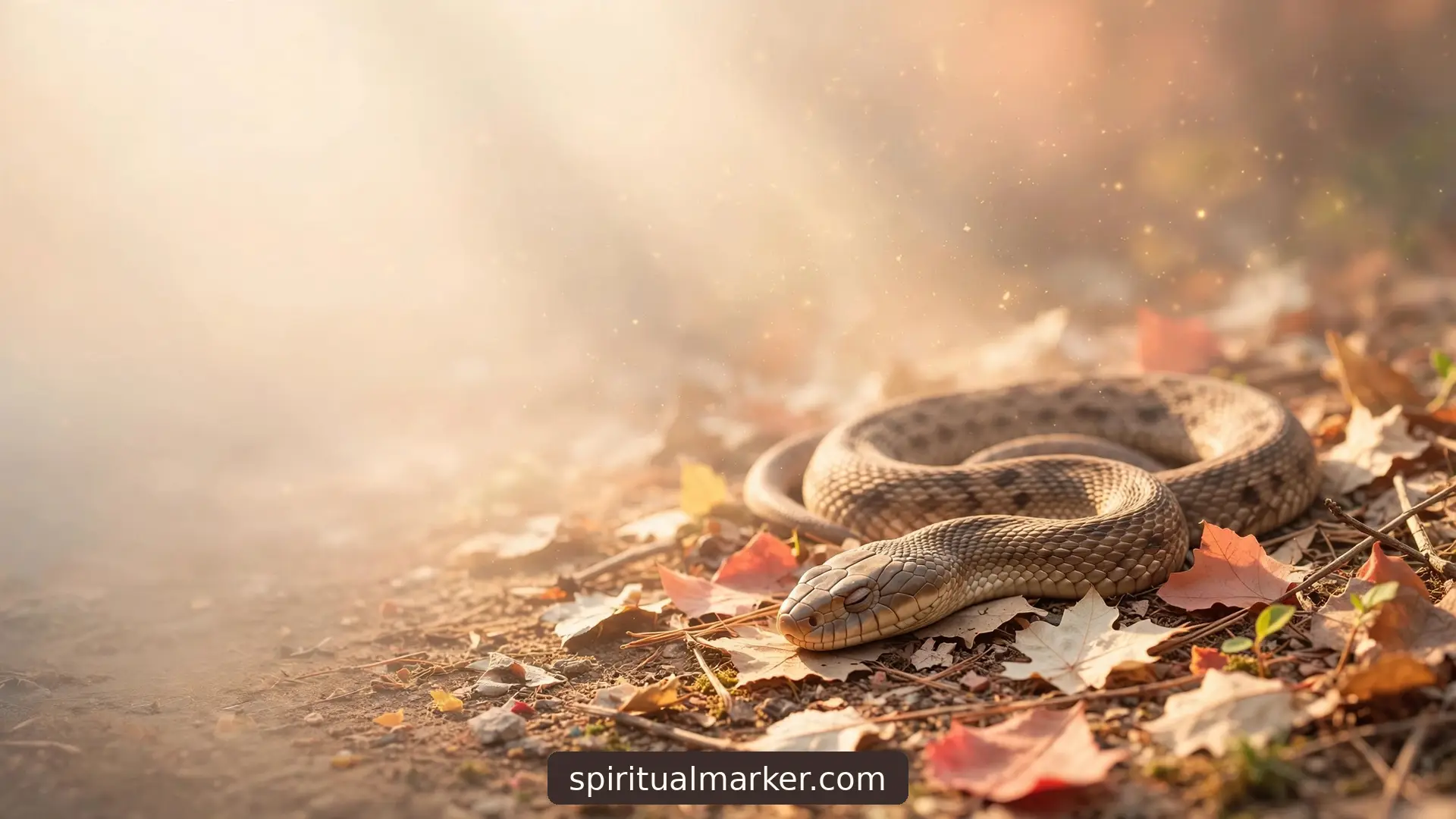
You step outside and there it is. A dead snake lying still on your path, in your yard, or even on the road ahead of you. Your stomach tightens. Your mind races. Was that just nature doing its thing, or was it a sign meant for you? Across centuries and cultures, snakes have carried weight far beyond their physical form, and a lifeless one carries even more. The dead snake spiritual meaning touches on transformation, closure, victory over hidden enemies, and the quiet end of a chapter you may not have realized was closing.
This moment of encounter rarely feels random to the person living through it. You notice the timing. You notice where it happened and what you were thinking about right before. Spiritual traditions from the Bible to Native American teachings to African folklore all treat snakes as messengers between worlds, and their death often marks a major turning point. Below, you will find a complete breakdown of what a dead snake symbolizes in waking life, in dreams, and across the world’s major belief systems. Each meaning connects to real patterns people report after this experience, so you can find clarity instead of staying stuck in worry.
Key Takeaways
Here are five important points to keep in mind before you read further:
- A dead snake most often symbolizes the end of a struggle, deception, or fear that has been draining your energy.
- In biblical terms, a dead serpent frequently points to victory over evil and the defeat of a hidden adversary.
- Seeing this image in a dream usually reflects an internal shift rather than a literal warning about danger.
- Many cultures view the snake’s death as a sign of spiritual rebirth, since snakes already symbolize shedding and renewal.
- The meaning shifts slightly depending on context, including the snake’s color, location, and whether you caused its death yourself.
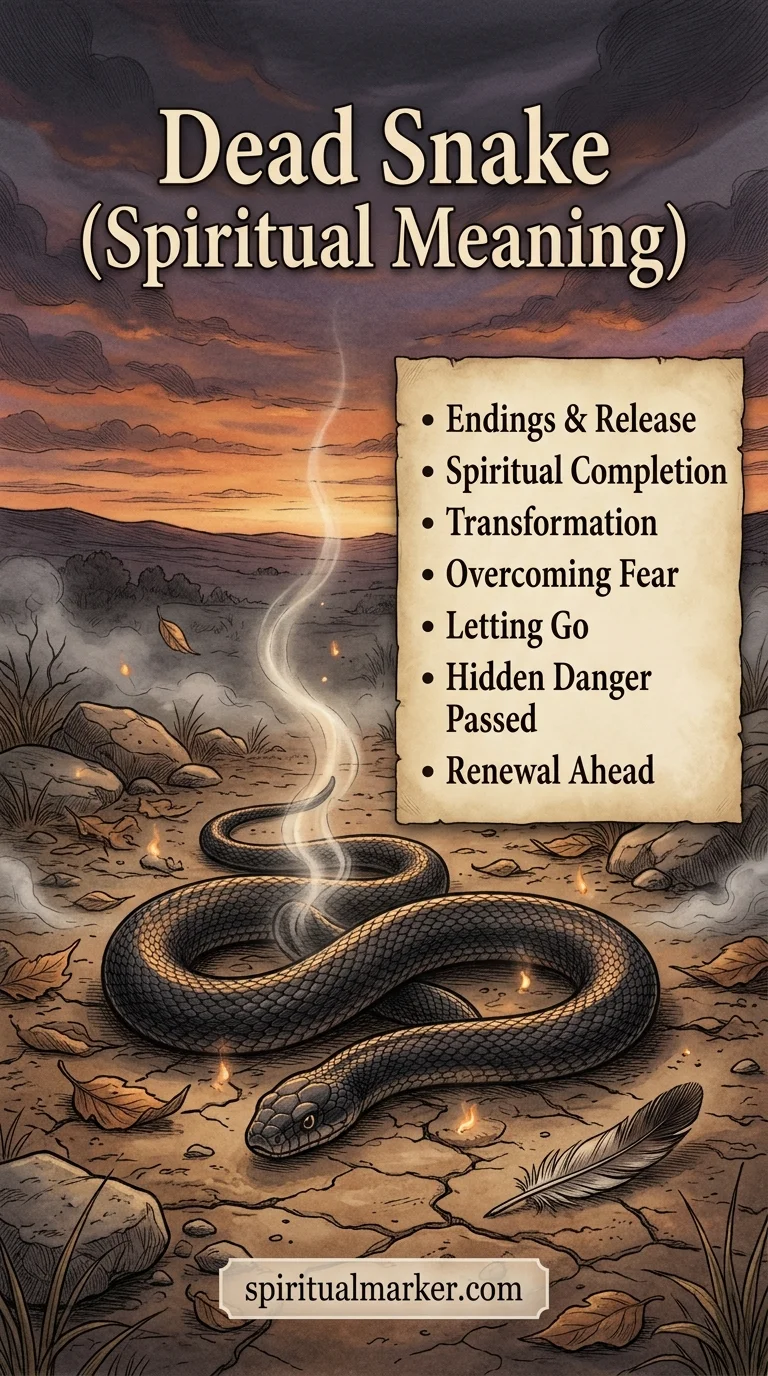
What Does a Dead Snake Symbolize in Spiritual Terms?
A dead snake represents the closing of an energetic cycle. Snakes carry a long history as symbols of transformation because they shed their skin throughout life. When you encounter one that has died, spiritual teachers often interpret this as the universe announcing that a difficult phase has reached its natural end. You are not just witnessing an animal’s death. You are witnessing a symbolic message about something within you finishing its course.
Many spiritual practitioners connect snakes to the base, or root, chakra. This energy center governs survival, fear, and primal instinct. A dead snake can suggest that fear-based thinking has lost its grip on you. Old anxieties that once controlled your decisions may finally be loosening. You might notice this shows up right after a season of stress, conflict, or self-doubt, almost as confirmation that you pushed through something significant.
There is also a protective layer to this symbolism. Snakes have long stood in for hidden threats, whether that means an enemy working against you in secret or a temptation you have struggled to resist. A dead snake often signals that this threat has been neutralized. The danger has passed, even if you were not consciously aware it existed. This is one reason people report a strange sense of relief after the encounter, even before they understand why.
Context always shapes the full picture. Where you found the snake, what you were doing at the time, and how it died all add detail to the message. A snake killed by another animal speaks differently than one that died of natural causes on its own. Keep these details in mind as you read through the meanings below, since they will help you apply the symbolism to your specific situation.
7 Spiritual Meanings of a Dead Snake
1. The End of a Toxic Situation or Relationship
One of the most common interpretations of a dead snake points to the conclusion of something harmful in your life. This could be a friendship built on jealousy, a job that drained your spirit, or a relationship marked by manipulation. Snakes have symbolized betrayal and poison since ancient storytelling began, so their death naturally suggests that toxicity has run out of power over you.
You may have already sensed this ending coming. Perhaps you made a decision recently to walk away from someone or something that no longer served your growth. The appearance of a dead snake can act as confirmation from the universe that you made the right call. It tells you the chapter is truly closed, not just paused.
People recovering from emotionally exhausting situations often describe a sense of lightness after this sighting. Therapists who study symbolic thinking note that the mind frequently uses external images to process internal closure. Whether you view this through a strictly spiritual lens or a psychological one, the takeaway stays consistent. Something poisonous in your life has lost its grip, and you are free to move forward without it.
2. Victory Over a Hidden Enemy or Threat
Snakes have long stood as symbols for enemies who work quietly behind the scenes. A dead snake often means that an unseen threat against you has been defeated, sometimes before you even realized it was active. This interpretation appears across folklore, scripture, and modern spiritual teaching with remarkable consistency.
You might think of this enemy as a literal person, someone spreading rumors or working against your success in private. You might also think of it as a more abstract force, like negative energy, jealousy directed at you, or spiritual attack in traditions that recognize such things. Either way, the snake’s death suggests the battle has already tipped in your favor.
This meaning carries a particularly strong message of reassurance. You do not need to keep fighting a battle that has already ended. Many people who experience this sign report a sudden resolution to conflicts that had felt impossible to escape, almost as if the encounter marked the exact turning point where things finally shifted in their favor.
3. Spiritual Rebirth and Personal Transformation
Snakes already symbolize renewal because they shed old skin to grow. A dead snake intensifies this message by representing a complete transformation rather than a gradual one. You are not just growing slowly. You are stepping into an entirely new version of yourself, leaving behind beliefs, habits, or identities that no longer fit.
This kind of rebirth rarely feels comfortable while it happens. Old patterns can resist letting go, and you may have felt unusually unsettled in recent weeks. The death of the snake mirrors the death of your old self. Something had to end completely before the new version of you could fully emerge.
Carl Jung, the influential psychologist who studied symbols extensively, wrote about the snake as an archetype of transformation present across nearly every human culture. His research suggests this symbolism runs deeper than coincidence. It taps into something universal about how people experience change. When a dead snake crosses your path, consider what part of your identity might be ready to be released for good.
4. Release From Fear and Anxiety
Fear of snakes ranks among the most common phobias worldwide, and this fear often becomes symbolic shorthand for anxiety in general. A dead snake can represent the dissolving of fears that have held you back, whether that fear involves failure, judgment, rejection, or uncertainty about your future.
You may have been carrying worry for months without fully naming it. This sighting can act as a gentle nudge, encouraging you to notice how much lighter you feel once that fear loses its hold. Spiritual teachers frequently describe this as the universe showing you proof that your fears were never as powerful as they seemed.
This meaning resonates strongly for people facing a major decision. If you have hesitated to take a leap because fear kept whispering worst-case scenarios, a dead snake can serve as encouragement. The thing you feared has already lost its power. You are being invited to move forward without that weight slowing you down.
5. A Warning Has Passed, Not Arrived
Many people assume any snake encounter signals danger ahead, but a dead snake usually points backward, not forward. It suggests a warning you may have ignored or a risk you barely avoided. The danger already passed, and you came through it safely, even if you never consciously registered the threat.
This interpretation often brings a wave of relief once people understand it correctly. Instead of bracing for something bad, you can recognize that something bad already happened and you survived it. Your intuition may have guided you around a problem without you fully noticing the guidance at the time.
Pay attention to recent decisions where you trusted your gut instead of logic. Did you turn down an opportunity that felt off? Did you avoid a person who seemed trustworthy on paper but raised quiet red flags? The dead snake confirms that instinct served you well, and it encourages you to keep trusting that same inner voice going forward.
6. Healing After a Period of Deception
Snakes carry strong associations with deception across nearly every mythology, largely thanks to their role in the biblical garden of Eden story. A dead snake frequently symbolizes the end of a period defined by lies, whether those lies came from someone else or from stories you told yourself to avoid a hard truth.
This healing process can feel disorienting at first. Discovering deception, even after it ends, often brings grief alongside relief. You might mourn the version of a relationship or situation you believed was real before the truth came out. The dead snake marks the start of genuine healing, separate from the discomfort of discovering you were misled.
Give yourself permission to move through this healing without rushing. Deception leaves a mark, and trust takes time to rebuild, both in others and in your own judgment. The spiritual message here centers on patience. The lie has died. Your healing is just beginning, and that is exactly where it should be.
7. A Call to Reclaim Your Personal Power
In many spiritual frameworks, snakes represent raw, primal power, both creative and destructive. A dead snake can suggest that power you once gave away to someone else, a circumstance, or a fear is finally returning to you. This interpretation often arrives during seasons when people feel ready to stand fully in their own authority again.
You might have spent recent years putting other people’s needs ahead of your own, staying quiet to avoid conflict, or doubting your own capability. This sign suggests a shift back toward self-trust. The snake’s death is not a loss in this context. It is a transfer, moving power from an external source back into your own hands.
Reclaiming personal power rarely happens overnight, but this symbolic moment can mark the beginning. Notice where you have felt small lately and ask what it would look like to take up that space again. The universe, through this sign, seems to be telling you that permission has already been granted.
Dead Snake Meaning Based on Color and Type
The specific appearance of the snake adds another layer to the overall message. A dead black snake often points to the end of a fear connected to the unknown, since black snakes commonly symbolize mystery and hidden emotion. People who find one frequently report that a long-standing source of unease in their life resolves shortly afterward, almost validating the symbolism in real time.
A dead white snake carries a gentler tone, frequently linked to spiritual purity and the closing of a karmic lesson. White has represented clarity and divine connection across countless traditions, so this combination suggests you have completed an important spiritual lesson successfully. You may feel an unusual sense of peace rather than alarm after this particular sighting.
A dead rattlesnake holds special weight in many Native American traditions, where this species symbolizes both danger and sacred transformation. Its death can represent the resolution of a conflict that required real courage to face. Meanwhile, a dead garden snake or grass snake, smaller and less threatening by nature, tends to symbolize the end of smaller, everyday worries rather than major life upheavals. Size and species both matter when reading the full message behind your encounter.
Dead Snake Meaning Based on Location and Circumstance
Finding a dead snake in your house carries a notably personal and intimate meaning compared to finding one outside. Your home represents your inner world, your family, and your sense of safety. This sighting often suggests that a threat targeting your personal life or peace of mind has already lost its power. Many people report finding this sign right after resolving a long-running family conflict or household stress.
A dead snake on your doorstep or path suggests protection over your journey forward. Paths symbolize the direction your life is heading, so a dead snake along that route can mean obstacles standing between you and your goals have been removed. You are being given a clearer road ahead, even if you cannot see every step of it yet.
Finding a snake that you personally killed introduces an active element of empowerment into the symbolism. This shifts the meaning from passive observation to direct victory. You took action against a threat, fear, or toxic force, and that action mattered. This version of the encounter often correlates with periods of major personal growth, where someone finally stood up for themselves after a long period of staying silent.
Dead Snake Symbolism Across Cultures and Traditions
Ancient Egyptian culture viewed snakes with deep reverence, connecting them to both danger and divine protection through the image of the cobra goddess Wadjet. A dead snake in this context often symbolized the defeat of chaos, since Egyptian mythology frequently framed serpents as guardians of order when properly respected. The pharaohs wore cobra symbols on their crowns specifically to represent protection over the kingdom, making the death of a serpent a powerful image tied to safeguarded leadership.
In Hindu spirituality, the snake holds an especially complex and sacred position through figures like Shesha and the kundalini energy coiled at the base of the spine. A dead snake in this tradition can represent the release of stagnant kundalini energy, allowing spiritual awakening to move freely upward through the body. Hindu teachings often connect this symbolism to meditation practices, where students work to “awaken” the serpent energy rather than suppress it entirely.
Chinese culture, through the lens of the zodiac, treats the snake as a symbol of wisdom, intuition, and transformation rather than something purely negative. A dead snake within this framework can suggest the completion of a wisdom-gathering cycle, where lessons learned have been fully absorbed and no longer need to be actively pursued. This interpretation aligns with the broader Taoist principle that endings create necessary space for new beginnings.
Native American traditions vary widely by tribe, but many share a respect for snakes as teachers of transformation and earth wisdom. Among the Hopi people, snake dances and ceremonies honor the creature’s connection to rain and fertility. A dead snake within these broader traditions can symbolize a completed cycle of growth, similar to how a harvest marks the end of a season’s labor. The Navajo, by contrast, often approach dead snakes with caution, viewing them as requiring ceremonial cleansing to avoid spiritual imbalance, which shows just how much interpretation can shift even within neighboring cultures.
West African spiritual traditions, including those connected to Vodun, frequently honor the serpent deity Dan as a symbol of continuity, movement, and life force. A dead snake here can carry weight related to disrupted flow, prompting practitioners to examine where energy in their life has stalled. This contrasts with the more triumphant interpretations found in Egyptian or biblical contexts, reminding you that the same image can carry very different emotional tones depending on the cultural lens applied to it.
Dead Snake Biblical Meaning and Scriptural Significance
The Bible introduces the serpent early, in the garden of Eden, where it represents deception and the fall of humanity into sin. Genesis 3:15 records God’s judgment against the serpent, stating it would be cursed and that enmity would exist between it and humanity. This passage sets the foundation for understanding why a dead snake in biblical symbolism so often represents victory over evil and temptation.
Scripture repeats this theme of serpents being defeated throughout both the Old and New Testaments. Psalm 91:13 declares that those under God’s protection will tread on the lion and the cobra and trample the great lion and the serpent, framing the serpent as a defeated enemy under divine protection. This verse offers comfort to believers who encounter snake imagery, suggesting that any hidden threat in their life falls under the same promise of protection and victory.
The story of Moses lifting up the bronze serpent in Numbers 21 adds another layer to this symbolism. God instructed Moses to create a bronze snake on a pole so that anyone bitten by the venomous serpents plaguing the Israelites could look at it and live. This account, later referenced by Jesus in John 3:14 as a foreshadowing of His own crucifixion, transforms the serpent from a symbol of judgment into a symbol of healing when properly understood within God’s redemptive plan.
Romans 16:20 offers one of the clearest New Testament promises connected to this symbolism, assuring believers that God will soon crush Satan, often depicted as a serpent, under their feet. For Christians who encounter a dead snake, this verse provides a direct theological anchor. The image affirms a promise already given, that evil ultimately loses and believers share in that victory through their faith.
Revelation continues this thread by referring to Satan directly as “that ancient serpent” in Revelation 12:9, tying the very first deception in Eden to the final defeat of evil at the end of biblical history. This full-circle imagery suggests that a dead snake spiritually echoes the entire arc of scripture, from the fall in the garden to ultimate redemption. For believers, this turns a simple wildlife encounter into a quiet but powerful reminder of faith’s central promise.
Dreaming About a Dead Snake: Spiritual and Psychological Interpretations
Dreams featuring a dead snake tend to leave a strong emotional residue, even after waking. Spiritually, this dream often mirrors the waking-life meanings above, frequently pointing toward the resolution of an internal conflict you may not have consciously addressed yet. Your subconscious mind processes emotional material during sleep, and a dead snake appearing there can signal that some form of inner reckoning has already taken place beneath the surface.
Psychologically, Carl Jung’s framework offers valuable insight here. He viewed the snake as a representation of the shadow self, the parts of our personality we tend to repress or deny. A dead snake in a dream can suggest successful integration of a shadow trait, meaning you have made peace with a part of yourself you once feared or rejected. This integration often correlates with increased confidence and a stronger sense of identity in waking life.
Dream researchers studying recurring symbols note that snakes frequently appear during periods of major life transition, including career changes, the end of relationships, or significant personal growth. A dead snake specifically tends to surface once the hardest part of that transition has already passed. If you have been navigating a difficult change recently, this dream may be confirming that you have moved through the most challenging stage already, even if daily life still feels unsettled.
Pay close attention to additional details within the dream itself, since they shift the meaning considerably. A dead snake that you encounter calmly suggests acceptance and peace regarding whatever ending the dream represents. A dead snake that frightens you, even though it cannot move, may indicate lingering fear about a situation that has technically resolved but still feels emotionally unresolved. Dreams rarely deliver tidy, single-layer messages, so sitting with the full emotional texture of the experience will give you the clearest read on what your mind is processing.
How to Respond Spiritually After Seeing a Dead Snake
Many spiritual traditions encourage a moment of quiet reflection immediately after this kind of encounter. Rather than reacting purely with fear or disgust, pausing to ask yourself what recently ended, resolved, or shifted in your life can open up real clarity. Your own life circumstances hold the key to interpreting this sign accurately, far more than any general guide ever could on its own.
Journaling shortly after the experience tends to help people connect the symbolism to their actual circumstances. Write down what you were thinking about, doing, or feeling in the hours before the sighting. Patterns often emerge once you look back over several similar entries, revealing exactly which area of your life this recurring symbol tends to address for you personally.
Some traditions also recommend a small ritual of gratitude following this sign, acknowledging the protection or release it represents. This does not need to be elaborate. A simple moment of quiet thanks, whether directed toward God, the universe, or your own intuition, can help anchor the positive meaning of the encounter rather than letting fear dominate your emotional response to it.
A Final Note
A dead snake rarely arrives as bad news once you understand its full spiritual context. Across scripture, mythology, dream psychology, and lived experience, this image consistently points toward closure, protection, and transformation rather than danger lying ahead. You are far more likely standing on the other side of something difficult than walking toward a new threat.
If this sign has appeared in your life recently, consider taking a few quiet minutes to reflect honestly on what has shifted for you lately. Look at relationships, fears, old habits, and lingering worries with fresh eyes, since one of them likely connects to the message behind this experience. You might also keep a simple journal of spiritual signs going forward, noting dates, locations, and your emotional state each time something meaningful crosses your path.
Trust the sense of relief if it comes, even if you cannot fully explain it yet. Spiritual symbolism often works ahead of conscious understanding, offering comfort before your mind catches up to what your spirit already knows. Whatever battle, fear, or deception this sign points to in your life, the message stays remarkably consistent across every tradition explored here. It is already behind you.