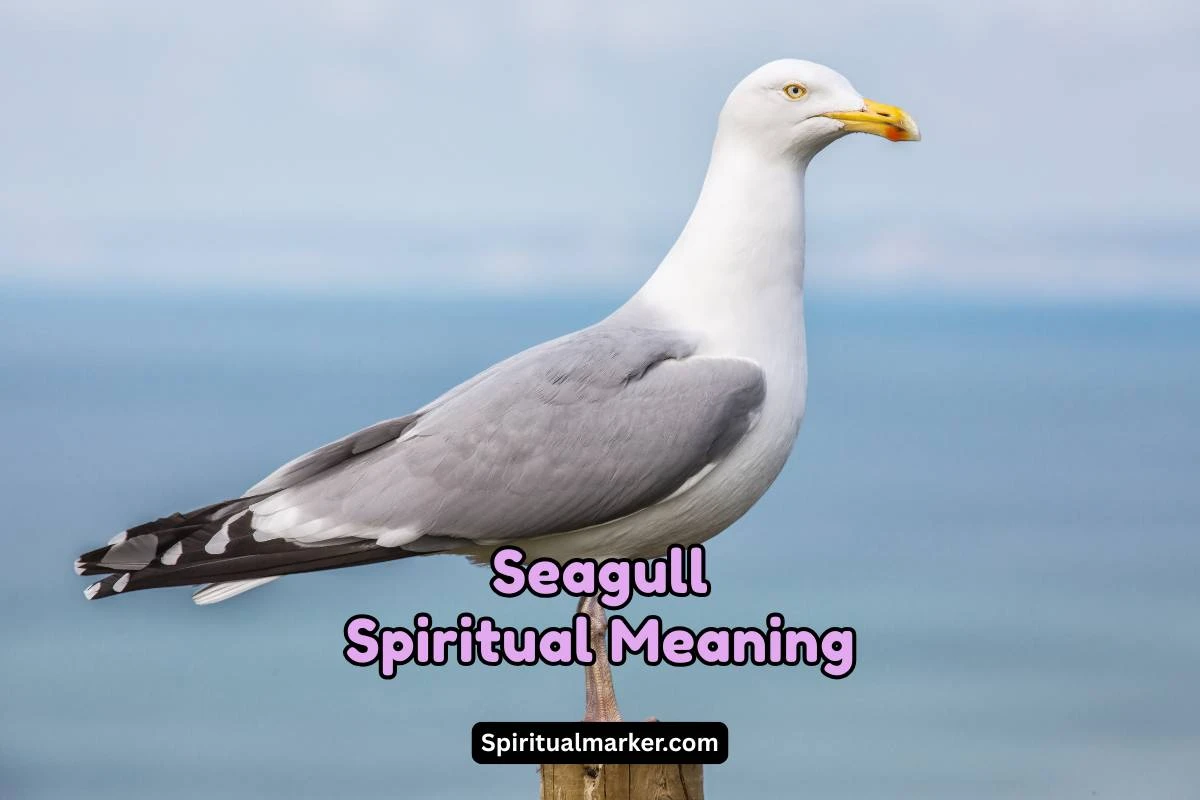
The seagull is a common sight near the coast. Its white feathers and raucous calls make it familiar. Across cultures, seagulls carry deep spiritual meaning and symbolism.
The seagull spiritual meaning often involves adaptability, survival, and spiritual freedom. Seagulls are opportunistic feeders, so they can signal a need to be resourceful. A spiritual meaning of a blue heron shares that water-bird focus, though herons carry a more solitary energy.
Some traditions view seagulls as messengers of the sea or guides for sailors. Others see them as a reminder to find joy in simple things. The seagull's behavior can add detail.
If a seagull appears in your life, it may bring a message of freedom. A spiritual meaning of a crane also deals with long-legged birds, though cranes carry a more graceful energy.
Key Takeaways
Before diving deep, here are five essential truths about seagull spiritual meaning you need to carry with you through this post.
- Seagulls symbolize freedom and the courage to leave safe shores. They do not anchor themselves to one place. They move with the tides of life, and they invite you to do the same. Their constant flight between land and ocean represents the spiritual call to release what no longer serves you.
- The seagull is a powerful messenger between worlds. Many cultures place the seagull at the spiritual crossroads of earth, water, and sky. Sailors historically believed seagulls carried the souls of lost seafarers. Seeing one at a critical moment often signals that departed loved ones are near.
- Seagull symbolism carries a strong lesson about adaptability. These birds eat almost anything, thrive in storms, and survive extreme environments. Spiritually, the seagull teaches you to use every available resource and stay resilient when life turns difficult.
- A seagull as a spirit animal points to your need for community balance. Seagulls are deeply social creatures. They communicate loudly and protect their flock. Their spiritual guidance often centers on the tension between personal independence and your responsibilities to those around you.
- Seagulls in dreams carry specific messages about transitions and emotional clarity. Water in dreams represents emotions and the unconscious. A seagull flying over water in your dream signals that you are processing a major life transition with growing spiritual awareness.
What Is the Seagull and Does It Hold Spiritual Power?
The seagull, formally known as a gull, belongs to the family Laridae. There are more than fifty species worldwide. They populate every coastal region on earth, from the Arctic tundra to tropical beaches. You find them at harbors, fishing docks, clifftops, inland lakes, and even in city parking lots. Their adaptability is extraordinary, and that adaptability is the first clue to their spiritual power.
Spiritually potent animals share a common trait: they exist at thresholds. The owl bridges day and night. The raven crosses life and death. The seagull lives at the edge of land and sea, navigating two completely different worlds with ease. Ancient peoples saw this as divine ability. They believed that animals dwelling at natural boundaries carried wisdom from both realms. The seagull, always hovering between the known and the unknown, became a natural spiritual guide.
Many spiritual traditions assign specific birds as messengers. In nearly every coastal culture, the seagull fills this role. Its loud, unmistakable cry was heard as a voice from the divine. Its ability to ride hurricane winds without being destroyed was seen as supernatural grace. The way it plunges fearlessly into the ocean and resurfaces untouched speaks of spiritual purification and renewal. These are not coincidences. People in every corner of the world recognized something sacred in the seagull long before modern spirituality gave it a label.
What Does Seeing a Seagull Symbolize or Represent?
When a seagull appears in your life, its exact behavior carries specific spiritual weight. A seagull flying high in clear skies signals clarity, liberation, and elevated perspective. Your spirit is being invited to rise above daily noise and see your situation from a higher vantage point. Many people report feeling an inexplicable calm when they watch seagulls soar. This calm is the spiritual message working on you before your conscious mind catches up.
A seagull that lands near you, particularly on an unusual surface like your car, your window ledge, or directly in your path, carries an urgent personal message. In spiritual traditions, an animal that breaks social distance and enters your personal space is attempting direct communication. This is the universe reducing the gap between you and spiritual guidance. Pay attention to your thoughts and feelings in that exact moment. The message often lives in what you are already thinking.
Seeing a seagull during a difficult period in your life represents endurance and the promise of navigation through storms. Sailors used seagulls to find land when lost at sea. Spiritually, this translates into the seagull arriving when you feel most disoriented, reminding you that land is near and you possess the instincts to find it. The seagull symbolism in this context is pure reassurance from a universe that knows where you are going even when you do not.
A flock of seagulls seen together symbolizes community, collective wisdom, and shared purpose. When you see many seagulls moving together, you are receiving a message about your relationships and social connections. Something in your community or family needs your attention. Alternatively, you may be called to join a group or cause that aligns with your deeper values.
7 Spiritual Meanings of the Seagull
1. Freedom and the Release of Limitations
The most central seagull spiritual meaning is freedom. No other bird embodies the concept of liberation quite like the seagull. Richard Bach captured this beautifully in the philosophical novella “Jonathan Livingston Seagull,” where a seagull’s obsessive pursuit of flight mastery becomes a metaphor for the soul’s desire to transcend its earthly limitations. This story resonated with millions because it touched something real and universal: the deep human hunger to break free.
Seagulls do not belong to any one place. They follow the wind, the food, and the season. No fence, fence line, or border constrains them. Spiritually, the seagull calls you to examine your own self-imposed limitations. What invisible borders have you drawn around your life? What stories do you keep telling yourself about what is possible? The seagull arrives to challenge those stories directly.
This freedom is not reckless. Seagulls are masterful navigators. They know the wind patterns, the tidal rhythms, and the safest flight paths. True spiritual freedom is informed freedom. The seagull teaches you to release control while deepening your inner wisdom. You do not need to know exactly where you are going. You need to trust that your instincts, sharpened through experience, will carry you safely forward. This is perhaps the most liberating and the most demanding lesson the seagull offers.
2. Adaptability and Resourcefulness
Seagulls are supreme survivors. They eat fish, insects, earthworms, scraps, and even other birds’ eggs. They build nests on cliffs, rooftops, and urban structures. They thrive in freezing northern coasts and blistering tropical shorelines. This breathtaking adaptability is not accidental in spiritual terms. The seagull carries the specific teaching that your survival and your success depend on your willingness to use what is available, not what is ideal.
When the seagull appears during times of scarcity or unexpected change, it delivers a precise spiritual instruction. Stop waiting for perfect conditions. Stop mourning the resources you wish you had. Look around with fresh eyes at what already exists in your environment. The seagull never starves because it never fixates on one food source. It pivots, adjusts, and moves with what life offers. This is a spiritual principle disguised as biological behavior.
Adaptability at a spiritual level also means releasing attachment to outcomes. Seagulls do not agonize over a fish that got away. They dive again, circle again, and try a different angle. Each failed attempt simply redirects their energy. The spiritual seeker who adopts this seagull approach to life experiences far less suffering during transitions. Problems become puzzles. Setbacks become course corrections. The seagull teaches you to treat failure as directional information rather than personal defeat.
3. Communication and the Power of Your Voice
The seagull’s cry is one of the most distinctive sounds in the natural world. Piercing, loud, and impossible to ignore, it carries enormous distances across wind and wave. Spiritually, the seagull’s call is a symbol of your own voice and your need to use it. If the seagull appears prominently in your life right now, the universe may be pointing to a truth you have been swallowing in silence.
Seagulls communicate with extraordinary precision. They use different calls for warning, for mating, for gathering the flock, and for distress. They do not just make noise. They communicate with intention and purpose. The spiritual lesson here runs deep: your voice is a tool of creation. What you speak aloud, you begin to materialize. Staying silent about your needs, your truth, or your boundaries does not protect you. It diminishes you.
Many people who feel a strong connection to seagull energy are natural communicators, teachers, storytellers, or advocates who have suppressed their voice due to fear of rejection or conflict. The seagull spirit animal calls these individuals back to authentic expression. Your cry, like the seagull’s, carries the power to orient others, warn of danger, and call your community together. Do not muffle it. The world needs what only your particular voice can say.
4. Connection to Spiritual Realms and Ancestral Messages
Sailors across multiple cultures held a profound belief: seagulls carry the souls of those lost at sea. This was not idle superstition. It was a deeply held spiritual conviction that governed behavior at sea for centuries. Harming a seagull was considered a terrible omen and a grave spiritual offense. The bird was understood to be a vessel of the departed, a messenger from the other side of life.
This ancestral connection gives the seagull a powerful role in grief, remembrance, and spiritual communication with departed loved ones. If you have recently lost someone, particularly someone connected to water, the ocean, or maritime life, a seagull appearing unexpectedly near you may carry their energy. Many people who have experienced this report a sudden warmth, an inexplicable comfort, or a strong sense of presence accompanying the bird’s appearance.
Beyond grief, the seagull’s connection to spiritual realms speaks to its role as a boundary crosser. It moves between water, earth, and air with equal confidence. In esoteric traditions, water represents the unconscious and the spiritual realm, earth represents the physical world, and air represents the realm of the divine mind. The seagull, masterful in all three, becomes a spiritual guide who can accompany you across dimensions of consciousness. Meditating with the seagull as your focus animal can open channels of ancestral wisdom and intuitive insight that ordinary awareness does not reach.
5. Perspective and the High View
Seagulls are gifted flyers. They reach significant altitudes and can hover motionless on updrafts, surveying vast stretches of ocean and coastline below. This elevated perspective is a core spiritual teaching of the seagull. When you are consumed by ground-level problems, the seagull invites you to rise. Change your altitude and your entire understanding of the landscape shifts.
Practically, this spiritual meaning applies to conflict, confusion, and decision-making. A problem that seems enormous when you stand inside it often reveals its solution when viewed from above. The seagull spirit animal is particularly powerful for people trapped in overthinking or emotional reactivity. It carries the medicine of detachment, not the cold detachment of indifference, but the clear-eyed perspective of a soul that can see the whole picture.
Many spiritual traditions describe enlightenment as a shift in vantage point rather than an acquisition of new information. You do not learn something you did not know. You see clearly what was always there. The seagull embodies this principle perfectly. It does not find new oceans. It simply rises high enough to see the fish schools moving beneath the surface. Spiritual elevation works the same way. Rise in consciousness, and your path becomes visible in ways it never was from sea level.
6. Courage in the Face of Storms
Most birds take shelter during storms. Seagulls do not. They ride storm systems with extraordinary skill, using updrafts created by violent weather to achieve effortless, soaring flight. Fishermen have long used seagull behavior to predict weather, and the image of seagulls flying calmly through a gale has become iconic. Spiritually, the seagull teaches that storms are not always your enemy. Sometimes they are your greatest source of power.
When the seagull appears during a turbulent period in your life, it is not bringing a warning. It is bringing reassurance. The storm you are currently navigating contains energy you can use. You are more capable than you believe. The seagull does not fight the storm wind. It aligns with it and uses the very force that would destroy a weaker creature to propel itself to greater heights. This is one of the most advanced spiritual teachings encoded in seagull symbolism.
This storm courage also applies to emotional bravery. Many people avoid difficult conversations, necessary endings, or painful truths because they fear the emotional tempest that might follow. The seagull challenges this avoidance directly. Enter the storm with skill and trust. You will not drown. You will be carried higher than you were before the storm arrived. Every emotional confrontation you have been avoiding holds the same potential energy as the wind that lifts the seagull.
7. Balance Between Independence and Community
Seagulls are simultaneously independent and deeply communal. They hunt alone with fierce individual focus. They also nest in massive colonies, raise young cooperatively, and mob predators together with remarkable coordination. This dual nature gives the seagull unique spiritual authority on the tension between self and community. Many people struggle with this balance their entire lives. The seagull has mastered it.
If the seagull appears as your spirit animal or totem, you likely experience this tension intensely. You may crave solitude and personal freedom while simultaneously feeling deeply responsible to your family, friends, or community. You might resist being defined by any group while also longing for deep belonging. The seagull does not ask you to choose one over the other. It models how to move fluidly between independence and connection without losing yourself in either.
Practically, the seagull’s teaching here is about knowing when each mode is appropriate. There are times for solitary hunting, for pursuing your individual goals with focus and speed. There are also times for the colony, for sharing resources, raising collective alarms, and protecting the vulnerable together. Spiritual maturity means developing the discernment to know which moment calls for which response. The seagull navigates this instinctively. Your practice is to cultivate that same instinct consciously.
Seagull Meaning and Symbolism Across Cultures and Religions
The seagull spiritual meaning is not confined to any single tradition. Cultures across the globe independently developed rich symbolic frameworks around this coastal bird, and the remarkable consistency of these frameworks confirms something genuine in the seagull’s spiritual signature.
In Celtic tradition, the seagull occupied sacred space as a creature of the liminal. Celtic spirituality placed enormous emphasis on thresholds and between-places: dawn and dusk, the shoreline, the forest edge, the threshold of a doorway. The seagull, permanently resident at the most powerful threshold of all, where land surrenders to sea, was considered a vessel of Otherworldly knowledge. Celtic seers would observe seagull behavior to receive omens, and coastal communities offered respect to seagulls as living symbols of the divine feminine, connecting them to goddesses of the sea and wisdom.
In Native American traditions, the seagull holds varied but consistently significant roles. The Haida people of the Pacific Northwest associated the seagull with communication and the carrying of messages between the human world and spiritual realms. The seagull appears in multiple creation stories as a witness or participant in the formation of the world. Some Plains tribes saw the seagull as a sign of distant water and used its appearance inland as a navigation signal during long journeys. In almost all Native American interpretations, the seagull carries an air of sacred utility, useful to those who know how to read its messages.
In East Asian spiritual traditions, particularly in Chinese and Japanese coastal communities, seagulls symbolize good fortune, safe travel, and the blessing of the sea. Fishermen in coastal China considered a seagull landing on a boat to be an auspicious sign before departure. Japanese Shinto tradition views seagulls as messengers of the sea kami (gods), and their presence near a shrine was treated as a divine visitation. The seagull’s white plumage in these traditions connects it to purity and the clean energy of new beginnings.
In Norse and Viking culture, seagulls were practical spiritual guides. Norse seafarers used seagull behavior to locate coastlines in fog, to predict storms, and to identify fishing grounds. At a spiritual level, the Norse associated seagulls with the transitional state between life and death. Some sagas describe the souls of fallen warriors taking on seagull form before their final passage to Valhalla or the Hall of the Sea goddess Ran. The seagull occupied a position of honor in Viking spiritual cosmology as a psychopomp, a guide of souls.
Seagull Symbolism in World Mythologies
Mythology amplifies spiritual symbolism into story, and the seagull plays meaningful roles in several of the world’s great mythological traditions. These stories reveal the deeper archetypal dimensions of seagull symbolism that pure cultural analysis sometimes misses.
In Greek mythology, the most direct seagull connection comes through the figure of Leucothea, whose name literally means “white goddess.” Leucothea was a sea goddess who transformed into a seagull to save the hero Odysseus from drowning after his raft was destroyed by the sea god Poseidon. She gave Odysseus her divine veil to keep him afloat. This myth encodes one of the deepest layers of seagull spiritual meaning: the seagull as rescuer, as divine grace arriving at the moment of greatest peril. The seagull does not merely observe your struggle from above. It carries sacred help directly to you.
In Irish mythology, the Children of Lir is one of the most beloved and heartbreaking tales in the Celtic world. King Lir’s children are transformed into swans by their jealous stepmother. Though swans rather than seagulls carry this specific story, the broader Irish mythological tradition places all seabirds, including gulls, within a sacred category of transformed souls. The seagull in Irish folklore frequently represents a person held between two worlds, someone who has experienced transformation so profound that they exist differently from ordinary human beings. This resonates powerfully with anyone undergoing a major spiritual awakening.
In Pacific Island mythologies, particularly among Polynesian peoples, seabirds including seagulls served as navigational deities or their physical representatives. Polynesian wayfinders, among history’s greatest navigators, read the behavior of seabirds as one of their primary instruments. Seagulls indicated proximity to land. At a mythological level, the bird that leads you home through featureless ocean became associated with divine providence, the unseen hand that orients the lost traveler. The seagull in Polynesian spiritual tradition is a symbol of finding your way home, not just geographically but existentially.
The philosophical mythology of “Jonathan Livingston Seagull” by Richard Bach, though modern, has entered the canon of seagull symbolism so thoroughly that no mythology section would be complete without it. Published in 1970, the novella tells the story of a seagull who prioritizes the perfection of flight over mere feeding and survival. The flock expels him. He achieves transcendence alone. He returns as a teacher. This story mirrors the classic hero’s journey and the mystic’s path: separation from the collective, spiritual trials in solitude, enlightenment, and the compassionate return to serve others. The seagull in this mythological frame represents the soul’s highest aspiration, the refusal to accept ordinary existence when extraordinary consciousness is possible.
Seagull as a Spirit Animal and Totem
If the seagull has appeared to you repeatedly, in waking life, in dreams, or through a strong intuitive pull, it may be presenting itself as your spirit animal or totem. People with the seagull as their spirit animal share a recognizable set of traits and life challenges that the seagull’s energy is specifically designed to address.
Seagull people are natural boundary-dwellers. They are often described by others as hard to categorize. They belong to multiple worlds simultaneously. They may work in creative fields while maintaining analytical minds. They love deep solitude but also need vibrant social connection. They feel at home near water but also in the city. This multi-world comfort is a direct reflection of the seagull’s own liminal nature, and it is a genuine spiritual gift, not a flaw or inconsistency to be corrected.
People with seagull totem energy are extraordinarily perceptive. Like the seagull that can spot a fish below dark ocean water from fifty feet in the air, seagull people notice what others miss. They read rooms instinctively, sense emotional undercurrents in relationships, and often know things they cannot explain rationally. This perceptiveness is the spiritual gift of elevated perspective encoded in the seagull’s biological reality. However, it also creates sensitivity to noise, conflict, and deception that can be exhausting if not consciously managed.
The primary challenge for seagull spirit animal people is overextension. Because they can thrive in so many environments and are highly resourceful, they often take on more than is sustainable. They commit to too many communities, too many projects, too many relationships. The seagull’s teaching here is that even the most adaptable bird needs to know its limits. Resourcefulness without discernment leads to depletion, not abundance. The seagull spirit animal calls its people to practice selective engagement and conscious rest.
Seagull Biblical Meaning and Significance
The Bible does not name the seagull by its modern designation, but seabirds and coastal birds appear throughout scripture in contexts that carry powerful spiritual weight for those studying seagull biblical meaning. Understanding the biblical framework helps ground seagull symbolism within a Judeo-Christian spiritual perspective.
In Leviticus 11:13-19, a list of birds considered unclean under Mosaic law includes the gull (translated variously as “sea gull” or “cuckoo” in different versions). This categorization placed the gull in the same class as the eagle, vulture, and raven. Biblical scholars note that these birds shared common traits: they were all boundary crossers, they ate from multiple sources including what was dead, and they did not fit neatly into the agricultural world of the Hebrew people. Their unclean status was not a moral judgment but a ritual one, reflecting their existence outside the conventional order. For spiritual seekers, this actually deepens seagull symbolism as a creature that operates beyond ordinary categories.
The broader biblical symbolism most relevant to the seagull centers on birds as divine messengers and symbols of the Holy Spirit. In Matthew 3:16, the Holy Spirit descends like a dove at Jesus’s baptism. The dove, like the seagull, is a white coastal bird. The spiritual principle of white-winged birds as vehicles of divine presence connects the seagull to this powerful biblical stream. In scripture, birds often appear at pivotal spiritual moments: ravens feed Elijah in the wilderness, doves signal the end of the flood, eagles represent the strength of those who wait on God in Isaiah 40:31.
Most relevant to seagull spiritual meaning is the biblical theme of divine provision in unexpected places. Ravens bring bread to Elijah. God provides manna in the desert. The seagull’s extraordinary ability to find sustenance anywhere, including places where food seems impossible to locate, resonates directly with the biblical promise of provision. When a seagull appears during a season of spiritual scarcity or material need, it may carry the biblical message that provision is already on its way, coming from a direction you have not yet considered.
Christian mystical tradition also connects the seagull to the concept of contemplative freedom. Early desert fathers, the third and fourth century Christian mystics who withdrew from society to pursue God in remote places, wrote extensively about birds as symbols of the soul freed from earthly attachment. The seagull, as a bird that dwells at the edge of the habitable world and moves freely across vast open spaces, embodies the contemplative ideal of a soul that travels lightly and places its ultimate trust in divine guidance rather than human security.
Seagull Color Symbolism and What Different Seagulls Mean
Not all seagulls look the same, and in spiritual symbolism, the physical appearance of an animal adds important nuance to its message. The color and condition of a seagull you encounter can deepen the spiritual reading significantly.
The white seagull is the most commonly encountered and carries the core spiritual signature: purity, clarity, new beginnings, and divine connection. White in virtually every spiritual tradition represents the divine light, truth stripped of all distortion, and the soul at its cleanest frequency. A predominantly white seagull appearing to you signals that you are either at a clean starting point or that you need to release something old to access a new beginning that is already waiting for you.
Many seagulls carry grey plumage, particularly on the wings and back. Grey in spiritual color symbolism represents neutrality, wisdom, and the place between absolutes. A grey-feathered seagull often delivers a message about nuance. The situation you are facing is not black and white. The answer you are seeking lives in a middle path you have not yet considered. The grey seagull invites you to sit with complexity rather than forcing a binary resolution.
Seagull chicks and juveniles carry brown or mottled plumage before their adult white feathers emerge. Seeing a juvenile seagull spiritually signals that you are in a development phase. Your current situation is not your final form. The messy, uncertain plumage of the young bird represents a natural transitional state that will resolve into something clean and clear. Do not judge yourself by your current appearance. The white feathers are coming.
Dreaming About Seagulls: Spiritual and Psychological Meanings
Dreams speak the language of symbol and metaphor with extraordinary precision. When seagulls appear in your dreams, they carry layered spiritual and psychological messages that deserve careful attention. The context, your emotional state within the dream, and the seagull’s specific behavior all combine to create a specific message tailored to your current life situation.
Dreaming of a seagull flying freely over open water is one of the most positive dream scenarios in spiritual interpretation. Open water represents the vast unconscious, the unexplored depth of your own psyche and potential. A seagull soaring freely above it signals that your soul is healthy, oriented, and moving in alignment with your deepest nature. You have achieved or are very close to achieving a level of emotional and spiritual freedom that many people spend lifetimes seeking. This dream often comes at moments of genuine breakthrough, confirming what your waking mind may not yet fully trust.
Dreaming of a seagull that cannot fly, one that is injured, grounded, or trapped, carries a more urgent message. Something in your waking life is suppressing your freedom. This could be an unhealthy relationship, a job that violates your values, a belief system that no longer fits your experience, or your own fear of claiming the life you actually want. The grounded seagull in a dream is your psyche’s direct SOS signal. It is time to identify what clips your wings and take steps, however small, to restore your ability to soar.
Dreaming of a seagull crying or calling loudly often signals that your own voice needs expression. Something is being held back. A truth, a need, a boundary, a creative impulse, or a long-suppressed desire is pressing against your inner container with increasing force. The seagull’s cry in your dream is your own voice speaking from the subconscious level, trying to break through the silence you have maintained in waking life. Psychologically, this dream pattern correlates strongly with people who habitually prioritize others’ comfort over their own authentic expression.
Dreaming of feeding seagulls carries rich spiritual meaning around generosity, community, and your relationship with the abundance around you. Feeding birds in dreams represents nurturing spiritual connections and investing in the web of life that sustains you. If the seagulls in your dream eat eagerly and you feel joy in the feeding, this signals that your current investments in relationships and community are well-placed and will return to you multiplied. If the seagulls refuse to eat, examine whether your generosity is reaching the people who genuinely receive it.
A seagull attacking you in a dream is startling but carries important information. An attacking seagull most often represents a truth or message you have been avoiding. The universe, having been politely ignored, delivers the message more forcefully. Alternatively, this dream can signal that someone in your waking life is overstepping boundaries and your psyche is using the aggressive seagull to alert you to what you may be minimizing or rationalizing. Take an attacking seagull dream seriously as a signal that something you are currently avoiding needs to be addressed directly.
Seagull Encounters: What Specific Situations Mean
Beyond general symbolism, specific seagull encounters carry targeted spiritual messages. A seagull flying directly toward you and then veering away often signals that an opportunity or a person is approaching your life. The near miss represents potential that has not yet fully materialized. Stay alert. What you thought passed you by has not gone far.
A seagull that stares directly at you without breaking eye contact is one of the most powerful encounter types in spiritual animal communication. Direct animal eye contact breaks the normal barrier between human consciousness and the natural world. The seagull is making conscious contact with you. Be still. Notice what you are feeling and thinking at exactly that moment. The spiritual message lives in your immediate inner experience, not in any external interpretation.
Finding a seagull feather is a specific and beloved spiritual occurrence. Feathers from any bird are widely understood across many traditions as communications from the spiritual realm. A seagull feather carries the bird’s full spiritual signature: freedom, adaptability, elevation, and the ability to navigate between worlds. A seagull feather found unexpectedly is often interpreted as a message from a deceased loved one, particularly one connected to the sea, travel, or the broader themes of freedom the seagull represents.
A dead seagull encountered on a beach or road does not carry a negative spiritual meaning in most traditions. Death in animal symbolism represents transformation rather than ending. A dead seagull specifically signals the completion of a cycle. Something in your life has run its full course. A relationship, a job, a phase of personal development, or a belief system has fulfilled its purpose and is ready to be released. The dead seagull is a compassionate message: the old chapter is complete. Grieve it if you must, but release it. The new chapter requires your full attention.
A Final Note
The seagull is one of the most layered, multidimensional spirit animals in the world’s symbolic vocabulary. Its messages are always timely and always personally relevant. It does not appear without reason. Whether you encounter one on a coastal walk, in a dream, through a feather left on your path, or through the persistent tug of fascination that brought you to this page, the seagull is communicating something specifically meant for you.
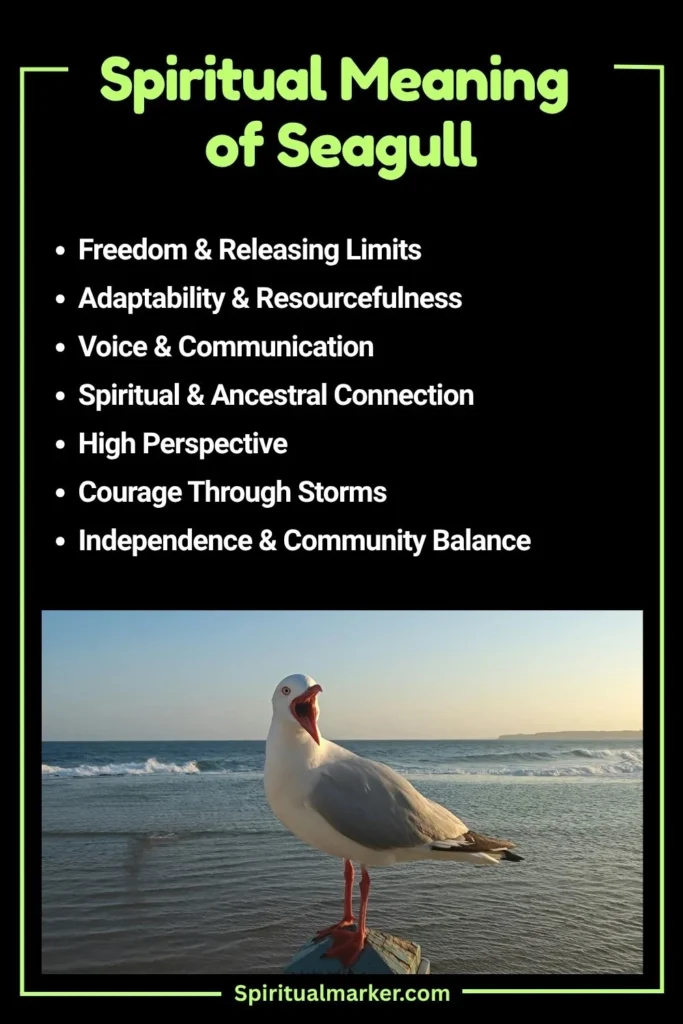
The core themes it carries are consistent: freedom, adaptability, elevated perspective, courageous communication, ancestral connection, storm-riding strength, and the sacred balance of self and community. These are not abstract ideals. They are practical tools for navigating the life you are living right now. The seagull offers them freely to anyone willing to observe, listen, and apply what they receive.
If the seagull spiritual meaning has spoken to something real in your experience today, consider spending time near the ocean or any body of water. Watch the birds work the wind. Notice how they rise without effort by simply opening their wings to what is already moving. That is the complete seagull teaching delivered in a single image. You do not need to create the wind. You only need to open your wings.
Allow the seagull’s wisdom to guide your next step. Trust the instincts that have been sharpened by everything you have already survived. Rise above the noise of uncertainty and look at your life from the altitude the seagull offers. The path forward is visible from up there. It always has been.