
Some gemstones catch the eye. Blue sapphire stops you in your tracks. Its deep, velvety blue color carries a weight that feels ancient, almost sacred. Many people who first hold a blue sapphire describe something unexpected. A sense of clarity. A quiet but undeniable pull toward stillness and inner focus.
That pull is not accidental. For thousands of years, blue sapphire has been one of the most spiritually revered gemstones on earth. Ancient Persian kings believed the sky reflected blue sapphire’s color. Medieval clergy wore it as a symbol of heavenly wisdom. Hindu sacred texts listed it among the most powerful of all gemstones. Across continents and across centuries, this stone has carried extraordinary spiritual weight.
Blue sapphire is not just beautiful. Its symbolism runs deep. People connect it with truth, loyalty, mental clarity, divine protection, and the kind of wisdom that only comes from honest self-reflection. Whether you are seeking mental focus, spiritual grounding, emotional steadiness, or a stronger sense of personal integrity, blue sapphire appears again and again in healing traditions as a stone that meets those needs.
This article covers the full meaning of blue sapphire, its spiritual symbolism across cultures and traditions, its healing properties, its chakra connection, and practical guidance on wearing and caring for blue sapphire jewelry. You will also find a detailed breakdown of the stone’s origins, historical significance, and the ways spiritual communities continue using it today.
5 Key Takeaways
- Blue sapphire symbolizes wisdom, truth, loyalty, mental clarity, and divine protection across numerous spiritual traditions.
- It connects primarily with the throat chakra and the third eye chakra, supporting honest communication and deep intuitive awareness.
- Ancient civilizations including the Greeks, Romans, Persians, Hebrews, and Hindus all assigned deep spiritual meaning to blue sapphire.
- Many people use blue sapphire during meditation, spiritual practice, and emotionally demanding life situations to strengthen inner clarity and focus.
- Blue sapphire ranks 9 on the Mohs hardness scale, making it one of the most durable gemstones available for everyday wear.
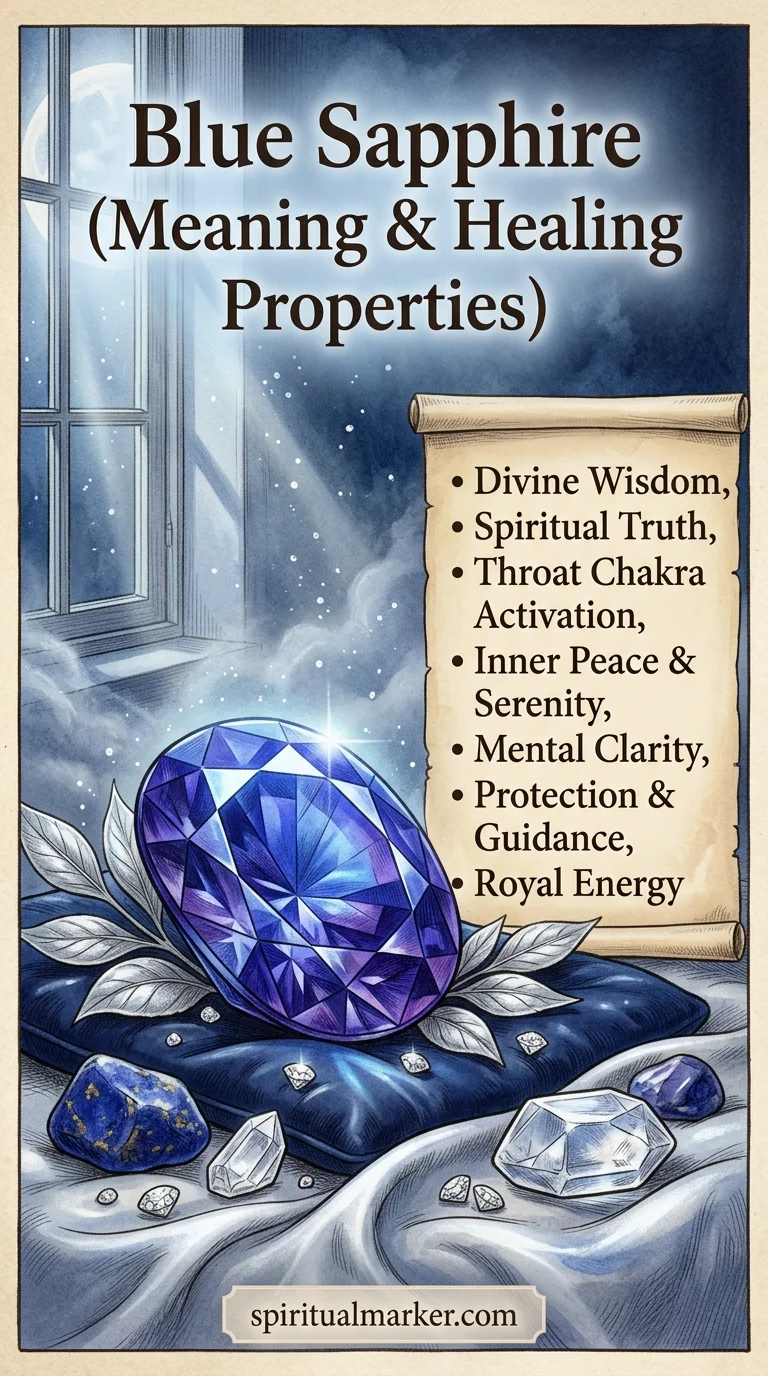
What is Blue Sapphire?
Blue sapphire is a precious gemstone belonging to the corundum mineral family. Corundum in its pure form is colorless. Trace elements give it color. In blue sapphire, iron and titanium create the signature deep blue that ranges from pale sky blue to intense midnight blue and every shade in between.
Not all sapphires are blue. Corundum appears in pink, yellow, green, orange, and purple varieties, all called sapphires. But when most people say “sapphire,” they mean blue sapphire specifically. Blue has always been the stone’s most iconic and spiritually significant color form.
Blue sapphire shares the corundum family with ruby. The only difference is color. Red corundum becomes ruby. Every other color becomes sapphire. This shared origin has long connected both stones in spiritual traditions that value clarity, passion, strength, and divine favor.
The most prized blue sapphires display what gemologists call velvety blue color with a slight violet undertone. The finest specimens traditionally come from Kashmir in India, where a legendary mine produced stones of unmatched depth and saturation between the late 1800s and early 1900s. Those Kashmir sapphires remain among the most sought-after gems in the world today.
Origins and Formation of Blue Sapphire
Blue sapphire forms deep within the earth under extreme heat and pressure. Corundum crystals develop in metamorphic and igneous rock environments. The process requires millions of years. This slow geological journey contributes to blue sapphire’s spiritual association with patience, endurance, and timeless wisdom.
Several regions produce the world’s finest blue sapphires. Kashmir remains legendary for its incomparable color. Burma (Myanmar) produces deeply saturated royal blue stones. Sri Lanka, historically called Ceylon, has supplied sapphires for centuries and is known for vivid cornflower blue specimens. Madagascar, Tanzania, Thailand, Australia, and Montana in the United States also produce significant quantities.
Sri Lankan blue sapphires hold particular spiritual reverence. The island has been called “the island of gems” throughout history. Ancient traders carried Sri Lankan sapphires along the Silk Road, spreading both the physical stone and its symbolic meaning across Asia, the Middle East, and Europe.
Heat treatment is common in the sapphire industry. Most commercial sapphires are heated to intensify their color. However, untreated natural blue sapphires carry greater value both in the gem trade and in many spiritual traditions that emphasize a stone’s unaltered, natural energy.
Key Properties of Blue Sapphire
| Property | Details |
|---|---|
| Color | Pale blue, cornflower blue, royal blue, midnight blue, violet-blue |
| Composition | Aluminum oxide (corundum) with iron and titanium |
| Hardness | 9 on the Mohs scale |
| Chakra Association | Throat chakra and third eye chakra |
| Symbolism | Wisdom, truth, loyalty, divine protection, mental clarity |
| Common Sources | Kashmir, Sri Lanka, Burma, Madagascar, Tanzania, Thailand |
| Transparency | Transparent to translucent |
| Energy Style | Focused, clarifying, spiritually elevating, protective |
Historical Use of Blue Sapphire Across Civilizations
Few gemstones carry a historical record as rich and consistent as blue sapphire. Its presence spans ancient empires, sacred texts, royal courts, and healing traditions across thousands of years and dozens of cultures. Understanding this history helps explain why blue sapphire’s spiritual symbolism feels so deeply embedded in human consciousness.
In ancient Persia, priests taught that the earth rested on a giant sapphire. Its reflection, they believed, gave the sky its blue color. This belief elevated blue sapphire from a precious gem to a cosmological symbol, something connecting earth to the heavens and the human to the divine.
The ancient Greeks and Romans associated sapphire with Apollo, the god of truth, prophecy, and light. Worshippers wore sapphire when consulting oracles at Delphi, believing it sharpened mental receptivity and drew truthful divine communication. This connection between sapphire and truth-seeking became one of the stone’s most enduring spiritual themes.
In Hebrew tradition, blue sapphire held enormous sacred significance. Many scholars believe the Ten Commandments were engraved on tablets of sapphire. The Book of Exodus describes the throne of God as being like a paved sapphire floor (Exodus 24:10). The high priest’s breastplate in the Hebrew Temple, known as the Hoshen, contained twelve gemstones representing the twelve tribes of Israel, and sapphire appeared among them. These references placed sapphire at the heart of divine communication and covenant.
In medieval Christian Europe, blue sapphire became the gemstone of clergy and scholars. Bishops wore sapphire rings as symbols of heavenly wisdom and connection to divine truth. The stone was believed to protect against temptation, attract divine favor, and quiet impure thoughts. It appeared frequently in ecclesiastical jewelry, church reliquaries, and royal crowns across England, France, and the Holy Roman Empire.
In Hindu Vedic astrology, blue sapphire holds a distinct and powerful place. Called Neelam in Sanskrit, it is associated with Saturn (Shani) in the Navaratna system, the sacred nine-gemstone arrangement that corresponds to the nine celestial bodies. Vedic tradition regards blue sapphire as one of the most powerful and fast-acting gemstones. When worn correctly after proper astrological consultation, it is believed to bring rapid transformation, mental focus, discipline, and protection.
Ancient Chinese imperial culture also prized blue sapphire as a symbol of authority, loyalty, and heavenly blessing. Rulers and high-ranking officials incorporated sapphire into ceremonial regalia and gifts. Its deep blue was associated with the sky, heaven, and the cosmic order that righteous rulers were meant to uphold.
5 Spiritual Meanings of Blue Sapphire
1. Wisdom and Mental Clarity
The most consistent and universal spiritual meaning connected to blue sapphire is wisdom. This symbolism appears across Persian, Greek, Roman, Hebrew, Christian, and Hindu traditions without exception. It is not a coincidence. Blue sapphire’s clarity, depth, and striking visual quality mirror what wisdom itself looks and feels like: clear, deep, and difficult to attain without effort.
Wisdom in spiritual traditions rarely means simply accumulating knowledge. It involves the ability to see clearly through confusion, to make sound judgments under pressure, and to align action with genuine understanding rather than impulse or fear. Blue sapphire spiritually symbolizes exactly this quality. People are frequently drawn to it during periods of mental overwhelm, decision fatigue, or intellectual uncertainty.
Many people describe the stone’s symbolism as mentally clarifying. During periods when the mind feels scattered by too much information, too many competing priorities, or too much emotional noise, blue sapphire represents the focused stillness that allows genuine insight to emerge. This makes its symbolism particularly meaningful for those in demanding intellectual roles such as scholars, writers, lawyers, teachers, and leaders.
Spiritual practitioners often associate blue sapphire with the third eye chakra, the energy center connected with inner vision, intuitive awareness, and mental discernment. When this energy center feels blocked, people may experience confusion, indecision, mental fog, or difficulty trusting their own perceptions. Blue sapphire symbolically supports the opening and strengthening of this center, encouraging clearer perception and sharper mental focus.
This meaning carries particular depth because wisdom requires more than intelligence. It requires the courage to face difficult truths honestly. Blue sapphire’s symbolism includes this aspect of wisdom. It does not represent comfortable or convenient thinking. It represents the kind of mental clarity that sees situations as they truly are, even when that clarity demands personal accountability and honest reassessment.
2. Truth and Integrity
Truth forms a central pillar of blue sapphire’s spiritual identity. Across dozens of traditions and thousands of years, this stone has been associated with honest speech, moral integrity, and the commitment to living in alignment with one’s deepest values. The ancient Greek association with Apollo as god of truth and light established this theme early, and it continued through Hebrew, Christian, and Hindu traditions with remarkable consistency.
People who struggle with self-deception often find blue sapphire’s symbolism particularly confronting. The stone does not represent comfortable illusions. Its energy is widely described as mentally clarifying and spiritually honest. In crystal traditions, it symbolizes the willingness to see situations, relationships, and personal patterns with clear-eyed accuracy rather than wishful thinking.
Truth in this context extends beyond honesty with others. It includes honesty with oneself. Many people carry beliefs, narratives, and emotional patterns that served them once but no longer reflect reality. Blue sapphire spiritually represents the courage to examine those patterns honestly. This internal truthfulness is often described as the foundation of genuine personal growth.
Blue sapphire’s connection with the throat chakra deepens this symbolism. The throat chakra governs honest verbal expression, clear communication, and the ability to speak personal truth even when that truth feels vulnerable or uncomfortable. When this energy center feels blocked, people may experience difficulty expressing genuine thoughts and feelings, habitual people-pleasing, or chronic dishonesty with themselves and others. Blue sapphire symbolically supports truthful, courageous communication from a place of integrity rather than fear.
Many spiritual practitioners connect blue sapphire with keeping commitments. Its association with integrity means that the stone symbolizes not just speaking truthfully but living truthfully. This alignment between words, values, and actions forms a central part of blue sapphire’s enduring reputation as a stone of moral strength.
3. Divine Protection and Spiritual Shielding
Throughout history, blue sapphire has been worn as a protective stone. Ancient and medieval traditions believed sapphire guarded its wearer against harm, evil, deception, and spiritual attack. Medieval European tradition held that sapphire detected poison by changing color. Persian astrologers believed sapphire protected travelers from physical danger. Hindu tradition connected sapphire with Saturn’s protective and disciplining influence over worldly hardship.
In modern crystal healing, blue sapphire continues to carry strong protective symbolism. Many practitioners believe it creates a kind of spiritual boundary around the wearer. This boundary is not imagined as a wall of isolation but rather as a field of clarity that helps the wearer discern what is genuinely good and aligned from what is deceptive, harmful, or energetically draining.
This protective quality feels especially relevant in emotionally complex situations. When people feel vulnerable to manipulation, false information, social pressure, or environments that conflict with their values, blue sapphire spiritually symbolizes the mental and moral clarity needed to recognize truth and act from a protected, grounded position. Protection in this sense is less about external physical shields and more about internal clarity that prevents deception from taking root.
Many spiritual traditions also associate blue sapphire with divine favor and heavenly protection. This sacred dimension of its protective meaning appears in the Hebrew tradition’s connection of sapphire with God’s throne, in Christian clergy’s belief that sapphire connected the wearer to divine grace, and in Vedic astrology’s view of sapphire as a channel for Saturn’s powerful cosmic influence. Across these different frameworks, blue sapphire consistently represents a connection to forces larger than individual human will.
For many people in modern spiritual practice, blue sapphire’s protective symbolism offers emotional reassurance during uncertainty. Life transitions, professional challenges, grief, and periods of spiritual questioning can all create vulnerability. The stone symbolizes steady spiritual protection during these moments, not by removing difficulty but by strengthening the wearer’s inner clarity and spiritual grounding.
4. Loyalty, Commitment, and Faithfulness
Blue sapphire has long symbolized loyalty and unwavering commitment. This association runs through royal traditions, religious symbolism, and romantic history alike. Medieval knights wore sapphire as a pledge of faithful service. Clergy wore it to symbolize commitment to divine truth. Royal families exchanged sapphire jewelry as symbols of enduring loyalty. Prince Charles famously chose a blue sapphire for Princess Diana’s engagement ring, continuing a centuries-long tradition that linked the stone with devoted love and lifelong commitment.
In spiritual symbolism, loyalty extends far beyond romantic relationships. It includes loyalty to one’s own values, spiritual path, and sense of purpose. Many people drift away from their genuine values during demanding life periods. Social pressure, fear, emotional exhaustion, or the desire for approval can slowly pull a person away from their authentic commitments. Blue sapphire symbolically represents the strength to remain faithful to what genuinely matters.
This makes blue sapphire particularly meaningful during moments of personal crisis or spiritual doubt. When circumstances challenge long-held beliefs, relationships, or commitments, the stone’s symbolism encourages remaining anchored in authentic values rather than abandoning them for temporary convenience. This quality of spiritual steadfastness is one reason blue sapphire has remained associated with people in positions requiring consistent moral courage.
Many crystal practitioners also connect blue sapphire with relationship integrity. Not just romantic relationships but all meaningful connections where trust, honesty, and sustained commitment matter. Friendships, family bonds, professional relationships, and spiritual communities all benefit from the kind of faithful, honest engagement that blue sapphire spiritually represents.
5. Spiritual Elevation and Connection to the Divine
Blue sapphire carries one of the strongest associations with spiritual elevation among all gemstones. Its deep blue color has long linked it visually with the sky, the cosmos, and the heavens. In virtually every culture that valued blue sapphire, that visual connection became a spiritual one. The stone was seen not simply as an earthly object but as a bridge between the material world and divine reality.
In Hindu Vedic tradition, this elevated spiritual status is explicit. Blue sapphire as Neelam corresponds to Saturn, the planet associated with karma, spiritual discipline, and the soul’s long evolutionary journey toward liberation. Wearing blue sapphire in this tradition is believed to accelerate spiritual development by strengthening the wearer’s connection to karmic truth and cosmic order. It is not considered a comfortable or casual stone. Its influence is described as powerful and transformative.
Many modern practitioners connect blue sapphire with meditation and contemplative practice. Its symbolism of mental clarity, inner stillness, and truthful perception aligns naturally with the goals of meditation. When the mind becomes quieter and more focused, deeper states of spiritual awareness become accessible. Blue sapphire represents this quality of meditative depth and spiritual receptivity.
Its connection with the third eye chakra is especially significant here. This energy center governs inner vision, spiritual insight, and the capacity to perceive reality beyond surface appearances. People working to develop intuition, deepen spiritual understanding, or access higher states of awareness during meditation often turn to blue sapphire as a symbolic and energetic support for that journey.
This spiritual elevation symbolism also carries a deeply humbling quality. Blue sapphire does not typically symbolize grandiosity or spiritual pride. Its energy is described as clarifying rather than inflating. It symbolizes the kind of spiritual growth that comes from honest self-examination, patient practice, and genuine alignment with truth rather than from seeking impressive spiritual experiences or social recognition for one’s spiritual life.
6 Healing Properties of Blue Sapphire
1. Mental Focus and Cognitive Clarity
Blue sapphire is strongly associated with mental focus and cognitive clarity in crystal healing traditions. People experiencing mental fog, difficulty concentrating, indecision, or mental overwhelm frequently turn to this stone. Its symbolism centers on cutting through mental noise to reach clear, purposeful thought.
Modern life creates extraordinary mental demands. People manage more information, more decisions, and more competing priorities than any previous generation. That constant mental load often creates a form of cognitive exhaustion where focus becomes difficult and clear thinking feels elusive. Blue sapphire spiritually represents the return of mental sharpness and directed focus during these periods.
Many practitioners believe the stone is particularly useful during periods of intense intellectual work. Writers, researchers, students, strategists, and professionals facing complex challenges often find blue sapphire’s symbolism aligns with their need for sustained focus, analytical clarity, and the ability to think deeply without becoming scattered or overwhelmed.
Its connection with the third eye chakra reinforces this healing property. This energy center governs mental perception, intuitive clarity, and the ability to discern genuine insight from superficial or misleading information. When this chakra functions well, thinking feels clear and perceptive. Blue sapphire symbolically supports that state of heightened mental receptivity and focused awareness.
2. Emotional Calm and Inner Steadiness
Despite its association with mental sharpness and spiritual intensity, blue sapphire also carries strong symbolism of emotional calm. Its deep blue color is naturally associated with water, depth, and stillness. Many people describe the stone’s energy as deeply settling, as though it brings emotional turbulence to a quieter, more manageable state.
Emotional volatility often accompanies periods of high stress, grief, significant life change, or spiritual crisis. Reactions feel exaggerated. Small frustrations create large emotional responses. Anxiety floods mental space that is needed for clear thinking and sound decision-making. Blue sapphire spiritually symbolizes the emotional steadiness that creates a stable foundation beneath these storms.
This calming quality differs from emotional suppression. Blue sapphire does not symbolize burying difficult feelings beneath a forced calm. Its energy is described as creating genuine emotional equilibrium, a state where emotions are acknowledged but not overwhelming. People can feel sadness, fear, or anger without being entirely controlled by those feelings.
Many practitioners use blue sapphire during grief, anxiety, and transition periods because its symbolism combines emotional steadiness with spiritual clarity. The stone represents the ability to move through emotionally demanding experiences with greater inner stability, without either suppressing genuine feelings or becoming lost in emotional reactivity.
3. Throat Chakra Activation and Honest Communication
Blue sapphire’s connection with the throat chakra makes it one of the most important gemstones for communication, honest expression, and verbal integrity in crystal healing traditions. The throat chakra governs how people express themselves, whether they speak their genuine truth, and whether their words reflect their authentic inner experience.
When this chakra is blocked or underactive, several communication patterns often appear. People may struggle to speak up for themselves. They may agree to things they do not genuinely support. They may feel that their real thoughts and feelings remain perpetually unexpressed. They may experience chronic anxiety around confrontation, public speaking, or any situation requiring direct personal expression. Blue sapphire symbolically supports the healing and activation of this energy center.
This healing property feels particularly relevant for people navigating professional environments, difficult personal relationships, or leadership roles that require clear and honest communication under pressure. Truthful, courageous communication does not come naturally to everyone, especially in emotionally charged or socially complex situations. Blue sapphire represents the inner clarity and confidence that makes honest expression feel more accessible.
Its association with integrity deepens this healing connection. The throat chakra is not simply about talking more. It is about ensuring that what is spoken reflects genuine values and authentic understanding. Blue sapphire symbolically supports that alignment between inner truth and outward expression, which many practitioners consider fundamental to both personal integrity and healthy relationships.
4. Spiritual Discipline and Inner Strength
In Vedic tradition and several other spiritual systems, blue sapphire is associated with the qualities that support long-term spiritual discipline. These include perseverance, moral courage, self-mastery, and the willingness to maintain spiritual practice even when external circumstances become difficult. Saturn’s influence in Vedic astrology is demanding, but it produces strength, depth, and genuine maturity in those who engage with it honestly.
Spiritual growth is rarely comfortable. Most serious spiritual paths involve periods of difficulty, self-examination, temptation, and doubt. Blue sapphire spiritually represents the inner strength required to continue that journey faithfully. Its symbolism is not about spiritual ease or instant transformation. It represents the steady, disciplined commitment that genuine spiritual development actually requires.
This healing quality extends into practical life as well. Many people struggle with follow-through on commitments to themselves, whether those involve creative projects, health habits, relationship patterns, or personal growth goals. Blue sapphire symbolizes the inner discipline that makes consistent, purposeful action possible over time. Its energy is described as strengthening rather than energizing, creating focused inner resolve rather than temporary motivation.
People undergoing major life transitions often find this quality of blue sapphire’s healing symbolism particularly meaningful. Career changes, grief, recovery from addiction, relationship transformations, and spiritual crisis all require a form of inner strength that goes beyond momentary willpower. Blue sapphire represents that deeper, quieter form of spiritual resilience that sustains people through long-term challenge.
5. Protection From Deception and Negative Influence
Blue sapphire has carried protective symbolism across virtually every tradition that valued it. In modern crystal healing, this protection is understood primarily in terms of mental and spiritual clarity rather than physical defense. The stone is believed to sharpen discernment, making it easier to recognize deceptive people, misleading situations, and influences that conflict with a person’s genuine values and well-being.
Many people go through periods when they feel particularly vulnerable to manipulation, social pressure, or environments that slowly erode their sense of self. This can happen in toxic workplaces, unhealthy relationships, or social environments where conformity is rewarded and authenticity is punished. Blue sapphire spiritually represents the mental clarity that resists these influences without requiring constant defensive vigilance.
Its protective symbolism also includes protection from one’s own self-deception. This may be the most meaningful dimension of this healing property. People often construct elaborate internal narratives to avoid confronting uncomfortable truths about themselves, their choices, or their relationships. Blue sapphire’s energy is associated with the kind of clear-eyed inner honesty that makes self-deception difficult to sustain. This may feel confronting initially, but it ultimately supports genuine healing and personal integrity.
6. Supporting Meditation and Contemplative Practice
Many spiritual practitioners use blue sapphire specifically during meditation because its symbolism of mental clarity, spiritual depth, and inner stillness aligns so naturally with the goals of contemplative practice. Meditation requires the ability to quiet surface mental activity and access deeper states of awareness. Blue sapphire represents exactly that kind of focused inner quiet.
People who find meditation difficult because of mental restlessness, intrusive thoughts, or difficulty achieving stillness sometimes find blue sapphire’s presence symbolically supportive. The stone represents the mental focus and spiritual intentionality that makes genuine meditative depth possible. Its deep blue color alone is visually calming in a way that many practitioners find settles mental activity before formal practice begins.
Its connection with both the throat chakra and the third eye chakra creates a particularly meaningful combination for spiritual practice. The third eye supports inner vision and spiritual awareness. The throat supports honest integration and expression of spiritual insight. Blue sapphire symbolically activates both, supporting a form of spiritual practice that combines deep inner perception with the integrity to live out genuine spiritual understanding in daily life.
Practitioners who use blue sapphire in breathwork, yoga, prayer, or sound healing also describe its symbolism as deepening the quality of their practice. Its energy encourages focus, authenticity, and spiritual seriousness without creating tension or pressure. It represents the calm intensity of genuine spiritual engagement.
Blue Sapphire and Chakra Connection
Blue sapphire connects most strongly with two energy centers: the throat chakra (Vishuddha) and the third eye chakra (Ajna). These two chakras together govern honest communication, inner perception, mental clarity, and spiritual awareness. Blue sapphire’s combined influence across both centers makes it one of the more versatile and comprehensive gemstones in chakra healing traditions.
The throat chakra sits at the base of the throat. It governs all forms of communication including speech, writing, creative expression, and the ability to live in alignment with one’s authentic values. A balanced throat chakra allows people to speak truthfully, listen well, express genuine thoughts and feelings without excessive fear, and maintain integrity between inner experience and outward expression. Blue sapphire’s symbolism of truth, loyalty, and honest expression connects directly with this energy center’s function.
The third eye chakra sits between and slightly above the eyebrows. It governs intuition, inner vision, mental discernment, and the ability to perceive reality clearly beyond surface appearances. When functioning well, this chakra supports clear-headed wisdom, sharp intuitive awareness, and the ability to see through confusion or deception. Blue sapphire’s symbolism of wisdom, mental clarity, and spiritual insight aligns with this chakra’s core function.
In crystal healing sessions, practitioners sometimes place blue sapphire on the throat or forehead area during energy work. Others carry it in their left pocket or wear it as jewelry during meditation, believing that consistent proximity to the stone strengthens these chakra energies over time. The key principle is intentional use combined with personal spiritual practice rather than passive possession of the stone.
How to Wear Blue Sapphire Jewelry for Spiritual Growth
Wearing blue sapphire jewelry with spiritual intention requires some thought about placement and purpose. In Vedic astrology, blue sapphire as Neelam is traditionally worn on the middle finger of the right hand in a silver setting. Vedic tradition also recommends wearing it on a Saturday during the waxing moon phase after proper ritual preparation and astrological consultation.
Outside of Vedic tradition, many people choose to wear blue sapphire as necklaces or pendants to keep it close to the throat chakra throughout the day. This placement symbolically aligns the stone’s energy with honest communication, authentic expression, and the ongoing integration of spiritual clarity into daily speech and interaction.
Blue sapphire rings are among the most popular form of this gemstone in jewelry globally. Wearing it on the dominant hand is sometimes associated with active self-expression and purposeful action aligned with truth. Wearing it on the non-dominant hand is sometimes associated with internal receptivity and spiritual development.
Many practitioners combine blue sapphire with complementary stones to create balanced spiritual energy. Amethyst amplifies third eye awareness and spiritual calm. Lapis lazuli deepens the connection between wisdom, truth, and spiritual insight. Clear quartz amplifies blue sapphire’s focused mental energy. Moonstone adds emotional sensitivity and intuitive softness to the stone’s more mentally focused symbolism.
Whatever form you choose, wearing blue sapphire with conscious intention matters more than placement alone. Setting a clear intention related to the stone’s symbolism, whether that involves mental clarity, honest communication, spiritual development, or inner strength, creates a more meaningful relationship with the stone and its energy.
Caring for Blue Sapphire Jewelry
Blue sapphire’s ranking of 9 on the Mohs hardness scale makes it one of the most durable gemstones available, second only to diamond in hardness. This durability means blue sapphire tolerates everyday wear far better than softer stones like opal, moonstone, or malachite. Still, proper care preserves both its physical beauty and its spiritual integrity over time.
Clean blue sapphire using warm water, mild soap, and a soft brush. A soft toothbrush works well for reaching behind settings and removing daily residue. Rinse thoroughly and dry with a clean, soft cloth. Unlike some softer gemstones, blue sapphire generally tolerates ultrasonic cleaning, but high-quality pieces with fracture fillings should be cleaned by hand only.
Store blue sapphire jewelry separately from other pieces when possible. Sapphire’s hardness means it can scratch softer gems stored alongside it. A soft pouch or padded compartment protects both the sapphire and other pieces in your collection.
Remove blue sapphire jewelry during activities involving harsh chemicals, heavy physical work, or high-impact contact. While sapphire is highly durable, sharp impacts can still chip the stone at certain angles, particularly at facet edges. Household cleaners, chlorine in swimming pools, and strong solvents can also damage metal settings and surface coatings over time.
Many people who value blue sapphire spiritually also cleanse it energetically on a regular basis. Common methods include exposure to moonlight during the full moon, placing the stone on a selenite charging plate, sound cleansing with singing bowls, or brief exposure to morning sunlight. Spiritual cleansing approaches vary widely depending on personal practice and belief tradition.
Table: Blue Sapphire Meaning at a Glance
| Aspect | Details |
|---|---|
| Primary Meaning | Wisdom, truth, loyalty, divine protection |
| Chakra Association | Throat chakra and third eye chakra |
| Main Spiritual Symbolism | Mental clarity, spiritual elevation, faithful commitment |
| Common Colors | Pale blue, cornflower blue, royal blue, midnight blue |
| Hardness | 9 on the Mohs scale |
| Main Sources | Kashmir, Sri Lanka, Burma, Madagascar, Tanzania |
| Emotional Associations | Inner calm, moral courage, emotional steadiness |
| Popular Jewelry Types | Rings, pendants, necklaces, earrings |
| Spiritual Uses | Meditation, throat and third eye chakra work, protection |
| Care Needs | Warm water cleaning, separate storage, avoid harsh chemicals |
A Final Note
Blue sapphire is not simply a beautiful gemstone. It is one of the most spiritually significant stones in human history. Its meaning runs across cultures, centuries, and belief systems with remarkable consistency. Wherever people valued wisdom, truth, loyalty, or divine connection, they reached for blue sapphire.
That enduring significance says something important. People in vastly different times and places arrived at the same symbolic conclusions about this stone independently. That kind of cross-cultural spiritual resonance is rare. It suggests that blue sapphire touches something genuinely deep in human spiritual experience.
If you feel drawn to blue sapphire, consider what aspect of its meaning speaks most directly to your current life. You might benefit from wearing it as jewelry near your throat during periods when honest communication feels difficult. You might keep it close during meditation when mental clarity and spiritual depth matter most. You might simply hold it during moments of uncertainty when you need a reminder of your own values and inner strength.
Some people experience an immediate resonance with blue sapphire’s energy. Others are drawn to its historical depth and symbolic richness without attaching specific metaphysical beliefs to it. Both approaches are completely valid. Blue sapphire’s beauty and meaning stand on their own, regardless of the framework through which you appreciate them.
Whether you are navigating a major life decision, deepening a spiritual practice, seeking emotional steadiness, or simply drawn to the stone’s extraordinary depth of color and history, blue sapphire offers something rare and enduring. It reminds you that wisdom, truth, and spiritual integrity are not just ancient virtues. They remain among the most valuable and sought-after qualities in human life today.