
Some stones carry history in their bones. Jadeite is one of them. Long before it appeared in museum cases or jewelry showcases, it sat at the center of ancient rituals, royal burials, and sacred ceremonies across China, Mesoamerica, and Southeast Asia. People did not simply admire it. They trusted it with their lives, their deaths, and their most important spiritual moments.
What draws people to jadeite today runs deeper than aesthetics. Yes, its vivid imperial green is striking. But spiritual practitioners, crystal healers, and gemstone collectors keep returning to it because of what it represents. Wisdom, protection, abundance, and emotional balance form the core of jadeite’s spiritual identity. Across cultures separated by oceans and centuries, this stone carried a remarkably consistent message: it belongs to those who seek to live with integrity and clarity.
Unlike stones associated with dramatic emotional intensity or rapid energetic shifts, jadeite works with steadiness. Its energy feels rooted and deeply anchored. People who wear it or work with it often describe a slow but reliable sense of inner alignment. That quality, rare among gemstones, explains why jadeite has outlasted empires and continues to hold cultural and spiritual relevance today.
This article covers the meaning of jadeite, its spiritual symbolism, healing properties, historical significance, and the practical ways people use it for personal growth. You will also learn how to wear and care for jadeite jewelry while honoring both its physical beauty and its energetic character.
5 Key Takeaways
- Jadeite symbolizes wisdom, protection, abundance, and emotional harmony across multiple ancient cultures.
- Many spiritual traditions connect jadeite with the heart chakra and with personal integrity.
- People use jadeite during meditation, manifestation work, emotional healing, and periods of major life transition.
- Jadeite ranks as one of the hardest and rarest forms of jade, forming only under extreme geological pressure.
- Wearing jadeite close to the skin or heart is believed to strengthen emotional clarity, spiritual grounding, and inner wisdom.
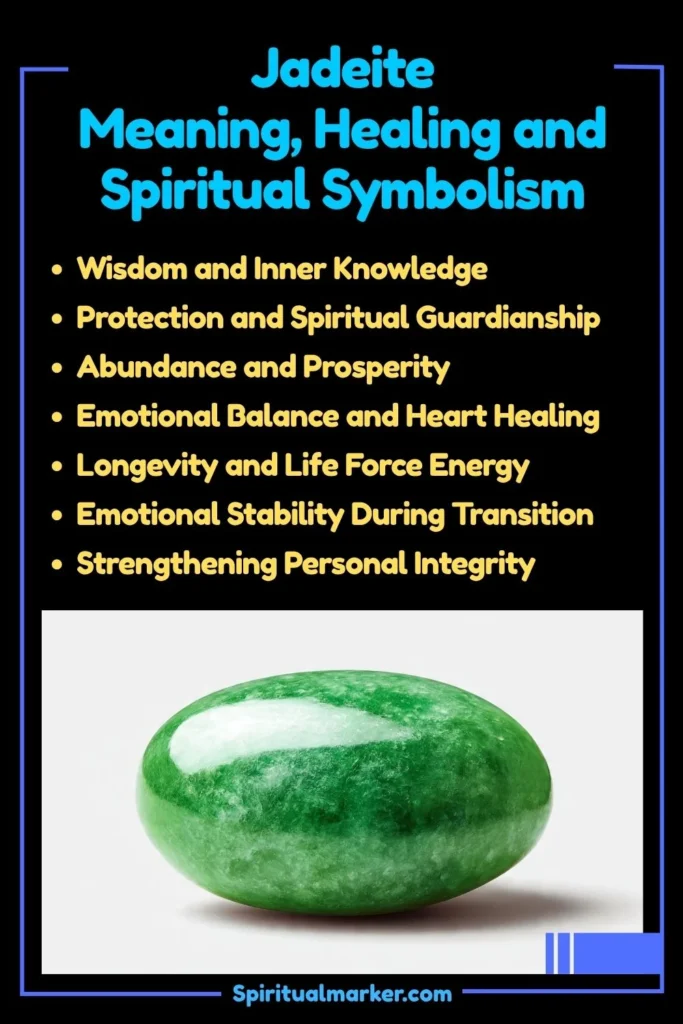
What is Jadeite?
Jadeite is a pyroxene mineral and one of two distinct minerals sold under the name “jade.” The other is nephrite. While both share the jade label, jadeite is rarer, harder, and more intensely colored. It scores 6.5 to 7 on the Mohs hardness scale. Its most prized form, called Imperial Jade, displays a saturated, vivid green that commands extraordinary value in international gemstone markets.
Chemically, jadeite is a sodium aluminum silicate. Its color range is broader than most people realize. While vivid green remains the most celebrated shade, jadeite also appears in lavender, white, red, yellow, black, and even combinations of these colors within a single stone. Each color carries distinct energetic associations in spiritual traditions.
Many people confuse jadeite with nephrite or with green stones like aventurine, serpentine, or prehnite. True jadeite feels denser and cooler to the touch than most substitutes. Its surface has a characteristic waxy luster. Mineralogically, it forms under very specific conditions of high pressure and relatively low temperature, which makes significant deposits rare worldwide.
Origins and Formation of Jadeite
Jadeite forms deep within the earth where tectonic plates collide and force rock into conditions of intense pressure without extreme heat. This unusual geological process, called blueschist metamorphism, creates the precise environment jadeite needs. The rarity of these conditions explains why significant jadeite deposits exist in very few places globally.
Myanmar, formerly Burma, remains the world’s dominant jadeite source. The Hpakant region in northern Myanmar produces the majority of high-quality jadeite entering global markets today. Smaller deposits exist in Guatemala, Japan, Kazakhstan, Russia, and the United States. Guatemalan jadeite holds special significance because it was the primary jade of ancient Mesoamerican civilizations, including the Maya and Olmec.
The geological conditions that create jadeite carry spiritual symbolism of their own. Extreme pressure transforms ordinary rock into something extraordinary. Many spiritual teachers use jadeite as a metaphor for personal transformation, noting that the stone’s very existence results from immense difficulty. That story resonates deeply with people navigating their own periods of pressure, loss, or challenge.
Because jadeite takes millions of years to form and requires such precise conditions, it has always been considered a gift of exceptional rarity. Ancient cultures did not treat it casually. They buried rulers with it, carved deities from it, and exchanged it as the highest form of diplomatic tribute. That reverence persists in modern crystal traditions and in contemporary gemstone markets alike.
Key Properties of Jadeite
| Property | Details |
|---|---|
| Color | Green, lavender, white, red, yellow, black, multi-color |
| Composition | Sodium aluminum silicate (NaAlSi₂O₆) |
| Hardness | 6.5 to 7 on the Mohs scale |
| Chakra Association | Primarily the heart chakra; also crown and solar plexus |
| Symbolism | Wisdom, protection, abundance, emotional balance, integrity |
| Common Sources | Myanmar, Guatemala, Japan, Kazakhstan, Russia |
| Transparency | Opaque to translucent; rarely transparent |
| Energy Style | Grounding, steady, protective, wisdom-amplifying |
Historical Use of Jadeite
Few gemstones carry the weight of history that jadeite does. In ancient China, jade held a status that exceeded gold. The philosopher Confucius described jade as embodying eleven virtues including benevolence, wisdom, courage, purity, and justice. Chinese emperors wore jade burial suits stitched together with gold wire, believing the stone would preserve their bodies and protect their souls in the afterlife.
In Mesoamerica, the Maya and Olmec civilizations considered jade more valuable than any other material. They carved jade into masks, pendants, and figurines for their most sacred ceremonies. Archaeologists found jade burial masks on Maya rulers at sites including Palenque and Tikal, confirming its status as the stone of royalty and divine connection. The Maya called it the stone of the heart and believed it carried the power of life itself.
In New Zealand, the Maori people worked with pounamu, a local form of jade, to create hei-tiki pendants and ceremonial weapons called mere. These objects were never merely decorative. They held the mana, or spiritual power, of their owners and were passed down through generations as living ancestral objects. Gifting pounamu to someone represented one of the most significant acts of respect and trust in Maori culture.
Across these cultures, separated by vast distances and entirely different belief systems, jadeite earned the same essential reputation. It was the stone of rulers, healers, ancestors, and the divine. That convergence of independent cultural reverence speaks to something genuine in the stone’s character that transcended geography and time.
5 Spiritual Meanings of Jadeite
1. Wisdom and Inner Knowledge
Jadeite has carried the symbolism of wisdom longer than almost any other stone in human history. That connection began in ancient China, where the Confucian tradition described jade as a direct mirror of moral and intellectual virtue. Wisdom in this context did not mean accumulated information. It meant the ability to perceive truth clearly, act with integrity, and make decisions aligned with one’s deepest values. Jadeite symbolized that capacity across Chinese philosophical, ceremonial, and spiritual life for thousands of years.
In modern crystal healing, jadeite continues to carry this association. Many practitioners describe it as a stone that helps people access inner knowledge rather than external opinions. During periods of confusion, pressure, or decision fatigue, jadeite is believed to support mental clarity by quieting the noise of anxiety and reconnecting people with their own deeper understanding. The symbolism matters because wisdom is rarely loud. It tends to emerge in stillness, and jadeite’s steady energy reflects that quality.
This meaning becomes especially significant during life transitions. Career changes, relationship decisions, spiritual questioning, and personal reinvention all require a quality of inner discernment that external advice cannot fully provide. Spiritually, jadeite represents trusting your own perception. It encourages clarity without arrogance and patience without passivity. Many people describe feeling more mentally settled when working with jadeite, not because the stone makes decisions for them, but because it symbolizes the wisdom they already carry.
Jadeite also symbolizes the wisdom that comes from lived experience. It forms under pressure. It endures. Spiritually, it reflects the idea that personal wisdom deepens through difficulty, not despite it. People who have navigated grief, failure, betrayal, or significant personal challenges often feel a particular resonance with jadeite because its very geological story mirrors their own process of transformation through pressure.
2. Protection and Spiritual Guardianship
Across virtually every culture that worked with jadeite, protection ranked among its most consistent spiritual meanings. Chinese warriors carried jade amulets into battle. Maori warriors embedded pounamu into their most prized weapons. Maya rulers wore jade burial masks to protect the soul during its journey through the underworld. The details differ by culture, but the core belief remained identical: jadeite guards those who carry it.
In contemporary spiritual traditions, jadeite’s protective symbolism extends beyond physical danger. Many practitioners associate it with protection against negative energy, emotional manipulation, and spiritual interference. People who feel energetically vulnerable, emotionally drained by others, or spiritually exposed during periods of grief or transition sometimes turn to jadeite as a stabilizing protective presence. Its dense, grounded energy is believed to create a kind of energetic boundary that reduces emotional permeability.
This protective quality also connects with the stone’s association with integrity. Spiritually, jadeite is believed to protect people from their own impulses toward dishonesty, self-deception, or moral compromise. In this sense, its protection works from the inside out. Rather than simply deflecting external threats, it strengthens the internal moral foundation that makes a person less vulnerable to begin with. Ancient Chinese philosophy described this as the stone reflecting the virtue of its owner back to them.
Many crystal practitioners place jadeite near doorways, on personal altars, or wear it continuously because they believe its protective energy requires proximity and consistency. Unlike stones associated with quick bursts of protective energy, jadeite’s protective symbolism feels slow and structural. It does not flash. It endures. That difference matters for people seeking long-term spiritual stability rather than momentary energetic relief.
3. Abundance and Prosperity
Jadeite’s connection with abundance runs through virtually every culture that worked with it. In Chinese tradition, jade was considered the stone of heaven and earth simultaneously, symbolizing the union of celestial blessing and earthly prosperity. Merchants carried jade carvings. Farmers sought jade amulets. Emperors adorned themselves with jade as a visible symbol of divine favor and material abundance. The stone did not merely represent wealth. It represented the alignment of virtue and prosperity.
This distinction matters spiritually. Jadeite does not simply symbolize material gain. Its abundance symbolism carries a moral dimension. Many traditions believed jadeite attracted prosperity only to those who earned it through honest effort and good character. The stone represented abundance as a natural consequence of living with integrity rather than abundance as something to be chased or manipulated into existence.
In modern manifestation practices, jadeite is frequently used during intention setting, abundance meditations, and prosperity rituals. People place it in financial areas of their homes according to feng shui principles, carry it during important business meetings, or hold it during goal-setting exercises. The symbolic logic is consistent with its ancient use: align yourself with integrity and clarity, and abundance follows naturally.
Jadeite’s abundance symbolism also extends into emotional and spiritual richness. Many practitioners describe feeling emotionally fuller, more grateful, and more aware of existing blessings when working with jadeite. That shift in perception, from scarcity thinking toward recognition of existing abundance, represents one of the stone’s most practically meaningful contributions to personal spiritual work.
4. Emotional Balance and Heart Healing
Jadeite connects strongly with the heart chakra, the energy center governing love, compassion, emotional trust, and interpersonal connection. Its green color reinforces this association naturally. Within crystal healing traditions, the heart chakra represents the bridge between earthly experience and spiritual awareness. Jadeite is believed to keep that bridge open, even during emotionally difficult periods when people tend to close themselves off protectively.
Many people carry unresolved emotional weight without fully recognizing it. Old grief, quiet resentment, lingering disappointment, and suppressed anger can settle deeply beneath daily functioning. These emotional residues affect relationships, self-perception, and spiritual clarity without always announcing themselves clearly. In crystal healing practice, jadeite symbolizes the patient release of emotional heaviness through a process of gradual softening rather than forceful confrontation.
Its emotional balance symbolism also extends to interpersonal relationships. Families carry generational emotional patterns. Romantic partnerships accumulate emotional history. Friendships shift through seasons of closeness and distance. Jadeite is frequently associated with emotional patience, the capacity to remain emotionally open and non-reactive during relational tension. Its energy is not aggressive. It does not push for immediate resolution. It symbolizes staying present through difficulty with both honesty and grace.
For people recovering from heartbreak, betrayal, or significant emotional loss, jadeite offers symbolism of emotional recovery that feels both sturdy and gentle. It does not rush healing. It does not minimize pain. Instead, its spiritual character reflects the belief that emotional strength and emotional softness are not opposites. You can remain open and still be resilient. Jadeite embodies that combination in its very geological nature, dense and enduring, yet luminous and flowing in color.
5. Longevity and Life Force Energy
Ancient Chinese culture associated jadeite directly with longevity, vitality, and life force. This belief was not merely poetic. People wore jade bangles believing the stone absorbed beneficial energy from the body and returned it amplified. They consumed jade powder in medicinal preparations. They slept on jade pillows. The underlying belief held that jade extended and enriched life itself.
Modern science does not validate those specific practices, but the spiritual symbolism they reflect remains powerful. In contemporary crystal traditions, jadeite represents vitality, sustained energy, and the preservation of life force during periods of depletion. People facing burnout, chronic illness, caregiving exhaustion, or prolonged emotional stress sometimes turn to jadeite because it symbolizes replenishment that works steadily over time rather than in dramatic bursts.
This longevity symbolism also carries a philosophical dimension. Jadeite encourages living with intention across time rather than consuming life reactively. The stone’s ancient use as a burial object was not simply about preserving the physical body. It reflected a belief in continuity of consciousness, in the idea that a life well-lived according to wisdom and virtue extends its influence beyond physical death. Spiritually, jadeite invites people to consider the long arc of their choices rather than only their immediate effects.
Many practitioners use jadeite during health-focused meditation, placing it over the heart or solar plexus while focusing on restoration and renewal. Its connection with life force energy gives these practices a symbolic anchor that feels both ancient and personally relevant. Regardless of specific spiritual beliefs, the idea that vitality requires intentional cultivation, rather than passive expectation, resonates across traditions. Jadeite has carried that message for millennia.
6 Healing Properties of Jadeite
1. Emotional Stability During Transition
Jadeite is frequently called upon during major life transitions because its energy feels anchoring rather than disorienting. Change, even positive change, often generates emotional turbulence. Career shifts, relationship endings, geographic moves, grief, and identity transformation can leave people feeling emotionally groundless. Jadeite’s healing symbolism centers on remaining emotionally stable while moving through uncertainty.
Many crystal practitioners describe jadeite as a stone that helps people maintain access to their emotional center during disorienting periods. It does not remove difficulty. It does not promise quick resolution. Instead, it symbolizes a quality of emotional steadiness that allows people to keep making wise decisions even when circumstances feel unstable. That specific quality, clear-headedness during chaos, has made jadeite one of the most consistently recommended stones for transition work in modern crystal healing traditions.
Its healing in this context also involves releasing attachment to outcomes. Emotional instability during transitions often stems from rigid attachment to how things “should” unfold. Jadeite’s connection with wisdom and patience symbolizes the healing that comes from releasing that grip, not passively but with active, conscious trust in the process of gradual change. Many people report feeling more emotionally flexible and less emotionally reactive during difficult transitions when working with this stone.
2. Stress Reduction and Mental Clarity
Jadeite carries a strong reputation for reducing mental noise and supporting clearer thinking during high-stress periods. Its energy is described consistently across traditions as calming without being sedating. People who feel mentally overwhelmed, chronically overstimulated, or trapped in anxious thought loops often find that working with jadeite creates a sense of mental spaciousness.
The distinction between calming and clarity-producing matters here. Some stones associated with stress relief primarily slow mental activity. Jadeite is believed to do something slightly different. It is said to quiet irrelevant mental noise while sharpening perception of what actually matters. Practitioners describe this as moving from overwhelm into discernment, from scattered attention into focused awareness. That combination makes it particularly valued during demanding professional periods, important personal decisions, or creative work requiring both calm and precision.
Many people place jadeite on their desks, hold it during important conversations, or wear it as jewelry during high-pressure workdays. Its cool, dense physical texture also contributes to its calming effect in a purely tactile sense. Running your fingers over polished jadeite creates a grounding sensory experience that interrupts stress responses and brings attention back to the present moment.
3. Strengthening Personal Integrity
One of jadeite’s most distinctive healing properties involves its association with personal integrity and moral clarity. This sets it apart from many other healing stones whose work focuses primarily on emotional or physical wellbeing. Jadeite operates at the level of character. Ancient Chinese philosophy was explicit about this. The stone was believed to reflect the true nature of its owner, rewarding virtue and revealing dishonesty through its behavior and appearance over time.
In modern practice, people work with jadeite during periods when they feel pulled between competing values, when external pressure conflicts with internal truth, or when they need support maintaining ethical boundaries in difficult environments. The stone symbolizes alignment between belief and action. That alignment, when it exists, creates a profound form of psychological stability that no amount of external success can replicate. When it fractures, even successful people feel internally hollow.
Jadeite’s healing in this context works by keeping the question of integrity consciously active. Carrying or wearing it serves as a daily reminder to examine choices against one’s own deepest values rather than only against external expectations. Many practitioners use it during journaling, ethical decision-making, or spiritual reflection because its symbolism provides a consistent reference point for self-examination without harsh self-judgment.
4. Supporting Dream Work and Intuition
Jadeite has long been associated with vivid dreams, intuitive insight, and access to deeper layers of consciousness. In Chinese tradition, jade pillows were used to promote wisdom-enhancing dreams. Many contemporary practitioners continue placing jadeite near their sleeping space or under their pillow for this purpose. The belief is that jadeite’s energy supports the mind’s natural ability to process unresolved material and surface intuitive guidance during sleep.
For people who feel disconnected from their intuition during waking hours, working with jadeite during meditation or at bedtime may help restore that channel. Intuition rarely shouts. It tends to surface through quiet moments, recurring images, or sudden clarity during stillness. Jadeite’s energy supports the conditions for intuitive perception by reducing mental interference and encouraging a state of receptive awareness.
This healing property also connects with jadeite’s broader wisdom symbolism. Wisdom and intuition operate from the same source. Both require quieting the louder parts of the mind to hear subtler forms of knowing. Jadeite symbolizes and supports that quieting process, making it valuable for meditation practices, creative visualization, spiritual discernment work, and any practice that requires accessing deeper layers of personal intelligence.
5. Promoting Self-Worth and Healthy Self-Regard
Jadeite carries healing properties specifically linked to self-worth and healthy self-regard, distinct from superficial self-esteem. Self-worth, in the spiritual sense jadeite embodies, means recognizing your inherent value as a person without requiring external validation to confirm it. Many people struggle with this. Criticism, rejection, comparison, trauma, and repeated disappointment can erode a person’s basic sense of their own worth over years of quiet accumulation.
Jadeite’s healing in this area works through its wisdom and integrity associations. When you consistently act in alignment with your values, self-respect becomes a natural byproduct. Jadeite symbolizes this relationship between character and self-worth. It does not offer false reassurance or empty affirmation. Instead, it encourages the kind of honest self-examination and value-aligned action that generates genuine self-regard from the inside rather than from external praise.
For people recovering from relationships where their sense of self was diminished, jadeite offers the symbolism of reclaiming personal authority. Its dense, enduring energy reflects resilience. Its ancient association with royalty reflects dignity. Working with jadeite during personal healing can remind you that your worth was never determined by the opinions of those who failed to recognize it.
6. Harmony in Relationships and Community
Jadeite’s healing extends naturally into the relational sphere through its heart chakra connection and emotional balance properties. In many Asian cultures, jade was exchanged between family members, lovers, and diplomatic partners as a symbol of lasting harmony and mutual respect. The practice was not merely ceremonial. It encoded a belief that jadeite’s energy supports the conditions for healthy, enduring relationships.
Those conditions include emotional honesty, patience during disagreement, willingness to see another person’s perspective, and commitment to the relationship’s long-term health over short-term emotional comfort. These are not easy qualities to maintain consistently. Jadeite symbolizes and potentially supports their cultivation by encouraging the emotional steadiness and wisdom that healthy relationships require from both participants.
In family healing contexts, jadeite is sometimes used to represent and support ancestral healing. Many families carry emotional patterns, unspoken conflicts, or generational wounds that affect multiple members without anyone fully understanding the source. Jadeite’s connection with ancestral wisdom and its historical use as an object passed between generations makes it a meaningful symbol for those doing intentional work on family dynamics and inherited emotional patterns.
How to Wear Jadeite Jewelry for Spiritual Growth
Jadeite has been worn as jewelry for thousands of years, and the way you wear it carries symbolic weight. Bangles remain one of the most traditional forms of jadeite jewelry, particularly in Chinese culture. A jade bangle worn on the left wrist, the wrist closest to the heart in traditional belief, is thought to draw the stone’s energy directly into the body’s energy field. Many people wear jade bangles continuously for years, believing that the stone absorbs personal energy and develops a unique connection with its wearer over time.
Pendants and necklaces keep jadeite close to the heart chakra, making them especially appropriate for emotional healing work, relationship intentions, and heart-centered spiritual practice. Many people choose carved jadeite pendants featuring traditional symbols. The dragon represents strength and protection. The phoenix represents renewal. The lotus represents spiritual purity. The selection of a symbol can align your jadeite jewelry with specific spiritual intentions.
Rings and earrings carry different symbolic associations. Rings on the right hand are often associated with outward action and intentional creation in crystal traditions. Earrings near the head connect jadeite’s wisdom properties with mental clarity and intuitive perception. Some people combine multiple pieces, wearing jadeite in different forms to work with its energy across multiple areas of life simultaneously.
When wearing jadeite for spiritual purposes, setting a clear intention amplifies the practice. Before putting on your jadeite jewelry, hold it briefly. Take three slow breaths. State internally what quality you are seeking to cultivate. Whether that is wisdom, protection, emotional balance, or abundance, this brief intentional moment aligns the stone’s symbolism with your specific spiritual focus.
Caring for Jadeite Jewelry
Jadeite is one of the harder and more durable gemstones commonly used in jewelry, which is part of why it has survived millennia of daily use in many cultures. However, durability does not mean indestructible. Jadeite can chip if struck against hard surfaces, and its polish can gradually dull under harsh conditions.
Clean jadeite gently using lukewarm water, mild soap, and a soft cloth. Rinse thoroughly and dry completely before storage. Avoid ultrasonic cleaners and steam cleaning, as both can damage jadeite’s structure, particularly in stones that contain natural fissures or have been treated. Harsh chemicals, bleach, and ammonia-based cleaners should never contact jadeite.
Store jadeite separately from harder gemstones like diamonds, rubies, and sapphires that could scratch its surface. Soft fabric pouches or padded jewelry boxes work best. Prolonged direct sunlight can gradually affect the color of some jadeite pieces, so storage away from consistent sun exposure helps preserve its appearance long term.
For energetic cleansing, many practitioners prefer methods that avoid water immersion for extended periods, though brief rinsing is fine. Moonlight exposure, placing jadeite on a selenite charging plate, or using sound cleansing with singing bowls are popular approaches. Smudging with sage or palo santo is another common method that respects the stone’s physical integrity while addressing its energetic maintenance. Spiritual cleansing practices vary widely according to personal tradition and belief.
Jadeite Meaning at a Glance
| Aspect | Details |
|---|---|
| Primary Meaning | Wisdom, protection, and integrity |
| Chakra Association | Heart chakra; also crown and solar plexus |
| Main Spiritual Symbolism | Abundance, longevity, emotional balance, guardianship |
| Common Colors | Imperial green, lavender, white, black, red, yellow |
| Hardness | 6.5 to 7 Mohs |
| Main Sources | Myanmar, Guatemala, Japan, Kazakhstan |
| Emotional Associations | Stability, self-worth, patience, clarity |
| Popular Jewelry Types | Bangles, pendants, rings, earrings, carved pieces |
| Spiritual Uses | Meditation, manifestation, dream work, ancestral healing |
| Care Needs | Gentle cleaning, avoid harsh chemicals and extreme impact |
A Final Note
Jadeite stands apart from most gemstones because its spiritual significance was never invented by a single tradition. Independently, across thousands of years and multiple continents, human beings assigned it the same essential meanings: wisdom, protection, abundance, and the alignment of virtue with life’s deepest possibilities. That convergence is remarkable. It suggests that something in jadeite’s character genuinely resonates with something in human experience.
Whether you approach jadeite through the lens of crystal healing, cultural heritage, historical fascination, or simple aesthetic appreciation, its story rewards engagement. You can wear it as jewelry, keep it on your desk, place it on your altar, or hold it during meditation. If you want to work with it more intentionally, consider pairing it with rose quartz for amplified heart healing, black tourmaline for layered protection, or citrine to reinforce its abundance energy.
What jadeite ultimately offers is a connection to something older than any individual spiritual system. It carries the accumulated intention of every person who held it with reverence before you. That lineage is rare. In a world that moves very fast and forgets very quickly, jadeite remembers.