
Most people walk past hessonite garnet without a second glance. Its warm, honey-golden color sits quietly among flashier gemstones. Yet for those who stop and look closely, something about it pulls at a deeper part of their awareness. The color feels ancient. The energy feels alive.
Hessonite garnet has carried enormous spiritual weight across centuries and continents. Ancient Vedic astrology placed it among the most powerful planetary gemstones in existence. Traditional Ayurvedic healers used it for physical and energetic restoration. Spiritual practitioners across South Asia, the Mediterranean, and beyond associated it with courage, clarity, karmic cleansing, and life-force energy.
This is not a gentle stone. Its symbolism does not revolve around softness or quiet emotional soothing. Instead, hessonite garnet carries a reputation for deep personal transformation, energetic activation, and the kind of inner courage that helps people move through periods of stagnation, self-doubt, or karmic confusion. Many people describe it as a stone that forces honest self-reflection while fueling the energy needed to act on what gets revealed.
This article covers the meaning of hessonite garnet, its spiritual symbolism, healing properties, historical roots, and the ways people use it during meditation, energy work, and daily life. You will also learn how to wear and care for hessonite garnet jewelry while honoring both its physical beauty and its energetic depth.
5 Key Takeaways
- Hessonite garnet symbolizes courage, karmic healing, self-awareness, and energetic transformation.
- Vedic astrology connects hessonite garnet with Rahu, the north lunar node, and views it as a powerful planetary gemstone for shadow work and karmic resolution.
- Many traditions link hessonite garnet with the root and sacral chakras, supporting vitality, grounding, and creative energy.
- People use hessonite garnet during meditation, karmic healing rituals, and periods of major life transition.
- Wearing hessonite garnet close to the skin may support emotional courage, mental clarity, and energetic protection.
What is Hessonite Garnet?
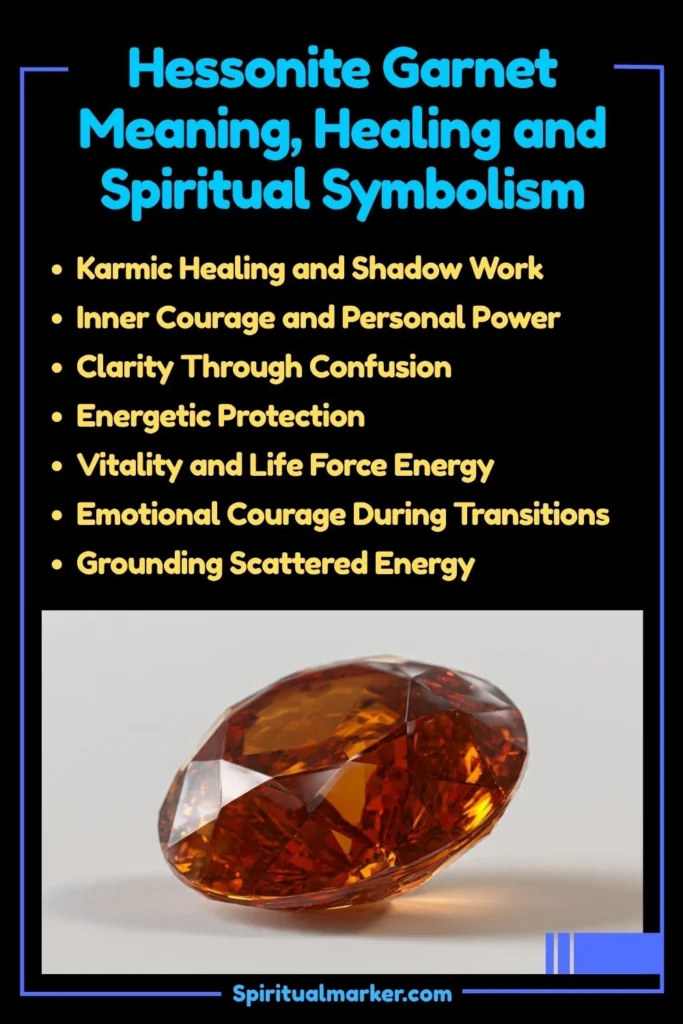
Hessonite garnet is a variety of grossular garnet known for its distinctive warm colors ranging from pale honey yellow to deep cinnamon orange and rich reddish-brown. Its name comes from the Greek word “hesson,” meaning inferior, which referred to its lower density compared to other garnets. That name has not aged well. Hessonite garnet carries one of the most significant reputations among all garnet varieties in spiritual and astrological traditions.
In terms of mineral composition, hessonite belongs to the grossular garnet family. It forms in calcium aluminum silicate deposits, often found within metamorphic and contact metamorphic rock environments. The warm orange-brown color comes primarily from iron and manganese trace elements present during crystal formation. Many hessonite specimens also show a characteristic internal swirling or oily appearance under magnification, which gem experts sometimes call the “scotch in water” effect.
People sometimes confuse hessonite garnet with spessartine garnet or orange sapphire because of overlapping color ranges. However, hessonite has a unique visual warmth and internal character that distinguishes it. Spiritually, hessonite also carries a much more specific astrological identity than most other gemstones, which sets it apart in planetary healing traditions.
Origins and Formation of Hessonite Garnet
Hessonite garnet forms deep within the earth under conditions of intense heat and pressure. It develops within calcium-rich metamorphic environments where silica-bearing fluids interact with surrounding rock over geological timescales. This slow, pressure-driven formation process connects hessonite symbolically with resilience, endurance, and transformation that requires time and intensity.
Sri Lanka produces some of the most prized hessonite garnet in the world. The island has been a gemstone source for thousands of years and remains central to the global trade in hessonite today. Other significant sources include India, Brazil, Canada, Madagascar, Tanzania, and parts of the United States. Indian hessonite holds particular cultural and astrological significance because of its deep integration into Vedic healing traditions over centuries.
The stone’s formation conditions also influence its energetic symbolism. Gemstones born under pressure often carry associations with inner strength and the power to endure difficult circumstances. Hessonite garnet reflects this fully. Its energy is not delicate. It carries the weight and warmth of something forged deeply within the earth, which explains why so many healing traditions connect it with vitality, courage, and energetic activation.
Key Properties of Hessonite Garnet
| Property | Details |
|---|---|
| Color | Honey yellow, cinnamon orange, reddish-brown |
| Composition | Calcium aluminum silicate (Grossular Garnet) |
| Hardness | 6.5 to 7.5 on the Mohs scale |
| Chakra Association | Root chakra, Sacral chakra |
| Symbolism | Courage, karmic healing, vitality, transformation |
| Common Sources | Sri Lanka, India, Brazil, Madagascar, Tanzania |
| Transparency | Transparent to translucent |
| Astrological Connection | Rahu (North Lunar Node) in Vedic astrology |
Historical Use of Hessonite Garnet
Few gemstones carry a historical record as rich and specific as hessonite garnet. In ancient Vedic tradition, hessonite was classified as one of the Navaratnas, the nine sacred planetary gemstones each associated with a specific celestial body. Hessonite was assigned to Rahu, the shadow planet representing the north lunar node. Rahu governs ambition, karma, illusion, obsession, and transformative life changes in Vedic astrology.
Wearing hessonite garnet was believed to appease Rahu’s influence and reduce the karmic disturbances associated with it. Ancient Indian texts including sections of the Garuda Purana and various Jyotisha (Vedic astrology) manuscripts discuss the use of hessonite for protection against confusion, fear, and the chaotic effects of unfavorable Rahu periods. These planetary periods, called Rahu Dasha, were believed to bring upheaval, illusion, and unexpected life changes when Rahu’s influence was dominant.
Beyond India, garnet varieties including hessonite appeared in ancient Roman jewelry, Egyptian ceremonial objects, and medieval European adornments. Garnet was associated with protection, vitality, and safe travel across multiple ancient civilizations. Roman soldiers wore garnet amulets for protection in battle. Medieval Europeans believed garnets protected travelers from accidents and injury.
In Ayurvedic medicine, hessonite was ground into fine powders and used in preparations aimed at supporting digestion, circulation, and overall vitality. While modern medicine does not validate these historical uses, they demonstrate how deeply hessonite garnet was woven into ancient healing systems that viewed the body, mind, and spirit as interconnected.
5 Spiritual Meanings of Hessonite Garnet
1. Karmic Healing and Shadow Work
The most distinctive spiritual meaning connected with hessonite garnet involves karmic healing. This meaning flows directly from its Vedic astrological identity as the gemstone of Rahu, the planet that governs unresolved karma, past-life influences, and the shadow aspects of human psychology. In Vedic tradition, Rahu is neither inherently good nor bad. It amplifies whatever it touches and forces karmic confrontation that the soul needs in order to evolve.
Many spiritual practitioners describe hessonite as a stone that accelerates karmic awareness. When someone carries unresolved emotional patterns, repeated behavioral cycles, destructive relationship dynamics, or persistent self-sabotage, those patterns often reflect deeper karmic material that has not been acknowledged or processed. Hessonite garnet is believed to bring these patterns into clearer conscious awareness.
This process is not always comfortable. Shadow work by nature involves examining aspects of the self that have been hidden, denied, or projected onto others. Carl Jung, who developed the concept of the shadow within psychology, described this work as essential for genuine psychological wholeness. In spiritual traditions, hessonite garnet symbolizes exactly this kind of honest inner confrontation. It does not allow comfortable illusions to persist.
People who work with hessonite garnet during shadow work or karmic healing practices often describe a heightened awareness of emotional patterns they previously ignored. This awareness can feel disorienting at first. But many practitioners view this disorientation as a necessary part of deeper healing. Hessonite garnet symbolizes the courage to see clearly before attempting to change.
Within this symbolism, hessonite also represents karmic release. Once karmic patterns are recognized honestly, spiritual traditions teach that they can be released through awareness, intention, and consistent behavioral change. Hessonite garnet is believed to support this release process by providing energetic clarity and the inner strength needed to sustain difficult personal changes.
2. Inner Courage and Personal Power
Courage forms one of the central spiritual themes associated with hessonite garnet. Unlike stones associated with gentle emotional healing or quiet reflection, hessonite carries an active, forceful energy that many practitioners describe as awakening. Its deep orange-brown warmth visually evokes fire, vitality, and intensity, and its spiritual symbolism mirrors that visual character closely.
Many people feel deeply stuck during certain periods of life. They know what changes they need to make. They understand what relationships are damaging them, what habits are limiting them, or what fears are holding them back. But knowing is different from acting. The gap between awareness and action often comes down to courage, and that is precisely where hessonite garnet’s symbolism becomes meaningful.
In Vedic tradition, a well-aspected Rahu can grant tremendous ambition, courage, and the drive to pursue goals with unusual intensity. Hessonite garnet is believed to channel this positive Rahu energy while minimizing the confusion and illusion that difficult Rahu transits can create. Spiritually, the stone represents accessing your deepest reserves of personal power without losing mental clarity in the process.
This meaning resonates particularly strongly with people in creative fields, leadership positions, or entrepreneurial paths where courage and risk-taking form necessary parts of the journey. Many practitioners use hessonite garnet when they feel creatively blocked, professionally fearful, or personally hesitant. Its symbolism centers on activating the will rather than simply soothing emotional discomfort.
Personal power in spiritual traditions does not mean dominance or control over others. It refers to a deep internal sense of agency, self-trust, and the belief that one’s choices and actions genuinely matter. Hessonite garnet symbolizes the rebuilding of this internal sense of power after periods of doubt, failure, or external pressure have eroded it.
3. Clarity Through Confusion
Rahu’s influence in Vedic astrology is famously associated with illusion and confusion. It distorts perception, magnifies fears, and creates mental fog that makes clear decision-making difficult. People experiencing strong Rahu transits often describe feeling lost, indecisive, obsessively focused on something that does not serve them, or unable to distinguish reality from projection. Hessonite garnet is traditionally believed to counteract this confusion by providing mental clarity and grounded perception.
In broader spiritual terms, hessonite garnet symbolizes the ability to see through illusion. Many people operate under self-created mental frameworks that distort reality. They may believe they are less capable than they are, less worthy of love, more isolated than they actually are, or trapped by circumstances that are more flexible than they appear. These mental distortions shape behavior in profound and often painful ways.
Hessonite garnet spiritually represents the cutting away of these distortions. Its energy is often described as sharp and clarifying rather than gentle and soothing. When you work with this stone during meditation or quiet reflection, practitioners believe it helps identify where your perception has drifted from truth. This kind of mental clarity is particularly valuable during complex life decisions, relationship crossroads, or periods of significant personal reinvention.
The symbolism of clarity through confusion also connects with hessonite’s role in supporting honest self-assessment. Many people avoid honest self-evaluation because it feels threatening. Hessonite garnet symbolizes the courage to look clearly at your own patterns, motivations, and blind spots without falling into harsh self-judgment. This balance between honest seeing and self-compassion forms a core part of its spiritual identity.
4. Energetic Protection
Throughout history, garnet has carried strong associations with protection. Ancient Romans, Egyptians, and medieval Europeans all used garnet varieties as protective amulets. They believed garnet created an energetic shield against danger, negative influences, and psychic disturbances. Hessonite garnet carries this broader garnet symbolism while adding its own specific protective reputation connected to Rahu’s influence.
In Vedic tradition, hessonite is specifically worn as protection against negative Rahu effects during difficult astrological periods. This includes protection from confusion, from obsessive thought patterns, from destructive ambition, and from the destabilizing effects of rapid life change. The stone is believed to act as a stabilizing force when Rahu’s energy creates chaos rather than growth.
Modern crystal practitioners extend this protective symbolism more broadly. Many believe hessonite garnet creates a strong energetic boundary around its wearer, reducing sensitivity to external emotional disturbances, psychic noise, or draining interpersonal dynamics. People who work in emotionally intense environments, caregiving roles, or high-pressure professional settings sometimes turn to hessonite for this kind of energetic support.
Protection in spiritual traditions rarely means invulnerability. Instead, it typically means maintaining a strong internal center even when external circumstances become turbulent. Hessonite garnet symbolizes this kind of protection: not a wall that blocks all experience, but a deep inner stability that prevents external chaos from destabilizing your core sense of self and direction.
5. Vitality and Life Force Energy
Hessonite garnet’s warm, fiery color naturally connects it with themes of vitality, physical energy, and life force. Many crystal traditions associate orange and red-toned stones with the body’s primal energies because these colors mirror blood, warmth, and the physical essence of being alive. Hessonite carries this symbolism strongly, particularly in its connection with the root and sacral chakras.
The root chakra governs survival instincts, physical safety, grounding, and basic life energy. When root chakra energy feels blocked or depleted, people often experience chronic fatigue, anxiety, disconnection from their body, or a pervasive sense of instability. The sacral chakra governs creative energy, emotional expression, pleasure, and motivation. Blocked sacral energy may appear as emotional numbness, creative stagnation, or a loss of enthusiasm for life.
Hessonite garnet is believed to stimulate both of these energy centers, helping to restore physical vitality and creative momentum. This makes it particularly meaningful for people recovering from prolonged illness, burnout, grief, or depression, where the body’s natural life-force energy has been significantly depleted. Its symbolism centers on reigniting that spark rather than quietly maintaining it.
In Ayurvedic tradition, hessonite was associated with improving digestive fire, known as agni, and overall physical constitution. While these historical medical uses belong to a very different framework than modern medicine, they consistently point toward hessonite’s energetic reputation as a stone that activates, warms, and vitalizes rather than calms and sedates. This distinguishes it clearly from cooling, soothing stones like moonstone or aquamarine.
6 Healing Properties of Hessonite Garnet
1. Emotional Courage During Difficult Transitions
Hessonite garnet is widely associated with providing emotional courage during periods of intense personal change. Life transitions such as ending long-term relationships, leaving stable careers, relocating, confronting grief, or beginning a completely new personal chapter can feel emotionally paralyzing even when those changes are clearly necessary. Fear of the unknown, fear of failure, and fear of judgment from others can create emotional stagnation that keeps people trapped long after they have recognized the need for change.
Within crystal healing traditions, hessonite garnet is believed to help break this kind of emotional paralysis. Its energy is described as activating and emboldening rather than simply comforting. This distinction matters. Some healing stones support people by creating a sense of calm and safety. Hessonite garnet tends to support people by awakening the inner drive to move forward despite fear rather than waiting for fear to disappear first.
This makes hessonite particularly meaningful for people in the liminal space between what was and what is coming. The transition itself often feels unbearable because neither the old life nor the new life feels fully real yet. Hessonite garnet symbolically represents the energy needed to keep walking through that discomfort toward genuine transformation rather than retreating back into familiar but limiting patterns.
2. Mental Focus and Decision-Making
One of hessonite garnet’s most valued healing associations involves its reputation for sharpening mental focus and improving decision-making clarity. Many people struggle with chronic indecision, overthinking, and mental overwhelm, particularly during complex life situations where multiple competing priorities demand attention simultaneously. This mental fog can prevent effective action and create a deepening sense of helplessness.
Hessonite garnet is believed to cut through this mental noise by helping the mind identify what truly matters. Many practitioners describe its energy as grounding mental activity in the present moment rather than allowing it to spiral into anxiety about future outcomes or regret about past decisions. This grounding effect does not suppress important thinking. Instead, it helps channel mental energy more productively.
In Vedic healing traditions, hessonite was specifically recommended during periods of Rahu influence when mental confusion and obsessive thinking become most problematic. The stone was believed to restore clarity of perception and help the mind distinguish genuine intuition from anxiety-driven distortion. Modern practitioners continue using it for this purpose during meditation, before important conversations, or while working through complex personal decisions.
3. Physical Energy and Vitality Restoration
Hessonite garnet has a long association with physical vitality in multiple healing traditions. While crystal healing operates outside conventional medicine and makes no clinical claims, the symbolic and energetic associations of hessonite consistently center on physical activation and restoration of depleted body energy. This is why many practitioners reach for it during periods of physical exhaustion, chronic fatigue, or recovery from illness.
The stone’s connection with the root chakra plays a central role here. When root chakra energy flows freely, the physical body tends to feel more vital, grounded, and energetically supported. Blocked root chakra energy often manifests as physical heaviness, persistent tiredness, immune system vulnerability, or a chronic sense of physical depletion. Hessonite garnet is believed to address these energetic deficiencies by stimulating root chakra activation.
Many people who work physically demanding jobs, maintain intensive athletic training schedules, or experience sustained periods of physical stress incorporate hessonite garnet into their recovery practices. Its symbolism as an energetically warming and activating stone aligns naturally with physical recovery contexts where rebuilding energy and resilience forms the central goal.
4. Release of Self-Sabotaging Patterns
One of the most psychologically significant healing associations connected with hessonite garnet involves the release of self-sabotaging behavioral patterns. Self-sabotage occurs when a person’s unconscious fears, beliefs, or emotional wounds cause them to undermine their own success, relationships, or well-being. It often operates below the level of conscious awareness, which makes it exceptionally difficult to address through willpower alone.
Common forms of self-sabotage include procrastination on meaningful goals, choosing partners who consistently fail to meet emotional needs, avoiding vulnerability in close relationships, creating conflict right when situations improve, or dismissing personal achievements before they can be fully received. These patterns often protect against deeper fears: fear of failure, fear of success, fear of abandonment, or fear of truly being seen by others.
Hessonite garnet’s connection with karmic awareness makes it particularly relevant here. Many spiritual traditions teach that self-sabotaging patterns reflect unresolved karmic material rather than simple weakness or character flaws. By bringing these patterns into clearer conscious awareness, hessonite garnet symbolically supports the recognition and eventual release of the underlying beliefs that sustain them. This process requires honest self-reflection sustained over time, not a single breakthrough moment.
5. Grounding Scattered Energy
People who think intensely, feel deeply, or operate in highly stimulating environments often struggle with scattered or unfocused energy. This can manifest as difficulty completing tasks, chronic restlessness, inability to stay present during conversations, or a constant sense of mental fragmentation. While some crystal traditions use high-vibration stones that amplify energy upward, hessonite garnet works differently.
Its connection with the root chakra and its earthy, warm color profile make it a naturally grounding stone. Grounding in energy work means anchoring dispersed mental and emotional energy back into the physical body and present moment. People who spend significant time in abstract thinking, spiritual practice, or intense emotional processing sometimes lose their sense of physical and practical groundedness. Hessonite garnet is believed to help restore this balance.
This grounding effect also benefits people recovering from periods of significant emotional turbulence. Grief, trauma, anxiety, and prolonged stress can leave the nervous system in a state of chronic dysregulation that feels like constant restlessness or emotional fragmentation. Hessonite garnet symbolically represents the return to a stable internal center that can hold strong feelings without being overwhelmed by them.
6. Strengthening Relationship Authenticity
Hessonite garnet’s healing associations extend into the realm of relationships through its symbolism of authenticity and honest self-expression. Many relationship difficulties stem not from a lack of love or goodwill but from a deep fear of being truly known. People present curated versions of themselves, hide emotional needs, suppress authentic reactions, or maintain emotional distance because they fear that their real selves will not be acceptable to those they love most.
This pattern of emotional inauthenticity creates a specific kind of relational pain: the loneliness of being surrounded by people who care about you but do not fully know you. Hessonite garnet is believed to support greater emotional honesty in relationships by strengthening the courage to be genuinely seen. Its energy does not force vulnerability. Instead, it supports the inner strength that makes authentic vulnerability feel less dangerous.
In relationships where trust has been damaged by dishonesty, hesitation, or emotional withdrawal, hessonite garnet symbolically supports the rebuilding of genuine connection. Its themes of karmic healing and courageous honesty both play a role in this process. Practitioners believe it encourages people to bring their full, unfiltered self into their most important relationships rather than protecting an emotional image at the cost of genuine intimacy.
How to Wear Hessonite Garnet Jewelry for Spiritual Growth
In Vedic astrological tradition, hessonite garnet is typically worn in silver or gold settings and placed on specific fingers depending on the practitioner’s guidance. Many Jyotishi (Vedic astrologers) recommend wearing hessonite on the middle finger of the right hand, particularly when it is being worn as a planetary gemstone to work with Rahu’s influence. The stone is often set in a ring that allows direct contact with the skin for maximum energetic effect.
Outside of Vedic tradition, many people wear hessonite garnet as pendants, bracelets, or earrings based on personal preference and spiritual intention. Wearing it close to the body during emotionally challenging periods, important meetings, creative work sessions, or meditation practices is a common approach. Some practitioners prefer wearing it on the left side of the body, which is traditionally associated with receiving energy in many cultural frameworks.
Many people combine hessonite garnet with complementary stones that support its energy. Black tourmaline may enhance its protective qualities. Citrine can amplify themes of vitality and mental clarity. Clear quartz is often used alongside hessonite to magnify its general energetic presence. Choosing complementary stones depends on your personal intentions and the specific qualities you want to emphasize during a particular period of work.
Caring for Hessonite Garnet Jewelry
Hessonite garnet ranks between 6.5 and 7.5 on the Mohs hardness scale, making it a reasonably durable gemstone for everyday wear. However, it still benefits from careful handling to preserve its clarity and surface polish over time. Store hessonite garnet separately from harder stones like diamonds, sapphires, or rubies, which can scratch its surface if stored together without padding.
Clean hessonite garnet using lukewarm water, mild soap, and a soft brush or cloth. Rinse thoroughly and dry gently. Avoid ultrasonic cleaners and steam cleaning, as thermal shock or intense vibration may affect stones with internal inclusions, which hessonite sometimes contains. Remove hessonite jewelry before intense physical activity, swimming in chlorinated pools, or exposure to harsh household chemicals.
From an energetic perspective, many practitioners who work with hessonite garnet regularly choose to cleanse it spiritually as well as physically. Common approaches include moonlight cleansing overnight, placing the stone near black tourmaline or selenite, or using sound cleansing with singing bowls. Avoid prolonged sunlight exposure for energetic cleansing purposes, as extended UV exposure may affect the stone’s color depth over time.
Hessonite Garnet Meaning at a Glance
| Aspect | Details |
|---|---|
| Primary Meaning | Karmic healing, courage, and energetic transformation |
| Chakra Association | Root chakra, Sacral chakra |
| Main Spiritual Symbolism | Courage, clarity, karmic resolution, vitality |
| Common Colors | Honey yellow, cinnamon orange, reddish-brown |
| Hardness | 6.5 to 7.5 Mohs |
| Main Sources | Sri Lanka, India, Brazil, Madagascar, Tanzania |
| Astrological Planet | Rahu (North Lunar Node) |
| Emotional Associations | Courage, clarity, emotional honesty, resilience |
| Popular Jewelry Types | Rings, pendants, bracelets |
| Spiritual Uses | Karmic healing, shadow work, meditation, vitality work |
A Final Note
Hessonite garnet stands in a category of its own among gemstones with spiritual significance. It does not promise easy comfort. It does not offer the quiet emotional soothing of rose quartz or the dreamy spiritual softness of moonstone. What it offers instead is something rarer and often more necessary: the courage to see clearly, the energy to act honestly, and the inner strength to work through what needs healing rather than avoid it.
Its history spans ancient Vedic astrology, Ayurvedic medicine, and protective traditions across multiple continents. Its symbolism connects deeply with karmic resolution, personal courage, mental clarity, and the activation of your most authentic self. Whether you view it through an astrological lens, a spiritual healing framework, or simply as a beautiful gemstone worth understanding, hessonite garnet rewards serious attention.
If hessonite garnet has caught your attention, you might consider what it represents within your current personal journey. Some people wear it for its Vedic astrological benefits during specific planetary periods. Others carry it as a daily reminder of the inner courage they are actively working to cultivate. And some simply appreciate it as a visually stunning stone with a history and symbolism that run far deeper than its warm surface suggests.