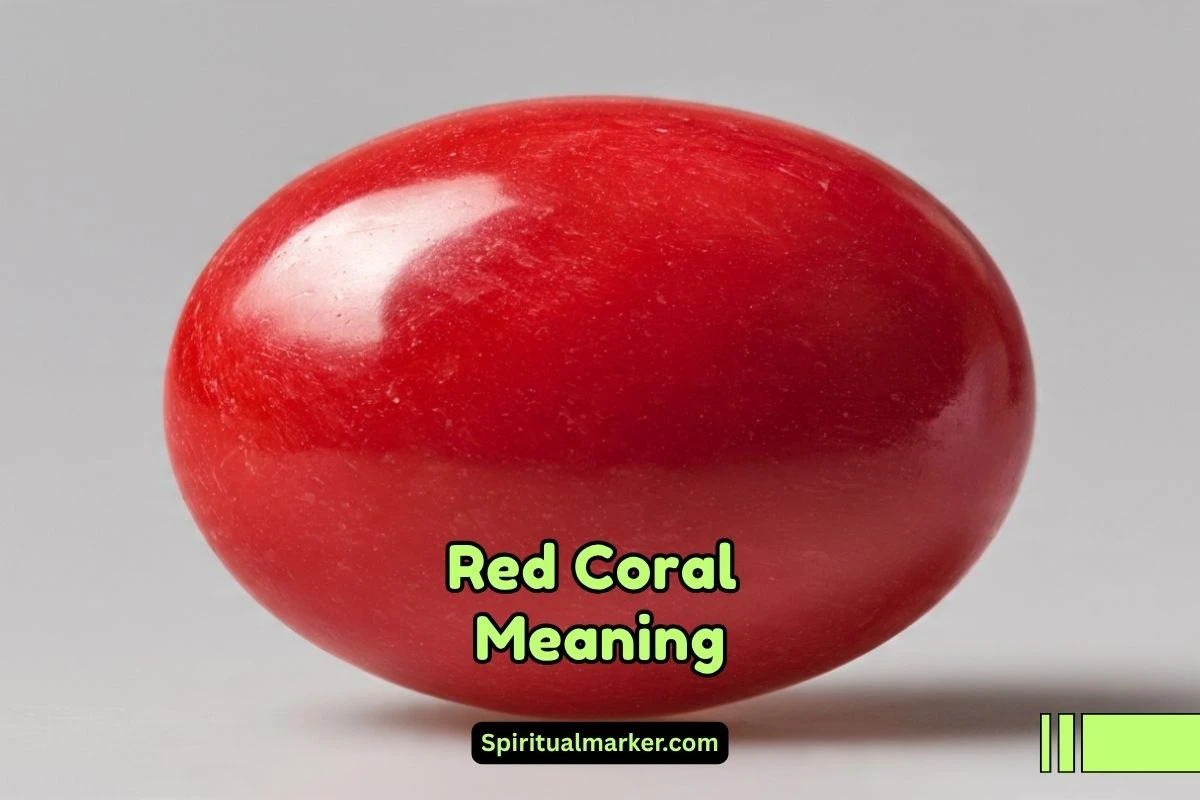
Have you ever held a piece of red coral and felt an immediate surge of energy? Many people report a strong, almost electric pull toward this vivid gemstone. Its deep red-orange tones feel alive. Its warmth feels immediate.
That reaction is not accidental. Red coral has carried deep symbolic weight across civilizations for thousands of years. Ancient Romans tied it around children’s necks for protection. Vedic astrologers prescribed it to strengthen Mars energy in a person’s birth chart. Indigenous cultures across the Mediterranean treated it as a sacred gift from the sea.
Unlike most gemstones that form beneath the earth, red coral is organic. It comes from living creatures. Coral polyps build intricate reef structures over centuries, and the skeletal remains harden into the brilliant gemstone people have prized since antiquity. That living origin gives red coral a distinct energetic identity that stone-formed crystals simply do not share.
Today, spiritual practitioners, astrologers, crystal healers, and gemstone enthusiasts continue turning to red coral for its reputation as a stone of vitality, courage, passion, and protection. It is connected with the root chakra and the sacral chakra, which means it works close to the body’s most primal energetic centers. These are the centers governing survival instinct, physical energy, emotional desire, and creative drive.
This article covers everything meaningful about red coral. You will learn its spiritual significance, healing properties, historical background, chakra connections, and practical guidance on wearing and caring for red coral jewelry.
5 Key Takeaways
- Red coral symbolizes vitality, courage, passion, protection, and life force across many spiritual traditions worldwide.
- Many crystal healers and Vedic astrologers connect red coral with Mars energy, making it a powerful stone for action and willpower.
- Red coral is associated with the root and sacral chakras, supporting grounding, physical strength, and emotional vitality.
- As an organic gemstone, red coral requires careful handling because it is softer and more chemically sensitive than most mineral-based stones.
- Wearing red coral jewelry close to the skin, particularly on the right hand, is believed to strengthen physical energy, confidence, and mental clarity.
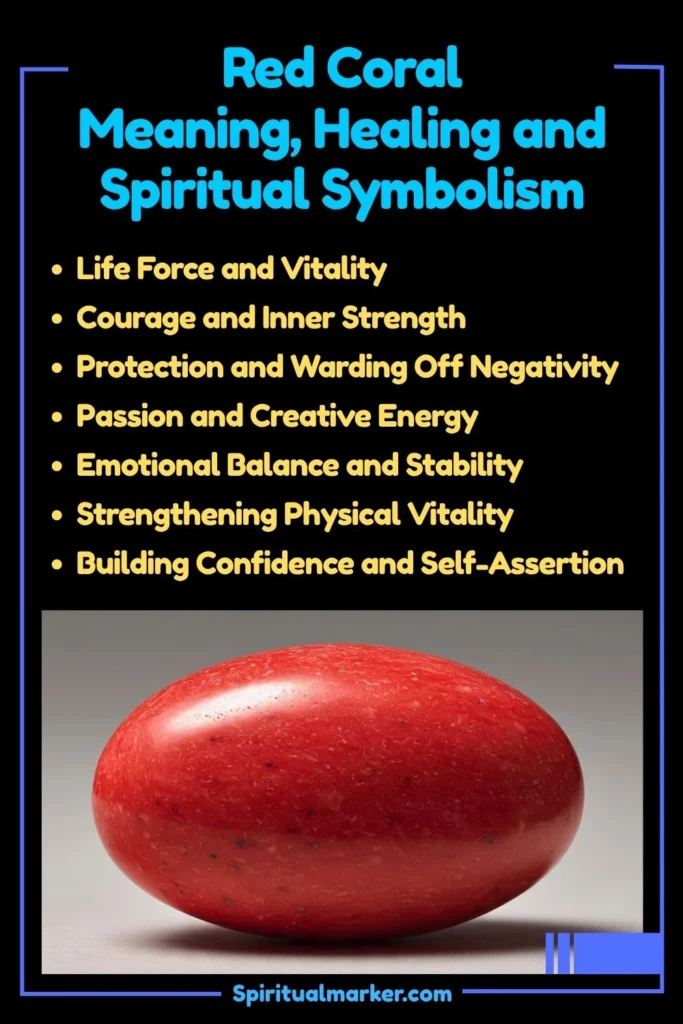
What Is Red Coral?
Red coral is not a mineral. That distinction sets it apart from almost every other gemstone in spiritual and healing traditions. It forms from the calcium carbonate skeletons of marine organisms called coral polyps. These tiny creatures build colonies over decades and centuries in warm, shallow ocean waters. When polyps die, their hard skeletal structures remain, gradually accumulating into the branching formations people harvest and shape into gemstones.
The gemstone ranges in color from soft salmon pink to deep ox-blood red. The most prized variety is a rich, uniform deep red or vivid orange-red tone, often called “bull’s blood” coral in trade circles. This intense color comes from carotenoid pigments within the organic matrix of the coral skeleton.
Chemically, red coral consists primarily of calcium carbonate in the calcite crystal form. It rates approximately 3 to 4 on the Mohs hardness scale, which makes it considerably softer than most gem-quality minerals. This softness makes it easy to carve and shape, which is why coral jewelry, beads, and decorative objects appear throughout ancient and modern cultures worldwide.
Red coral is sometimes confused with red jasper or carnelian because all three share warm red tones and similar energetic themes. However, red coral carries a distinctly oceanic, organic energy that mineral-based stones cannot replicate. Spiritually, its living origin connects it with themes of life force, vitality, and the deep rhythms of the natural world.
Origins and Formation of Red Coral
Red coral grows in ocean environments across the Mediterranean Sea, the Red Sea, the waters surrounding Japan and Taiwan, and various parts of the Pacific and Indian Oceans. The Mediterranean has historically produced some of the world’s most prized gem-quality coral, particularly from waters near Italy, Algeria, Tunisia, and Morocco.
Coral polyps are filter feeders. They draw minerals and nutrients from surrounding seawater and secrete calcium carbonate to build rigid structures around their soft bodies. Over centuries, entire reef systems develop from these layered skeletal deposits. When coral is harvested for gemstone use, the organic material is cleaned, polished, and shaped into beads, cabochons, and carved ornamental objects.
Japan and Taiwan are today’s largest commercial suppliers of Corallium rubrum and related species used in jewelry. Italian coral from the Torre del Greco region near Naples remains among the most historically significant, with craftsmanship traditions in coral carving stretching back over five centuries.
Because coral is an organic, living-origin material, its harvest raises environmental concerns. Responsible sourcing matters. Many reputable dealers now work with certified sustainable coral or offer vintage and antique coral pieces to avoid contributing to reef depletion.
The living origin of red coral deeply influences its spiritual symbolism. It formed not in silent geological darkness, but in moving, breathing ocean water. That origin connects it energetically with life, movement, growth, and the cycles of the living world.
Key Properties of Red Coral
| Property | Details |
|---|---|
| Color | Salmon pink, orange-red, deep red, ox-blood red |
| Composition | Calcium carbonate (organic) |
| Hardness | 3 to 4 Mohs |
| Chakra Association | Root chakra, sacral chakra |
| Symbolism | Vitality, courage, passion, protection, life force |
| Common Sources | Mediterranean, Japan, Taiwan, Pacific Islands |
| Transparency | Opaque |
| Energy Style | Activating, grounding, protective, physically energizing |
| Planetary Association | Mars |
| Astrological Signs | Aries, Scorpio |
Historical Use of Red Coral
The historical record for red coral is remarkably long and geographically widespread. Few gemstones appear across as many distinct cultures with such consistent symbolism as red coral does.
Ancient Rome provides some of the earliest documented evidence. Roman parents routinely hung red coral amulets around their children’s necks. They believed coral protected against evil spirits, illness, and misfortune. Pliny the Elder, writing in the first century AD, described coral’s protective properties in his encyclopedia Naturalis Historia, noting that Gauls used it to decorate weapons and helmets as a symbol of courage and divine protection.
In ancient Greece, coral held sacred associations with the goddess Aphrodite. One mythological account describes red coral as drops of blood from Medusa’s severed head that fell into the sea and hardened. Perseus had carried Medusa’s head while resting over the water, and where her blood touched the waves, coral grew. This origin story embedded red coral deeply in Greek symbolism around power, transformation, and divine feminine energy.
Across ancient Egypt, red coral appeared in burial objects and protective amulets. Egyptians associated its red color with blood, life force, and regenerative power. Coral pieces have been found in tombs and ritual contexts spanning thousands of years.
In Vedic tradition from South Asia, red coral holds one of the most formalized roles of any gemstone in spiritual and astrological practice. It is classified as one of the Navaratna, the nine sacred gemstones of Vedic astrology, each corresponding to a celestial body. Red coral governs Mars, known as Mangal in Sanskrit. Vedic astrologers traditionally prescribe red coral to strengthen Mars in a person’s horoscope, particularly for individuals whose charts show a weak or afflicted Mars placement.
Tibetan and Nepali Buddhist traditions also prize red coral highly. It appears frequently in traditional Tibetan jewelry, thangka paintings, and religious ornaments. In Tibetan symbolism, red coral represents life force, longevity, and protection from harmful energies. It frequently appears alongside turquoise and amber in sacred ornamental combinations.
In Native American cultures, particularly among Southwestern tribes including Zuni, Navajo, and Pueblo peoples, red coral has long served in ceremonial jewelry, trading, and spiritual ornamentation. Its warm color connects it with fire, blood, and the life-giving energy of the sun.
This consistent cross-cultural symbolism speaks to something universal about red coral’s energy. Across languages, continents, and centuries, people independently arrived at similar conclusions about what this gemstone represents.
5 Spiritual Meanings of Red Coral
1. Life Force and Vitality
Red coral’s most fundamental spiritual meaning is life force itself. This meaning makes immediate sense when you consider the stone’s origin. It grew from living organisms. It formed in moving ocean water. It carries the energetic imprint of biological life rather than geological silence.
In many spiritual traditions, the color red carries strong associations with blood, breath, heartbeat, and physical vitality. Red coral combines this color symbolism with an organic origin to create one of the most physically energizing gemstones in the crystal tradition. Its spiritual meaning centers on the raw energy that drives physical existence forward.
Many people are drawn to red coral during periods of physical depletion, chronic fatigue, illness recovery, or burnout. Its energy is frequently described as activating rather than calming. Where stones like green opal or moonstone encourage stillness, red coral encourages forward momentum and physical renewal. It symbolizes the return of energy after periods of exhaustion or stagnation.
Life force as a spiritual concept extends beyond physical health alone. It also includes passion, motivation, and the will to engage fully with life. People experiencing emotional withdrawal, depression, creative blocks, or prolonged disengagement sometimes describe feeling drawn to red coral precisely because its energy feels opposite to emptiness. It symbolizes fullness of living rather than retreat from it.
In Vedic tradition, this life force meaning connects directly to the concept of prana, the Sanskrit word for vital life energy. Mars, which red coral governs, rules over physical strength, assertiveness, and the drive to act. Strengthening Mars through red coral is believed to restore prana when a person’s Mars energy becomes depleted or blocked.
This spiritual meaning is ancient and consistent. Whether approached through Greek mythology, Roman protective traditions, Vedic astrology, or modern crystal healing, red coral circles back to the same core symbolism. It represents the energy of being alive, fully present, and physically engaged with existence.
2. Courage and Inner Strength
Red coral has carried the symbolism of courage across almost every culture that has worked with it. Roman soldiers associated it with battlefield bravery. Vedic warriors wore it for strength. Ancient seafarers carried it for protection against unpredictable ocean dangers. This symbolism feels woven into the stone’s identity at a fundamental level.
Spiritually, courage in the context of red coral does not only mean physical bravery. It also means the inner strength required to face fear, move through uncertainty, and act decisively when circumstances feel overwhelming. Many people find themselves paralyzed by indecision, fear of failure, or anxiety about outcomes. Red coral symbolizes the energetic push that helps a person move forward despite those fears.
This connects directly to its association with Mars energy. Mars in astrology governs action, assertiveness, ambition, and the willingness to pursue what one wants without excessive hesitation. When Mars energy is strong, people often feel decisive, confident, and energetically motivated. When Mars energy feels weak or blocked, people may experience chronic procrastination, low confidence, physical lethargy, or difficulty standing up for themselves.
Red coral spiritually represents an antidote to that blocked energy. Its meaning encourages people to reconnect with their inner authority. It symbolizes the courage to set healthy boundaries, pursue personal goals, defend one’s values, and take meaningful action in the face of difficulty.
This symbolism appears across different life contexts. A person navigating a difficult career decision, a challenging personal boundary, a creative risk, or an emotionally demanding confrontation may find red coral’s symbolism meaningful. Its spiritual energy is not associated with aggression. Instead, it reflects controlled, purposeful, self-directed strength rather than reactive anger or hostility.
Many healers also associate red coral’s courage symbolism with emotional bravery. Being emotionally honest, vulnerable, and authentically present takes real courage. Red coral supports that kind of inner strength alongside physical and decisive courage. This broader interpretation makes it meaningful across many different personal situations.
3. Protection and Warding Off Negativity
Protection is one of red coral’s oldest and most consistent spiritual meanings. Ancient Romans hung it above doorways. Greek sailors carried it at sea. Tibetan monks incorporated it into protective ritual objects. Across all of these traditions, the message remains essentially the same. Red coral keeps harmful energies away.
In crystal healing traditions, protective stones are generally believed to create an energetic boundary around the person carrying or wearing them. They symbolize a kind of spiritual shield that reduces vulnerability to negative influences, psychic attack, emotional toxicity, or harmful environmental energies. Red coral is among the most widely recognized protective gemstones in this tradition.
Its protective symbolism is closely linked to its red color and organic vitality. Red is universally associated with blood and survival. A stone that carries life force naturally becomes a symbol of protection because life force and vulnerability are opposites. Many spiritual traditions see red coral’s intense red energy as actively repelling energies that threaten life, health, and well-being.
This meaning extends beyond supernatural protection. Many people use red coral symbolically to strengthen emotional protection during psychologically demanding periods. When relationships feel draining, when work environments feel toxic, or when social interactions consistently feel emotionally depleting, red coral symbolizes energetic self-preservation. It represents the maintenance of personal energy and emotional integrity under external pressure.
Red coral’s protective symbolism is also notable for being active rather than passive. Some protective stones work by creating stillness or emotional withdrawal. Red coral works differently. Its protective energy is vigorous and outward-facing. It does not hide from threats. Spiritually, it stands its ground. This active quality connects back to its associations with Mars, courage, and assertive self-expression.
In modern crystal practices, many people wear red coral specifically during emotionally difficult transitions such as moving to a new city, beginning a new career, leaving a difficult relationship, or navigating intense personal challenges. Its protective symbolism offers both practical grounding and spiritual reassurance during periods of heightened vulnerability.
4. Passion and Creative Energy
Passion is a defining theme of red coral’s spiritual identity. This meaning arises naturally from the stone’s color, its Mars association, and its organic origin. Red has long symbolized desire, drive, and emotional intensity across cultures. Red coral carries all of those associations while adding the dimension of living energy that purely mineral-based red stones cannot duplicate.
In spiritual contexts, passion refers not only to romantic or physical desire. It also encompasses creative fire, devotional intensity, professional ambition, and the deep motivation that gives life personal meaning. People experiencing creative stagnation, loss of purpose, emotional numbness, or disconnection from what once excited them sometimes find themselves drawn to red coral’s energetic symbolism.
Its connection with Mars reinforces this meaning. Vedic astrology associates a strong Mars placement with artistic ambition, creative boldness, and the drive to build something meaningful. Mars-ruled individuals often possess intense creative energy when their planetary influence is balanced and expressed healthily. Red coral symbolically supports this creative Mars energy when it feels blocked, depleted, or unexpressed.
Many artists, musicians, entrepreneurs, and creative professionals across different spiritual traditions have carried or worn red coral as a symbol of creative vitality. The gemstone represents the energetic state where passion, skill, and willingness to act converge into meaningful creative output.
Passion symbolism in red coral also extends into romantic and relational contexts. Many cultures have associated red coral with love, desire, and the magnetic energy that draws people together. In Mediterranean traditions, red coral was commonly given as a gift between romantic partners. Italian coral carvers produced elaborate love tokens and betrothal jewelry in coral for centuries. This tradition reflects the stone’s long symbolic connection with heartfelt emotional intensity and relational desire.
5. Emotional Balance and Stability
Red coral’s most energetically activating qualities might seem to suggest emotional volatility. But its spiritual meaning actually includes emotional balance as a significant component, particularly through its root chakra association.
The root chakra governs feelings of safety, stability, and groundedness. When root chakra energy flows well, people generally feel emotionally secure, physically present, and stable even during challenging circumstances. They are less likely to feel overwhelmed by anxiety, reactive to minor stressors, or emotionally destabilized by external changes. Red coral’s connection with the root chakra gives it an important stabilizing role alongside its more energizing qualities.
Many people who feel emotionally unmoored, chronically anxious, easily overwhelmed, or disconnected from practical reality find red coral’s symbolism meaningful precisely because it represents grounding. It does not create distance from emotion. Instead, it symbolizes feeling emotions from a stable, rooted foundation rather than feeling swept away by emotional turbulence.
This stabilizing quality also reflects red coral’s oceanic origin. The ocean moves constantly. Waves shift, currents change, and conditions fluctuate. But deep ocean water beneath the surface remains remarkably stable. Spiritually, red coral carries both dimensions. It holds passionate, moving surface energy alongside deep foundational stability.
Many practitioners use red coral during emotional transitions when both energy and groundedness are required simultaneously. Starting a business, relocating, ending a long relationship, recovering from a significant loss, or beginning a major creative project all require both emotional courage and emotional stability. Red coral symbolically supports both qualities at once, which is part of why it has remained spiritually meaningful across so many different cultural contexts.
6 Healing Properties of Red Coral
1. Strengthening Physical Vitality
Red coral is perhaps most widely known in crystal healing for its association with physical energy and vitality. Many practitioners describe its energy as genuinely activating, meaning it seems to increase rather than calm physical energy. This makes it different from most calming crystals in the healing tradition.
People experiencing chronic fatigue, low physical motivation, post-illness recovery, or a general sense of physical depletion often turn to red coral during their recovery journeys. Its Mars association in Vedic tradition directly connects it with physical strength, muscular vitality, and the body’s capacity for sustained action.
Some traditional Ayurvedic-adjacent healing practices actually ground red coral recommendations in physical health contexts. Coral calcium, derived from fossilized coral, has appeared in nutritional supplement discussions relating to bone density and mineral absorption, though these are distinct from gemstone healing practices and require professional medical guidance. The symbolic connection between coral’s calcium carbonate structure and physical skeletal strength, however, appears across multiple healing traditions.
Red coral also symbolizes blood health and circulatory vitality in several folk medicine traditions. Its deep red color connects it symbolically with blood. Several historical healing practices associated it with supporting healthy circulation and physical warmth in the body. While these are symbolic associations rather than clinically validated medical claims, they reflect how deeply red coral has connected with physical life force in human consciousness across centuries.
For spiritual practitioners today, red coral represents an energetic tool for rebuilding physical vitality during depletion. Whether worn as jewelry, placed near a bed, or held during meditation, its symbolism centers on physical renewal and the return of physical strength after exhaustion or illness.
2. Building Confidence and Self-Assertion
Low confidence is one of the most common emotional struggles people bring into crystal healing traditions, and red coral frequently appears as a recommended gemstone for this challenge. Its connection with Mars, courage, and personal authority gives it a strong symbolic identity as a confidence-building stone.
Many people develop patterns of emotional self-suppression over time. Criticism, rejection, social conditioning, and repeated experiences of feeling overlooked or dismissed can slowly erode a person’s sense of personal authority. They may begin undervaluing their contributions, avoiding self-advocacy, or remaining silent in situations where speaking up would genuinely serve them.
Red coral spiritually symbolizes the opposite of that suppression. It represents clear, grounded, unapologetic self-expression rooted in an honest understanding of one’s own value. Its energy is not associated with arrogance or aggression. Instead, it reflects the quiet, solid confidence of someone who knows their worth and acts accordingly.
In Vedic astrological tradition, a poorly placed Mars in a person’s natal chart is often associated with confidence challenges, difficulty initiating action, hesitation, and suppressed assertiveness. Wearing red coral is believed to strengthen Mars energy and thereby strengthen these qualities over time. Whether approached through a Vedic lens or a broader crystal healing perspective, the core symbolism remains consistent. Red coral supports personal authority and confident self-expression.
Practitioners often recommend red coral for people navigating new professional environments, public speaking challenges, leadership transitions, or personal situations requiring strong boundary-setting. Its symbolic energy encourages the kind of grounded self-assurance that makes these situations more manageable.
3. Emotional Grounding During Anxiety
Anxiety often manifests as emotional disconnection from the body. People experiencing anxiety frequently feel mentally trapped in future worries, worst-case scenarios, or recurring fear patterns while feeling physically tense and emotionally destabilized. Grounding tools help interrupt this pattern by reconnecting the mind with physical presence.
Red coral functions as a grounding stone through its association with the root chakra. The root chakra is the energetic foundation that tethers a person to their physical existence, basic safety, and present-moment awareness. When root chakra energy flows freely, anxious mental spiraling often becomes less consuming because the person feels more physically and emotionally anchored.
Many people experiencing anticipatory anxiety, generalized worry, or emotional volatility keep red coral close during difficult periods. Its warm, activating energy is described as emotionally anchoring rather than emotionally stimulating. It helps people reconnect with physical body awareness, present-moment focus, and emotional stability rather than drifting further into mental anxiety loops.
This grounding function complements red coral’s more energizing qualities. It does not create emotional numbness or emotional withdrawal. Instead, it supports engaged, present, grounded emotional awareness. People can feel their emotions clearly without being overwhelmed by emotional instability.
Practitioners sometimes combine red coral with calming stones like blue lace agate, aquamarine, or howlite to balance its activating energy with additional emotional soothing. This combination may support both physical grounding and emotional calming simultaneously, which can be particularly useful during intense anxiety episodes.
4. Supporting Willpower and Discipline
Willpower and disciplined action are consistent themes in red coral’s healing tradition, especially within Vedic astrological practice. Mars governs not only courage but also sustained effort, disciplined action, and the capacity to work toward goals without losing momentum over time.
Many people struggle less with knowing what they want to accomplish and more with maintaining consistent action toward those goals. Procrastination, self-doubt, inconsistency, and emotional resistance all interrupt the focused effort that meaningful achievement requires. Red coral symbolically addresses this challenge through its Mars energy connection.
In Vedic tradition, a strengthened Mars placement is associated with improved focus, better follow-through, stronger work ethic, and greater capacity for disciplined effort across professional and personal domains. Wearing red coral is one traditional method for reinforcing these qualities when they feel consistently difficult to access.
From a crystal healing perspective beyond Vedic practice, red coral’s root chakra association also supports this meaning. The root chakra governs basic functional stability, including the capacity to maintain consistent routines, meet daily responsibilities, and build sustainable habits. When root chakra energy is balanced, people often find it easier to maintain the kind of grounded, consistent effort that long-term goals require.
Many practitioners specifically recommend red coral for people navigating large projects, academic challenges, athletic training, or professional goals that require extended periods of disciplined focus. Its symbolic energy supports sustained effort rather than only initial bursts of enthusiasm.
5. Stimulating Creative Expression
Creative energy often becomes blocked by fear, self-doubt, perfectionism, or emotional exhaustion. Creative practitioners across many fields know the frustrating experience of feeling a desire to create while simultaneously feeling unable to access the internal energy required for genuine creative output.
Red coral symbolically addresses creative blocks through its association with passion, Mars-ruled creative drive, and sacral chakra energy. The sacral chakra sits just below the navel and governs creative expression, emotional flow, sensory pleasure, and the energetic connection between feeling and creating. Many traditions connect creative vitality directly with sacral chakra health.
When sacral chakra energy feels blocked, people may experience creative stagnation, emotional flatness, difficulty accessing inspiration, or a sense of disconnection from their creative identity. Red coral’s activating energy is believed to help restore the flowing, passionate quality that creative work requires.
Many artists, writers, performers, and other creative professionals have incorporated red coral into their creative practices over the centuries. Mediterranean cultures produced remarkably detailed coral carvings depicting mythological scenes, natural figures, and intricate ornamental designs, suggesting a long intuitive connection between coral and artistic expression.
Red coral’s creative symbolism is also tied to its emotional intensity. Strong creative work often draws from deep emotional experience. The courage required to create authentically, share personal vision, and risk creative vulnerability connects directly to the courage symbolism that red coral carries. Spiritually, it supports both the emotional openness and energetic drive that meaningful creative work requires.
6. Strengthening Relationships Through Passionate Engagement
Relationships require energy. Long-term partnerships, deep friendships, and meaningful family bonds all need consistent emotional investment, attentive presence, and genuine enthusiasm to remain vibrant over time. When personal energy becomes depleted, relationships often quietly suffer as a consequence.
Red coral’s symbolism includes the passionate, engaged energy that nourishes meaningful relationships. This is different from the gentle, healing energy that stones like rose quartz or green opal bring to relationship work. Red coral focuses less on emotional soothing and more on energetic presence, desire, and passionate engagement within relationships.
Many Mediterranean cultures used red coral as betrothal gifts and love tokens precisely because of this passionate relational symbolism. Italian coral craftsmen produced elaborate coral cameos, rings, and jewelry pieces exchanged between romantic partners for centuries. This tradition reflects an intuitive understanding of red coral as a stone that energizes romantic and relational connection.
Beyond romantic love, red coral also symbolizes the passionate commitment and sustained energy that deep friendships and meaningful family bonds require. When relationships feel dull, disconnected, or emotionally flat, red coral’s energetic quality may symbolically encourage people to re-engage with emotional presence and genuine relational investment.
This relational healing aspect also connects back to courage. Truly engaging with meaningful relationships requires emotional bravery, vulnerability, and willingness to show up fully. Red coral symbolically supports that emotional courage within relational contexts alongside its broader associations with personal strength and vitality.
How to Wear Red Coral Jewelry for Spiritual Growth
Wearing red coral correctly matters in many spiritual traditions, particularly within Vedic astrology where highly specific guidance exists around setting, finger placement, metal type, and timing of first wearing.
In Vedic tradition, red coral is typically set in gold or copper and worn on the ring finger or index finger of the right hand. The ring finger connects symbolically with Mars energy in Jyotish astrology. Many Vedic practitioners recommend having red coral set by a skilled jeweler and “activated” through specific ritual processes before first wearing. Consulting a qualified Vedic astrologer before wearing red coral for astrological purposes is widely recommended because Mars energy, when incorrectly stimulated, can sometimes create agitation rather than strength.
For non-astrological spiritual purposes, red coral can be worn as rings, pendants, bracelets, or earrings based on personal preference and intention. Wearing it against the skin is generally considered most effective in crystal healing traditions because direct skin contact is believed to allow continuous energetic exchange between stone and body.
Pendants worn over the chest or stomach work well for people focusing on sacral chakra creativity or emotional vitality. Red coral rings on the dominant hand carry symbolism around action, decisiveness, and professional assertiveness. Bracelets allow easy access to the stone’s energy throughout the day without permanent commitment to a single placement.
Many people wear red coral during physically demanding work, competitive athletic activities, important professional meetings, creative sessions, or emotionally demanding personal situations. Its symbolism feels particularly aligned with contexts requiring both energy and courage.
Some practitioners combine red coral with clear quartz to amplify its energy, or pair it with black tourmaline to add protective grounding alongside its activating vitality. Avoid combining red coral with very calming stones like lepidolite or blue kyanite in spiritually sensitive contexts, as their opposing energetic styles may feel counterproductive.
Caring for Red Coral Jewelry
Red coral demands thoughtful care because its organic composition and relatively low hardness make it considerably more vulnerable than most mineral gemstones.
Store red coral separately from harder gemstones. Diamonds, sapphires, rubies, and even quartz crystals will scratch coral surfaces if stored together. Use soft fabric pouches, individual compartments, or padded jewelry boxes for separate storage.
Avoid water exposure as much as possible. While coral comes from the ocean, finished jewelry-grade coral is sensitive to prolonged water contact. Chlorinated water, saltwater, and even soapy water can gradually dull the surface or weaken the organic structure. Remove red coral jewelry before swimming, bathing, or washing dishes.
Clean red coral gently using only a soft, dry cloth or a slightly damp cloth with no soap or chemicals. Never use ultrasonic cleaners, steam cleaners, baking soda, vinegar, or commercial jewelry cleaning solutions. These products can permanently damage coral’s organic surface.
Avoid perfume and cosmetics contact. Apply perfume, hairspray, sunscreen, and lotions before putting on red coral jewelry. The chemicals in these products react poorly with coral’s organic composition and can cause discoloration or surface damage over time.
Protect from heat and direct sunlight. Prolonged exposure to intense heat or UV light can cause red coral to fade, bleach, or crack. Store it away from sunny windowsills, heating vents, and other intense heat sources.
For energetic cleansing, many practitioners use moonlight, sound cleansing with singing bowls, or gentle smoke cleansing with sage or palo santo. Avoid burying red coral in soil or submerging it in water for cleansing purposes, as both methods risk physical damage to the stone’s surface.
Red Coral in Astrology and Planetary Symbolism
No other gemstone carries as formalized an astrological role as red coral does within Vedic tradition. Its assignment as the gemstone of Mars (Mangal) makes it one of the nine planetary gemstones in the Navaratna system, one of the most sophisticated gemstone-to-planetary correspondence systems ever developed.
Mars in Vedic astrology governs ambition, physical courage, competitive drive, sexual vitality, military strength, assertiveness, and the capacity for disciplined effort. When Mars is well-placed in a natal chart, these qualities tend to flow naturally. The individual feels energetic, decisive, motivated, and physically robust. When Mars is weakened, debilitated, or poorly aspected, people may struggle with low energy, poor follow-through, timidity, anger management issues, or chronic health challenges associated with blood and physical vigor.
Wearing red coral is traditionally prescribed to strengthen a weak Mars placement, thereby improving the qualities Mars governs in that individual’s life. Vedic astrologers typically analyze a full birth chart before recommending red coral because strengthening Mars energy is not always appropriate. A badly placed Mars amplified further could potentially increase anger, recklessness, or conflict rather than channeling Mars energy productively.
In Western astrology, Mars rules Aries and Scorpio. People born under these signs often feel a natural resonance with red coral’s energy themes of passion, courage, intensity, and decisive action. However, Western astrological tradition does not formally assign gemstones to planets in the same structured way Vedic tradition does.
Red coral’s planetary identity also connects it with masculine, solar, and active energy within broader esoteric frameworks. This contrasts with stones like moonstone or pearl, which carry lunar, feminine, and receptive energy. Red coral therefore works particularly well for people who need to strengthen their active, assertive, and outwardly expressive qualities rather than their receptive or inward-focused ones.
Table: Red Coral Meaning at a Glance
| Aspect | Details |
|---|---|
| Primary Meaning | Life force, vitality, and courage |
| Chakra Association | Root chakra, sacral chakra |
| Main Spiritual Symbolism | Protection, passion, strength, grounding |
| Common Colors | Salmon pink, orange-red, deep red, ox-blood red |
| Hardness | 3 to 4 Mohs |
| Main Sources | Mediterranean, Japan, Taiwan, Pacific Islands |
| Emotional Associations | Courage, passion, confidence, stability |
| Planetary Ruler | Mars (Vedic and Western astrology) |
| Popular Jewelry Types | Rings, pendants, bracelets, earrings |
| Spiritual Uses | Vitality restoration, protection, creative stimulation, astrological strengthening |
| Care Needs | Dry storage, no chemicals, avoid water and heat |
| Astrological Signs | Aries, Scorpio |
A Final Note
Red coral stands among the most historically significant gemstones in human spiritual history. No other organic gemstone has appeared so consistently, across so many cultures and centuries, with such remarkably similar symbolic themes. Life force, courage, protection, passion, and physical vitality appear in Roman writings, Greek mythology, Tibetan ritual practice, Vedic astrology, and Native American ceremony alike.
That consistency is meaningful. When diverse civilizations, separated by thousands of miles and centuries of time, arrive at nearly identical conclusions about a gemstone’s spiritual significance, it deserves genuine respect and attention.
Red coral is not a gentle, subtle stone. Its energy is warm, activating, and direct. It suits people navigating moments that require real courage, real energy, and real action. It suits people rebuilding physical vitality, rekindling creative passion, or strengthening personal authority after periods of depletion.
Its organic origin also makes it uniquely alive among gemstones. It formed in moving water. It grew through living biological processes. It carries the energetic signature of real biological life force, which is something no mineral crystal can quite replicate.
If red coral draws your attention, that connection may reflect something your energy genuinely needs right now. Some people turn to it during moments of physical depletion. Others carry it for confidence and courage. Many wear it simply because its warm, vivid color feels deeply, instinctively alive.
When you are ready to work with a stone that does not whisper but speaks with quiet authority, red coral may be exactly the right companion for where you are headed.