
Have you ever looked at a piece of turquoise and felt something stir inside you? Many people feel that pull long before they know anything about the stone’s history or meaning. Its striking blue-green color feels alive. It carries a sense of ancient stillness that is difficult to put into words.
For thousands of years, cultures across the world have treated turquoise as one of the most sacred stones on earth. Ancient Egyptians buried it with their pharaohs. Native American tribes wore it as armor against evil. Persian warriors inscribed prayers onto it before battle. Tibetan monks carried it as a bridge between the earthly and the divine. This stone has not simply survived history. It has shaped it.
Today, turquoise continues to hold deep meaning for crystal healers, spiritual seekers, and jewelry lovers worldwide. Its healing properties span emotional, physical, and spiritual dimensions. Its symbolism touches themes of protection, communication, wisdom, and inner truth. Whether you wear it daily or keep it close during prayer and meditation, turquoise carries a weight that goes far beyond its beautiful color.
This article covers the full meaning of turquoise, its spiritual symbolism, healing properties, historical significance, chakra connections, and the ways people use it in everyday spiritual practice. You will also find guidance on wearing and caring for turquoise jewelry so it remains both beautiful and energetically strong.
5 Key Takeaways
- Turquoise is one of the oldest gemstones in human history, revered across Egypt, Persia, Tibet, and the Americas.
- It is primarily connected with the throat chakra, supporting honest communication, emotional expression, and self-truth.
- Many spiritual traditions associate turquoise with protection, wisdom, and healing across all dimensions of life.
- Turquoise rates between 5 and 6 on the Mohs hardness scale and requires careful handling to preserve its natural beauty.
- Wearing turquoise close to the skin or throat may strengthen spiritual awareness, emotional clarity, and personal protection.
What is Turquoise?
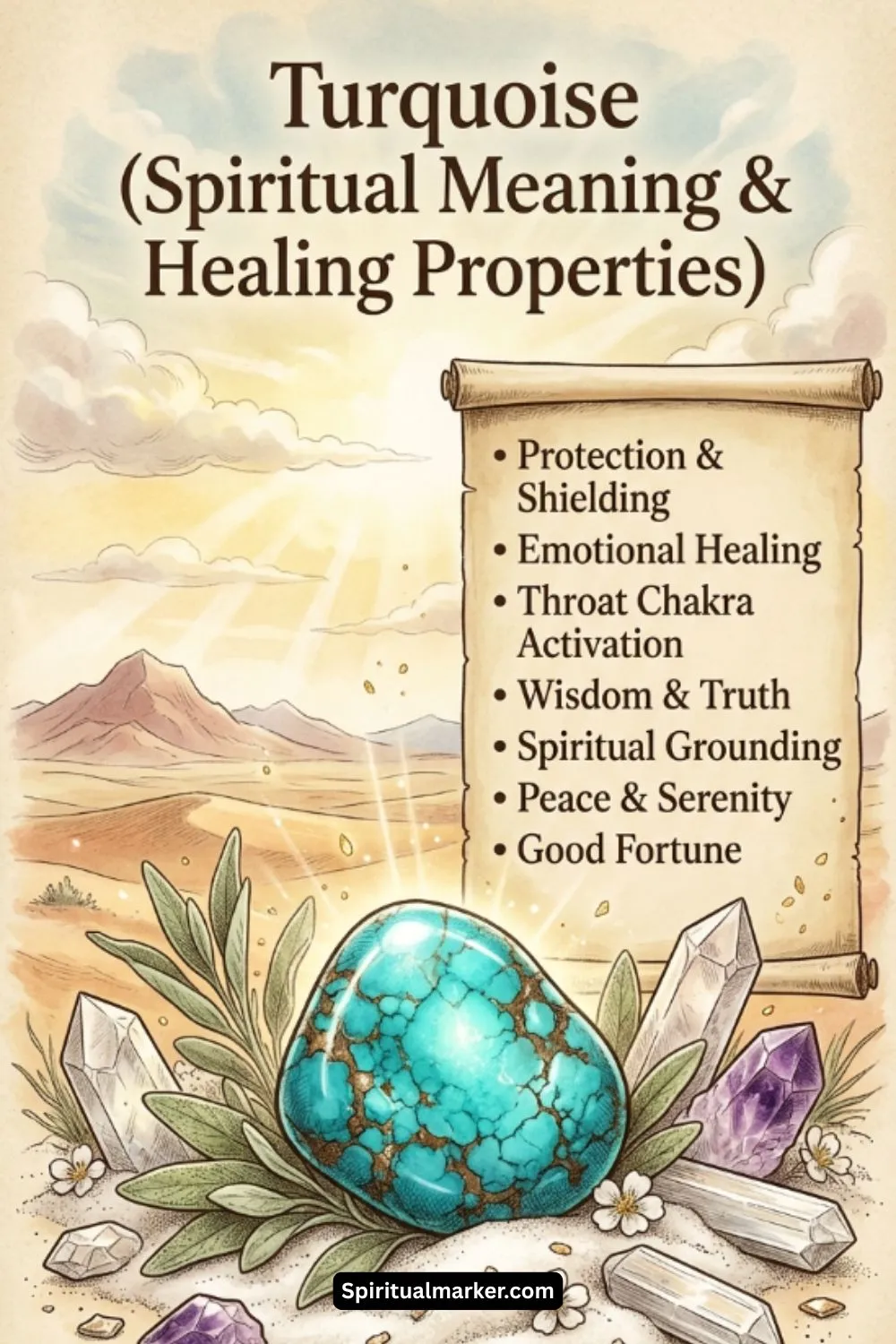
Turquoise is an opaque blue-green mineral formed through a chemical process that occurs when water containing copper and aluminum slowly moves through rock over thousands of years. As these minerals react, they create the distinctive blue-green material that humans have treasured since before recorded history. Its color ranges from sky blue to deep green depending on the concentration of copper and iron within its chemical composition.
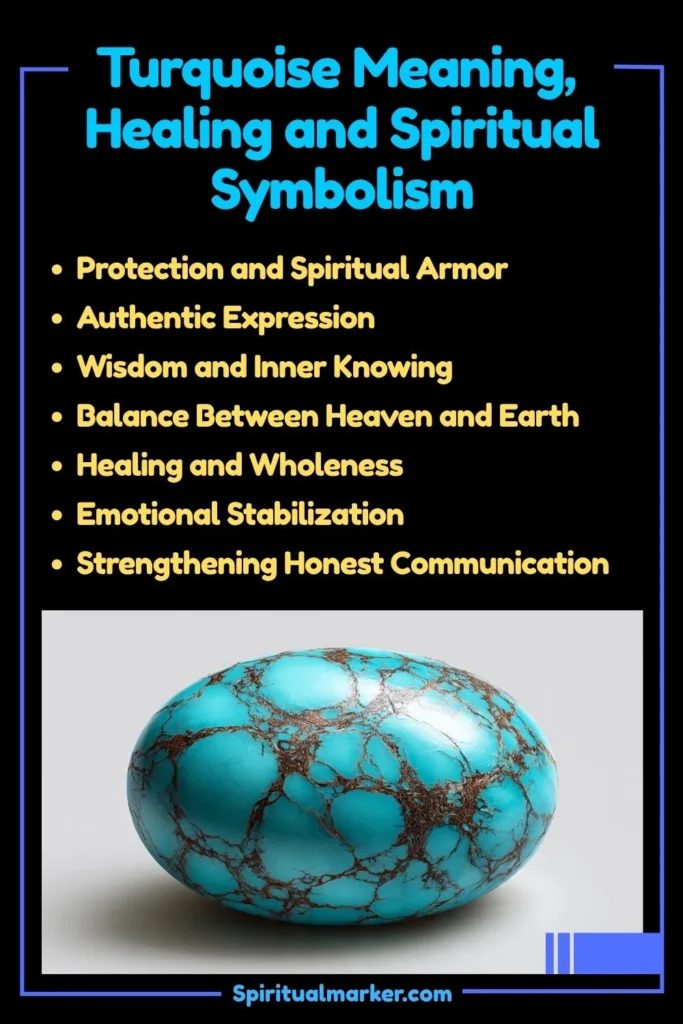
Chemically, turquoise is a hydrated phosphate of copper and aluminum. Its vivid color comes primarily from copper, which pushes the stone toward blue tones, while iron content drives it toward greener shades. No two pieces of turquoise look exactly the same. The dark veining patterns, called matrix, come from the host rock in which the stone forms. These patterns give each piece a completely unique visual identity.
People sometimes confuse turquoise with chrysocolla or amazonite because of shared color tones. However, turquoise carries a distinctly heavier, more grounded energy than either of those stones. Spiritually, turquoise feels ancient and protective, rooted in both the earth and the sky. That dual nature forms a major part of its enduring symbolic identity.
Origins and Formation of Turquoise
Turquoise forms in arid, copper-rich environments where rainfall slowly seeps through rock containing copper deposits. As the water evaporates, it leaves behind the mineral compounds that gradually solidify into turquoise over immense periods of geological time. This slow formation process adds deep symbolic weight to the stone. It represents patience, endurance, and transformation through gradual pressure.
Some of the world’s most significant turquoise deposits exist in Iran, where the famous Nishapur mines have produced turquoise for over three thousand years. Iran’s Persian blue turquoise remains among the most prized in the world for its pure, robin’s-egg blue color and minimal matrix. The United States, particularly the American Southwest, also produces exceptional turquoise from states like Arizona, Nevada, New Mexico, and Colorado. Turquoise from the Sleeping Beauty mine in Arizona became globally recognized for its clean, sky-blue appearance with little to no matrix.
Other notable sources include China, Mexico, Australia, and Tibet. Tibetan turquoise carries a distinctly green hue due to higher iron content, and it holds particular spiritual significance within Tibetan Buddhist traditions. Each region produces turquoise with slightly different coloring, texture, and energetic character, which is why spiritual practitioners often feel drawn to specific sources based on personal resonance.
Key Properties of Turquoise
| Property | Details |
|---|---|
| Color | Sky blue, blue-green, green, teal |
| Composition | Hydrated copper aluminum phosphate |
| Hardness | 5 to 6 on the Mohs scale |
| Chakra Association | Primarily the throat chakra; also third eye |
| Symbolism | Protection, wisdom, truth, healing, communication |
| Common Sources | Iran, USA, China, Tibet, Mexico, Australia |
| Transparency | Opaque |
| Energy Style | Protective, grounding, communicative, calming |
Historical Use of Turquoise Across Civilizations
Few gemstones carry as long and as rich a historical record as turquoise. Its story stretches back more than seven thousand years, making it one of the first gemstones ever used by human beings. Archaeological digs in Egypt have uncovered turquoise jewelry and amulets dating back to at least 3200 BCE. Pharaohs wore it. Priests used it in sacred rituals. Tutankhamun’s famous burial mask features turquoise prominently among its gold and lapis lazuli inlays.
In ancient Persia, turquoise was deeply woven into the national spiritual identity. Persian warriors believed turquoise offered divine protection in battle. They engraved Quranic verses and prayers onto the stone’s surface. Many wore it on armor, swords, and bridles. The stone’s name itself traces back through the French word “turquoise,” meaning Turkish, because the stone first reached Europe via Turkish trade routes from Persian mines.
Among Native American tribes, turquoise held sacred status across multiple nations. The Navajo, Zuni, and Hopi peoples of the American Southwest incorporated turquoise into jewelry, ceremonial objects, and spiritual practices for thousands of years. The Navajo considered turquoise a living stone. They believed it held the power to communicate between the human world and the spirit world. Apache shamans attached turquoise to their bows believing it improved accuracy and called in divine favor.
Aztec civilization treated turquoise as one of its most important materials. Aztec priests and rulers wore turquoise mosaics as symbols of divine authority. The famous Aztec turquoise mask, believed to represent the god Quetzalcoatl, remains one of the most striking examples of ancient turquoise artistry ever recovered. In Tibetan Buddhism, turquoise functioned as a bridge between the physical world and the higher realms of consciousness, commonly offered to monks and used in religious ceremonies.
5 Spiritual Meanings of Turquoise
1. Protection and Spiritual Armor
Across nearly every culture that used turquoise, protection emerged as its most consistent spiritual meaning. This is not a coincidence. Ancient peoples were extraordinarily observant of the natural world. When a stone appeared again and again in contexts of warfare, sacred ceremony, royal burial, and divine communication, it carried a reputation earned through generations of lived experience.
Persian soldiers inscribed turquoise with protective prayers. Native American hunters and warriors wore it against harm. Tibetan monks used it to guard against negative spiritual forces. Egyptian priests placed it in sacred tombs to protect the dead in their journey through the afterlife. That same protective symbolism runs through turquoise’s spiritual identity today. Many crystal practitioners believe it creates an energetic shield around the person who carries or wears it, deflecting negative energy and harmful intentions before they can take hold.
Spiritually, this protection is not passive. Turquoise does not simply block negative energy from the outside. Many traditions describe its protective quality as actively strengthening the inner self. A person who feels spiritually strong and emotionally grounded is naturally more resistant to external negativity. Turquoise symbolizes that inner fortification, the kind of spiritual resilience that comes from deep self-awareness and honest connection with one’s own values.
This meaning feels especially relevant during periods of major life change, emotional vulnerability, or spiritual uncertainty. When people face transitions that shake their sense of identity or stability, turquoise symbolically acts as an anchor. It grounds spiritual energy while maintaining an open, receptive connection to higher guidance. That combination of rootedness and openness makes its protective symbolism deeply layered rather than superficially defensive.
2. Truthful Communication and Authentic Expression
Turquoise has one of the strongest connections to truthful communication of any crystal in spiritual tradition. Its primary chakra association is the throat chakra, the energy center governing speech, self-expression, honesty, and authentic voice. When a person’s throat chakra operates with balance and clarity, they speak from a place of inner truth without fear, defensiveness, or distortion. When it feels blocked or suppressed, communication becomes difficult, dishonest, or emotionally loaded.
Many people carry deep fear around honest communication. That fear often develops slowly through experiences of being silenced, criticized, misunderstood, or punished for speaking truthfully. Over time, this creates emotional filters that distance speech from genuine inner experience. Spiritually, turquoise symbolizes the gradual process of reclaiming authentic voice. It encourages people to speak from a place of emotional honesty rather than social performance.
This symbolism also connects with listening. Genuine communication is never one-sided. Turquoise represents both the courage to speak truthfully and the receptivity to hear others clearly. Many traditional healers believed turquoise strengthened the ability to listen with empathy, without immediately reacting, judging, or filtering what is heard through personal defensiveness. That combination of honest expression and empathetic receptivity reflects the stone’s balanced energetic character.
In relationships, spiritual communities, professional environments, and personal healing, the ability to communicate honestly and kindly forms the foundation of trust. Turquoise spiritually represents this foundation. It does not encourage reckless or harsh speech. Instead, it symbolizes truth expressed with emotional wisdom and compassion, the kind of communication that builds rather than destroys connection.
3. Wisdom and Inner Knowing
Turquoise carries a deep association with wisdom that stretches far beyond intellectual knowledge. The wisdom turquoise symbolizes is not found in books or academic study alone. It is the kind of knowing that comes from lived experience, spiritual reflection, emotional honesty, and a willingness to look inward without flinching. Ancient cultures recognized this quality and honored turquoise as a stone that supported clear, unfiltered perception of reality.
In Native American traditions, wisdom elders frequently wore turquoise as a mark of spiritual authority. The stone represented not just age or status but the quality of inner clarity that develops when a person has spent a lifetime honestly examining their own motivations, actions, and spiritual relationship with the world. That depth of self-knowledge formed the basis of trusted leadership in many tribal communities.
Turquoise also connects with intuitive wisdom. Many spiritual practitioners associate it with the third eye chakra alongside its primary throat chakra connection. The third eye governs intuition, higher perception, and the ability to perceive truth beyond surface appearances. When both the throat and third eye energy centers operate in harmony, a person can both perceive deep truth and communicate it effectively. Turquoise spiritually represents this integration of inner knowing and outer expression.
This wisdom symbolism also involves learning from difficulty. True wisdom does not appear only during peaceful periods. It often deepens most profoundly through struggle, loss, failure, and emotional pain honestly processed. Turquoise reflects this reality. It does not symbolize wisdom as something static or inherited. Instead, it represents wisdom as something earned through courageous self-examination and sustained spiritual practice.
4. Balance Between Heaven and Earth
The color of turquoise sits at a fascinating spiritual intersection. Its blue tones connect symbolically with the sky, higher consciousness, and divine realms. Its green undertones connect with the earth, nature, physical grounding, and life force. This visual duality is not accidental. Across multiple spiritual traditions, turquoise was viewed as a stone that bridged heaven and earth, the spiritual and the material, the visible and the invisible.
Tibetan Buddhist practitioners placed turquoise at the center of spiritual altars because they believed it opened channels between the human realm and higher planes of consciousness. Native American traditions viewed turquoise as a piece of the sky that had fallen to earth, containing within it the energy of both worlds simultaneously. Persian spiritual texts described turquoise as carrying the light of heaven within an earthly form.
This symbolism carries deeply practical spiritual implications. Many people struggle to integrate spiritual awareness with everyday physical life. Spiritual experiences and insights can feel disconnected from the demands of daily reality. Turquoise spiritually represents the possibility of living fully in both dimensions simultaneously. It symbolizes a person who remains grounded, responsible, and fully present in the physical world while maintaining open access to spiritual awareness and divine guidance.
That integration is what many spiritual traditions describe as true wholeness. It is not about escaping physical life for the sake of spiritual experience. It is about bringing spiritual depth into physical life so that every action, relationship, and decision carries conscious awareness. Turquoise reflects this integrated way of being. Its dual nature as earth and sky makes it a powerful symbol of spiritual wholeness expressed through grounded living.
5. Healing and Wholeness
Across ancient Egypt, Persia, China, Tibet, and the Americas, turquoise carried a consistent reputation as a healing stone. Ancient healers did not always separate physical, emotional, and spiritual healing the way modern medicine does. They understood health as a unified condition affecting the whole person simultaneously. Turquoise symbolized this comprehensive healing, a restoration of wholeness rather than the fixing of isolated symptoms.
In Egyptian medical and spiritual practice, turquoise amulets were placed on the body to support healing and ward off disease. Persian physicians and spiritual healers used powdered turquoise in certain remedies, believing the stone carried healing energy that the body could absorb. While these specific applications differ from modern crystal healing practices, they reflect the same underlying belief: turquoise carries a healing quality that operates on multiple levels of human experience simultaneously.
Modern crystal healing traditions associate turquoise with emotional and energetic healing rather than direct physical treatment. Many practitioners believe it helps release stored emotional tension that silently accumulates in the body over time. Unprocessed grief, chronic stress, suppressed anger, or long-term anxiety may eventually manifest as physical symptoms. Turquoise symbolizes the gentle dissolution of that emotional residue through honest acknowledgment and spiritual release.
Its connection to healing also carries a forward-looking dimension. Turquoise does not only symbolize recovery from past wounds. It represents the movement toward greater wholeness and increased vitality. Many people who work with turquoise during personal healing journeys describe feeling more energetically aligned, more emotionally present, and more spiritually awake as the healing process unfolds over time.
6 Healing Properties of Turquoise
1. Emotional Stabilization
Turquoise carries a deeply calming energetic presence. Many people turn to it during periods of emotional turbulence, anxiety, overwhelm, or grief because its energy feels steady and stabilizing rather than stimulating or intense. Within crystal healing traditions, turquoise is widely believed to help reduce emotional reactivity, allowing a person to respond to difficult situations from a calmer, more centered internal state.
Emotional stabilization is not the same as emotional suppression. Turquoise does not symbolize pushing difficult emotions away or pretending everything is fine. Instead, many practitioners describe its healing energy as creating an internal emotional spaciousness where feelings can surface, be acknowledged, and gradually release without becoming chaotic or overwhelming. This process of honest emotional acknowledgment within a calm internal space forms the core of turquoise’s stabilizing healing role.
People dealing with anxiety, mood instability, emotional exhaustion, or post-traumatic stress often find turquoise particularly resonant. Its association with the throat chakra also connects it with the specific anxiety that surrounds communication and self-expression. Many individuals feel emotional distress not only from external circumstances but from the chronic internal pressure of suppressing their true thoughts, needs, and feelings. Turquoise symbolically addresses that specific form of emotional tension by encouraging authentic expression alongside emotional calm.
2. Strengthening Honest Communication
Because turquoise connects directly with the throat chakra, its healing properties include a powerful influence on communication. The throat chakra governs not only spoken words but the entire process of moving inner truth outward into the world through language, creative expression, leadership, teaching, and relational honesty. When this energy center operates freely, communication feels natural, confident, and emotionally genuine.
Many people experience throat chakra blockage as chronic difficulty expressing themselves clearly. They may feel verbally fumbling in important conversations, unable to advocate for their own needs, prone to saying yes when they mean no, or chronically misunderstood despite sincere effort. In crystal healing, turquoise is commonly used to help dissolve these communication blocks by encouraging a deeper alignment between inner truth and outer expression.
This healing property extends beyond personal conversation. Writers, teachers, public speakers, therapists, spiritual leaders, and anyone whose work depends on clear and authentic communication often feel drawn to turquoise because of this property. The stone symbolically supports the courage required to speak truthfully even when that truth is difficult, vulnerable, or unpopular. That kind of communicative courage is not about recklessness. It is about the slow, steady development of vocal integrity rooted in self-knowledge.
3. Boosting Self-Confidence and Personal Power
Turquoise has a long historical association with personal power. Kings wore it. Warriors carried it. Shamans used it. That consistent pattern across radically different cultures points to something meaningful. Turquoise symbolically supports the kind of personal power that comes not from dominance or aggression but from deep self-knowledge, spiritual clarity, and the confidence that grows when a person lives in alignment with their own values.
Many people struggle with genuine self-confidence not because they lack capability but because they have lost touch with their own inner authority. Chronic self-doubt, habitual people-pleasing, fear of judgment, or repeated experiences of being dismissed or invalidated can quietly erode a person’s sense of their own worth and power. Turquoise spiritually symbolizes the reclaiming of personal authority through honest self-reflection and the willingness to stand in one’s own truth.
This healing property also connects with leadership. Many spiritual traditions describe turquoise as a stone that strengthens the leader within each person. Not the performative leader who seeks approval, but the grounded, authentic leader who makes decisions based on inner wisdom rather than external pressure. That quality of leadership begins within and radiates outward. Turquoise symbolizes the inner development that makes genuine, trust-worthy leadership possible.
4. Spiritual Protection From Negative Energy
One of turquoise’s most consistent healing properties across all traditions is its role as a protective stone against negative energy, harmful intentions, and spiritual disturbance. Ancient cultures did not view the world as purely physical. They understood reality as multi-layered, containing spiritual forces that could either support or undermine human wellbeing. Turquoise was valued because it was believed to actively defend the wearer against those harmful spiritual influences.
Modern crystal healing traditions preserve this understanding. Many practitioners believe turquoise creates a stable energetic boundary around the person who wears or carries it, preventing the absorption of toxic emotional energy from other people or environments. This matters particularly for empaths, caregivers, teachers, and healers who regularly work in emotionally charged situations. Without energetic protection, consistent exposure to heavy emotional environments can lead to what many practitioners describe as spiritual fatigue or energetic depletion.
Turquoise symbolically addresses this vulnerability by strengthening the energetic field rather than simply blocking everything from outside. A person who feels spiritually strong and internally grounded naturally becomes more resilient to the emotional weight of difficult environments. Turquoise’s protective healing property works in harmony with its other qualities of grounding, emotional stability, and authentic self-expression to create a comprehensive energetic resilience.
5. Encouraging Forgiveness and Releasing the Past
Within spiritual healing traditions, turquoise is associated with the ability to release emotional attachments to the past that prevent present growth. Unresolved resentment, unprocessed grief, lingering guilt, or long-held anger can silently anchor a person to painful past experiences long after those experiences have ended. That emotional anchoring often creates a kind of invisible weight that limits personal freedom, emotional wellbeing, and spiritual development.
Forgiveness within this spiritual context does not mean minimizing harm or pretending that painful things did not happen. It means releasing the internal emotional grip that past pain continues to exert on present experience. Many spiritual traditions across different cultures and faiths emphasize this principle. Proverbs 17:9 states that “whoever would foster love covers over an offense,” pointing toward the spiritual value of releasing relational wounds for the sake of ongoing wellbeing and connection.
Turquoise symbolizes this process of emotional release and spiritual renewal. Its calming energy creates internal space where the decision to release past pain becomes possible without forcing emotional suppression. Many people find that working with turquoise during periods of forgiveness practice, grief processing, or emotional healing from relational wounds helps create a gentle but consistent movement toward greater emotional freedom and present-moment awareness.
6. Supporting Physical Vitality and Energetic Flow
While crystal healing is not a substitute for medical care, many traditions associate turquoise with physical vitality and energetic flow throughout the body. Ancient Egyptian, Persian, and Native American healing practices all incorporated turquoise into holistic health rituals that addressed physical symptoms alongside emotional and spiritual imbalances. The underlying belief was that physical wellbeing could not be separated from emotional honesty and spiritual alignment.
In modern energetic healing, turquoise is sometimes associated with supporting respiratory health, the immune system, and overall physical regeneration because of its strong connection to the throat and upper body region. Some practitioners also believe it supports the body’s natural ability to process and eliminate physical toxins by first dissolving the emotional and energetic toxins that may be burdening the physical system.
This healing property reflects turquoise’s broader symbolic identity as a stone of comprehensive wholeness. Physical vitality, in many spiritual traditions, is understood as the natural result of emotional honesty, spiritual alignment, and energetic balance maintained consistently over time. Turquoise symbolizes that integrated approach to health, treating the whole person rather than isolated symptoms. Its energy supports the kind of deep, sustainable vitality that flows from inner alignment rather than surface-level physical management alone.
Turquoise and the Throat Chakra Connection
The throat chakra, known in Sanskrit as Vishuddha, sits at the center of the neck and governs the entire spectrum of human communication and self-expression. It influences how people speak, listen, create, lead, and ultimately express their inner truth outward into the world. A balanced throat chakra allows for speech that is clear, confident, compassionate, and authentically aligned with inner knowing.
When the throat chakra carries energetic blockage, people often experience it as chronic difficulty expressing themselves clearly. They may speak over-apologetically, avoid important conversations, struggle with public speaking, find creative expression blocked, or feel that their true thoughts and feelings remain constantly unexpressed even when they desperately want to communicate them. Physical symptoms sometimes associated with throat chakra imbalance include sore throats, thyroid irregularities, jaw tension, and neck stiffness.
Turquoise’s vibrational frequency in crystal healing is believed to align naturally with the throat chakra’s energy. Many practitioners use turquoise during throat chakra meditation by holding the stone at the base of the throat while focusing on releasing communication fears and allowing authentic inner truth to rise naturally toward expression. The stone’s calming quality creates emotional safety around vulnerability, which many people need before honest communication becomes possible.
Beyond personal expression, the throat chakra also governs creative voice. Artists, musicians, writers, and performers often experience profound creative blocks when this energy center feels suppressed. Turquoise symbolically supports the opening of creative channels by aligning inner creative impulse with the courage required to express it authentically. That alignment between inner creative truth and outer creative expression often produces the most powerful and resonant creative work.
How to Wear Turquoise Jewelry for Spiritual Growth
People wear turquoise jewelry in many different forms depending on their spiritual intentions and personal style. Because turquoise connects most directly with the throat chakra, necklaces and pendants remain the most spiritually aligned choice for those specifically working with communication, authentic expression, or emotional healing related to self-voice. Wearing turquoise close to the throat creates a consistent energetic relationship between the stone and the chakra it resonates with most naturally.
Turquoise rings and bracelets carry their own significance, particularly in Native American jewelry traditions where turquoise rings often symbolized status, protection, and spiritual connection within the wearer’s community. Wearing turquoise on the hands may strengthen mindful, conscious communication during daily interactions and creative work. Many people also choose turquoise bracelets because constant physical contact with the stone throughout the day maintains a steady energetic relationship with its healing properties.
Turquoise earrings carry symbolism connected with listening and receptivity. Because the ears sit near the throat chakra and third eye chakra, turquoise worn at the ears may support both the ability to speak clearly and the deeper capacity to truly hear and receive what others communicate. This combination reflects turquoise’s balanced communicative energy, which honors both authentic expression and genuine, empathetic listening.
Many spiritual practitioners combine turquoise with other complementary crystals to create layered energetic support. Lapis lazuli pairs naturally with turquoise because both stones connect with the throat chakra and support truthful expression. Chrysocolla shares similar blue-green color and calming energy. Amazonite complements turquoise with its emphasis on emotional courage and boundary-setting in communication. Rose quartz combined with turquoise creates a combination of honest expression supported by compassionate heart energy.
Caring for Turquoise Jewelry
Turquoise requires gentle care because of its relatively porous structure and moderate hardness. Unlike diamonds or sapphires that resist most common chemical exposure, turquoise can absorb substances that permanently alter its color and structure. Oils, perfumes, sunscreen, cleaning products, and even heavy perspiration can penetrate its surface over time and cause discoloration or structural weakening.
Store turquoise jewelry separately from harder gemstones. Diamonds, rubies, sapphires, and even quartz crystals are harder than turquoise and can scratch its surface during storage or travel. Use soft fabric pouches or individual compartments in padded jewelry boxes. Avoid storing turquoise in areas with extreme temperature fluctuations, excessive dryness, or prolonged direct sunlight because these conditions can cause surface cracking or color fading over time.
Clean turquoise using a soft cloth slightly dampened with plain water. Avoid ultrasonic cleaners, steam cleaning equipment, harsh chemical jewelry cleaners, or abrasive cloths entirely. These can damage the stone’s surface, penetrate its porous structure, or loosen it from its setting. Remove turquoise jewelry before swimming, showering, exercising, gardening, or using household cleaning products.
Many people who work with turquoise spiritually also practice regular energetic cleansing of the stone. Common methods include leaving it under moonlight overnight, placing it near cleansing herbs like sage or cedar, using sound cleansing with a singing bowl or tuning fork, or simply holding it during intention-setting meditation with a focused focus on releasing any accumulated energetic residue. Spiritual cleansing practices vary widely depending on personal belief and tradition, so choose what feels most natural and aligned with your own spiritual framework.
Turquoise Meaning at a Glance
| Aspect | Details |
|---|---|
| Primary Meaning | Protection, communication, wisdom, healing |
| Chakra Association | Throat chakra (primary); third eye (secondary) |
| Main Spiritual Symbolism | Truth, balance, spiritual connection, wholeness |
| Common Colors | Sky blue, blue-green, teal, green |
| Hardness | 5 to 6 Mohs |
| Main Sources | Iran, USA, Tibet, China, Mexico, Australia |
| Emotional Associations | Calm, confidence, emotional honesty, resilience |
| Popular Jewelry Types | Pendants, rings, bracelets, earrings |
| Spiritual Uses | Throat chakra healing, protection, meditation |
| Care Needs | Soft cloth cleaning, avoid chemicals and heat |
A Final Note on Turquoise
Turquoise has earned its place in human spiritual life through thousands of years of consistent, cross-cultural recognition. No single civilization invented its meaning. No single tradition holds exclusive claim to its symbolism. Instead, cultures separated by vast distances and radically different worldviews arrived independently at the same conclusion: this stone carries something remarkable, something that speaks to the deepest human needs for protection, truth, healing, and connection with the sacred.
Its meaning today reflects that layered history. Whether you are drawn to turquoise for its protective symbolism, its connection with honest communication, its ancient healing reputation, or simply the way its color makes you feel something genuine, that attraction carries its own form of wisdom. Stones do not speak in words, but they speak in ways that language often struggles to capture.
If turquoise keeps appearing in your awareness, consider what its core themes might be reflecting in your current life. Are you navigating a period that calls for greater self-truth? Are you healing from experiences that require both emotional courage and inner calm? Are you seeking a stronger sense of spiritual protection while remaining open to growth? You might wear turquoise as a daily spiritual companion, keep a raw piece during meditation, or give a piece to someone walking through a season of significant personal change. However it enters your life, turquoise tends to make its presence felt in ways that matter.