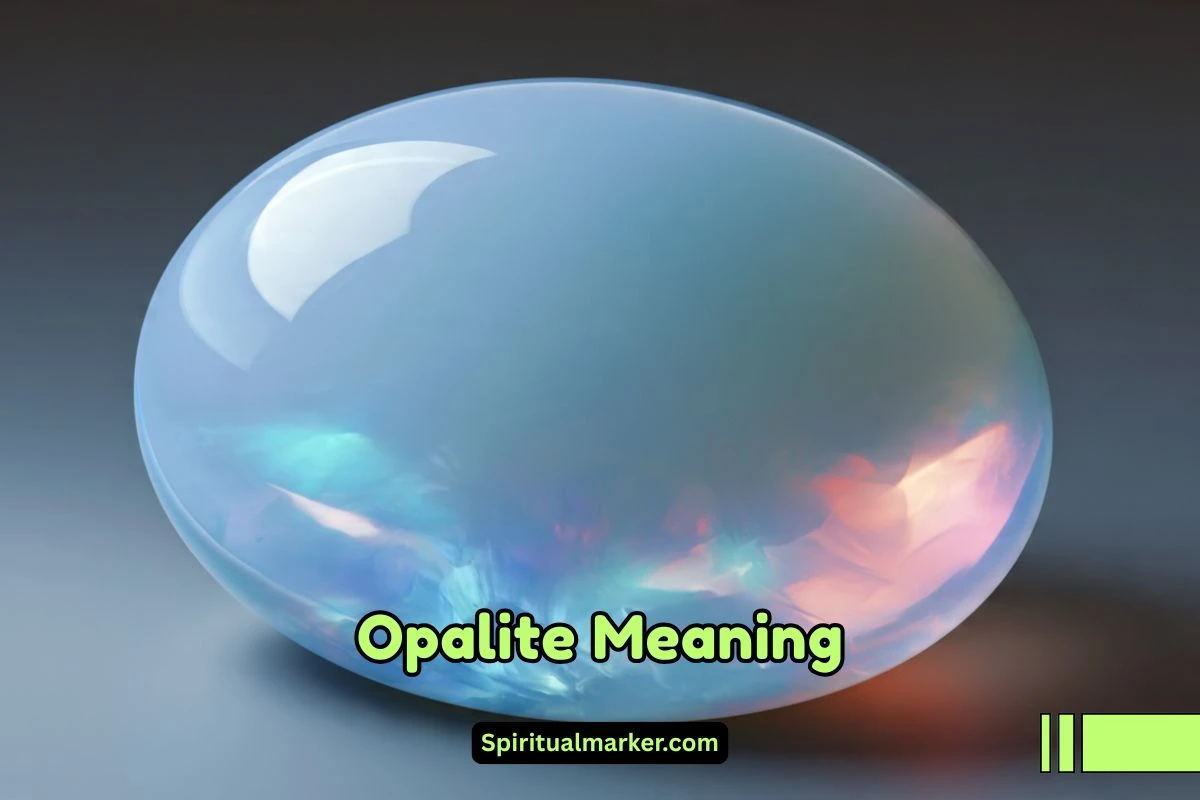
Opalite is a stone of hope and clarity. Its milky, iridescent surface glows with soft colors. In spiritual practice, this stone carries uplifting and calming energy.
The opalite meaning often involves hope, communication, and spiritual insight. It is a stone of the crown and throat chakras, helping to express truth and invite peace. A spiritual meaning of opal shares that opal focus, though opal carries a more vibrant energy.
Opalite is used in crystal healing to lift mood, improve communication, and support meditation. It can also symbolize optimism and new beginnings. The stone's energy is gentle and soothing.
If you feel drawn to opalite, it may signal a need for hope. A spiritual meaning of moonstone also deals with iridescent stones, though moonstone carries a more lunar energy.
Key Takeaways
- Opalite symbolizes emotional healing, inner clarity, transition, and spiritual communication.
- Many traditions connect Opalite with the third eye chakra and crown chakra, supporting intuition and higher awareness.
- People frequently use Opalite during meditation, life transitions, grief recovery, and spiritual growth work.
- Opalite is a man-made glass material, not a naturally formed mineral, yet its metaphysical reputation remains widely respected.
- Wearing or carrying Opalite may strengthen feelings of calm, clarity, emotional honesty, and spiritual openness.
What Is Opalite?
Opalite is a man-made, opalescent glass that mimics the appearance of natural opal. It has a soft, milky translucence with a signature blue glow when held against light. Against dark backgrounds, it often appears to shift between pale blue, violet, and white. Against lighter backgrounds, it takes on a warm golden or orange hue.
Despite being synthetic in origin, Opalite has earned genuine respect in crystal healing communities. Many practitioners value it not for its geological status but for the emotional and spiritual qualities people associate with it. Its calm appearance, smooth texture, and luminous quality contribute to its strong symbolic identity.
Some sellers market Opalite under different names, including Tiffany Stone, Sea Opal, Ice Cream Stone, or Purple Opal. This labeling is worth knowing when shopping. Genuine natural opals are a separate gemstone entirely, formed through geological processes over millions of years.
Opalite’s manufactured nature does not diminish its significance to those who work with it spiritually. Many crystal traditions hold that the intention, symbolism, and emotional resonance of a stone matter as much as its geological origins.
Origins and Creation
Natural opal forms when silica-rich water seeps through rock cavities over thousands of years. That process produces the flashing rainbow colors found in precious opals. Opalite, by contrast, is created in glassmaking facilities using a blend of glass compounds treated to produce its distinctive opalescent glow.
The result is a highly consistent stone. Unlike natural gemstones that vary in color, clarity, and quality from piece to piece, Opalite tends to look uniform and smooth. That visual consistency contributes to its wide availability and relatively affordable price compared to natural opals.
Some natural stones are occasionally sold under the Opalite name. These include opalite feldspar deposits found in certain parts of Africa and Australia. These natural versions form through volcanic activity and carry a similarly soft appearance. However, most Opalite found in crystal shops worldwide is the man-made glass variety.
Its origin story connects spiritually to themes of creation, transformation, and luminosity. Just as raw materials are shaped into something glowing and beautiful, many practitioners see Opalite as a symbol of inner transformation from ordinary to radiant.
Key Properties
| Property | Details |
|---|---|
| Type | Synthetic opalescent glass |
| Color | Milky white, pale blue, violet tones |
| Chakra Association | Third eye, crown chakra |
| Symbolism | Clarity, transition, communication, inner light |
| Hardness | Approximately 5.5 to 6.5 Mohs |
| Transparency | Translucent to semi-opaque |
| Energy Style | Gentle, uplifting, emotionally clearing |
| Common Uses | Meditation, jewelry, emotional healing, spiritual work |
Historical Use and Background
Natural opal has a long and rich history across ancient civilizations. Roman scholars believed opal contained the combined beauty of all gemstones. Ancient Arabic traditions described opal as having fallen from the sky in lightning flashes. In ancient India, opal was connected with the goddess of rainbows. These associations embedded opal firmly within spiritual symbolism long before modern crystal traditions emerged.
Opalite, as a manufactured material, has a shorter modern history. However, it inherited much of the symbolic identitysurrounding natural opal. Because it shares opal’s soft iridescence and luminous appearance, many practitioners extended opal’s spiritual meanings onto Opalite as well.
In New Age and crystal healing communities, Opalite grew in popularity during the late twentieth century. Its affordability, consistency, and visually calming beauty made it accessible to a wide audience. Crystal healers began working with it as a tool for emotional clearing, spiritual communication, and third eye activation.
Its milky glow also inspired comparisons to moonstone, another stone associated with intuition, emotional balance, and feminine energy. This visual similarity strengthened Opalite’s reputation for helping people access deeper emotional and spiritual awareness.
Today, Opalite remains one of the most popular stones used in beginner and advanced crystal practices alike. Its symbolism has matured through decades of use within spiritual communities worldwide.
5 Spiritual Meanings of Opalite
1. Emotional Healing and Release
Opalite carries a strong association with emotional healing because its energy is consistently described as clearing, calming, and emotionally honest. Many people seek it out during periods of emotional heaviness. Grief, heartbreak, confusion, or emotional numbness often bring people toward this stone before they consciously understand why.
Emotional wounds rarely announce themselves clearly. A person may feel vaguely tired, emotionally withdrawn, irritable without cause, or disconnected from relationships they genuinely value. These are often signs of suppressed emotional pain that has settled beneath the surface over time. Within crystal traditions, Opalite is believed to help bring these buried emotions gently toward awareness so they can be acknowledged and processed.
The key word in Opalite’s healing symbolism is gentleness. It does not force emotional confrontation or create dramatic inner upheaval. Instead, it is associated with a gradual emotional softening. Think of a knot slowly loosening rather than snapping suddenly. That slower emotional release allows people to process difficult feelings without becoming overwhelmed.
Many practitioners also associate Opalite with emotional honesty. People often carry feelings they have never fully admitted to themselves, including unexpressed sadness, unspoken resentment, or quiet fear. Spiritually, Opalite is believed to create a safer emotional environment for that honesty to surface. When emotions are named and acknowledged, healing becomes possible in ways it cannot when emotions stay hidden.
This meaning also reflects emotional self-compassion. Opalite’s soft, luminous energy symbolizes the idea that healing does not require emotional perfection. You do not need to have everything resolved or fully understood. The stone symbolizes progress, not completion. Its light-filled appearance reflects the idea that even small emotional shifts carry real significance.
2. Communication and Expression
Opalite has a well-established reputation for supporting communication, both human-to-human and spiritual in nature. Many practitioners connect it with clearer verbal expression, emotional honesty in conversation, and greater spiritual receptivity. People who struggle with expressing feelings, asking for what they need, or speaking truthfully about inner experiences are frequently drawn to this stone.
Communication difficulties often stem from emotional fear rather than lack of words. People may know what they want to say but feel too vulnerable, too afraid of rejection, or too uncertain of their own emotional validity to say it openly. Opalite spiritually represents the courage that emotional clarity makes possible. When you feel more inwardly settled, speaking honestly becomes less frightening.
In spiritual traditions, Opalite is also associated with communication beyond the physical. Many practitioners use it during prayer, meditation, channeling, or spiritual journaling because they believe it strengthens receptivity to higher guidance. It is sometimes called a stone of communication within metaphysical traditions for this reason.
Its connection to the third eye chakra reinforces this symbolism. The third eye governs intuition, inner vision, and the ability to perceive beyond surface appearances. When this energy center feels open and active, people often report clearer intuitive insights, stronger emotional discernment, and a greater sense of spiritual connection.
Opalite also symbolizes listening as part of healthy communication. True communication is not only about speaking clearly. It involves the ability to receive, to hear what others are truly expressing beneath their words. Spiritually, Opalite reflects this receptive quality, supporting both the courage to speak and the openness to truly hear.
3. Transition and Change
Among all the spiritual meanings associated with Opalite, its connection with transition may be the most widely recognized. Crystal practitioners have long associated this stone with major life changes, endings, and new beginnings. Its shimmering, color-shifting appearance mirrors the nature of transition itself: something that looks different depending on how the light falls on it.
Transitions are emotionally complex experiences. Even positive changes carry grief. A person moving toward a new career, ending a relationship, relocating, recovering from illness, or entering a new phase of identity often feels a complicated mix of hope, fear, loss, and uncertainty simultaneously. Opalite is said to ease this emotional complexity by encouraging emotional steadiness during uncertain periods.
Many people resist transition even when they intellectually know it is necessary. Fear of the unknown often feels more powerful than the discomfort of staying in familiar but limiting situations. Opalite spiritually symbolizes the courage to move forward even when the path ahead is not entirely clear. Its glowing translucence reflects the idea that clarity does not require complete visibility. You can move forward with partial light.
This symbolism also reflects release. Every meaningful transition requires leaving something behind. Old identities, relationships, habits, emotional patterns, or beliefs that once felt necessary may need to be released for new growth to occur. Opalite is frequently associated with this releasing process, particularly when clinging to the past creates emotional pain or stagnation.
Many practitioners use Opalite during life milestone ceremonies, grief rituals, or intention-setting practices connected with major changes. Its glowing quality symbolizes the light that becomes visible when one chapter closes and another begins. Rather than representing darkness or loss alone, Opalite reflects transformation as a luminous process.
4. Spiritual Awareness and Intuition
Opalite is strongly associated with heightened spiritual awareness, intuitive development, and deepened inner perception. Its connection with the third eye and crown chakras places it within a tradition of stones believed to support consciousness expansion, spiritual insight, and connection with higher wisdom.
Spiritual awareness, in practical terms, means becoming more attuned to inner guidance. It involves noticing intuitive signals before they become impossible to ignore, developing greater sensitivity to energetic environments and relationships, and building the kind of self-knowledge that comes from deep inner reflection rather than surface-level thinking.
Many people feel spiritually disconnected during demanding periods. When daily life becomes heavily focused on productivity, external obligations, and mental problem-solving, spiritual sensitivity often dulls. You may stop noticing subtle intuitive signals, feel disconnected from meaningful spiritual practice, or experience a general sense of inner flatness that is difficult to trace to a specific cause.
Opalite is said to support the gradual reopening of spiritual awareness. Rather than forcing sudden psychic experiences or overwhelming intuitive floods, its energy is described as inviting and gentle. People who meditate with Opalite often report quieter minds, clearer mental imagery, and stronger feelings of spiritual connection during practice.
Its translucence carries spiritual meaning as well. Light passes through Opalite rather than reflecting entirely off its surface. Many practitioners interpret this as a symbol of spiritual permeability, the capacity to receive higher guidance without blocking it with excessive mental resistance, emotional defensiveness, or rigid belief systems.
Crown chakra connections further deepen Opalite’s spiritual identity. The crown chakra governs connection with universal consciousness, spiritual purpose, and awareness beyond the physical self. When this energy center feels open, people often describe feelings of expanded perspective, greater spiritual peace, and a quieter, more trusting relationship with life’s uncertainties.
5. Inner Clarity and Personal Truth
One of Opalite’s most meaningful spiritual associations involves inner clarity and the pursuit of personal truth. Many people move through daily life carrying a significant gap between what they genuinely feel and what they present to the world. This gap may develop gradually through years of emotional conditioning, social pressure, self-doubt, or fear of judgment.
Inner clarity means becoming honest with yourself about what you truly value, what you genuinely feel, and what you actually need rather than what you believe others expect from you. This kind of honesty requires emotional courage. It also requires a quiet enough inner environment that your own truth can be heard beneath the noise of external expectations.
Opalite spiritually represents this inner quieting process. Its calm, luminous energy is associated with creating the emotional stillness necessary for self-honesty to emerge. When the emotional environment feels safer and more settled, personal truth becomes clearer and less threatening.
Many practitioners also associate Opalite with authenticity. People who spend long periods performing emotional states they do not genuinely feel often experience a subtle but persistent sense of inner fragmentation. Something feels off even when external circumstances look fine. Opalite’s symbolism points toward the emotional realignment that becomes possible when inner experience and outer expression become more aligned.
This meaning resonates especially during periods when self-doubt has been particularly strong. After experiences of rejection, repeated criticism, or prolonged emotional pressure, many people lose touch with their own perceptions and instincts. They begin second-guessing feelings that are actually accurate and valuable. Opalite symbolically represents the recovery of trust in one’s own inner experience.
6 Healing Properties of Opalite
1. Emotional Balance
Opalite’s primary healing reputation centers on emotional balance. Many crystal practitioners describe it as a stone that helps stabilize emotional swings without suppressing genuine feeling. This distinction matters. Emotional balance does not mean emotional flatness or emotional numbness. It means creating a more regulated internal emotional environment where difficult feelings can be experienced without becoming destabilizing.
Emotional dysregulation is common during periods of sustained stress, trauma recovery, grief, or major life upheaval. Feelings may arrive suddenly and intensely. Emotional reactions may feel disproportionate to their triggers. Emotional exhaustion may make even ordinary daily tasks feel overwhelming. Opalite’s healing symbolism focuses on gently steadying this emotional instability.
Many people who work with Opalite describe the experience as calming without being numbing. They still feel their feelings. However, those feelings begin to feel more manageable and less consuming. This reflects Opalite’s general energetic identity as a stone of emotional clarity rather than emotional suppression.
Its soft visual appearance reinforces this healing quality. The milky, light-filled translucence of Opalite aesthetically mirrors what emotional balance can feel like: clear, soft, and illuminated from within rather than darkened by emotional overload.
2. Clearing Mental Fog
Many people associate Opalite with mental clarity and the relief of mental fog. Mental fog often accompanies emotional stress, grief, burnout, hormonal shifts, or periods of spiritual disconnection. It creates a sense of cognitive dullness where concentration feels difficult, decision-making feels uncertain, and mental energy feels chronically low.
Within crystal traditions, Opalite is believed to support clearer thinking by helping to calm the emotional undercurrents that often create mental cloudiness. When emotional noise quiets, mental clarity often follows naturally. The mind functions better when it is not simultaneously managing high emotional pressure.
Practitioners frequently use Opalite during study, creative work, journaling, and reflective thinking sessions. Its calming but clarifying energy is believed to support focused mental states without the overstimulation that sometimes accompanies stones associated with higher energy activation.
This healing property also connects with decision-making during transitions. When major life decisions feel emotionally overwhelming, clarity becomes especially precious. Opalite’s symbolism suggests that clearer choices emerge when emotional turbulence settles enough to allow genuine inner discernment.
3. Strengthening Intuition
Opalite is frequently used in practices specifically aimed at developing and trusting intuition. Intuition refers to the kind of knowing that arrives without full conscious reasoning. It is the sense that something is right or wrong before you can fully articulate why. Many people dismiss their intuitive signals as irrational until emotional evidence eventually confirms what intuition communicated first.
Within crystal healing traditions, Opalite is said to help strengthen the signal-to-noise ratio of intuitive experience. Instead of intuitive signals being drowned out by mental noise, emotional reactivity, or self-doubt, they become clearer and more consistent. Many practitioners report stronger gut feelings, more meaningful dream experiences, and greater sensitivity to energetic shifts in their environments when working regularly with Opalite.
Third eye chakra activation is central to this healing property. The third eye governs inner vision and intuitive perception. When this energy center feels clear and active, intuitive awareness tends to sharpen. Opalite’s association with this chakra makes it a natural tool for practices aimed at intuitive development and spiritual discernment.
4. Supporting Grief and Loss
Opalite has earned a particular reputation for supporting people through grief and loss. Grief is one of the most emotionally complex human experiences. It does not follow predictable patterns. It arrives in waves, often during unexpected moments. And it frequently involves a deeply personal process that cannot be hurried, bypassed, or resolved through willpower alone.
Crystal practitioners often bring Opalite into grief support practices because its energy is described as emotionally holding rather than emotionally rushing. It does not push people toward resolution before they are ready. Instead, it symbolizes compassionate presence with the pain of loss, which is often what grieving people need most.
Its connection with transition makes it especially relevant in grief work. Loss is, among other things, a profound transition. It involves the painful adjustment to a life that no longer contains what was previously present. Opalite spiritually reflects this adjustment process, acknowledging that transition takes time and that emotional pain during that time is valid and significant.
Many practitioners place Opalite in spaces dedicated to grief rituals, memorial practices, or quiet emotional reflection. Its soft glow symbolically reflects the light that remains even in the presence of deep loss.
5. Sleep and Dream Support
Some crystal practitioners use Opalite specifically to support restful sleep and meaningful dreaming. Sleep disruption commonly accompanies emotional stress, anxiety, grief, or periods of major life change. The mind may feel unable to quiet enough to allow genuine rest, or sleep may come but without the restoration it normally provides.
Opalite’s calming energy is said to help ease the transition from waking consciousness to sleep. Its gentle third eye connection is believed to support clearer, more vivid, and more emotionally meaningful dream experiences. Many practitioners who value dream work as a spiritual practice use Opalite on their bedside table or beneath their pillow during sleep.
Dreams carry significant emotional content in many traditions. They may process experiences the waking mind has not fully integrated. They may surface feelings that have been suppressed during waking hours. Opalite’s healing symbolism in sleep contexts centers on supporting emotional processing through the dream state, allowing deeper rest and more meaningful unconscious reflection.
6. Anxiety Relief
Opalite carries a consistent reputation for supporting people experiencing anxiety. Anxiety often creates a relentless internal experience of emotional tension, mental overactivity, and physical restlessness. The mind anticipates future threats, replays past difficulties, or maintains a low-level alarm state that feels impossible to switch off.
Crystal practitioners describe Opalite as particularly helpful for calming this internal alarm. Its energy is not forceful or intense. Instead, it represents the kind of steady, quiet calm that slowly reduces emotional reactivity without requiring dramatic effort or intervention.
Many people carry Opalite in pockets, wear it as jewelry, or hold it during moments of acute anxiety because physical contact with the stone provides an anchor for grounding attention in the present moment. This sensory focus can interrupt anxious thought cycles and create a brief but meaningful pause in emotional escalation.
Opalite’s symbolism of inner light during uncertainty also carries emotional comfort for people living with anxiety. The stone visually represents the idea that clarity, calm, and brightness exist even when emotional experiences feel heavy or clouded.
How to Use Opalite for Spiritual Practice
Opalite works well across many different spiritual practices. Its gentle energy makes it accessible for both beginners and experienced practitioners. You do not need an elaborate ritual to benefit from its symbolism and calming presence.
Meditation is one of the most common uses. Holding Opalite in your palm or placing it at your third eye during seated meditation is said to deepen stillness, sharpen inner focus, and support clearer intuitive awareness. Even ten minutes of quiet meditation with Opalite held in both hands can create a noticeably calmer internal state.
Many people also use Opalite during journaling sessions focused on emotional processing, self-reflection, or spiritual inquiry. Keeping the stone on the table or desk while writing is believed to support emotional honesty and clearer self-expression.
Dream work practitioners often place Opalite near their sleeping space. Setting a specific intention before sleep, such as receiving clarity about a situation or processing a particular emotional experience, combines well with Opalite’s symbolic connection to inner vision and transition.
Some practitioners combine Opalite with stones like amethyst for deepened spiritual awareness, moonstone for intuitive sensitivity, or clear quartz for amplified clarity. These combinations can create a layered energetic environment suited to complex healing work.
How to Wear Opalite Jewelry for Spiritual Growth
Wearing Opalite jewelry allows ongoing contact with the stone throughout daily life. This consistent presence is believed to strengthen its calming and clarifying influence over time.
Opalite pendants worn near the throat or chest align the stone with both communication and heart-centered awareness. Many people find this placement supports clearer emotional expression during conversations that feel emotionally charged.
Opalite rings and bracelets keep the stone in frequent physical contact with the hands and wrists. Because hands are involved in nearly all daily activity, this placement symbolically extends Opalite’s calming influence throughout the day. Many people reach for an Opalite bracelet during moments of stress or emotional tension.
Earrings featuring Opalite place the stone near the head, which many practitioners associate with its third eye and crown chakra connections. This placement is said to support clearer thinking, intuitive openness, and spiritual awareness during daily activity.
Some people rotate which piece of Opalite jewelry they wear depending on their emotional or spiritual focus for the day. This intentional approach deepens the stone’s symbolic relevance by matching its placement with a specific healing or spiritual intention.
Caring for Your Opalite
Caring for Opalite requires relatively gentle handling. Because it is a glass material, it can chip, scratch, or crack if dropped or exposed to significant impact.
Store Opalite separately from harder stones and metals that may scratch its surface. A soft fabric pouch or a cushioned jewelry box works well. Avoid leaving it in direct sunlight for extended periods because prolonged heat exposure may affect its clarity over time.
Clean Opalite gently using lukewarm water and a soft cloth. Mild, unscented soap is acceptable for occasional cleaning. Avoid chemical cleaners, ultrasonic cleaning machines, or abrasive materials that could damage its surface polish.
Remove Opalite jewelry before swimming, bathing, or engaging in physically demanding activity. Chlorine and saltwater may damage the stone’s finish over time.
For energetic cleansing, many practitioners prefer moonlight exposure, sound cleansing with a singing bowl or tuning fork, or placing Opalite near cleansing herbs such as lavender. Because Opalite is glass rather than a porous natural stone, it does not absorb water-based energetic preparations as readily as some natural crystals. Moonlight and sound methods are widely considered safe and effective for maintaining its energetic quality.
Table: Opalite Meaning at a Glance
| Aspect | Details |
|---|---|
| Primary Meaning | Emotional clarity and transformation |
| Chakra Association | Third eye chakra, crown chakra |
| Main Spiritual Symbolism | Transition, intuition, inner light, communication |
| Common Colors | Milky white, pale blue, violet tones |
| Material Type | Synthetic opalescent glass |
| Emotional Associations | Calm, clarity, emotional release, hope |
| Healing Focus | Anxiety relief, grief support, emotional balance |
| Popular Jewelry Types | Pendants, bracelets, rings, earrings |
| Spiritual Uses | Meditation, dream work, intuition development |
| Care Needs | Gentle cleaning, protection from impact and heat |
A Final Note
Opalite holds a quiet but powerful place in the world of crystal healing and spiritual symbolism. Its luminous glow, emotionally calming presence, and connection with transition and clarity make it genuinely meaningful to people navigating emotionally complex periods of life.
Its manufactured origin does not reduce its significance. Meaning, intention, and symbolism carry weight in spiritual practice. The emotional resonance people feel when working with Opalite reflects something real in the relationship between visual, tactile, and symbolic experience. Many practitioners have found genuine comfort and clarity through working with this gentle, glowing stone.
Whether you are drawn to Opalite’s beauty, its calming energy, its connection with intuition, or its reputation as a stone of transition and inner light, that pull is worth honoring. You may find it becomes a meaningful companion during periods when emotional steadiness, spiritual clarity, or simply a quiet sense of inner brightness feels most needed.