
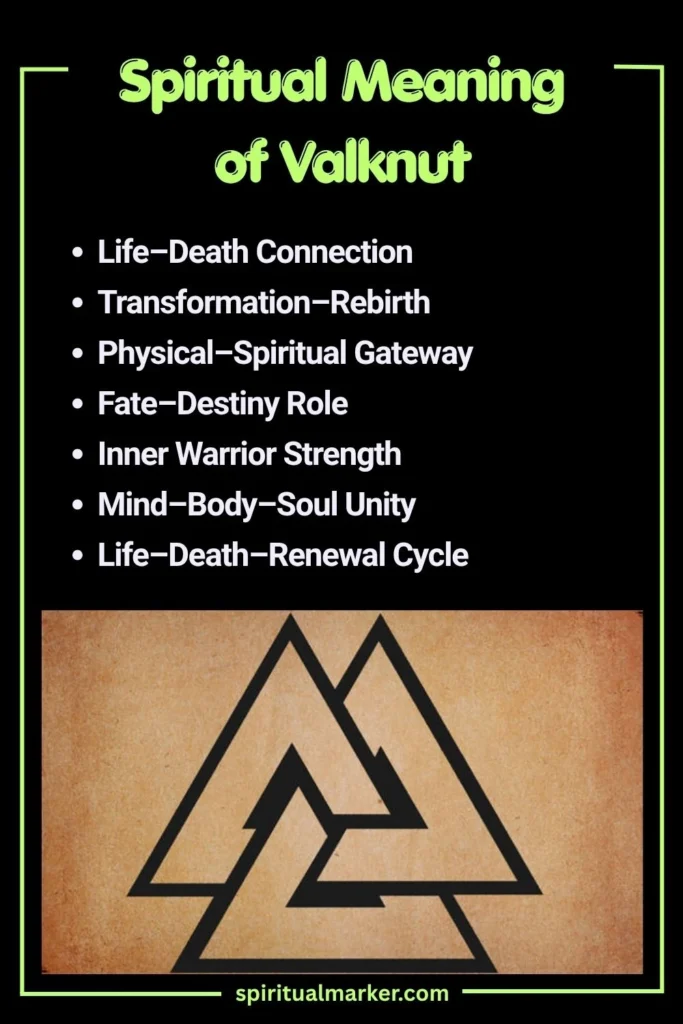
The valknut is a symbol of three interlocking triangles. It appears in Norse art and mythology, often associated with Odin and the slain. Across cultures, this symbol carries deep spiritual meaning and power.
The valknut spiritual meaning often involves fate, death, and the transition between worlds. The three triangles can represent the past, present, and future, or the realms of the living, dead, and divine. A spiritual meaning of three dots in a triangle shares that triangle-focused symbolism, though three dots carry a simpler message.
Some traditions view the valknut as a symbol of protection or a guide for the soul. Others see it as a sign of sacrifice and transformation. The context of where you see the symbol can add detail.
If the valknut keeps appearing, it may signal a need for courage. A spiritual meaning of an upside down triangle also deals with triangle symbolism, though an upside down triangle carries a different energy.
What is the Valknut? Origins and Symbolic Structure
The word Valknut comes from Old Norse roots. “Valr” means fallen warriors, while “knut” means knot. Together, it often translates to the “knot of the slain.”
Visually, the Valknut consists of three interlocking triangles. These triangles form a continuous loop, which has no clear beginning or end. That design alone hints at cycles, eternity, and connection.
Historians found this symbol carved on ancient stones, especially in Viking burial sites. It often appears near images of warriors or scenes of battle. Because of this, many scholars connect it with death and the afterlife.
However, its structure also suggests something deeper. The number three holds spiritual power in many traditions. It often represents balance, unity, and the connection between realms. In the Valknut, those triangles may reflect mind, body, and spirit, or past, present, and future.
So while its origin lies in Norse culture, its meaning stretches far beyond one interpretation.
10 Spiritual Meanings of Valknut
1) Life–Death Connection
The Valknut carries a deep message about the link between life and death. At first glance, death feels like an ending. However, in Norse belief, it works more like a doorway. The symbol reminds us that existence does not stop. Instead, it shifts into another form.
In Viking culture, warriors who died bravely did not simply vanish. The Valkyries chose them and guided them to Valhalla. Because of this, the Valknut became closely tied to this sacred passage. It stood as a mark of honor and transition.
At a spiritual level, this meaning helps reduce fear of death. It suggests that death belongs to a natural rhythm. When you reflect on it, you begin to see life as part of a bigger cycle. This perspective often brings peace, especially during times of loss.
2) Transformation–Rebirth
The interlocking triangles also represent transformation. Nothing in life stays fixed. Everything changes, evolves, and takes on new forms. The Valknut captures this constant motion in a simple yet powerful design.
In Norse mythology, Odin sacrificed himself to gain wisdom. That act was not about loss alone. It was about growth through hardship. Because of this story, the Valknut often symbolizes rebirth through struggle.
Spiritually, this meaning encourages you to accept change. Even painful endings can lead to new beginnings. When something falls apart, something else quietly starts forming. The symbol reminds you to trust that process.
3) Physical–Spiritual Gateway
Another important meaning lies in the connection between the physical and spiritual worlds. The three triangles seem to weave through each other. Because of that, they suggest movement between different realms of existence.
In Norse thought, reality was not limited to what people could see. There were multiple worlds, all connected in unseen ways. The Valknut reflects that idea. It acts as a symbolic bridge between visible and invisible dimensions.
When people use this symbol in meditation, they often focus on awareness. It helps them look beyond the surface of daily life. As a result, they feel more connected to something greater than themselves.
4) Fate–Destiny Role
The Valknut also speaks about fate. In Norse belief, the Norns shaped the destiny of every individual. No matter how strong or wise someone was, they could not escape their path.
Because of this, the symbol reminds people to accept their journey. It does not mean giving up control. Instead, it means understanding that some events are part of a larger design.
This idea can feel both heavy and comforting. On one hand, it limits control. On the other hand, it removes the pressure to fight everything. You begin to move with life instead of against it.
5) Inner Warrior Strength
The Valknut strongly connects to the idea of the warrior spirit. However, this does not only apply to physical battles. It also reflects inner struggles that everyone faces.
Life brings challenges, doubts, and fears. During those moments, the symbol acts as a reminder of strength. It pushes you to stand firm, even when things feel uncertain.
In modern times, many people use it as a personal symbol of courage. It encourages mental resilience. It also builds the confidence to face difficult situations without backing down.
6) Mind–Body–Soul Unity
The three triangles naturally point to a three-part balance. Many interpret this as the unity of mind, body, and soul. Each part plays a role, and none should dominate the others.
When one part becomes weak, imbalance follows. For example, a strong mind with a neglected body leads to burnout. Similarly, ignoring the soul can create a sense of emptiness.
The Valknut reminds you to care for all three aspects. When they work together, life feels more stable. You think clearly, act with purpose, and feel connected on a deeper level.
7) Life–Death–Renewal Cycle
Beyond the connection between life and death, the symbol also highlights renewal. Each triangle can represent a stage: birth, life, and death. Together, they form a continuous loop.
This idea reflects nature itself. Seasons change, plants grow and fade, and life constantly renews itself. The Valknut mirrors this endless rhythm.
When you understand this cycle, endings become less frightening. You start to see them as necessary steps. Every ending clears space for something new to grow.
8) Journey Protection
Historically, the Valknut appeared on runestones and burial sites. Because of that, many believe it offered protection during spiritual journeys. It guided souls through uncertain spaces.
Even today, people use the symbol for protection in a different way. They see it as a shield during emotional or spiritual transitions. For example, during deep meditation or personal change.
It acts like a quiet companion. It does not remove challenges, but it provides a sense of safety. That feeling helps people move forward with more confidence.
9) Higher Purpose Sacrifice
Sacrifice plays a central role in Norse mythology. Odin’s quest for wisdom required pain and loss. Warriors also sacrificed their lives for honor and a greater cause.
The Valknut reflects this idea of giving something up for a higher purpose. It does not glorify suffering. Instead, it highlights meaningful sacrifice.
In daily life, this meaning appears in small choices. Sometimes you let go of comfort to achieve growth. Other times, you give your time or energy for something bigger than yourself. The symbol reminds you that such sacrifices can lead to deeper fulfillment.
10) Spiritual Interconnectedness
Finally, the interlocking design itself carries a powerful message. Nothing exists in isolation. Every part connects with another, forming a larger whole.
This idea applies to people, nature, and even unseen forces. Your actions affect others, even in ways you may not notice. The Valknut reflects this hidden web of connection.
When you truly accept this, your perspective shifts. You become more aware of your choices. You also feel more connected to the world around you. That awareness often leads to a more mindful and meaningful life.
Norse Mythology and the Valknut Connection
To understand the Valknut, you must step into the world of Norse mythology. This symbol often appears alongside Odin, the Allfather and god of wisdom, war, and death.
Odin had a unique role. He guided fallen warriors to Valhalla, where they prepared for the final battle. Because of this, many believe the Valknut represents those chosen by Odin.
Interestingly, Odin also practiced seidr, a form of magic linked to fate and transformation. This adds another layer to the symbol. It may not only represent death but also the power to move between worlds.
Some interpretations suggest that the Valknut symbolizes Odin’s ability to bind and unbind the mind. In other words, it reflects control over life, death, and consciousness.
So, while the symbol connects to fallen warriors, it also speaks about spiritual mastery and deeper awareness.
Cultural and Historical Interpretations
Over time, the Valknut has taken on different meanings across cultures and perspectives.
First, in Viking burial sites, it clearly connects to death rituals and the afterlife. It often appears near ships or warriors, suggesting a journey beyond this world.
Second, some scholars interpret it as a symbol of sacrifice. Warriors who died in battle were seen as offering themselves for a greater purpose.
Third, in spiritual circles today, people view it as a sign of transformation. It reflects the idea that endings always lead to new beginnings.
Fourth, others see it as a protective symbol. They believe it helps guide the soul during transitions, whether physical or emotional.
Fifth, modern interpretations connect it to personal growth. The interlocking triangles can represent breaking old patterns and stepping into a new version of yourself.
Sixth, some link it to cosmic balance. The three triangles may represent different realms working together in harmony.
Finally, a few interpretations focus on mystery and hidden knowledge. The symbol invites you to question reality and explore deeper truths.
Black Valknut Vs White Valknut Symbol Meaning
Color often changes how a symbol feels. The Valknut is no exception.
A black Valknut usually carries a heavier, more intense energy. People often connect it with death, mystery, and the unknown. It can represent endings, shadow work, or facing inner fears.
On the other hand, a white Valknut feels lighter and more peaceful. It often symbolizes purity, spiritual awakening, and protection. Many see it as a guide through transformation rather than a sign of loss.
While both versions share the same structure, their emotional impact differs. One leans toward depth and shadow. The other leans toward clarity and light.
Your interpretation depends on what resonates with your personal journey.
Valknut or 3 Interlocking Triangles Tattoo Meaning
Choosing a Valknut tattoo is rarely random. People who wear it often feel a strong personal connection.
For some, it represents strength and courage. It reminds them to face challenges like a warrior. For others, it symbolizes transformation after a difficult phase in life.
Many also choose it to honor lost loved ones. In this case, the symbol becomes a quiet tribute, carrying memory and respect.
At the same time, some people wear it as a sign of spiritual awakening. It reflects their journey toward deeper understanding and self-discovery.
Placement matters too. A tattoo near the heart may represent emotional growth. One on the arm may symbolize strength and action.
In the end, the meaning becomes deeply personal. The symbol may have ancient roots, but your story gives it life.
Is Valknut a Symbol of Death or Transformation?
This question comes up often, and the answer is not simple.
Yes, the Valknut connects to death. Its presence in burial sites and its link to fallen warriors make that clear. However, stopping there misses the bigger picture.
Death in many spiritual traditions does not mean an end. Instead, it marks a transition. It opens the door to something new.
The Valknut reflects that idea beautifully. Its interlocking triangles suggest movement and continuity. Nothing truly disappears. It changes form.
So rather than seeing it only as a symbol of death, it makes more sense to view it as a symbol of transformation. It represents the cycle that keeps life moving forward.
Should You Use or Wear the Valknut Symbol?
This decision depends on your intention and understanding.
If you feel drawn to the Valknut, take a moment to reflect. Ask yourself what it represents for you. Is it strength, change, or a connection to something deeper?
At the same time, it helps to respect its origins. The symbol comes from a rich cultural background. Learning about it adds meaning and prevents misunderstanding.
Also, consider how others might see it. While many view it positively, some may associate it strongly with death or Norse traditions.
If your intention feels clear and respectful, then wearing or using the Valknut can become a powerful personal symbol. It can serve as a reminder of growth, resilience, and spiritual connection.
Final Thoughts
The Valknut stands as one of the most mysterious symbols from ancient times. At first glance, it looks simple. Yet, the more you explore it, the more layers you uncover.
It speaks about life, death, and everything in between. It holds stories of warriors, gods, and spiritual journeys. At the same time, it invites you to reflect on your own path.
Some people see it as an ending. Others see it as a beginning. Many realize it is both at once.
That balance is what makes the Valknut so powerful. It does not give you a single answer. Instead, it opens a door and lets you decide what lies beyond it.
References
- https://themysticstones.com/blogs/blog/the-valknut-symbol-exploring-life-death-and-the-afterlife
- https://kingsroadtattooparlor.com/valknut-tattoo-meaning/
- https://www.univers-celtique.uk/blogs/celtique/valknut
- https://ragnararmoury.com/blogs/viking-symbols/valknut-the-mysterious-symbol-of-norse-mythology
- https://www.facebook.com/vikingnorsemyth/posts/the-valknut-stands-eternal-fate-death-and-honor-bound-as-one-/822584907402558/
- https://talesofvalhalla.com/blogs/tales-of-valhalla-norse-mythology/the-hidden-meaning-behind-the-valknut-symbol
- https://www.valknutmeadery.com.au/valknut-meaning