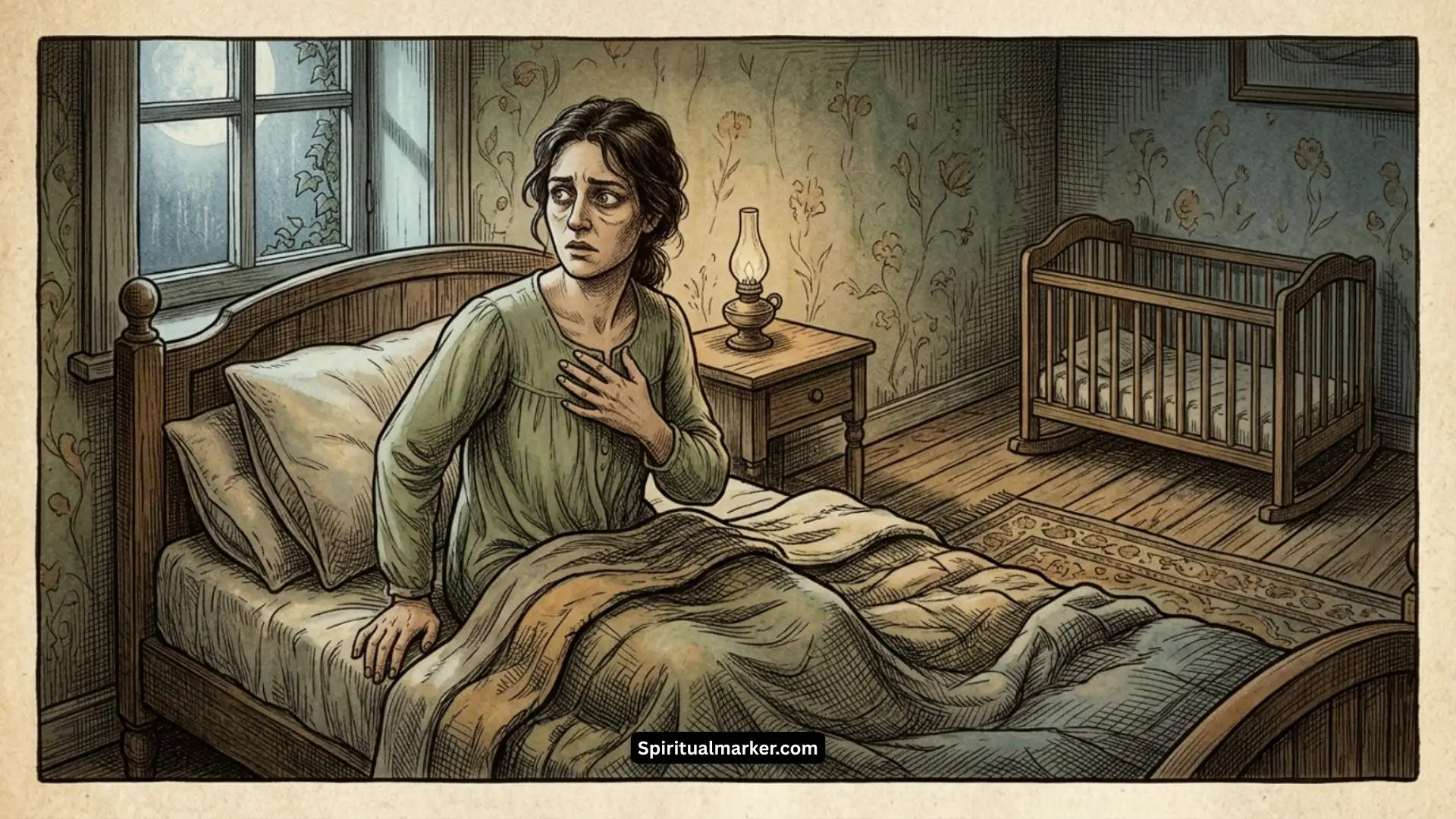
A baby’s cry can pierce the quiet. When the sound comes with no baby nearby, the moment can feel eerie and sad.
The hearing a phantom baby cry spiritual meaning often connects to grief, missed opportunities, or a spirit trying to get attention. Some people link it to a lost pregnancy or a child who never arrived. A related sound appears in hearing a baby cry spiritual meaning and dreams explained.
The cry may also signal a need for comfort or a call to nurture yourself. Your emotional reaction matters most.
If you also hear knocking, spiritual and biblical meaning of hearing knocking offers a related sign.
Key Takeaways
Before moving into the full depth of this topic, here are five core insights to hold in mind as you read.
- The phantom baby cry is a recognized cross-cultural spiritual phenomenon. Cultures from West Africa to East Asia, from Indigenous America to medieval Europe, all carry traditions that explain this experience in spiritual terms. It is not isolated to one faith or region.
- The experience often signals a message from the spiritual realm. Many traditions interpret hearing a baby cry with no physical source as a communication from spirits, ancestors, or divine forces. The message is almost never seen as malevolent in origin, even when it is startling.
- The timing of the experience carries enormous significance. Hearing this sound during pregnancy, after a miscarriage, during grief, or at a major life transition is widely interpreted as spiritually meaningful rather than coincidental.
- Superstitions around this phenomenon vary widely but share common themes. Warning, protection, new beginnings, and spiritual visitation all appear consistently across superstitions tied to the phantom baby cry, regardless of cultural origin.
- Emotional and spiritual healing is often intertwined with this experience. For people who have experienced pregnancy loss, infant death, or infertility, hearing this sound frequently carries layered meaning tied to grief, unfinished emotional bonds, and the soul’s journey.
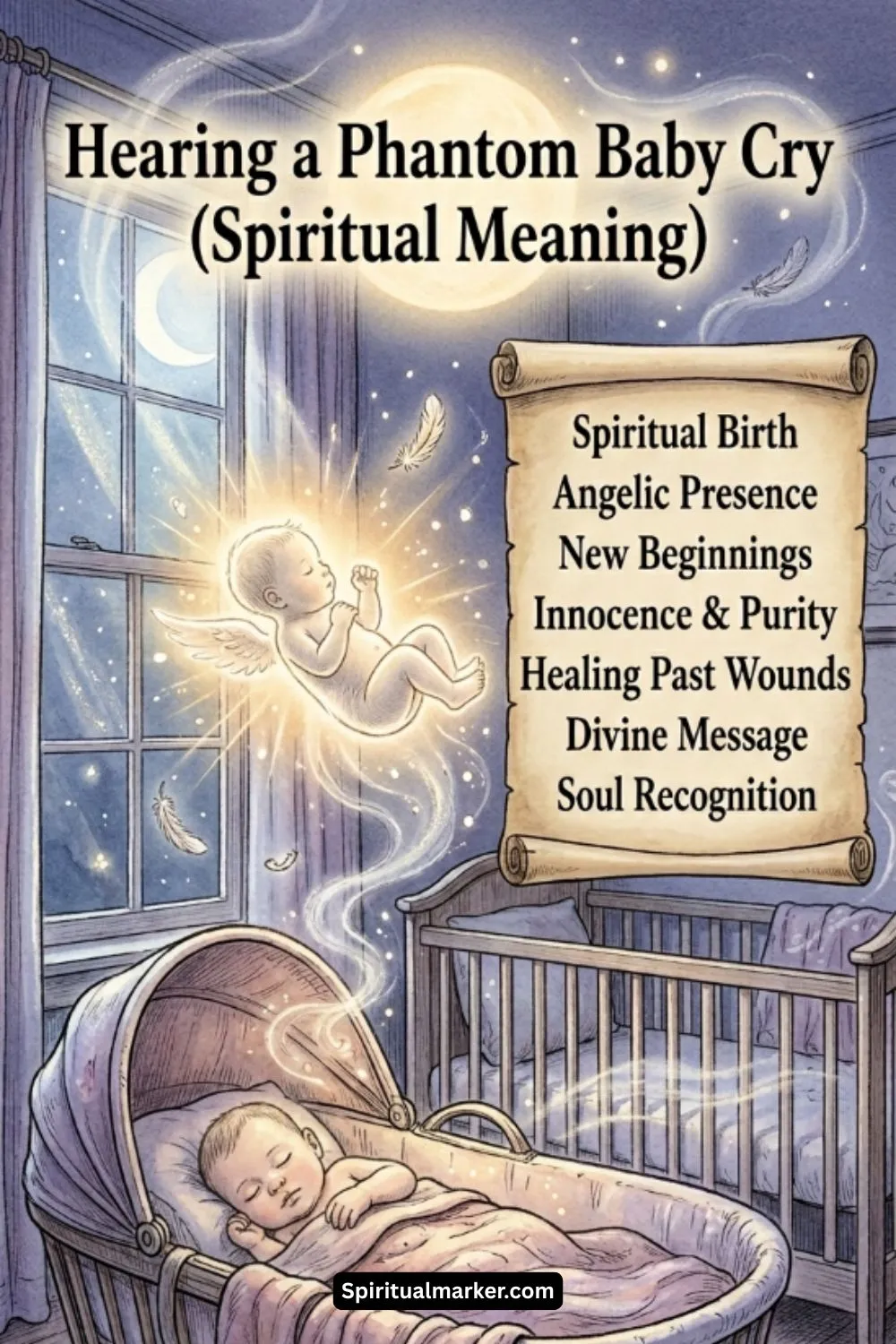
What Is a Phantom Baby Cry and Why Does It Happen?
A phantom baby cry refers to the auditory experience of hearing a baby or infant crying when no baby is physically present. The sound can range from a faint whimper to a full, urgent wail. It may seem to come from nearby or from a distance. People report hearing it outdoors, indoors, in the dead of night, or in the middle of an ordinary afternoon. The sound feels external. That is what makes it so jarring.
From a medical and psychological standpoint, auditory hallucinations are more common than most people realize. Research published in journals like Psychological Medicine shows that up to 10–15% of the general population experiences some form of auditory hallucination in their lifetime, most without any psychiatric disorder. The brain, particularly during states of fatigue, grief, heightened emotion, or sensory deprivation, can generate sounds that feel entirely real. New mothers, in particular, frequently report phantom baby cries due to neurological hypervigilance around infant cues.
But the spiritual traditions of the world do not reduce this experience to brain chemistry alone. They ask a different question: not “what caused the sound?” but “what is the sound trying to tell you?” That reframing is where the richness of the phantom baby cry spiritual meaning truly begins.
7 Spiritual Meanings of Hearing a Phantom Baby Cry
1. A Soul Seeking to Enter the Physical World
One of the most widely held spiritual interpretations is that a soul is waiting to be born. Many spiritual traditions, particularly those rooted in reincarnation beliefs, teach that souls exist in a pre-birth realm between incarnations. These souls sometimes communicate with the living as they draw near to physical birth. The cry you hear may not be a baby who exists yet. It may be a soul announcing its intention to arrive.
In Hindu cosmology, the soul, or atman, passes through cycles of death and rebirth. During the transition between lives, the soul may communicate through sensory impressions experienced by those in the physical world. A woman who hears a phantom baby cry shortly before discovering a pregnancy, or before deciding to pursue one, is seen within this framework as receiving a direct message from the incoming soul. The cry is not random. The soul is calling out to its future mother or family.
This interpretation is comforting and purposeful. It positions the experience not as something frightening but as a form of pre-birth communication. Some spiritual teachers describe it as the soul “knocking at the door” of the physical realm, announcing readiness, choosing its family, and making its presence known before conception even occurs. People who have experienced infertility and then later conceived sometimes recall hearing phantom baby cries in the months before their successful pregnancy, and they describe those sounds as deeply significant in retrospect.
Shamanic traditions in Siberia and parts of Central Asia teach that a shaman can sometimes hear the cries of unborn souls during ceremonies. These cries indicate souls that are ready to incarnate and are seeking guidance toward the right family or birth circumstances. The phantom cry of an unborn soul is treated with reverence in these traditions and prompts spiritual action rather than fear or dismissal.
2. A Message from a Deceased Child or Infant Spirit
Perhaps the most emotionally charged interpretation of the phantom baby cry spiritual meaning involves contact from a child who has passed. Parents who have lost infants, experienced stillbirth, or suffered miscarriage frequently report hearing phantom baby cries in the months and years that follow. Spiritual traditions across the globe recognize this as more than coincidence. Many see it as the spirit of the lost child making contact with the parent who grieves them.
In Japanese spiritual belief, the spirit of a child who dies young, particularly a miscarried or aborted child, becomes a mizuko, meaning “water child.” These spirits are understood to linger between the world of the living and the world of the dead. They may cry out because they feel unfinished or emotionally untethered. Japanese Buddhist temples dedicated to mizuko kuyo, a memorial rite for lost children, explicitly address this phenomenon. Parents who hear phantom cries are often guided to participate in these rituals as a way of helping the spirit find peace and move forward.
In West African Yoruba tradition, a child who dies and returns in a subsequent birth is called an abiku. The cries of such a spirit, heard by the family, are understood as the spirit’s ongoing communication with the living. This tradition frames the cry not as haunting but as bonding. The spirit and the family share an ongoing relationship that transcends physical death. Hearing the cry is an invitation to acknowledge that bond, honor it, and speak back to the spirit through prayer or ritual.
For many grieving parents, regardless of cultural background, the phantom baby cry arrives as a source of both anguish and relief. The anguish is obvious. The relief comes from the sense that the child is still present, still connected, still real in some meaningful dimension. The sound, however painful, confirms that the love does not end with death. Many spiritual counselors and grief workers treat this experience as a legitimate form of spiritual connection worthy of acknowledgment and gentle exploration.
3. A Warning of Impending Change or Danger
Not all interpretations of the phantom baby cry are gentle or comforting. In many folk traditions and superstition systems, hearing a baby cry with no visible source is treated as an omen or warning. The cry signals that something significant, and often challenging, is about to happen. The specific nature of the warning varies by tradition, but the urgency is consistent.
In Irish and Celtic folklore, the banshee is a supernatural figure whose wail announces an impending death in a family. While the banshee is traditionally described as a wailing woman rather than a crying infant, some regional variants of the legend describe the cry as resembling that of a baby. Hearing this sound near the home of a family member was treated with grave seriousness and prompted prayer, preparation, and spiritual protection. The cry was not seen as the cause of death but as a compassionate warning given so the living could prepare.
In parts of Latin American folk belief, a crying baby heard at night with no visible source can be linked to La Llorona, the weeping woman of legend. La Llorona is said to wander near water, crying for her lost children. Hearing infant-like cries near rivers, lakes, or at night is treated as a warning to stay indoors, avoid dangerous places, or pay attention to the safety of children and family members. Whether one accepts the legend literally or symbolically, the underlying message is consistent: the sound demands attention and protective action.
In broader superstition, hearing a phantom baby cry three times in a row, or hearing it on consecutive nights, is sometimes interpreted as a warning of family change. This could mean an unexpected pregnancy, an illness, a relocation, or a significant disruption to household life. The number three carries strong spiritual weight in many traditions, and a triple occurrence of any supernatural sound elevates it from coincidence to clear communication.
4. An Awakening of Maternal or Creative Energy
Spiritual traditions around the world associate the cry of an infant with the activation of nurturing, creative, and generative energy. In this interpretation, the phantom baby cry is not about a literal child at all. It is your own spiritual and creative life force demanding to be heard, nurtured, and brought into the world. The baby represents something within you that has been gestating and is now ready to be born.
Carl Jung’s concept of the Divine Child archetype maps closely onto this interpretation. In Jungian psychology, the Divine Child represents the self’s potential for wholeness, renewal, and the emergence of authentic identity. When this archetype activates in a person’s psyche, it often does so through dreams, visions, or spontaneous sensory experiences. Hearing a baby cry, even in waking life, can signal that the inner Divine Child is awakening, demanding recognition, and calling the person toward a more authentic expression of their gifts and purpose.
This interpretation resonates strongly with people who are at a creative crossroads. Artists who hear phantom baby cries often report that the experience preceded a major artistic breakthrough or the birth of a new creative project. Entrepreneurs, writers, healers, and spiritual teachers describe hearing this sound at moments when they were on the verge of stepping into their larger calling but held back by fear or self-doubt. The cry is interpreted as their unlived purpose crying out for attention.
Many indigenous spiritual traditions speak of creative and generative energy as feminine in nature, regardless of the biological sex of the individual carrying it. The phantom cry of creative awakening is therefore especially significant for people who have been suppressing their creative voice, denying their intuition, or living in ways that contradict their authentic spiritual identity. The cry is a call to stop waiting. It is the voice of the unlived life, demanding to be lived.
5. A Visit from an Ancestral Spirit
Many spiritual traditions position ancestors as active participants in the lives of their living descendants. The idea that the dead are simply gone is foreign to most of the world’s indigenous and traditional spiritual frameworks. Instead, ancestors are understood to watch over the living, offer guidance in times of crisis, and communicate through signs and experiences that the living are meant to notice. The phantom baby cry as an ancestral visit is a recognized phenomenon in many of these traditions.
In many African traditional religions, including Akan spirituality from Ghana and Yoruba spirituality from Nigeria, the boundary between the living and the ancestors is highly permeable. Ancestors are believed to speak through dreams, through nature, and through auditory experiences. A phantom baby cry heard in or near the family home can indicate that an ancestral spirit is near. The ancestor may be bringing a blessing, offering protection, or calling the family to remember and honor their lineage.
In Chinese ancestor veneration, the spirits of deceased family members, including children, are believed to remain close to the family home, especially around significant dates like births, deaths, and major life transitions. Hearing unexplained sounds associated with children during these periods is treated as a sign of ancestral presence. Families who hear such sounds are encouraged to acknowledge the ancestor through prayer, offerings, or simply speaking aloud to the spirit with gratitude and respect.
The Native American Lakota tradition speaks of the spirit world as existing alongside the physical world. Spirits of relatives who have passed, including infants and children, may attempt to communicate through sounds, smells, or sudden emotional impressions. A phantom baby cry heard near a sacred site, during a ceremony, or following a period of prayer is treated as a meaningful sign. Spiritual elders in many traditions would encourage the person who heard the cry to sit quietly, offer tobacco or another sacred substance, and open themselves to receiving whatever message the ancestral spirit wished to convey.
6. A Sign of Spiritual Sensitivity and Psychic Opening
In many esoteric and metaphysical traditions, the ability to hear sounds that others cannot is treated as evidence of heightened spiritual perception. The ears, in spiritual symbolism, are not just physical organs of hearing. They are gateways to the unseen world. People with strong clairaudient gifts, the psychic ability to hear beyond the physical, are sometimes the very people who experience phantom sounds most frequently. The phantom baby cry, in this context, is not a sign that something is wrong. It is a sign that something is awakening.
Clairaudience, from the French words for “clear hearing,” is one of the recognized psychic gifts in spiritualist and metaphysical traditions. People who develop this gift report that it often begins with subtle experiences: hearing their name called when no one spoke it, hearing music that stops when they try to locate its source, or hearing voices, sighs, or cries that others nearby cannot detect. A phantom baby cry is frequently reported as one of the early experiences of people who are opening to clairaudient gifts.
In the spiritualist tradition that flourished in the 19th and early 20th centuries, mediums were often described as having extraordinarily sensitive hearing. The spirit world was believed to operate at frequencies slightly different from the physical world. Those with psychic sensitivity could perceive these frequencies, hearing sounds from the spirit realm that the ordinary person’s senses could not register. A phantom baby cry, heard by a spiritually sensitive person, might be understood as a spirit reaching through the veil and making contact in a way that the receiver’s own sensitivity made possible.
If you consider yourself spiritually sensitive, empathic, or psychically aware, the phantom baby cry may be an invitation to take your gifts more seriously. Many spiritual teachers describe these experiences as the universe’s way of confirming that your perception is opening. Rather than frightening you into dismissal, the sound is meant to orient your attention toward deeper spiritual practice, greater intuitive trust, and a more conscious engagement with the unseen dimensions of life.
7. A Call to Grieve, Heal, and Release
Grief is one of the most spiritually potent human experiences. It breaks open the heart in ways that ordinary life does not. And spiritual traditions across the world recognize that grief, when denied or suppressed, does not disappear. It finds other channels. It rises up in dreams, in physical symptoms, in emotional eruptions, and sometimes in sensory experiences like the phantom baby cry. For many people, this sound is the grief itself speaking, demanding to be heard, honored, and finally released.
Pregnancy loss, in particular, carries a unique and often unacknowledged spiritual weight. Miscarriage, stillbirth, and infant death are losses that society frequently minimizes. Mothers and fathers are told to move on, to be grateful for what they have, to try again. But the soul knows what was lost. The bond between parent and child begins before birth. When that child does not survive, the love does not simply dissolve. It needs somewhere to go. The phantom baby cry can be the spiritual form that unprocessed grief takes when it can no longer remain silent.
In many indigenous healing traditions, unresolved grief is understood as a spiritual wound that requires active, ritual attention. The Dagara people of Burkina Faso, as described by spiritual teacher and author Malidoma Somé, hold grief rituals in which the community gathers to allow grief to be fully expressed, witnessed, and released. The sounds made during these rituals, the wailing, the weeping, the collective keening, are understood as sacred. They move grief through the body and into the earth, where it can be composted into strength. The phantom baby cry may be the spirit’s invitation to begin this process.
Psychologists who work at the intersection of spirituality and mental health, including those in the field of transpersonal psychology, recognize that some auditory experiences accompanying grief carry genuine spiritual and psychological significance. The phantom cry heard by a bereaved parent is not necessarily a symptom of disorder. It may be part of the soul’s natural mourning process. Honoring the experience rather than pathologizing it, and allowing the grief behind it to fully surface, can be profoundly healing. Many people report that once they allowed themselves to fully grieve, the phantom cries stopped. The message had finally been received.
Phantom Baby Cry Meaning Across Cultures and Religions
The spiritual meaning of the phantom baby cry is not the property of any single culture or religion. It appears across an astonishing range of traditions, each offering its own lens through which to interpret this shared human experience.
In Christianity, the cry of an infant carries profound symbolic weight rooted in the birth of Jesus Christ. The Gospel of Luke describes the infant Jesus crying at birth like any human child, a moment that theologians have called the “cry of incarnation,” the sound of the divine entering the human. Some Christian mystics have interpreted phantom baby cries heard in quiet prayer or meditation as a reminder of the soul’s need for rebirth and spiritual renewal. The baby’s cry, in this context, calls the believer back to the simplicity and vulnerability of new spiritual life in Christ.
In Islam, the soul, or ruh, is understood to be a divine gift breathed into the human body by Allah. Children who die young, including infants, are given a special status in Islamic eschatology. They are understood to dwell in paradise and to intercede for their parents. Some Islamic folk traditions, particularly in parts of the Middle East, South Asia, and West Africa, hold that the phantom cry of a deceased infant can indicate the child’s spirit visiting its family. While mainstream Islamic theology discourages reading too much into such experiences, folk practice has long treated them with spiritual seriousness.
In Buddhism, the cry of an infant is associated with the moment of rebirth into a new life. Buddhist cosmology teaches that a soul in the bardo, the intermediate state between death and rebirth, may reach toward the living through subtle sensory impressions. Tibetan Buddhist teaching on the bardo, as described in the Bardo Thodol (Tibetan Book of the Dead), identifies the period immediately preceding rebirth as one in which the consciousness seeks connection with the new family it is moving toward. A phantom baby cry, in this context, could indicate a soul in transit, making contact with those who will know it in its next life.
In Hinduism, the concept of jiva, the individual soul, embraces a long journey through many lifetimes. The moment of birth is seen as a spiritual event of great magnitude, and the newborn’s first cry is understood as the soul’s first declaration of presence in the physical world. Hearing a phantom baby cry in Hinduism can be interpreted as a sign from the divine, particularly from goddesses associated with birth and motherhood such as Lakshmi, Saraswati, or the fierce protective goddess Durga. The sound may signal that a new soul is being prepared to enter the family’s lineage under divine protection.
Phantom Baby Cry Superstitions from Around the World
Superstition, when examined carefully, often contains encoded cultural wisdom about the relationship between human beings and the spiritual world. The superstitions surrounding phantom baby cries are remarkably widespread and share certain common threads despite originating in cultures separated by oceans and centuries.
In Filipino folklore, hearing a baby cry at night with no visible source is associated with the tiyanak, a supernatural being that takes the form of an infant to lure victims. However, this superstition carries a deeper cultural warning. Mothers who abandoned or harmed infants were said to face this spirit as a form of karmic consequence. The cry is not just frightening folklore. It encodes a cultural value around the sacred responsibility of parenthood and the spiritual consequence of abandoning that responsibility.
In Scottish Highland tradition, hearing a baby cry on the wind, particularly near lochs or moorland, was said to indicate that a changeling had been placed in a nearby household. Changelings, in Celtic folklore, were fairy children substituted for human infants. The cry of the changeling, heard at a distance, was a sign that the real child had been taken to the fairy realm. While this is clearly mythological, the spiritual core of the belief is significant: it encodes anxiety about the vulnerability of new life and the reality that some forces in the universe seem to desire what is most precious and innocent.
In parts of West Africa, the cry of an unseen infant heard near the entrance to a home is considered a sign that an ancestral spirit is requesting to be welcomed inside. The appropriate response is to open the door symbolically, offer a blessing, and invite the ancestor to enter with peace. Ignoring the cry or reacting with fear is considered spiritually impolite and may cause the ancestor to withdraw protection from the household. The cry is not a threat. It is a knock on the door from the invisible family.
In certain Eastern European folk traditions, hearing a baby cry without a visible source near a cemetery or churchyard is interpreted as a sign that a child buried there has not found peace. The living person who hears the cry is considered spiritually appointed to pray for that soul. This superstition created a sense of social and spiritual responsibility among community members. The hearing was not passive. It was an assignment, calling the listener to act on behalf of a soul who could not act for itself.
What It Means Spiritually When You Hear a Baby Cry at Night
Night is a spiritually charged time across virtually all human traditions. The darkness strips away the distractions of the day. The rational mind quiets, and the intuitive, spiritual senses open more fully. It is no coincidence that the majority of phantom baby cry experiences are reported at night. Nighttime, in spiritual symbolism, is the hour of truth, of depth, of the unseen world pressing most closely against the visible one.
In many traditions, 3:00 AM specifically has been called the “witching hour” or the “devil’s hour.” This is the period when the boundary between the physical and spiritual worlds is considered thinnest. A phantom baby cry heard specifically during this hour carries amplified spiritual significance in folk traditions. It is not merely a sound. It is a sound arriving through a temporarily thinned veil between realms.
Hearing a baby cry at night that stops immediately when you try to locate it is particularly significant. The sudden silence is itself a spiritual signal. In many traditions, spirits cannot sustain direct, prolonged physical interaction. They reach through briefly and then retreat. The stopping of the sound is not the sound disappearing. It is the spirit stepping back behind the veil, having delivered its message. Your awareness of the sound is the delivery confirmation. You received it.
Spiritually attuned people who hear these nighttime cries are often advised to remain still and open rather than rushing to find the source. The impulse to locate a physical cause is understandable. But in spiritual terms, moving frantically to explain the sound away may prevent you from receiving whatever communication was being sent. Stillness, deep breathing, prayer, or simple internal acknowledgment: “I hear you. I am listening.” These are the responses that spiritual traditions across the world commend in the presence of the unseen.
Phantom Baby Cry and Pregnancy Loss: A Spiritual Perspective
No discussion of the phantom baby cry spiritual meaning is complete without addressing the experience of those who have lost pregnancies or infants. This is where the topic becomes most sacred and most tender. For bereaved parents, the phantom baby cry is not an abstract phenomenon. It is deeply personal, often arriving in the darkness of early grief, sometimes years after a loss, sometimes in the middle of an ordinary moment that suddenly becomes extraordinary.
Spiritual frameworks from across the world affirm one essential truth that grieving parents often need to hear: the soul of your child was real. The connection you formed was real. The love that developed, even in the short time that pregnancy or infant life lasted, created a bond that does not dissolve when the physical body is gone. The spirit of the lost baby continues to exist, and in many traditions, that spirit may reach back toward its parents through precisely the kind of experience you have had.
Buddhist teacher Thich Nhat Hanh wrote that those we love never truly leave us. They transform. They continue in different forms. The person who has passed is not “nowhere.” They are in a different form, a different dimension of being, still part of the vast interconnected web of existence. Applying this teaching to infant loss, the phantom cry becomes a touch from across that transformation. The soul has changed form, but the love continues to reach across that change.
Many bereaved parents find that performing a simple ritual of acknowledgment after hearing a phantom baby cry brings a sense of peace. Lighting a candle, speaking the child’s name, writing in a journal, holding a memorial object, or offering a prayer of love directed toward the child’s spirit: these acts honor the experience rather than suppressing it. Numerous grief counselors who work from a spiritually integrated framework report that clients who honor these experiences in some intentional way tend to move through grief with greater depth and resolution than those who dismiss or pathologize them.
Phantom Baby Cry in Dreams: Spiritual and Symbolic Meanings
When the phantom baby cry occurs not in waking life but in the dream state, its spiritual significance shifts slightly but remains profound. Dreaming of hearing a baby cry with no visible baby present is one of the most emotionally charged dream experiences people report. The sound in the dream feels completely real. You wake up certain you heard something. The transition between dreaming and waking can make it impossible to know which state the sound actually occurred in.
In dream symbolism, a baby almost universally represents new beginnings, potential, innocence, and the self in its most vulnerable and authentic form. A baby that cries but cannot be found in a dream often signals that something new in your life is calling for attention but has not yet been acknowledged. The crying is urgency. The invisibility is the not-yet-manifested nature of what is trying to emerge. You sense it. You feel its presence. But you cannot yet see it or hold it.
Dreams of phantom baby cries frequently increase during periods of major transition: a career change, the end of a significant relationship, the beginning of a new spiritual practice, or the approach of a major birthday or life milestone. The subconscious and the spiritual self work together in the dream state to bring urgent messages to consciousness. If this dream is recurring for you, the universe is being persistent. Something within your life is crying for your attention with increasing urgency.
From a Jungian perspective, hearing a baby cry in a dream that you cannot locate is an encounter with the Shadow, the unacknowledged parts of the self that have been pushed aside. The baby represents an unlived aspect of your personality or potential. It cries because it has been forgotten or suppressed. The dream is not frightening in its core intention. It is a call to integration, to wholeness, to finally bringing that unlived part of yourself into the light of conscious awareness and daily life.
How to Respond When You Hear a Phantom Baby Cry
The first and most important response is to resist panic. The experience can be startling. It can feel unsettling or even frightening, especially in the dark of night. But virtually every spiritual tradition that addresses this phenomenon counsels stillness and openness over fear and flight. The sound, whatever its source, is not arriving to harm you. Spiritual traditions broadly agree on this point.
After the initial shock passes, take a breath and ask yourself what was happening in your life at the moment you heard the cry. Were you thinking about someone who has passed? Were you wrestling with a decision about family or creativity? Were you in the middle of a grief process you have been trying to rush through? The context of the experience often illuminates its message. The spiritual world speaks in the language of your own life. It uses the material of your existing circumstances to point toward what needs attention.
Prayer, meditation, and journaling are the three most widely recommended responses across spiritual traditions. Speaking aloud to whatever presence you sensed, acknowledging that you heard something and that you are open to understanding its meaning, is a powerful spiritual act. Many people who do this report a sense of peace settling over the experience almost immediately. The act of conscious acknowledgment seems to satisfy the spiritual impulse behind the cry. You heard it. You responded. The message was received.
A Final Note
The phantom baby cry spiritual meaning is one of the most deeply human of all mysterious experiences. It touches the most sacred terrain of human life: birth, death, grief, love, creativity, and the longing for connection across the boundaries that separate the visible from the invisible world. You are not alone in this experience. You are not imagining something that does not matter. Across centuries and cultures, human beings have heard what you heard, paused as you paused, and searched for meaning with the same urgency you feel now.
What those traditions collectively affirm is that this sound carries weight. It carries intention. It arrives for a reason that is almost always connected to something of genuine spiritual significance in your life. Whether it is the cry of an arriving soul, a departing one, a grieving one, or your own unlived potential demanding to be born, the invitation is the same. Stop. Listen. Be still long enough to hear not just the sound, but what the sound is pointing toward.
If you have experienced pregnancy loss and this phenomenon resonates with your grief, allow yourself to create a small ritual to honor your child. Light a candle and speak their name, whether you gave them one or not. If the experience feels connected to a creative calling you have been ignoring, take one small step today toward that unlived work. If it feels like a spiritual opening, consider finding a meditation practice, a spiritual director, or a community that can support your deepening awareness.
The cry you heard was real in every way that matters. The question is not whether it happened. The question is what you will do with the invitation it extended. That answer belongs entirely to you.