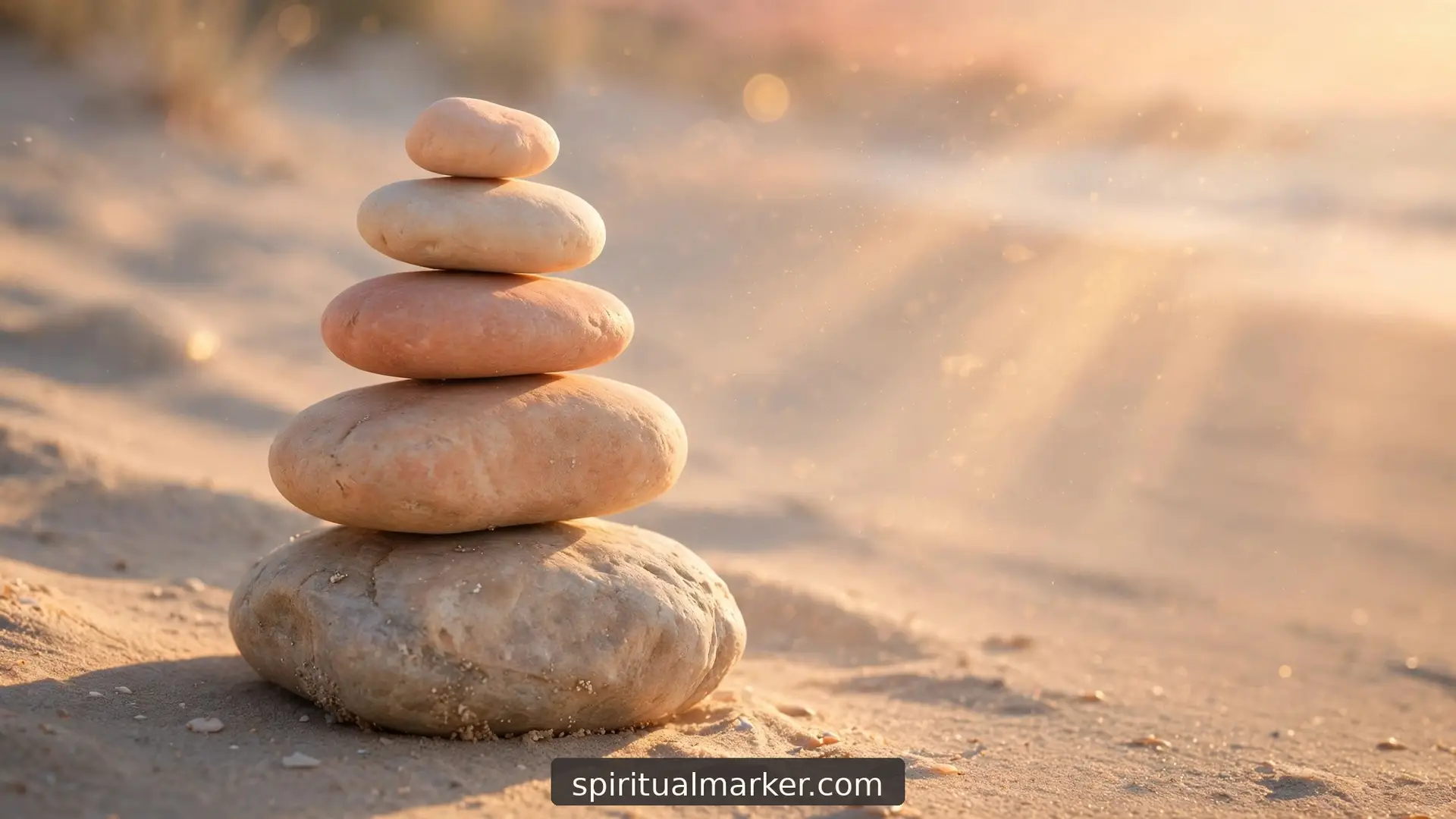
You have probably seen them before. A quiet stack of stones balanced along a riverbank, a hiking trail, or the edge of a sacred site. At first glance, they look simple. But the spiritual meaning of stacking rocks runs far deeper than a casual outdoor activity. These carefully balanced stones carry centuries of sacred symbolism, spiritual intention, and human longing for connection with something greater than the self.
Rock stacking, also called building rock cairns, has been practiced across every continent and in nearly every major spiritual tradition. Ancient Celtic peoples built them as waymarkers and burial monuments. Native American tribes raised them as prayer offerings and directional guides. Buddhist monks stacked stones as acts of meditative devotion. The practice is ancient, universal, and deeply meaningful.
Today, people still stack rocks without always knowing why the act feels so powerful. You might feel a surge of calm when you place the final stone on top. You might sense that you are leaving something behind, marking a moment, or sending a message to the universe. That feeling is not accidental. The symbolism of stacked stones taps into something primal and spiritual. This post walks you through everything you need to know about the spiritual meaning of stacking rocks, from ancient traditions to dream interpretations.
Key Takeaways
Before going deeper, here are five essential truths about the spiritual meaning of stacking rocks:
- Rock cairns are sacred across cultures. From Celtic Scotland to Buddhist Tibet, stacking stones carries deep spiritual weight in traditions worldwide.
- Balance is the central spiritual message. Each stone placed with intention represents the harmony between body, mind, and spirit.
- Stacking rocks is an act of prayer. Many traditions treat rock cairns as physical prayers, offerings, or messages sent to the divine.
- They mark spiritual transitions. Rock piles often signal a threshold, a journey complete, a vow made, or a soul remembered.
- Dreaming of rock cairns carries specific meaning. Your subconscious uses stacked rocks in dreams to communicate messages about stability, purpose, and spiritual progress.
What Are Rock Cairns and Do They Hold Spiritual Power?
A rock cairn is a human-made pile or stack of stones. The word “cairn” comes from the Scottish Gaelic word càrn, meaning a pile of rocks or a rocky hill. People have built cairns for thousands of years, using them as trail markers, burial mounds, landmarks, altars, and spiritual monuments. Their presence spans cultures, continents, and centuries.
But do they actually hold spiritual power? Many traditions say yes, and the reason is rooted in the nature of stone itself. Rocks are among the oldest materials on Earth. They form under intense heat and pressure deep within the planet. Many spiritual traditions teach that stones absorb energy, carry memory, and act as conduits between the earthly realm and the divine. When you pick up a stone and place it with intention, you activate that energy.
The act of building a rock cairn also involves focused attention, patience, and physical presence. You must slow down. You must feel the weight of each stone. You must find the point of balance. That process alone is a form of mindful meditation, which many spiritual teachers consider a doorway to the sacred. Whether you approach rock stacking from a religious standpoint or a secular one, the practice invites you into a state of heightened awareness that many people describe as spiritual.
What Does Stacking Rocks Symbolize or Represent?
The symbolism of stacking rocks is rich, layered, and surprisingly consistent across cultures. At its most basic level, a stack of stones represents intentional human presence. Someone was here. Someone paused, chose each stone carefully, and created something deliberate. That act of creation carries spiritual weight.
On a deeper level, stacked stones symbolize balance. Each stone must sit in relationship with the others. Remove one, and the whole structure falls. This mirrors the spiritual teaching found in nearly every tradition: life requires balance. The spiritual balance symbolized by rock cairns speaks to the harmony needed between opposites, between rest and action, between the earthly and the divine, between the self and the community.
Rock cairns also represent permanence in the face of impermanence. A stone endures long after the person who placed it has gone. Many people stack rocks as memorials, as markers of grief, or as monuments to love. The act says: this moment mattered. This person mattered. This prayer was real. In that way, the meaning of stacking rocks becomes a bridge between the temporary nature of human life and the enduring quality of spirit.
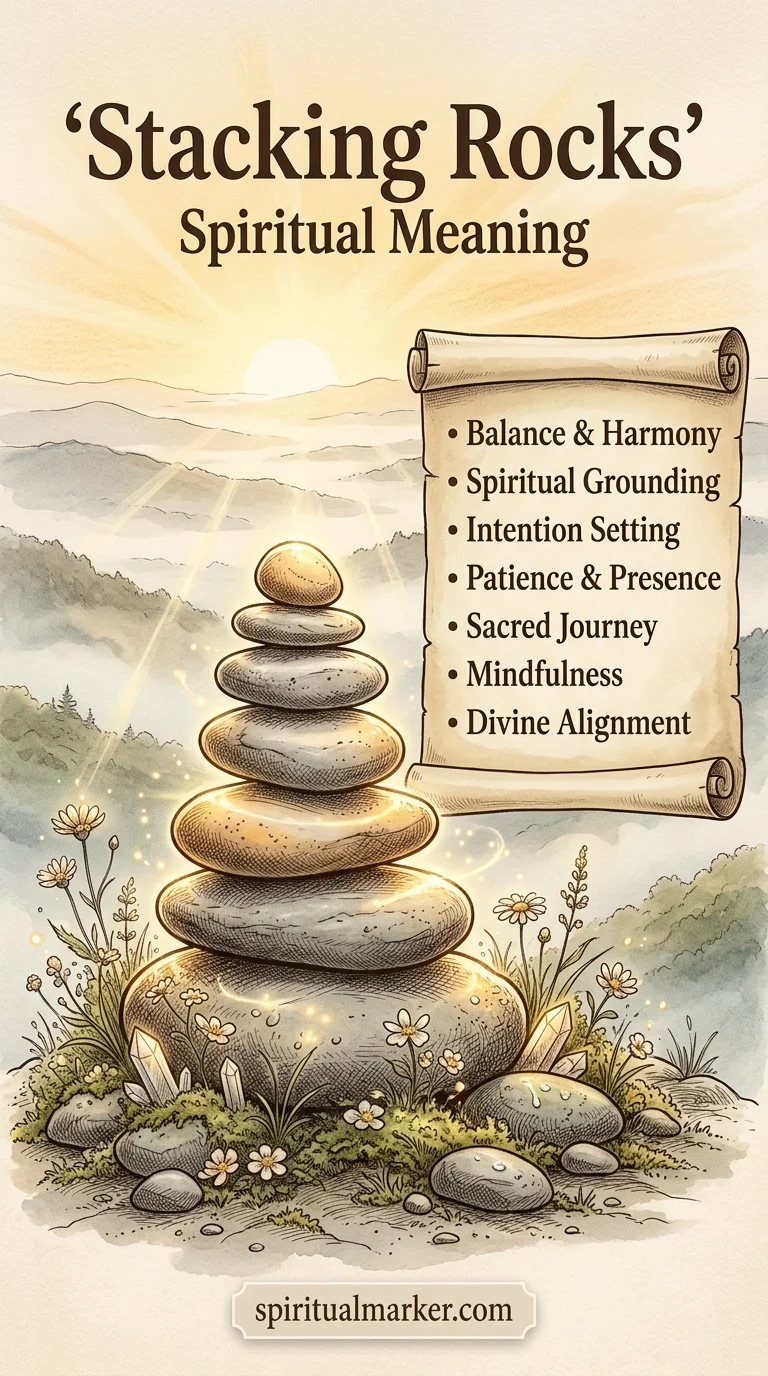
7 Spiritual Meanings of Stacking Rocks
1. A Symbol of Balance and Inner Harmony
The most immediate spiritual meaning of stacking rocks is balance. Every stone in a cairn must be carefully placed so the weight distributes evenly. If you rush, the stack falls. If you force a stone that does not fit, the structure collapses. The process teaches patience and attunement, qualities central to spiritual growth in traditions from Taoism to Zen Buddhism.
Many spiritual teachers use rock balancing as a metaphor for the inner life. Your emotional, mental, and physical energies must align. When they do, you feel grounded and centered. When they do not, everything topples. The act of physically stacking stones can become a meditation on inner balance, helping you reconnect with your center when life feels unstable.
Buddhist monks in particular use stone stacking as a mindfulness practice. Each breath corresponds to each stone. Each placement becomes an act of conscious presence. The finished cairn stands as visible proof that balance is possible, even on uneven ground.
2. A Prayer or Offering to the Divine
In many spiritual traditions, stacking rocks is a form of prayer. The act of choosing a stone, holding it with intention, and placing it deliberately is understood as sending a message to the divine. Tibetan Buddhists build stone cairns called ovoos as offerings at sacred sites, mountain passes, and riverbends. Each stone added to the pile carries a prayer or a wish.
Native American traditions across North America use stone piles as altars where prayers are offered to ancestors, spirits, and the Creator. The physical act of placing a stone grounds the prayer in the material world. It makes the invisible visible. Your intention moves from thought into form, from spirit into matter.
In Celtic tradition, cairns built at sacred sites were understood as communication with the spirit world. Pilgrims added stones to existing piles as acts of devotion. Some stones were placed to ask for healing. Others were placed to give thanks. The cairn became a living record of prayer, growing taller with each act of faith.
3. A Marker of Spiritual Journey and Progress
Rock cairns have served as waymarkers on spiritual paths for thousands of years. In the Scottish Highlands, cairns marked pilgrimage routes to sacred sites. In the deserts of the American Southwest, stacked stones guided travelers through treacherous terrain. The physical cairn said: you are on the right path. Keep going.
On a metaphorical level, stacking rocks marks spiritual progress. Each stone represents a step taken, a lesson learned, or a challenge overcome. Building a cairn at the end of a difficult hike or a hard season of life acknowledges the journey. It says: I came this far. The act honors the effort and marks the milestone.
Many people instinctively build rock cairns at significant moments in their lives. After completing a vision quest, ending a relationship, beginning a new chapter, or surviving a crisis, they feel drawn to place stones in a deliberate pattern. The spiritual meaning of this rock stacking is a recognition that something has shifted. The cairn marks the threshold between who you were and who you are becoming.
4. A Memorial and Connection to Ancestors
Throughout history, cairns have served as burial monuments and memorials. The ancient practice of piling stones over graves is found in Celtic cultures, Native American traditions, Jewish customs, and many others. The spiritual meaning of stacking rocks over a burial site is multifaceted: the stones protect the dead, honor their memory, and create a visible meeting point between the living and the ancestors.
In Jewish tradition, mourners place small stones on graves when visiting. This practice, called placing a stone, honors the deceased and signals that someone came to pay respects. Unlike flowers that wither, stones endure. The stone symbolism here carries messages of permanence, memory, and unending connection.
Many people today still feel a pull to stack rocks near places where loved ones have died, such as accident sites, riversides, or mountains. The act creates a sacred space for grief and remembrance. It connects the builder to both the person lost and to the long human tradition of honoring those who came before.
5. A Symbol of Stability, Strength, and Rootedness
Stone is one of the most ancient symbols of stability and endurance. Mountains, cliffs, and boulders appear in sacred texts and myths across every culture as symbols of divine strength and unshakeable foundation. When you stack rocks, you align yourself with that ancient stone energy.
The spiritual meaning of rock cairns as symbols of strength is especially powerful during times of uncertainty. Building a cairn when life feels chaotic is an act of defiance against disorder. You are saying: I can create something stable. I can find the center of gravity even here. The completed structure stands as physical evidence that stability is achievable.
Many crystal healing and earth-based spiritual traditions hold that specific stones carry specific grounding and stabilizing energies. Basalt, granite, and obsidian are particularly associated with rootedness and protection. Choosing and stacking these stones intentionally amplifies the spiritual message: I am grounded. I am strong. I will not fall.
6. An Expression of Mindfulness and Present-Moment Awareness
The act of stacking rocks demands full presence. You cannot balance stones while thinking about tomorrow’s meetings or yesterday’s arguments. The weight of each stone, its texture, its shape, and its center of gravity require your total attention. This forced presence is itself a spiritual practice.
Many practitioners of mindfulness meditation use rock balancing as a physical anchor for their practice. The stones give the wandering mind something concrete to return to. Each breath becomes a chance to refine the balance. Each moment of stillness becomes a meditation on impermanence, because a gust of wind or a slight shift can bring the whole stack down.
Zen Buddhism teaches that any ordinary act done with complete presence becomes sacred. Stacking rocks with full attention transforms a simple task into a moving meditation. The spiritual meaning here is not in the finished cairn but in the quality of attention brought to each stone. That attention is itself a form of spiritual awakening.
7. A Symbol of Human Connection and Collective Spirit
Rock cairns often grow over time as multiple people add to them. A single stone placed by one traveler becomes the foundation for a structure built by hundreds. This collaborative nature carries deep spiritual meaning about community and shared humanity. Each addition says: I was here too. My journey matters. We are all connected.
The collective symbolism of rock cairns resonates strongly with spiritual traditions that emphasize interdependence. Buddhist teachings on interbeing, Indigenous concepts of the web of life, and Christian teachings on the body of believers all reflect this truth: no stone stands alone. The cairn only rises because many people contributed.
When you add a stone to an existing cairn, you join a lineage of pilgrims, travelers, and seekers. You participate in something larger than your individual journey. The spiritual meaning of this act is profound: you are never alone on your path. Countless others have walked here before you. Their prayers, their struggles, and their hope are all built into the pile beneath your stone.
Stacking Rocks Symbolism Across Cultures and Religions
The spiritual meaning of stacking rocks appears in virtually every major culture on Earth. Each tradition brings its own interpretation, but the common thread is clear: humans across time have recognized stones as sacred and their deliberate arrangement as meaningful.
In Tibetan Buddhism, mani stones are flat rocks carved with sacred mantras and prayers, then stacked into large cairns called mani walls. Travelers traditionally walk around these walls clockwise as an act of devotion. Adding a stone to a mani wall is considered a powerful act of merit-making. The stones carry the prayers of everyone who carved them, creating an accumulation of sacred intention.
In Korean shamanic tradition, stone cairns called dokt-tap are built at mountain passes and village boundaries to appease spirits and ensure safe passage. Passers-by add a stone and spit three times for luck, a gesture that combines the spiritual power of stones with the ancient belief that saliva carries protective energy.
Celtic and Scottish traditions feature cairns heavily in both spiritual and practical contexts. Clach cuid fir, or “the stone of the man’s share,” were large boulders that young men had to lift and carry as a rite of passage. Cairns were built at graves, at clan boundaries, and at the summit of sacred hills. Adding your stone to a clan cairn was an act of spiritual and familial solidarity.
In Native American traditions, particularly among the Inuit of the Arctic, inuksuit (singular: inuksuk) are stone figures built to mark sacred places, hunting grounds, and travel routes. These human-shaped stone structures carry complex spiritual messages: they identify sacred sites, mark the presence of spiritual power, and communicate guidance to travelers. The spiritual symbolism of these stone figures is inseparable from the land itself.
Stacking Rocks Symbolism in World Mythologies
World mythologies are filled with stories that reveal the sacred meaning of stones and rock cairns. These ancient narratives encode spiritual wisdom that helps us understand why the act of stacking rocks feels so charged with meaning.
In Greek mythology, Hermes, the god of travelers, boundaries, and communication, was closely associated with stone piles called hermai. These cairns marked crossroads and boundaries throughout the ancient Greek world. Travelers would add a stone to honor Hermes and ask for his protection on their journey. The spiritual symbolism of these rock piles connected the earthly world of travel and trade to the divine realm of the gods.
Norse mythology features stone mounds as places where the boundary between the living and the dead grows thin. The howes, or burial mounds, of Norse tradition were built from earth and stone. Ancient Norsemen believed their ancestors continued to inhabit these mounds and could be consulted for wisdom and protection. Adding stones to a howe maintained the sacred connection between the living and ancestral spirits.
In Japanese Shinto tradition, small stone piles called ishi doro appear throughout sacred forests and shrine precincts. Children who die before their parents are said to pile stones along the banks of the Sanzu River in the afterlife, building cairns to earn their way to paradise. The image is poignant and powerful: even in death, stone stacking is a spiritual act that opens the path forward.
In Andean mythology, the Apus, or mountain spirits, are considered among the most powerful divine beings. Stone cairns called apacheta mark mountain passes throughout the Andes. Travelers add a stone to the apacheta and sometimes leave offerings of coca leaves, alcohol, or small figurines. The act acknowledges the power of the Apu and asks for safe passage through the mountain’s domain. The spiritual meaning of these Andean cairns is a direct negotiation with the divine forces of the landscape.
Stacking Rocks and Their Spiritual Meaning in Specific Settings
The location where you stack rocks also influences the spiritual meaning of the act. Different environments carry different energies, and those energies shape the prayer or intention embedded in the cairn.
Stacking rocks near water carries especially powerful spiritual symbolism. Water represents the flow of emotion, the passage of time, and the unconscious mind in many spiritual traditions. Building a cairn beside a river or lake is often understood as an act of emotional release or healing. Many people who are processing grief, trauma, or transition find themselves drawn to stack stones near water. The combination of the water’s flow and the stone’s permanence creates a powerful spiritual statement: I release what no longer serves me, and I build something solid in its place.
Stacking rocks on a mountain or hilltop connects to ancient traditions of high-place worship. Mountain summits have been considered sacred in virtually every culture. They are closer to the sky, to the stars, and to the divine. A cairn built at altitude carries the spiritual energy of elevation and transcendence. Many people feel a powerful urge to mark a summit with stones, instinctively participating in a tradition as old as human spirituality itself.
Stacking rocks at a crossroads echoes the ancient Greek tradition of honoring Hermes at boundary points. Crossroads represent choice, change, and the threshold between one phase of life and another. A cairn built at a crossroads carries the spiritual meaning of conscious decision-making. It marks the moment you chose a direction. It honors the roads not taken and consecrates the path ahead.
Biblical Meaning of Stacking Rocks and Stone Symbolism
The Bible contains numerous significant references to stone piles and rock cairns. Understanding their biblical meaning adds an important layer to the spiritual significance of stacking rocks within the Christian tradition.
One of the most famous biblical accounts involves Jacob’s stone pillar in Genesis 28. After dreaming of a ladder reaching to heaven, Jacob took the stone he had used as a pillow, set it upright, and poured oil on it, dedicating it as a sacred monument. He called the place Bethel, meaning “House of God.” This single stone became a marker of divine encounter, a physical reminder of a moment when heaven and earth touched.
In Joshua 4, God commanded the Israelites to take twelve stones from the middle of the Jordan River after crossing it miraculously. These stones were set up as a memorial cairn so that future generations would ask about them and learn the story of God’s faithfulness. The biblical meaning of these stacked stones is clear: they are monuments to divine intervention and community memory.
The prophet Samuel set up a stone after Israel’s victory over the Philistines and named it Ebenezer, meaning “stone of help,” declaring that God had helped them to that point (1 Samuel 7:12). This single stone cairn became a testimony to divine faithfulness. The act of naming it transformed the stone from a simple rock into a theological statement.
Across the Hebrew scriptures, stones and rock piles serve as altars, memorials, boundary markers, and covenant witnesses. The stone is consistently treated as a sacred object capable of holding spiritual memory and testifying to divine encounter. Jesus himself is described in the New Testament as the cornerstone, using stone symbolism to communicate his foundational role in spiritual life (Matthew 21:42, Ephesians 2:20).
Dreaming About Stacking Rocks: Spiritual and Psychological Meanings
Dreams involving stacked rocks or rock cairns are more common than you might expect, and they carry important spiritual and psychological messages. Your subconscious often uses familiar symbols to communicate truths your waking mind has not yet processed.
Dreaming of successfully stacking rocks is generally a positive sign. It suggests that you are finding balance in your waking life. You are managing competing demands and priorities with skill and patience. The dream may also indicate that a period of spiritual growth is consolidating. You have laid important foundations, and now you are building carefully on top of them.
Dreaming of a rock cairn falling carries a different message. It often signals anxiety about instability, whether in relationships, career, health, or spiritual life. The falling stones may represent plans that feel shaky or a foundation that needs reinforcement. Psychologically, this dream type is common during periods of transition or stress. Spiritually, it may be an invitation to examine what you are building your life upon and whether those foundations are truly solid.
Dreaming of finding a rock cairn in an unexpected place often points to spiritual guidance. The cairn in your dream may represent a marker left by your higher self, your ancestors, or the divine to reassure you that you are on the right path. Pay attention to where the cairn appears in the dream. A cairn at a crossroads suggests you are approaching an important decision. A cairn at a summit suggests you are near the completion of a long effort.
Dreaming of stacking rocks for someone who has died is a powerful grief and ancestor communication dream. Many cultures teach that the dead can communicate through dreams. Building a cairn for a deceased person in your dream may indicate that your relationship with that person is being spiritually processed and healed. The act in the dream mirrors the ancient human instinct to honor the dead with stone and to maintain connection across the boundary of death.
From a psychological standpoint, the symbolism of stacking rocks in dreams often connects to themes of control, patience, and creative problem-solving. Psychologist Carl Jung identified stone as a powerful dream symbol representing the self in its most enduring and essential form. A cairn of stones in a Jungian framework might represent the accumulation of life experience and the gradual construction of the integrated self.
The Spiritual Meaning of Rock Balancing as a Personal Practice
Rock balancing has grown significantly in popularity as a personal spiritual practice. Artists and spiritual seekers around the world spend hours balancing stones in seemingly impossible configurations, creating temporary sculptures that embody profound teachings about presence, patience, and the nature of reality.
The spiritual teacher and rock balancing artist Michael Grab has spoken extensively about how the practice connects him to a state of deep stillness. He describes feeling the energetic center of each stone and working with gravity rather than against it. This cooperative approach to balance reflects a key spiritual teaching: life flows more gracefully when you stop forcing and start listening.
Rock balancing as a spiritual practice teaches several important lessons. First, it teaches that every object, no matter how rough or irregular, has a point of perfect balance. Finding that point requires slowing down and paying attention. Second, it teaches that the most stable configurations are often the most unexpected. Sometimes the path to equilibrium looks counterintuitive. Third, it teaches acceptance of impermanence. The most perfectly balanced cairn will eventually fall. The spiritual freedom found in letting go of permanence is one of rock balancing’s most powerful gifts.
Many people incorporate rock balancing and rock stacking into their spiritual rituals. Some build a new cairn at the beginning of each year as an intention-setting ceremony. Others stack a stone every day as part of a gratitude practice. Still others build cairns at places where they have experienced healing, breakthrough, or divine encounter. Each approach transforms a simple physical act into a meaningful spiritual ritual.
Environmental Considerations and the Ethics of Rock Stacking
No discussion of the spiritual meaning of stacking rocks would be complete without addressing the environmental dimension. In recent years, land managers, ecologists, and spiritual teachers alike have raised important questions about the impacts of widespread rock cairn building in natural areas.
Moving rocks from their natural position disturbs microhabitats that countless organisms depend on. Insects, salamanders, mosses, and lichens all use the undersides and crevices of stones as shelter, breeding grounds, and food sources. When many people stack rocks in popular natural areas, the cumulative ecological impact can be significant.
Many spiritual teachers emphasize that true reverence for nature includes leaving it undisturbed. A practice that honors the spirit of a place by disrupting its ecology contradicts itself. For those called to the spiritual practice of rock stacking, many traditions now recommend stacking stones brought from home, or using only stones already loose in the environment, or practicing in your own garden or yard.
This ethical dimension of rock stacking is itself spiritually instructive. It asks you to consider: how do I honor the sacred without imposing my human will on the natural world? That question sits at the heart of many earth-based spiritual traditions. The most spiritually mature approach to rock cairns combines deep intention with profound respect for the living systems of the Earth.
A Final Note
The spiritual meaning of stacking rocks is ancient, universal, and surprisingly personal. Every cairn ever built carries the energy of the person who built it: their prayers, their grief, their hope, their gratitude, their longing for connection. When you stack stones with intention, you join a lineage of spiritual seekers stretching back tens of thousands of years.
You do not need to belong to any specific religious tradition to experience the sacred power of rock stacking. The practice speaks a language older than any religion. It speaks the language of the human hand reaching toward the divine, of matter shaped by intention, of impermanence honored with something enduring.
The next time you feel drawn to pick up a stone and place it carefully on another, pay attention to that impulse. You might consider what prayer lives in your hands as you build. You might reflect on what balance you are seeking, what memory you are honoring, or what threshold you are marking. You might sit quietly with the finished cairn and feel the weight of all the human hands that have done the same before yours.
Your spiritual practice with stones does not need to be elaborate or public. A single stone placed with full presence and clear intention holds all the power of the most ancient cairn. The spirit you bring to the stones is the spirit that gives them meaning. And that spirit, in the end, is what endures.