You walk into a room and spot a dead fly lying on the windowsill. Then another one shows up near the door. A third turns up on the kitchen counter days later, and you start wondering whether this is plain bad luck with pests or something that carries more weight.
Dead flies in house spiritual meaning has become a common search for a reason. Flies carry centuries of symbolic weight tied to decay, transformation, and divine warning, and finding them dead inside your own home tends to feel different than swatting one mid flight. Your mind notices patterns. A string of small, lifeless insects in your space can stir up real curiosity about what your environment or your spirit might be trying to say.
This post breaks down what dead flies actually represent across spiritual traditions, religious texts, and cultural folklore. You will learn the deeper symbolism, the biblical weight behind this insect, and what dream interpretations suggest when flies show up while you sleep. None of this requires you to abandon logic or skip pest control. It simply gives you a fuller picture of why this small, strange moment caught your attention in the first place.
Key Takeaways
- Dead flies often symbolize the end of a draining situation, a relationship, or a stagnant mindset that has run its course.
- In biblical history, flies are tied to Beelzebub, plagues, and spiritual corruption, making their presence a call toward self examination.
- A dead fly frequently signals the need for spiritual cleansing, both in your physical space and in your inner emotional world.
- Cultures from ancient Egypt to medieval Europe viewed flies as messengers tied to mortality, vigilance, and moral testing.
- Dreaming about dead flies usually points to unresolved guilt, suppressed emotions, or the closing of a difficult chapter in your waking life.
What Are Flies and Do They Hold Spiritual Power?
Flies are small insects, but their symbolic footprint is enormous. Ancient Egyptians crafted golden fly amulets and gave them to soldiers as a badge of courage, since flies returned again and again no matter how many times you tried to chase them off. That persistence earned them a strange kind of respect, even while people despised their presence around food, waste, and decay.
Religious and folk traditions rarely treated flies as background noise. Scripture associates them with divine judgment, ancient Near Eastern religions linked them to specific deities, and pre-Christian Europe treated insects in general as carriers of spiritual lessons about life, death, and renewal. A fly’s connection to decay and rot gave it a permanent spot in the symbolic language of mortality across multiple belief systems.
Spiritual power, in this context, does not mean the insect itself holds magic. It means flies became a symbolic shorthand that humans used to process uncomfortable truths about death, corruption, and the passage of time. When something that small and persistent suddenly stops moving inside your home, it taps into that long, layered history whether you consciously recall it or not.
What Does Finding a Dead Fly Symbolize?
A dead fly inside your house typically symbolizes an ending. Something that was buzzing around your life, whether a habit, a relationship, or a draining situation, has reached its natural stopping point. The stillness of the insect mirrors the stillness you may be craving in some corner of your own life.
Many spiritual practitioners read a dead fly as a sign that negative energy has been neutralized, at least temporarily. Flies are often associated with chaos, irritation, and low vibrational disturbance, so their death inside your space can represent a small spiritual victory, even if you never consciously asked for one. It is your environment quietly telling you that something disruptive has run its course.
There is also a more cautionary layer to this symbolism. A dead fly can point to neglect, especially if multiple flies appear in the same area over a short stretch of time. It may be nudging you to look at a space, relationship, or habit you have been ignoring. The symbolism rarely arrives to frighten you. It arrives to get your attention, the same way a fly buzzing near your ear forces you to notice it before you can swat it away.
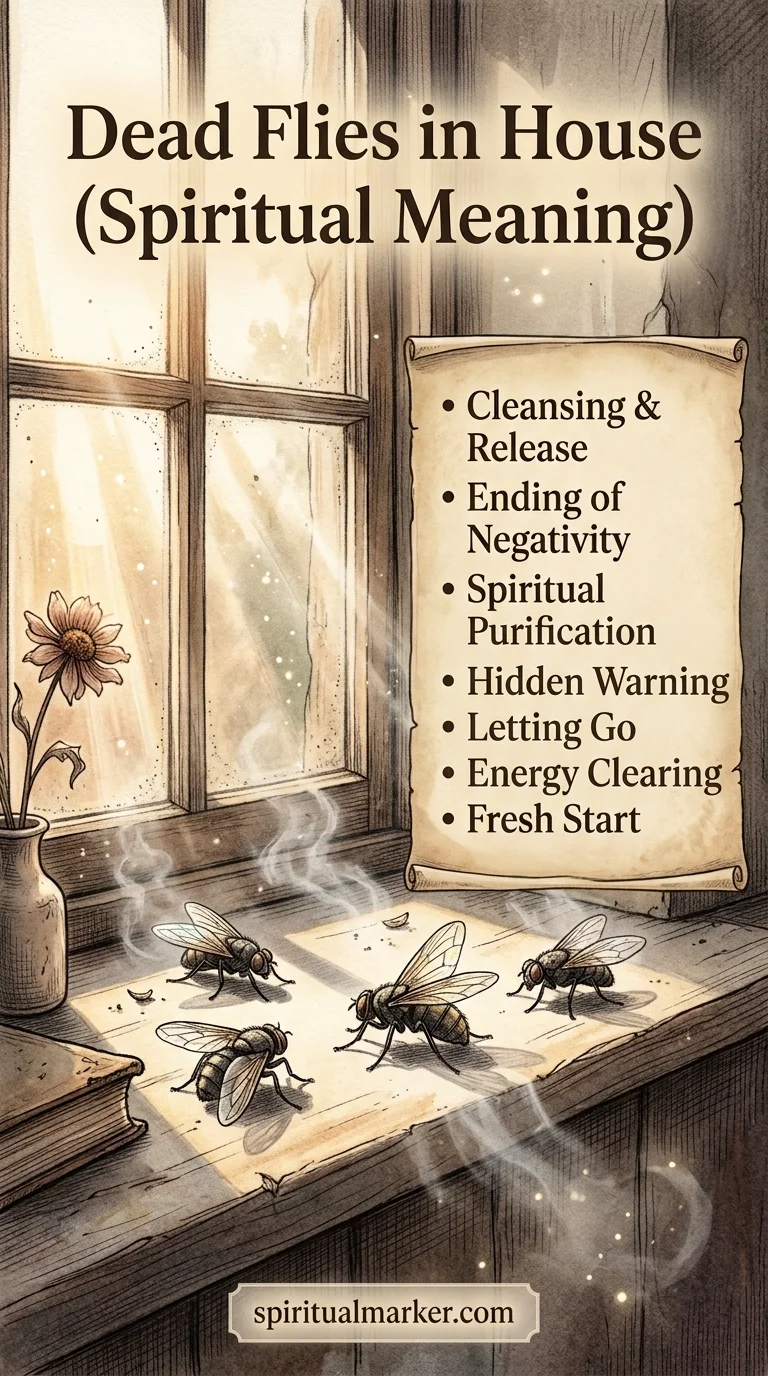
7 Spiritual Meanings of Dead Flies in Your House
1. The Closing of a Difficult Chapter
A dead fly often marks completion. Flies represent movement, irritation, and persistence while alive, so their stillness signals that a chapter defined by struggle or distraction has reached its end. If you have been pushing through a hard season at work, in a relationship, or within your own mind, this sign may be confirming that the hardest part is behind you. You do not need to search for a dramatic event to validate this meaning. Sometimes the chapter closes quietly, without fanfare, the same way a fly simply stops moving without warning.
2. A Call for Spiritual Cleansing
Stagnant energy tends to accumulate the same way clutter does, and dead flies often appear as a prompt to cleanse both your home and your inner world. Their presence can be a reminder to address negative energy, unresolved emotions, or stagnant situations that may be cluttering your spiritual path. Burning sage, opening windows, or simply decluttering a neglected room can shift the energy in a noticeable way. Spiritual cleansing does not require elaborate rituals. It asks for intention, consistency, and a willingness to release what no longer serves you.
3. Release From Emotional Burdens
Many people interpret dead flies as confirmation that they are finally releasing old burdens. Flies are linked to decay, and decay is simply matter breaking down so something new can take its place. If you have recently let go of guilt, resentment, or a grudge, a dead fly may be marking that release on a symbolic level. This meaning resonates strongly with people going through grief, recovery, or any major emotional transition where letting go has become the central theme of their daily life.
4. A Warning Against Neglect
Flies are drawn to decay, waste, and things left unattended, so their presence, even dead, can point toward an area of neglect in your life. This might be a friendship you have stopped nurturing, a health habit you have ignored, or a goal you abandoned halfway through. The warning is gentle rather than alarming. It functions more like a tap on the shoulder than a siren, encouraging you to revisit what you have been avoiding before it grows into a larger problem.
5. Protection From Spiritual Disturbance
Some spiritual traditions view a dead fly as evidence that your space has successfully repelled a disturbance. Since flies symbolize chaos, irritation, and even demonic association in certain belief systems, their death inside your home can represent a small but meaningful spiritual win. Your environment, in this interpretation, acted as a filter, catching and neutralizing something disruptive before it could take hold. This meaning brings a sense of reassurance rather than fear, especially for people who actively maintain protective spiritual practices in their homes.
6. A Signal to Reflect and Slow Down
A still, lifeless fly forces a pause that a living, buzzing one never allows. Spiritually, this stillness can represent an invitation to slow down and reflect before making your next move. You may be rushing through decisions, relationships, or daily routines without giving yourself space to think. The dead fly interrupts that momentum, almost like a punctuation mark in the middle of a sentence you were reading too fast to understand.
7. Confirmation of Personal Transformation
Transformation rarely feels comfortable while it happens, but dead flies can serve as quiet confirmation that you have already moved through it. The insect’s life cycle, from larva to adult to death, mirrors the human process of growth and shedding old identities. If you have recently changed your mindset, habits, or surroundings, finding a dead fly may simply be your environment reflecting that internal shift back at you, letting you know the transformation has taken root.
Dead Flies in House Meaning Across Cultures and Religions
Cultural interpretations of dead flies vary, yet most circle back to themes of mortality, vigilance, and moral testing. In ancient Egypt, flies symbolized courage and persistence, which is why soldiers wore fly shaped amulets into battle. Egyptians associated flies with courage in battle, due to metal fly amulets, while Greeks and Romans linked flies to plagues and decay, emphasizing vigilance. A dead fly in that ancient context would have symbolized the end of a battle or struggle, since the persistent insect had finally gone still.
The Greeks took this symbolism further by tying flies directly to their pantheon. Zeus carried the title Apomyios, meaning fly averting, a name invoked by people seeking protection from swarms during plagues and times of disease. This title suggests that even the gods needed defense against flies, which tells you how seriously ancient cultures took the insect’s symbolic and literal threat. A dead fly inside a Greek household might have been read as a small sign that this protection had already taken hold, sparing the family from a larger swarm.
Medieval European folklore leaned more heavily into the unsettling side of fly symbolism. Insects in general were treated as omens, and a swarm or sudden cluster of dead flies was sometimes read as a moral warning, a nudge toward self examination rather than complacency. This lines up closely with how flies are treated in Christian scripture, where their presence often signals corruption that needs to be confronted rather than ignored. Villagers during this period often linked unexplained insect activity to witchcraft or curses, treating a sudden cluster of dead flies as confirmation that someone or something had targeted their home.
In Jewish tradition, the fly held particularly negative connotations, often viewed as impure and linked to demonic influence. This belief shaped how later religious texts and demonology treated flies, eventually contributing to the association between flies and the figure known as Beelzebub. Rabbinical commentary frequently equated the Philistine deity Baal Zebub with the fly itself, reinforcing the insect’s reputation as a symbol of false worship and spiritual corruption rather than a neutral pest.
Modern American spiritual culture tends to soften these older, harsher interpretations. Wellness communities and self help circles often frame dead flies as invitations toward mindfulness rather than warnings of demonic activity. Energy cleansing language has replaced fear based folklore in many circles, with people focusing on stagnant energy, emotional clutter, and personal growth instead of curses or punishment. Across nearly every tradition examined, though, the fly’s symbolism circles back to a single core idea: something small, persistent, and uncomfortable is trying to get your attention, and ignoring it rarely makes the message disappear.
Does the Location of the Dead Fly Change the Meaning?
Where you find a dead fly inside your home can sharpen the symbolism considerably. A dead fly near the front door often points toward something trying to enter or leave your life, whether that is an opportunity, a person, or an old pattern finally exiting for good. Entryways carry strong symbolic weight in nearly every spiritual tradition, since they represent the threshold between your private world and everything outside it.
A dead fly found in the bedroom tends to relate to rest, intimacy, or your subconscious mind. Since this room is tied so closely to dreams and vulnerability, a fly dying here might point toward emotional exhaustion or a relationship that has quietly run out of energy. Many people report finding dead flies in the bedroom during periods of heavy stress, grief, or major life transitions, which lines up with the room’s symbolic connection to rest and renewal.
The kitchen carries its own distinct meaning, since it represents nourishment, family, and daily sustenance. A dead fly here may point toward an unhealthy habit around food, finances, or how you care for yourself day to day. Finding flies near the kitchen sink or counter, specifically, often nudges people toward examining routines they have let slide, whether that means skipped meals, neglected self care, or financial stress tied to the home.
A dead fly discovered in a workspace or office typically ties back to career, ambition, or a project that has reached its natural conclusion. This location resonates strongly with the completion themes already tied to fly symbolism, since work related endings, whether a job, a deal, or a long stretch of overtime, tend to mirror the stillness of an insect that has finally stopped buzzing.
Does the Number of Dead Flies Matter?
Numerology plays a quiet but persistent role in how people interpret dead flies, and the quantity you find often shapes the message as much as the location does. A single dead fly is usually read as a small, personal sign, tied to one specific situation or emotion rather than a broader pattern. It tends to represent closure on something narrow and contained, like a single conversation, decision, or short lived worry.
Finding two or three dead flies in the same general area often signals a pattern rather than an isolated event. This number suggests that whatever is ending or needing attention touches more than one part of your life, perhaps a relationship and a related habit, or a job and the stress it created at home. Spiritually minded readers often treat this number as confirmation that the message is worth taking seriously rather than dismissing as coincidence.
A larger cluster, four or more dead flies appearing together, tends to carry a stronger sense of urgency. This grouping often points toward a more significant shift already underway, whether that is a major life transition, a long overdue cleansing, or, in more cautionary interpretations, a warning against neglect that has been building for some time. It is worth noting that a large cluster of dead flies almost always has a practical explanation too, often tied to an infestation, pesticide use, or a seasonal die off, so this is one of the clearest moments where pairing spiritual reflection with practical pest control matters most.
Dead Flies and the Bible: Beelzebub, Plagues, and Spiritual Warnings
Scripture gives flies a surprisingly significant role, and a closer look at this history adds real weight to the biblical meaning of dead flies. The clearest reference appears in Ecclesiastes 10:1, which states that dead flies cause a perfumer’s oil to give off a foul smell. This verse uses the insect as a metaphor for how a small amount of corruption, whether pride, dishonesty, or hidden sin, can ruin something otherwise pure and valuable. A dead fly is a metaphor for anything that contaminates a fine perfume causing a stench, and it could represent pride, lust, bitterness, gluttony, or selfish ambition.
The Old Testament also describes one of the most dramatic fly related events in scripture, the fourth plague against Egypt. Thick swarms of flies entered the house of Pharaoh and the houses of his servants, and throughout Egypt the land was devastated because of the swarms, yet the Israelites remained unaffected. This plague functioned as a direct judgment against Egyptian belief systems, since one Egyptian deity was specifically tied to flies and protection from them. The swarm exposed the powerlessness of that deity while demonstrating a different kind of authority at work.
Flies also connect to one of the more unsettling figures in biblical demonology. The name Beelzebub translates to “lord of the flies,” derived from the Philistine deity Baal Zebub. Baal Zebub appears in 2 Kings 1:2 through 16, where King Ahaziah of Israel sought guidance from this Philistine god after suffering an injury, a decision the prophet Elijah condemned as a rejection of God’s authority. Over time, this name evolved into a reference for Satan himself within Jewish and Christian tradition. Jews eventually used Beelzebub as another name for Satan, and the title became a term of contempt used by the Pharisees against Jesus in the New Testament.
The New Testament references this figure several times, often in moments of direct confrontation. In Matthew 12:24, religious leaders accuse Jesus of casting out demons through the power of Beelzebub, the prince of demons, a charge Jesus dismantles by pointing out the logical contradiction of evil working against itself. Mark and Luke contain similar exchanges, and each instance reinforces how deeply this fly associated name had become tied to ultimate spiritual opposition by the first century. Some scholars believe the original Philistine title was closer to Baal Zebul, meaning lord of the high place or lord of the dwelling, and that Hebrew scribes deliberately twisted the name into something insulting tied to flies and filth as a form of theological mockery against a rival god.
This biblical backdrop explains why some Christian traditions view dead flies inside a home as more than coincidence. The insect’s link to corruption, false worship, and demonic association gives the sign a heavier spiritual weight for believers who take scripture literally. Rather than treating it purely as fear inducing, many use it as a moment for self examination, asking whether something impure has quietly taken root in their life, much like a dead fly spoiling a once fragrant oil. Within this framework, a dead fly is not a curse to panic over. It functions closer to a mirror, prompting an honest look inward rather than outward blame.
Dreaming About Dead Flies: What Your Subconscious Might Be Saying
Dreams about dead flies carry their own distinct symbolism, separate from encountering them while awake. Psychologically, dreams pull from your subconscious processing of recent stress, guilt, or unresolved emotional matters, and flies tend to surface when something has been quietly bothering you beneath the surface.
A dream filled with multiple dead flies often points to suppressed guilt or regret. You may be carrying something you have not fully processed, whether a decision you second guess or words you wish you had not said. The dream does not necessarily mean something catastrophic happened. It simply means your mind is using a familiar, slightly unsettling image to flag unresolved emotional residue that deserves your attention.
A single dead fly in a dream tends to carry a gentler meaning, often tied to closure. This might reflect the end of a stressful project, the resolution of a conflict, or simply your mind processing the conclusion of a difficult week. Spiritually inclined dreamers sometimes interpret this as confirmation that a struggle has truly ended, giving you permission to relax instead of bracing for round two.
Context matters heavily here. A dream where you are actively cleaning up dead flies suggests an active, conscious effort to clear out emotional clutter, while a dream where you stumble upon them unexpectedly may point to something you have been avoiding finally surfacing on its own. Either way, these dreams rarely arrive to frighten you. They arrive to highlight something your waking mind has not fully acknowledged yet.
The setting of the dream adds another layer worth noting. Dead flies appearing in a childhood home within a dream often connect to old family patterns or unresolved issues from earlier in life that have resurfaced unexpectedly. Dead flies in a workplace setting, by contrast, usually point toward professional stress, office politics, or a project nearing its natural end. Paying attention to where the dream takes place, alongside how the flies appear, gives you a much sharper read on what your subconscious is actually trying to process.
What To Do When You Find Dead Flies in Your House
Spiritual reflection works best alongside practical action, and finding dead flies calls for both. Start with the physical task of cleaning the area thoroughly, since dead insects can attract bacteria and should never be left sitting around regardless of any symbolic meaning attached to them. Wipe down surfaces, check nearby windows and doors for gaps, and look for any obvious source that might explain why flies entered your space in the first place. Common entry points include torn screens, gaps under doors, and open garbage containers left near the house, so a quick inspection often solves the practical side of the mystery fairly fast.
Once the physical cleanup is done, you can address the spiritual layer with simple, grounded practices. Many people choose to open windows for fresh air, light a candle, or spend a few quiet minutes journaling about what area of their life might need attention. None of this requires elaborate ritual. A few minutes of honest reflection, paired with a tidy, well aired space, tends to do more good than any complicated ceremony. Some traditions also recommend a short walk through the home with the intention of noticing what feels heavy or neglected, treating the dead fly as a starting point for a wider check in rather than the entire message itself.
If you lean toward more structured spiritual practice, consider pairing this moment with prayer or meditation focused specifically on release. You do not need elaborate words. A simple, honest request to let go of whatever has been weighing on you carries just as much weight as a longer ritual. For those who follow Christian tradition, reflecting on Ecclesiastes 10:1 alongside a personal prayer for purity and self examination can turn an unsettling moment into a genuinely productive one.
If the symbolism keeps nagging at you, give yourself permission to sit with the question rather than rushing toward an answer. Ask what has recently ended, what you have been neglecting, or what emotional weight you might still be carrying. The fly itself is not magic. It is a prompt, and prompts only work if you actually pause long enough to answer them honestly.
Frequently Asked Questions About Dead Flies in the House
Are dead flies always a bad spiritual sign? No. Most interpretations lean toward closure, release, or a gentle nudge toward reflection rather than outright misfortune. Fear based readings exist, particularly within certain biblical and demonological traditions, but the majority of modern spiritual perspectives treat dead flies as neutral messengers rather than curses.
Does a dead fly mean something different than a live fly? Yes. A living fly tends to symbolize persistence, irritation, or an ongoing disturbance that has not yet resolved. A dead fly, by contrast, almost always points toward completion, since the insect’s stillness marks the end of whatever movement or chaos it represented while alive.
Should I worry if I keep finding dead flies in the same spot? A recurring pattern is worth investigating on both levels. Practically, it often points toward a hidden entry point or food source nearby. Spiritually, it suggests the message tied to that specific room, whether it involves rest, work, or family, deserves more attention than a one time glance.
Is it bad luck to leave a dead fly where you found it? Most spiritual traditions recommend cleaning up a dead fly fairly soon after finding it, both for hygiene and to symbolically complete the release the insect represents. Leaving it in place is generally seen as stalling the message rather than inviting additional misfortune.
A Final Note
Dead flies in your house rarely deserve panic, but they do deserve a moment of honest reflection. Whether you lean toward biblical interpretation, cultural folklore, or simple dream psychology, the recurring theme stays consistent: something has ended, something needs cleansing, or something quietly deserves your attention.
If this sign showed up for you recently, consider spending a few minutes journaling about what feels unresolved in your life right now. You might also try a simple home cleansing ritual, like opening windows and decluttering a neglected space, to pair the physical and spiritual sides of this experience. And if the curiosity sticks around, exploring related topics like the spiritual meaning of insects in dreams or the symbolism of other household pests can help you build a fuller picture of what your environment may be trying to tell you.