
You wake up at two in the morning to a sound that does not belong to a dream. It is low, drawn out, and almost human. Your cat is crying somewhere in the house, and the hair on your arms rises before your mind even catches up. That single sound can turn a quiet night into a question you cannot shake: what does it mean when a cat cries at night?
Cats have walked beside human history for thousands of years, and they have never been treated as ordinary animals. Ancient temples honored them. Medieval villages feared them. Modern homes adore them. Through every era, people have sensed that a cat’s voice carries something beyond biology, especially when that voice rises in the dark. The spiritual meaning of a cat crying at night touches on grief, warning, intuition, and protection all at once.
This article walks through the full picture. You will find the practical reasons cats cry after dark, the deeper spiritual meanings behind the sound, the symbolism tied to it, and the superstitions that different cultures have carried for centuries. Whether you came here out of curiosity or genuine unease, you will leave with a clearer sense of what your cat’s nighttime cry might be telling you.
Key Takeaways
- A cat crying at night often symbolizes a spiritual message, ranging from a warning to a sign of protection.
- Many cultures view nighttime cat cries as connections to ancestral spirits or the unseen world.
- The type of sound a cat makes, whether a yowl, screech, or low wail, changes its spiritual significance.
- Superstitions about crying cats vary widely, from omens of bad luck in Western folklore to signs of guardianship in others.
- Dreaming about a crying cat often reflects unresolved emotional tension or a need for inner attention.
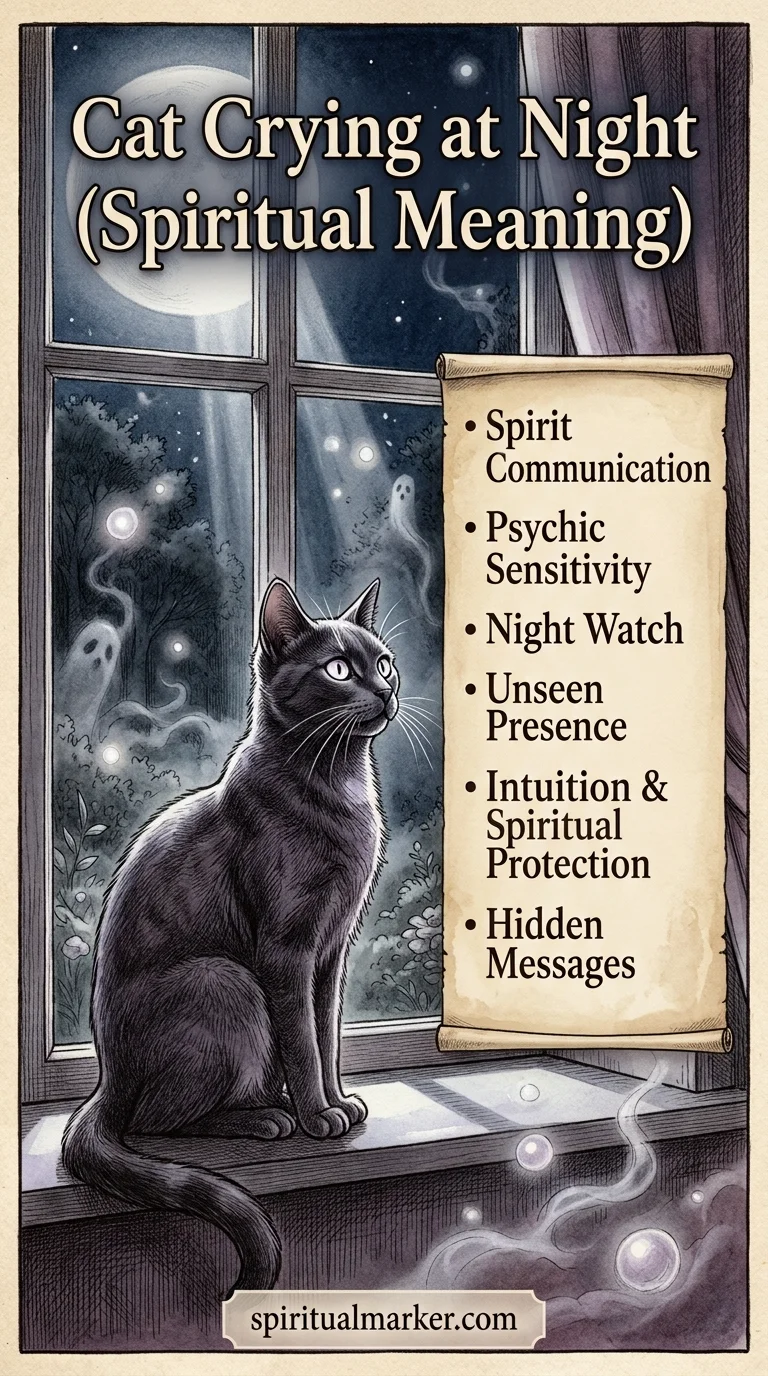
Why Do Cats Cry at Night?
Before diving into spiritual symbolism, it helps to understand the natural side of this behavior. Cats are crepuscular animals, meaning they are most active during dawn and dusk, though many also roam and vocalize through the deeper hours of night. Their bodies are wired for low light hunting, so darkness does not slow them down the way it slows down humans. A cat crying at 2 a.m. is often simply a cat operating on its natural internal clock.
Physical and emotional needs explain much of the noise. Hunger, loneliness, boredom, and the urge to mark territory all push a cat toward vocalizing loudly once the house goes quiet. Unspayed or unneutered cats cry more during mating season, and older cats sometimes develop a condition called cognitive dysfunction syndrome, which causes confusion and nighttime yowling similar to dementia in humans. Veterinarians often recommend a checkup if crying becomes sudden, frequent, or paired with other behavioral changes.
Even with these explanations on the table, something about a cat’s nighttime cry still unsettles people in a way that barking dogs or chirping birds do not. Cats sit at a unique crossroads in human imagination. They are domestic yet untamed, affectionate yet mysterious. That tension is exactly why their voices, especially after dark, have carried spiritual weight across nearly every culture on earth.
What Does a Cat Crying at Night Symbolize?
At its core, a cat’s nighttime cry symbolizes a threshold moment. Night has always represented the unknown, the space between waking life and whatever lies beyond ordinary perception. Cats, with their reflective eyes and silent movement, have long been seen as creatures comfortable moving through that threshold. When a cat cries during these hours, many spiritual traditions interpret it as a signal that something from the unseen world is brushing against your own.
This symbolism is rarely one-dimensional. A crying cat can represent a warning, a comfort, a memory, or an invitation to pay closer attention to your inner life. Context matters here. The sound itself, the timing, your emotional state, and even recent events in your life all shape how a particular cry should be understood. A grieving person who hears a cat wail outside their window may interpret it very differently than someone going through a season of spiritual awakening.
What stays consistent across most interpretations is the idea that cats act as sensitive conduits. Many spiritual practitioners believe animals, and cats in particular, pick up on subtle energies long before humans consciously register them. A cry at night, in this view, is not random noise. It is the animal responding to something real, even if that something cannot be seen or measured.
7 Spiritual Meanings of a Cat Crying at Night
1. A Message from the Spirit World
One of the oldest interpretations of a cat crying at night centers on communication from beyond the physical world. Across many spiritual traditions, cats are seen as natural mediums, creatures capable of sensing presences that humans simply cannot perceive. Their cry, in this context, is not random distress. It is a reaction to something passing through the room, the yard, or the energy of the home itself.
People who practice mediumship or energy work often describe cats as especially attuned during the late hours, when the so-called veil between worlds is believed to thin. A sudden, sharp cry from a cat staring intently at an empty corner has fueled countless personal stories of spirits, ancestors, or simply unexplained presences making themselves known. Whether or not you hold this belief literally, it speaks to a deep human instinct to treat animal behavior as meaningful rather than incidental.
This meaning often surfaces strongest for people who recently lost someone close to them. A cat crying at an unusual hour, especially near an anniversary or a meaningful date, frequently gets interpreted as a gentle signal that a loved one is nearby. The cry is not feared in this framing. Instead, it becomes a strange but welcome reminder that connection continues even after physical loss.
2. A Warning of Danger or Negative Energy
Folklore across many regions treats a cat’s nighttime cry as an early warning system. Long before modern security systems existed, people relied on the instincts of animals to sense danger approaching a home. A cat suddenly crying out, especially in a tone different from its usual voice, was traditionally read as a sign that something threatening, whether physical or spiritual, had entered the area.
This interpretation connects closely to the belief that cats can detect negative energy before humans become consciously aware of it. Many people describe their cats acting strangely right before an argument breaks out in the household, before a storm rolls in, or during periods of heightened personal stress. A loud cry in these moments is understood as the cat reacting to tension building in the environment, almost like an emotional smoke detector.
It is worth noting that this warning symbolism is rarely about catastrophe. More often, it points toward smaller disruptions: unresolved conflict, draining relationships, or stagnant energy that has built up unnoticed. A cat’s cry, read this way, becomes less of an alarm bell and more of a gentle nudge to examine what has been quietly accumulating around you.
3. A Sign of Grief or an Unseen Loss
Some traditions interpret a crying cat as a reflection of grief held in the home rather than a message coming from outside it. Animals are widely believed to absorb emotional residue from the people and spaces around them. A cat that cries persistently at night, particularly during periods of mourning, may be spiritually echoing sorrow that has not yet been fully processed by the humans living there.
This meaning often resonates with people navigating loss, whether through death, breakup, or significant life change. The cat’s cry becomes a kind of mirror. It does not create the grief, but it reflects it back, sometimes more honestly than the household members themselves are willing to express out loud. This is one reason many grieving people report finding unexpected comfort in their cat’s presence during difficult nights.
In some interpretations, a crying cat is also linked to grief that is not personal at all but ambient, picked up from a wider community or even a previous occupant of the home. Older houses, in particular, carry layered emotional history. A sensitive animal noticing that residue and crying in response is a theme that appears repeatedly in folk belief, regardless of geography.
4. The Presence of Ancestral Spirits
Many cultures connect a cat’s nighttime cry directly to the presence of ancestral spirits. In several African and Asian spiritual traditions, animals are considered intermediaries between the living and those who have passed on. A cat crying out during the night, particularly if it appears to be watching or reacting to something specific, is often understood as the animal acknowledging an ancestor’s presence in the space.
This belief carries a notably different emotional tone than the warning interpretation discussed earlier. Rather than signaling danger, an ancestral visit is generally seen as protective or instructive. Families holding this belief often respond to a cat’s cry not with fear but with quiet acknowledgment, sometimes lighting a candle or speaking softly to honor whoever may be present.
This meaning also reinforces why many households historically kept cats close rather than treating them as purely functional pest control. A cat was not just a working animal. It was viewed as a living bridge to family history, capable of sensing and responding to presences that mattered deeply to the people who had come before.
5. A Call to Awaken Your Intuition
A recurring theme in modern spiritual interpretation treats a cat’s nighttime cry as a call toward intuition. Cats are frequently associated with heightened perception, quiet observation, and the ability to navigate darkness without losing their footing. Hearing one cry unexpectedly is often read as an invitation to trust your own instincts more fully, particularly around a decision you have been hesitant to make.
People who feel disconnected from their inner guidance sometimes describe these nighttime cries as oddly clarifying. The sharp, sudden nature of the sound interrupts mental noise and forces a moment of full presence. In that brief pause, some people report sensing an answer to a question they had been avoiding, or a renewed sense of certainty about a path forward.
This interpretation aligns closely with the cat’s broader symbolic role across spiritual practice as a guardian of hidden knowledge. The animal does not hand over answers directly. It simply creates the conditions, through sound and presence, for a person to look inward rather than outward when seeking clarity.
6. Protection and Guardianship Over Your Home
Not every nighttime cry carries a heavy or unsettling meaning. In many spiritual frameworks, a cat’s voice in the dark represents active guardianship. Ancient Egyptian belief held cats in extraordinarily high regard, associating them with the goddess Bastet, a protector of homes, women, and children. A cat crying or pacing at night was, in this tradition, read as the animal actively standing watch over the household.
This protective symbolism persists in many modern spiritual circles. Some people interpret a sudden cry as the cat sensing a shift in the home’s energy and responding by asserting its presence, almost like sounding an alarm meant to reassure rather than frighten. Under this view, the cry is less about danger arriving and more about the cat reaffirming its role as a watchful presence within the space.
This meaning offers a comforting reframe for anyone who feels uneasy after hearing their cat cry unexpectedly. Rather than assuming the worst, it invites a different question. What if your cat is not warning you of something wrong, but simply confirming, in its own voice, that it is doing exactly what it has done for thousands of years: keeping watch while you sleep.
7. A Reminder to Release Fear and Anxiety
The final spiritual meaning worth sitting with is less about the cat and more about you. A sudden cry in the dark naturally triggers a startle response, and many people interpret that jolt itself as spiritually significant. In this view, the cry serves as a mirror for whatever fear or anxiety you have been carrying just beneath the surface, brought briefly into sharp focus by an unexpected sound.
People under chronic stress often describe a heightened sensitivity to ordinary nighttime sounds. A cat’s cry, in this state, can feel far more ominous than it would on a calmer night. Spiritually, this pattern is often interpreted as an invitation to address the underlying tension rather than the surface-level startle. The cat becomes an unintentional messenger, pointing toward unprocessed worry rather than causing it.
Some spiritual practitioners suggest treating these moments as small checkpoints. When a cat’s cry jolts you awake, take a breath before reacting with fear. Ask yourself honestly what has been weighing on your mind lately. More often than not, the cry’s deeper meaning has less to do with the cat itself and more to do with the emotional weight you were already carrying into the night.
Cat Crying at Night: Beliefs and Superstitions Across Cultures
Superstitions about crying cats differ sharply depending on where you look, and those differences reveal a great deal about how each culture relates to the unseen world. In parts of Western Europe and North America, particularly during the medieval period, a cat crying at night near a house was often viewed with suspicion. Cats were associated with witchcraft during this era, and an unexplained cry could be interpreted as a sign that something supernatural, often unwelcome, was nearby.
In contrast, Japanese folklore takes a more layered approach. While certain cat spirits are feared, ordinary domestic cats are generally seen as bringers of fortune rather than misfortune. A cat crying at an odd hour is sometimes interpreted as a sign that a change in luck, for better or worse, is approaching. The famous beckoning cat figure, the maneki-neko, reflects this deep cultural belief in cats as fortune-bearing creatures rather than purely ominous ones.
Celtic traditions held cats, particularly black cats, in a position of genuine respect tied to the otherworld. A cat’s cry near a threshold, such as a doorway or window, was sometimes seen as a sign that spirits were attempting to pass between realms. Rather than purely fearing this, many Celtic households treated it as an opportunity to honor the spiritual world rather than shut it out entirely.
Across parts of South Asia, a crying cat is frequently tied to omens involving travel, money, or upcoming news. A specific cry heard near sunset versus deep into the night can carry entirely different meanings within local tradition. In several African spiritual systems, as mentioned earlier, the emphasis leans heavily toward ancestral communication, with the cat acting as a respected conduit rather than a frightening presence. Taken together, these varied beliefs show just how universally humans have looked to cats for spiritual signals, even while disagreeing on exactly what those signals mean.
Cat Crying at Night in World Mythology and Folklore
Mythology offers some of the richest context for understanding why cats carry such heavy spiritual symbolism after dark. In ancient Egypt, the goddess Bastet was depicted with the head of a cat and worshipped as a protector of the home, fertility, and women specifically. Egyptians so revered cats that harming one carried serious legal consequences. A cat’s cry within this worldview was never dismissed. It was treated as communication from a creature considered sacred.
Norse mythology connects cats to the goddess Freyja, associated with love, fertility, and a particular form of magic known as seidr. Freyja’s chariot was said to be pulled by two large cats, linking the animals directly to feminine spiritual power and otherworldly travel. A cat crying at night within Norse-influenced folk belief was sometimes interpreted as a sign that Freyja’s energy, or magic more broadly, was active nearby.
Japanese folklore introduces more complex and sometimes unsettling figures, such as the bakeneko and nekomata, cats believed to gain supernatural abilities as they age, including shapeshifting and the power to speak. Stories warn that an aging cat crying strangely at night might be undergoing this transformation. While modern pet owners obviously do not take this literally, the folklore reflects a long-standing cultural unease about the boundary between ordinary cats and something more.
Celtic mythology features the Cat Sith, a large black cat believed to roam the highlands, said to either bless or curse a household depending on how it was treated. Crying near a home at night was, in some versions of the legend, a test of hospitality. Across nearly every mythological tradition, the pattern repeats. Cats are never simply animals. They are messengers, guardians, or tricksters, and their voices in the dark carry weight that ordinary daytime meowing never quite holds.
Different Cat Sounds at Night and Their Spiritual Meanings
Not all nighttime cat sounds carry the same spiritual weight, and learning to distinguish between them can sharpen your sense of what your cat may be communicating. A regular meow, repeated calmly, is generally interpreted as a simple request for attention, food, or company. Spiritually, this sound rarely signals anything beyond connection and is often read as a reminder to stay present with those around you, animal and human alike.
A yowl or wail, the long, drawn-out sound most people associate with eerie nighttime crying, carries the heaviest spiritual symbolism. This is the sound most closely tied to warnings, grief, and spirit communication across folklore. Its intensity and unusual tone are exactly why it triggers such a strong instinctive reaction in humans, and why it dominates so much of the symbolism discussed throughout this article.
A sharp screech or scream, often associated with distress or territorial conflict, is spiritually linked to sudden disruption or an abrupt shift in energy. Many traditions interpret this sound as confirmation that something has changed quickly, whether a threat passing through or an emotional outburst occurring nearby. It is rarely read as a peaceful sign.
A low growl or hiss heard at night is almost universally connected to protective symbolism. This sound suggests the cat has identified something specific to react against, reinforcing the guardianship meaning discussed earlier. Finally, purring during nighttime hours, sometimes paired with soft vocalizations, is widely interpreted as a sign of calm, healing energy, and reassurance, often welcomed rather than questioned.
Biblical Meaning of a Cat Crying at Night
Cats are not mentioned directly anywhere in the Bible, which often surprises people searching for a specific scriptural reference. Unlike sheep, lions, doves, or serpents, cats simply do not appear within biblical text in any meaningful way. This absence does not mean Scripture has nothing to offer on the subject, but it does mean any biblical interpretation of a crying cat at night requires looking at broader themes rather than a direct verse.
Scripture repeatedly emphasizes the importance of spiritual watchfulness, particularly during nighttime hours. First Peter 5:8 warns believers to stay alert because an adversary prowls like a roaring lion seeking opportunity. Many Christians who experience an unsettling nighttime cat cry connect it loosely to this broader call toward vigilance, treating the sound as a prompt to pray or reflect rather than a literal supernatural sign.
Psalm 91 offers a different angle, describing divine protection that covers a person through the night, free from the terror that comes in darkness. Some believers find comfort in applying this verse when nighttime sounds, including a cat’s cry, stir anxiety. Rather than reading the sound itself as ominous, they lean on the promise of protection as the more meaningful spiritual takeaway from the experience.
It is worth noting that historical Christian attitudes toward cats were not always favorable, particularly during periods when cats were unfairly associated with witchcraft and superstition. Modern biblical interpretation generally moves away from treating animals as omens altogether, focusing instead on God’s broader sovereignty over both day and night. For many believers, a crying cat is simply a creature doing what creatures do, while the spiritual focus stays fixed on faith and trust rather than fear of a sound.
Dreaming About a Crying Cat: Spiritual and Psychological Meanings
Dreams involving a crying cat tend to leave a strong emotional residue, often lingering well into the next day. From a psychological perspective, particularly within Jungian dream theory, cats frequently represent the unconscious feminine, independence, and aspects of the self that operate outside conscious control. A crying cat in a dream may reflect a part of you that feels unheard, neglected, or quietly distressed despite your waking efforts to stay composed.
Spiritually, many dream interpreters treat a crying cat as a signal pointing toward unresolved emotional tension. The dream is not necessarily predicting an external event. More often, it is surfacing something internal that you have been avoiding during waking hours. People who dream of a cat crying shortly after a major life decision, for example, often later recognize the dream as reflecting their own buried doubts rather than any outside warning.
The setting and tone of the dream matter considerably. A cat crying for help that you are able to comfort within the dream is generally interpreted as a positive sign, suggesting you are actively working through difficult emotions in your waking life. A cat crying that you cannot reach or soothe often points toward a situation that currently feels outside your control, leaving you with a lingering sense of helplessness even after waking.
If this kind of dream is recurring or distressing, it is worth treating it as useful information rather than something purely mystical. Persistent dreams about a crying cat often point toward chronic stress, grief that has not been fully processed, or anxiety that deserves direct attention. The spiritual message and the psychological one frequently overlap here, both pointing in the same gentle direction: something inside you is asking to be acknowledged.
Is a Cat Crying at Night a Good Omen or a Bad Omen?
After exploring so many traditions and interpretations, a natural question remains. Is a crying cat at night something to fear or something to welcome? The honest answer is that it depends heavily on context, culture, and your own intuitive read of the moment. No single tradition holds a universal monopoly on truth here, and that diversity is itself meaningful rather than confusing.
A useful approach involves paying attention to your own emotional response alongside the symbolism you have just read. If the cry feels jarring and your instinct leans toward unease, it may be worth exploring what fears or tensions are currently active in your life. If the cry feels oddly comforting, even strange as that may sound, it may align more closely with the protective or ancestral interpretations discussed earlier.
Many spiritual teachers encourage treating these moments as invitations rather than verdicts. A crying cat does not hand you a fixed, unchangeable fate. It opens a door toward reflection, intuition, and deeper self-awareness. What you choose to do with that open door, whether through prayer, journaling, quiet observation, or simply a calmer night’s sleep, matters far more than assigning the sound a permanent label of good or bad.
A Final Note
A cat crying in the dark touches something old in the human mind, something that predates electricity, modern medicine, and rational explanation. Whether you lean toward folklore, faith, psychology, or simple curiosity, that nighttime cry clearly means something to nearly everyone who hears it. Few sounds carry this much shared history across so many unrelated cultures.
If your own cat cries at night, consider sitting with the sound for a moment rather than immediately reacting with fear or annoyance. Notice the tone, the timing, and your own emotional response before reaching for an explanation. You might also keep a simple journal of when these cries happen, since patterns over time often reveal more than a single startling night ever could.
And if a vet visit rules out anything physical, give yourself permission to sit with the mystery a little longer. Some of the oldest comforts in human history have come from creatures who watch over us while we sleep, crying out not to frighten, but simply to remind us that we are not as alone in the dark as we sometimes feel.