
You look up at the night sky and see nothing. No glowing disk. No silver light. Just darkness where the moon used to be. Most people overlook that moment entirely. But for millennia, spiritual traditions across every continent have treated this precise moment with deep reverence and intentional power.
The new moon spiritual meaning is rich, layered, and surprisingly personal. It is the phase when the moon goes invisible to the naked eye, sitting directly between the Earth and the sun. Astronomers call it a lunar phase. Spiritual seekers call it a sacred threshold. Ancient priests called it a divine reset. The question is: what does it mean for you?
Across Hinduism, Islam, Judaism, Celtic paganism, and Indigenous traditions, the new moon has always signaled a fresh beginning. It carries the energy of new starts, hidden potential, inner reflection, and spiritual renewal. Many spiritual practitioners treat the new moon as the most powerful time of the month to set intentions, release the past, and call in what they truly desire.
This post breaks down the new moon symbolism, its spiritual significance across world religions and cultures, what it means to dream about a new moon, and how different traditions have honored this sacred lunar phase for thousands of years. Whether you are a seasoned spiritual practitioner or simply moon-curious, this guide offers something meaningful for you.
Key Takeaways
Before diving deeper, here are five essential truths about the new moon spiritual meaning that anchor everything in this post.
1. The new moon represents a sacred beginning. It marks the start of a fresh lunar cycle. Spiritually, it signals the perfect moment to plant seeds, set intentions, and begin new chapters in life.
2. Darkness holds spiritual power. The new moon is invisible, yet its invisibility is precisely the point. Many traditions teach that true transformation begins in darkness, in that quiet inner space before the light returns.
3. New moon energy is deeply feminine. Across most spiritual traditions, the moon governs feminine energy, intuition, and the subconscious. The new moon phase amplifies these qualities, making it an ideal time for inner work.
4. Every major world religion acknowledges the new moon. From the Islamic Hijri calendar to the Jewish Rosh Chodesh to Hindu lunar festivals, the new moon holds sacred significance across faiths and continents.
5. The new moon in dreams carries spiritual messages. Dreaming of a new moon often signals spiritual awakening, coming transitions, or your own subconscious urging you toward renewal and self-discovery.
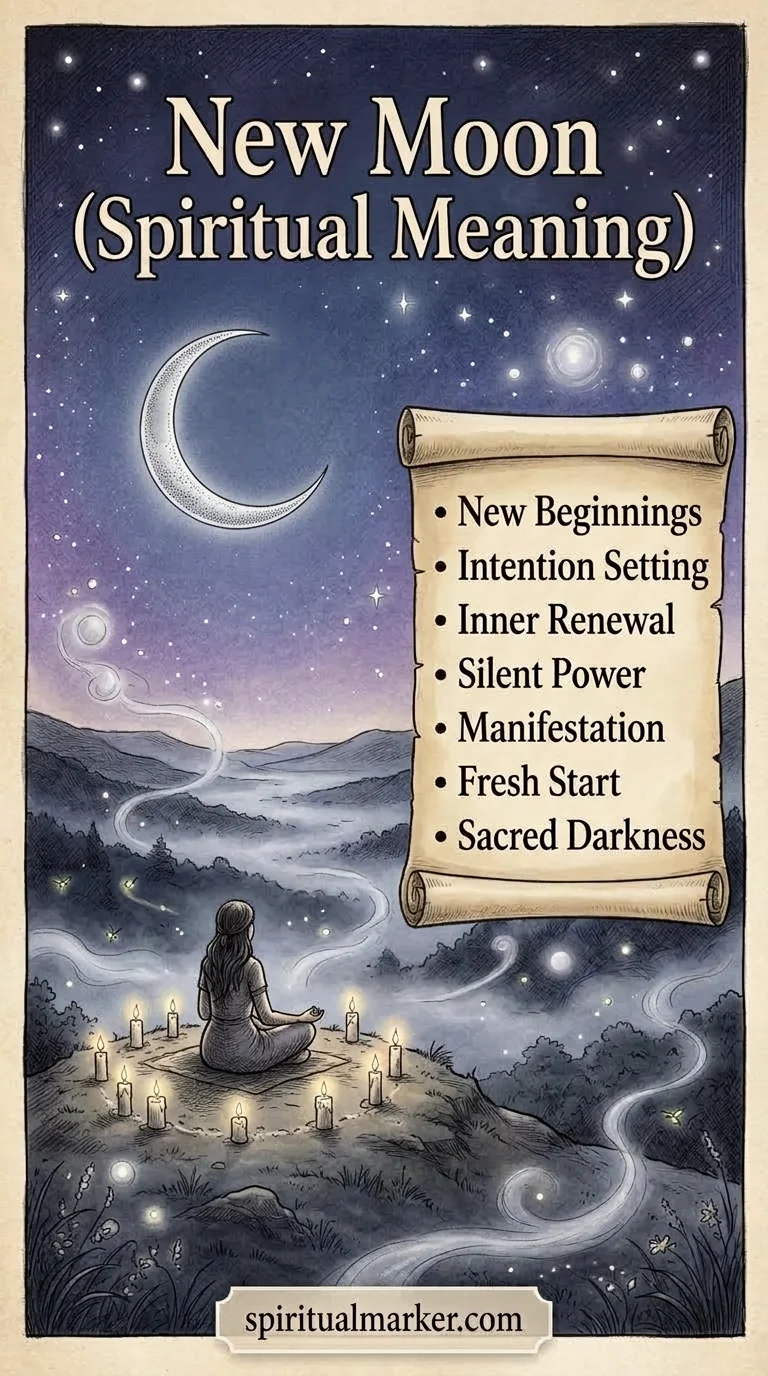
What Is the New Moon and Does It Hold Spiritual Power?
The new moon occurs when the moon aligns directly between the Earth and the sun. The sun illuminates only the far side of the moon during this phase. As a result, you see a completely dark sky where the moon normally shines. This happens once every 29.5 days, completing one full lunar cycle.
But the new moon is far more than an astronomical event. Humans have tracked lunar cycles for at least 20,000 years. Ancient cave paintings in France and bones carved with lunar notches in Africa all suggest early humans watched the moon with purpose. They connected it to tides, seasons, fertility, death, and rebirth. They built calendars around it. They organized religious festivals on its schedule.
The spiritual power of the new moon comes from its symbolism of hidden potential. Just because something is invisible does not mean it is absent. A seed buried underground holds enormous power. A thought not yet spoken can reshape a life. The new moon teaches that beginnings often happen in the dark, in the quiet, before anything visible takes shape. Many spiritual systems teach that this invisible phase amplifies intention-setting because the slate is energetically clean. Nothing old lingers. Nothing clutters the field. The new moon offers pure, open space for what comes next.
Modern astrologers, energy healers, and spiritual teachers agree on one thing: the new moon is the most powerful time of the month for manifestation, prayer, and intention work. Science backs this partially too. Studies published in journals examining circadian rhythms show that human sleep patterns and stress hormones shift with lunar cycles. The moon’s gravitational pull moves the ocean’s tides. Your body is roughly 60 percent water. The connection is not purely symbolic.
What Does Seeing a New Moon Symbolize or Represent?
When you spot the faint sliver of a crescent new moon just after the dark phase, something stirs inside you. That thin arc of silver light rising in the west after sunset carries an unmistakable message: something new is beginning. Across spiritual traditions and psychological frameworks, seeing a new moon holds several layered meanings.
First, it represents renewal and fresh starts. The new moon begins the lunar cycle from zero. All that occurred in the previous cycle has completed. Spiritually, this signals that you have permission to begin again. Past mistakes, old wounds, and stuck energy are released. The new moon says: start fresh, without apology and without hesitation.
Second, the new moon symbolizes hidden potential waiting to emerge. The moon still exists even when you cannot see it. The same is true of your dreams, your gifts, and your unlived life. The new moon reminds you that great things often grow in silence before they show up in the world. Many spiritual teachers point to this phase as proof that absence is not the same as non-existence.
Third, seeing a new moon represents intuition and inner knowing. The new moon governs the subconscious mind in many esoteric traditions. When this phase appears, you are being invited to listen inward. Your gut feelings, dreams, and quiet inner nudges carry more truth during this time than at any other point in the month.
Fourth, the new moon symbolizes feminine wisdom and cyclical living. Many ancient goddesses were associated with this phase, including Artemis, Hecate, and Kali. These were not gentle, passive deities. They governed transformation, initiation, and the dark wisdom that comes from sitting with the unknown. The new moon calls you into that same courageous stillness.
7 Spiritual Meanings of the New Moon
1. New Beginnings and Fresh Starts
The most universally recognized new moon spiritual meaning is the energy of new beginnings. Every lunar cycle starts here. Every 29.5 days, the cosmic clock resets and hands you a clean page. Spiritual practitioners across traditions treat this moment as the most auspicious time to launch new projects, start new habits, make important decisions, and call in positive change.
In astrology, the new moon in each zodiac sign amplifies that sign’s energy. A new moon in Aries ignites courage and action. A new moon in Taurus grounds intentions in material reality. Each new moon offers a specific flavor of new beginning tailored to the cosmic season you find yourself in. Many spiritual journals include monthly new moon intention rituals for this very reason.
The deeper teaching here is about trust. Beginning something in the dark requires faith. You cannot see the outcome. You cannot guarantee the result. The new moon teaches you to plant seeds anyway, to act from intention rather than evidence, and to trust the cycle enough to begin before you feel ready.
This is why so many spiritual traditions treat new moon night as a time for prayer, ritual, and declaration. You are not simply setting a goal. You are aligning your inner desire with the natural rhythm of the universe. That alignment carries tremendous spiritual power.
2. Darkness as a Sacred Space for Growth
Western culture often treats darkness as something to fear or escape. Many spiritual traditions take the opposite view. They teach that darkness is where true growth begins. The new moon embodies this teaching perfectly. Its power lives not in what you can see but in what you cannot.
Seeds germinate underground. Babies develop in the womb. Stars are born inside dark nebulae. Every creation story across human history involves a moment of deep darkness before life emerges. The new moon holds this same creative darkness. Spiritually, it signals that you are in a gestation phase, and that what you are growing needs darkness to take root properly.
Many mystics and contemplatives have spoken of this truth. St. John of the Cross wrote about the dark night of the soul as the necessary precursor to spiritual illumination. Sufi poets described the annihilation of the ego before union with the divine. Buddhist teachings honor the void as the pregnant emptiness from which all things arise. The new moon represents all of these dark, fertile spaces.
When you feel as though life has gone quiet, invisible, or directionless, the new moon reminds you that you are not lost. You are gestating. The darkness is not an ending. It is the first sacred step in a new creation cycle.
3. Intention Setting and Manifestation
Perhaps no new moon spiritual practice is more widely known than intention setting. The new moon marks the beginning of the waxing phase, when the moon grows from darkness to full light. Energetically, this makes the new moon an ideal time to plant the seeds of what you wish to grow. As the moon gains light over the following two weeks, your intentions gain momentum.
Many spiritual traditions teach that writing down intentions on new moon night carries special power. In Vedic astrology, new moon days called Amavasya are considered ideal for prayers and intentions because the mind is more receptive to spiritual influence. Wiccan and pagan practitioners hold new moon circles specifically for this purpose, casting intentions and calling in desired outcomes.
The spiritual principle behind new moon manifestation is alignment. You align your desires with the natural cycle of expansion. You do not fight the current. You plant when the season says to plant. You trust the growth will come as the light returns. This is not passive wishful thinking. It is intentional co-creation with natural law.
Modern manifestation teachers like those rooted in the law of attraction also point to the new moon as an amplified window for this work. The energetic field during a new moon is considered clean, receptive, and highly responsive to focused intention. Setting clear, emotionally charged intentions during this phase is said to accelerate their movement into physical reality.
4. Death, Release, and Letting Go
The new moon does not only mean beginnings. It also marks the end of the previous cycle. Before you can begin something new, the old must complete. The new moon carries the energy of release and surrender, the conscious act of letting go of what no longer serves your highest good.
Many spiritual traditions prescribe specific release rituals during new moon periods. In some Indigenous American traditions, practitioners burn written lists of what they wish to release. In certain Hindu practices, the day before the new moon, called Amavasya, is dedicated to ancestral prayers and releasing karmic debts. In modern spiritual practice, releasing old patterns, beliefs, relationships, and identities during the new moon is considered energetically potent.
The spiritual symbolism here is powerful. The new moon is the moon’s death and rebirth in miniature. Every 29.5 days, the moon disappears completely. Every cycle, it is reborn as a crescent. You are invited into this same rhythm. What parts of your identity, your story, your habits need to die so something new can be born? The new moon asks this question with gentle but persistent force.
Grief, endings, and transitions often intensify around new moon phases for sensitive people. This is not a malfunction. The new moon amplifies emotional depth and surfaces what is ready to be released. Honoring this with ritual, journaling, or quiet contemplation transforms the process from painful to purposeful.
5. Feminine Energy and Divine Intuition
The moon has been associated with feminine energy in virtually every ancient culture on Earth. The new moon, in particular, governs the most inward and receptive aspect of this energy. Where the full moon governs expression and illumination, the new moon governs receptivity, stillness, and the deep listening of the divine feminine.
Ancient Greek mythology linked the new moon specifically to the goddess Hecate, the mistress of the crossroads and the guardian of liminal spaces. Hecate appeared at the dark of the moon, holding torches to light the hidden path. She represented the wisdom available only in the dark, the kind of knowing that comes not from thinking but from deeply feeling and sensing.
In many goddess traditions, the lunar cycle mirrors the feminine life cycle. The new moon corresponds to the maiden archetype, fresh, full of potential, standing at the threshold of something new. This maiden energy is not naïve. It carries the innocent power of someone who has not yet been told they cannot achieve what they dream. The new moon reconnects you with that energy every month.
For anyone seeking to develop their intuition, the new moon offers a monthly amplification window. Psychic sensitivity, dream vividness, and emotional attunement all tend to sharpen during this phase. Paying close attention to your gut feelings, inner visions, and quiet knowings during new moon periods can significantly accelerate spiritual development.
6. Spiritual Awakening and Soul Contracts
Many spiritual teachers point to new moon phases as pivotal moments in spiritual awakening experiences. People report sudden clarity, unexpected revelations, vivid dreams, or dramatic life shifts beginning around new moon periods. The reason, energetically, is that the new moon clears the field and creates space for higher frequencies to enter.
In certain metaphysical traditions, new moons are believed to activate soul contracts: agreements your soul made before incarnating about key lessons, relationships, and experiences to pursue in this lifetime. When the lunar cycle resets, the energetic environment becomes receptive to these deeper callings. Events that feel fated, meetings that feel destined, and inner callings that feel irresistible often surface around new moon periods.
Numerology also intersects here. The number zero, which represents the new moon’s visual state, is associated with infinite potential and divine source energy in many numerological frameworks. It is the number before all numbers, the pregnant void from which everything emerges. Meditating on this symbolism during the new moon can open doors to profound spiritual insight.
If you have been feeling a spiritual call, a deep inner restlessness, or a persistent sense that you are meant for something more, the new moon invites you to take it seriously. This is not random restlessness. The new moon amplifies soul-level truths and brings them closer to the surface. Listen carefully during these phases. Your higher self speaks loudest in the dark.
7. Protection, Purification, and Spiritual Cleansing
The new moon carries strong associations with spiritual protection and purification in traditions worldwide. The absence of moonlight during this phase was historically seen as a time when protective spiritual barriers needed strengthening. Many cultures developed specific rituals for this period to cleanse homes, bodies, and energy fields.
In Vedic tradition, new moon day is one of the most sacred times for spiritual bathing, prayer, and ritual cleansing. Bathing in sacred rivers on Amavasya is believed to remove karmic impurities and ancestral burdens. Prayers offered to ancestors on this day are said to reach them more easily because the veil between worlds thins during the dark moon phase.
In folk magic traditions across Europe and the Americas, new moon nights were used to cleanse tools, crystals, and living spaces. Burning sage, sprinking salt water, and reciting protective prayers during the new moon were all common practices. The new moon’s clean slate energy made it ideal for resetting the energetic environment of homes and sacred spaces.
Modern spiritual practitioners continue these traditions. Cleansing your home, decluttering your physical space, taking a ritual bath with sea salt and essential oils, or burning protective herbs like rosemary and cedar during the new moon are all meaningful ways to honor this protective energy. You reset your outer environment to match the inner reset that the new moon invites.
New Moon Meaning and Symbolism Across Cultures and Religions
The new moon spiritual significance extends across virtually every major civilization in human history. No matter where you look, the dark of the moon has been treated as a sacred moment demanding attention, ritual, and reverence.
In ancient Mesopotamia, the new moon marked the official beginning of the calendar month. Babylonian priests performed elaborate rituals at the temple of the moon god Sin during each new moon. They believed Sin controlled destiny, and that offerings and prayers made on new moon nights had direct influence over the fates of individuals and kingdoms. The crescent moon became one of the most powerful religious symbols in the ancient world as a result of this tradition.
In ancient Egypt, the lunar cycle was governed by the god Thoth, the keeper of sacred knowledge and cosmic order. The new moon represented Thoth’s act of resetting the cosmic record, wiping the slate of the previous month and beginning the sacred count anew. Egyptian priests conducted purification rituals and made offerings to Thoth during each new moon to ensure cosmic harmony continued undisturbed.
Native American traditions are rich with new moon symbolism. Many tribes held new moon ceremonies focused on planting prayers and community intentions. The Cherokee, for instance, observed the new moon as a time to plant crops and pray for growth, both agricultural and spiritual. Many Indigenous lunar calendars named each new moon according to the season, teaching that each fresh lunar cycle carried the specific medicine of that time of year.
In Chinese tradition, the new moon begins each lunar month and carries particular importance in the Chinese lunisolar calendar. New moon days are considered auspicious for beginning new ventures, making important family decisions, and conducting ceremonies. The Chinese New Year itself begins on a new moon, amplifying its association with fresh starts and abundant new beginnings in East Asian culture.
In Celtic traditions, the new moon was associated with the goddess Brigid and later with the dark goddess the Morrigan. Celtic spiritual practitioners viewed the new moon as a liminal moment when the boundary between the physical world and the spiritual realm grew thin. Prayers, spell-work, and vision quests conducted during this phase were believed to be especially powerful because they operated at the intersection of both worlds.
New Moon Symbolism in World Mythologies
World mythologies have woven the new moon symbol into their most profound stories about creation, transformation, and divine power. These myths offer a window into how deeply humanity has always felt the spiritual significance of this lunar phase.
In Greek mythology, the goddess Selene drove her silver chariot across the sky, but during the new moon, she rested. Her rest was not idleness. Ancient Greeks understood that this invisible period was when Selene gathered power for the next cycle. The goddess Hecate took over during the dark moon, moving through the world unseen, holding the crossroads of past and future, offering her wisdom to those brave enough to call on her in the dark.
In Hindu mythology, the moon god Chandra wanes to invisibility each month because of a curse from the god Daksha. But Lord Shiva saves Chandra by wearing him on his head, allowing him to wax back to fullness. This myth encodes a profound teaching about the new moon: even the darkest moment is not destruction but the beginning of a divine restoration. The new moon in Hindu mythology is not a defeat but a divine turning point.
In Norse mythology, the moon god Máni drove the moon chariot across the sky, pursued eternally by the wolf Hati. During the new moon, Máni moved so close to the sun that he became invisible. Norse tradition treated this as a sacred pause, a moment between breaths in the cosmic story. Viking communities observed the new moon as a time to rest from raids, make peace agreements, and prepare spiritually for the battles ahead.
In Aztec mythology, the moon goddess Coyolxauhqui was dismembered and her pieces scattered across the sky, forming the moon’s phases. The new moon represented the moment of her greatest dissolution, but also her greatest mystery. Aztec priests conducted ceremonies on new moon nights to honor her and petition the gods for protection, fertility, and wisdom. The new moon was the cosmos at its most vulnerable and, paradoxically, its most powerful.
New Moon Biblical Meaning and Significance
The new moon biblical meaning is well-documented and carries significant spiritual weight in both the Hebrew Bible and the broader Judeo-Christian tradition. The new moon is not a peripheral topic in scripture. It appears repeatedly as a divinely appointed time worthy of special observance.
In the Old Testament, the new moon, called Rosh Chodesh in Hebrew, was formally commanded as a sacred observance. Numbers 28:11-15 prescribes specific burnt offerings to be made at the beginning of each new month. The new moon was a time of communal gathering, rest from ordinary work, and special worship. Psalm 81:3 specifically commands the blowing of the shofar (ram’s horn) at the new moon, signaling its status as a sacred announcement to the community.
The prophet Isaiah referenced new moon observances in Isaiah 66:23, where God declares that all humanity will come to worship before Him at each new moon and every Sabbath. This places the new moon in the same sacred category as the weekly Sabbath, one of the most holy observances in the Jewish tradition. The new moon in scripture is not a minor footnote. It is a recurring divine appointment that God himself established.
In the New Testament, Colossians 2:16-17 references new moon festivals as part of the shadow of things to come that pointed to Christ. This suggests the early Christian community recognized new moon celebrations as meaningful but saw their fulfillment in the person of Jesus. For many Christian theologians, the new moon’s biblical symbolism of renewal, cleansing, and fresh beginnings finds its ultimate expression in the doctrine of regeneration and the new covenant.
In Islamic tradition, the new moon holds foundational importance. The entire Islamic calendar is lunar, and every new month officially begins with the sighting of the new crescent moon. The crescent moon is the central symbol of Islam globally. The new moon beginning Ramadan is among the most spiritually significant moments of the Islamic year, marking the start of a month of fasting, prayer, and intensified spiritual devotion. The Quran explicitly references the moon’s phases in Surah Ya-Sin (36:39), calling the crescent moon a sign of God’s creative order.
New Moon Meaning in Astrology and Spiritual Practice
In modern astrology, the new moon is one of the most significant events of the monthly calendar. Each new moon occurs in a specific zodiac sign, and that sign’s energy colors the entire intention-setting window for that cycle. Astrologers publish new moon guides each month because the specific placement of the new moon dramatically influences what kinds of intentions carry the most momentum.
A new moon in Scorpio, for instance, favors deep emotional transformation, shadow work, and clearing old trauma. A new moon in Gemini favors communication, learning new skills, and starting writing projects. A new moon in Capricorn favors career goals, long-term planning, and disciplined new habits. Astrology gives the new moon spiritual practice a precise and personalized dimension that many practitioners find invaluable.
Solar eclipses always occur on new moons, and these are considered especially powerful portals in astrology. A new moon solar eclipse carries amplified intention energy and is said to accelerate change in the area of life it touches in your natal chart. Eclipse new moons are treated with particular reverence by astrologers because their effects often unfold over six months to two years rather than a single lunar cycle.
The new moon window for intentions is typically considered the 48 hours surrounding the exact new moon time. Many practitioners write their intentions within this window, light candles in colors aligned with their goals, meditate on their desires, and place their written intentions on altars or beneath crystals like clear quartz, moonstone, and labradorite, all stones associated with lunar and new moon energy.
Dreaming About the New Moon: Spiritual and Psychological Meanings
Dreams involving the new moon carry significant spiritual and psychological weight. Your subconscious speaks in symbols, and the new moon is one of the most potent symbols available. Paying attention to new moon dreams can offer genuine insight into your waking spiritual journey.
Dreaming of a dark, moonless sky often signals that you are in a transitional period in waking life. The darkness is not threatening in this context. It represents the space between one chapter and the next. Your subconscious is acknowledging that something has ended and something new has not yet begun. The dream invites patience and trust rather than anxiety and rushing.
Seeing a thin crescent new moon in a dream often signals new possibilities on the horizon. Something you have been waiting for is beginning to take shape. The crescent moon in dreams frequently appears at the start of new romantic relationships, new careers, creative projects gaining traction, or spiritual paths opening up. It is an encouraging symbol, a cosmic nod from the subconscious that your new beginning is real and underway.
Dreaming of the new moon against a vivid star-filled sky carries amplified spiritual significance. Stars in combination with the new moon often suggest that you are receiving guidance from a higher source. Many spiritual dreamers report this image appearing before major life decisions or spiritual breakthroughs. The stars represent divine lights illuminating the dark path ahead of you, assuring you that you are not alone in the darkness.
From a Jungian psychological perspective, the new moon in dreams often represents the unconscious itself. Carl Jung associated the moon with the unconscious mind, the shadow self, and the anima, the feminine principle within all people. Dreaming of the new moon may signal that your unconscious is particularly active, that material you have suppressed is ready to surface, or that your shadow self is calling for integration. Jung believed that engaging with these dream images consciously accelerated psychological wholeness and spiritual individuation.
If you dream of performing a ritual under a new moon, this often signals a spiritual calling or an invitation to deepen your practice. Many people report this type of dream at the beginning of a new spiritual phase in their lives. The dream is not merely reflecting your waking practices. It is often inviting you toward ones you have not yet begun. Take it seriously as a message from your deeper self.
New Moon Spiritual Rituals: Honoring the Dark Phase
Across traditions, specific practices have been developed to harness the spiritual energy of the new moon. These rituals work because they align your personal intention with the natural energetic momentum of the lunar cycle.
Intention journaling is the most accessible new moon practice available. On the night of the new moon, write down ten intentions, desires, or seeds you wish to plant in the coming cycle. Frame them in the present tense as though they are already unfolding. This activates the subconscious toward the goal and aligns your energy with the expansive new moon frequency.
New moon meditation is equally powerful. Sitting in complete darkness or candlelight during the new moon and directing your awareness inward allows you to access the deep stillness this phase offers. Many practitioners visualize their intentions taking root during this meditation, seeing them as seeds planted in fertile inner soil, certain to grow as the light returns.
Crystal charging during the new moon is a widely practiced ritual in metaphysical circles. Placing crystals like moonstone, labradorite, selenite, and clear quartz in the window or outdoors during the new moon is believed to charge them with fresh lunar energy. This is the opposite of what most people expect, since many assume you need full moonlight for crystal charging. But the new moon’s dark energy is considered a uniquely powerful charging frequency for crystals used in intention work and inner healing.
Ancestral prayers and offerings during the new moon are central to Hindu, certain African spiritual traditions, and some Indigenous practices. The veil between the living and the ancestors is considered thinnest during the dark moon phase. Lighting a candle, placing food offerings, speaking aloud to those who have passed, and asking for guidance or blessing are all meaningful ways to honor this aspect of new moon energy.
A Final Note
The new moon spiritual meaning is not a relic of superstition. It is a living tradition that stretches from Babylonian temples to modern meditation circles, from ancient Hindu riverbanks to Jewish synagogues, from Celtic groves to Islamic mosques. Every civilization that has ever looked up at the sky has felt something stir in the dark between moons.
You do not have to call yourself spiritual or religious to benefit from the new moon’s energy. You simply have to be willing to pause. To reflect. To release something old and open your hands for something new. The moon does this every 29.5 days without fail, resetting, renewing, and beginning again in the dark before growing toward light.
The next time the moon goes dark, consider what you want to plant. Consider what you are ready to release. Consider what kind of person you are becoming and what seeds that becoming requires. The new moon asks only that you show up in the dark with open hands and honest intentions.
Nature says begin. The cycle says now. The darkness says trust. You can consider starting a new moon journal practice, creating a simple monthly ritual that fits your beliefs, or simply stepping outside on new moon nights to stand in the quiet dark and feel the reset happening all around you. The new moon is always here, doing its sacred work, whether you notice it or not. The invitation is simply to notice.