
Dreadlocks are more than a hairstyle. They carry history, culture, and spiritual significance. Across traditions, locked hair symbolizes devotion, strength, and connection to the divine.
The spiritual meaning of dreadlocks often involves sacred vows, spiritual discipline, and cultural identity. In some traditions, locks are worn as a sign of renunciation or devotion. A spiritual meaning of braided hair shares that hair-focused symbolism, though braids carry a different energy.
Some people view dreadlocks as a connection to ancestors or a way to channel spiritual energy. Others see them as a statement of freedom and self-expression. The length and maintenance of the locks can add detail.
If you feel drawn to dreadlocks, it may signal a need for spiritual grounding. A spiritual meaning of a single long white hair also deals with hair symbolism, though a single strand is different from locks.
Key Takeaways
- Dreadlocks symbolize a deep spiritual covenant and often represent a vow of dedication to a higher power or sacred path.
- Multiple ancient cultures independently developed the practice of wearing locked hair as a sign of wisdom, power, and divine connection.
- The natural formation of dreadlocks is seen as allowing energy to flow freely, connecting the wearer to cosmic and earthly forces.
- In dreams, dreadlocks can signify spiritual awakening, patience, the need for grounding, or a call to embrace your authentic self.
- Wearing dreadlocks intentionally can serve as a daily spiritual practice, reminding the wearer of their commitment to growth, humility, and higher consciousness.
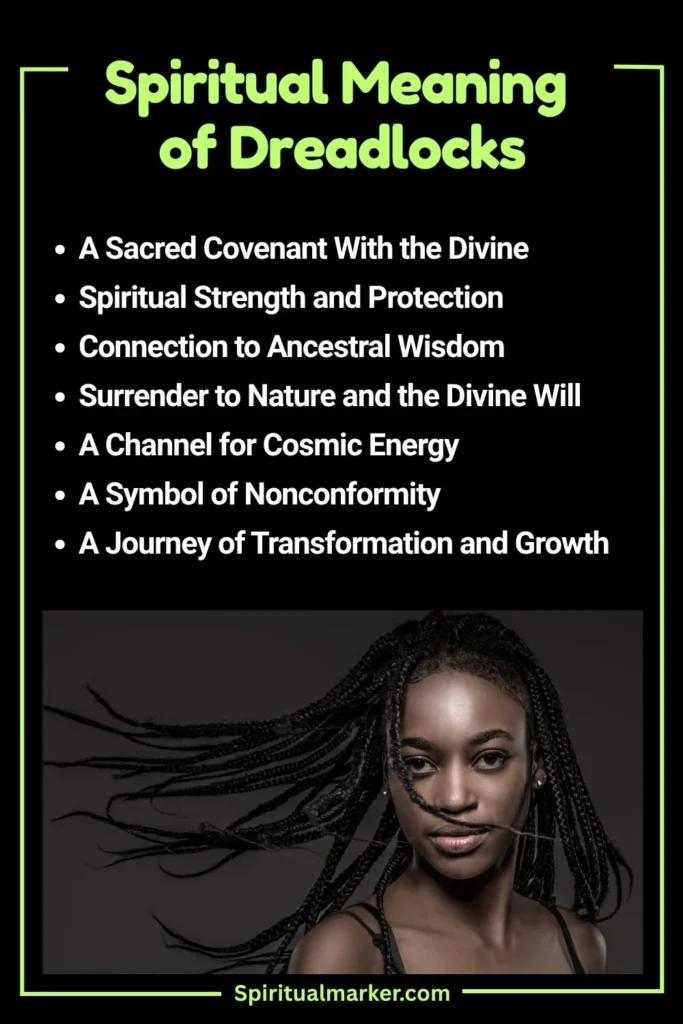
What Are Dreadlocks and Do They Hold Spiritual Power?
Dreadlocks form when hair is allowed to mat and tangle naturally over time, creating ropelike strands that lock together. Some people cultivate them intentionally through techniques like twisting, backcombing, or simply letting hair grow without combing. Others allow their hair to lock spontaneously, viewing the process as a surrender to nature and the divine.
But do dreadlocks actually hold spiritual power? Many traditions say yes. In Hinduism, the god Shiva is depicted with a crown of matted locks, and sadhus who renounce worldly life often grow their hair into jata, or sacred dreadlocks. They believe the hair acts as a vessel for spiritual energy, storing and channeling prana, the life force. Cutting the hair would sever this connection, so it remains uncut as a sign of devotion.
In Rastafari, dreadlocks are called “crowns” and are worn as a symbol of the Lion of Judah and a rejection of Babylon, the materialistic Western world. Rastafarians believe their locks represent strength, identity, and a direct link to Jah (God). The Nazarite vow in the Bible also instructed certain individuals, like Samson, never to cut their hair. Samson’s legendary strength was tied to his uncut locks, suggesting that hair itself could be a conduit for divine power.
Across these traditions, dreadlocks are not merely aesthetic. They are seen as living symbols of faith, patience, and spiritual accumulation. The longer and thicker the locks, the more wisdom and energy they are believed to contain. Whether you view this power as literal or metaphorical, the consistent thread is clear. Dreadlocks represent a commitment to something greater than oneself.
What Does Seeing or Wearing Dreadlocks Symbolize?
When you see someone wearing dreadlocks, you are often witnessing a visible declaration of their spiritual journey. For the wearer, dreadlocks can symbolize several things depending on their personal beliefs and cultural background.
Patience and time are central themes. Dreadlocks do not form overnight. They require months or even years to fully mature. This slow process mirrors the spiritual path itself, which demands persistence, trust, and a willingness to let things unfold naturally. The wearer learns to embrace imperfection during the early stages when locks are messy and uneven. Over time, beauty and order emerge from what seemed like chaos.
Dreadlocks also symbolize a rejection of vanity and societal norms. In many cultures, grooming the hair is associated with attractiveness and social acceptability. Allowing hair to lock can be an act of rebellion against these standards. It says, “I value my inner spiritual state more than external approval.” For some, this represents freedom from ego and the illusion of physical appearance.
Additionally, dreadlocks can signify unity and interconnection. Each strand of hair joins with others to form a single lock. This mirrors the spiritual truth that all beings are connected, part of a larger whole. The wearer carries this reminder on their head at all times.
For observers, seeing dreadlocks may trigger curiosity, admiration, or even discomfort. This reaction often reveals something about the observer’s own relationship with spirituality, conformity, and authenticity.
7 Spiritual Meanings of Dreadlocks
1. A Sacred Covenant With the Divine
One of the most powerful spiritual meanings of dreadlocks is their role as a covenant or sacred agreement with a higher power. In many traditions, growing dreadlocks represents a vow. The wearer pledges to live according to certain spiritual principles, and the uncut hair serves as a visible sign of that commitment.
This mirrors the Nazarite vow in the Hebrew Bible, where individuals like Samson and Samuel were consecrated to God from birth. Part of their vow included never cutting their hair. The locks became a physical manifestation of their dedication. Similarly, Hindu sadhus grow jata as a sign of their renunciation of worldly life and their surrender to Shiva or another deity.
For Rastafarians, dreadlocks are a covenant with Jah and an expression of their African heritage. The locks declare, “I am set apart. I belong to something sacred.” This meaning transforms the hair from a biological feature into a spiritual contract, carried visibly for all to see.
When you wear dreadlocks with this intention, every glance in the mirror becomes a reminder of your vow. The weight of the locks on your head is the weight of your commitment.
2. Spiritual Strength and Protection
Many cultures associate dreadlocks with spiritual strength and protective power. The story of Samson is perhaps the most famous example. His uncut hair was the source of his supernatural strength, and when Delilah cut his locks, he became weak and vulnerable. This narrative suggests that hair itself can serve as a reservoir of divine energy.
In African traditions, some warriors and priests grew dreadlocks as a form of spiritual armor. The matted hair was believed to ward off negative energies and provide protection in battle, both physical and spiritual. The locks were sometimes treated with sacred herbs or oils to enhance their protective qualities.
This meaning extends to modern practitioners who view their dreadlocks as a form of energetic shielding. The dense, layered structure of locked hair is seen as a barrier against psychic attacks, negative influences, and spiritual harm. Wearing dreadlocks becomes an act of self-protection and empowerment.
The strength associated with dreadlocks is not only defensive. It also represents the inner fortitude required to walk a spiritual path in a world that often values materialism over meaning.
3. Connection to Ancestral Wisdom
Dreadlocks carry a deep connection to ancestral lineage and inherited wisdom. For many people of African descent, wearing locks is a way of honoring their forebears who wore similar styles for centuries. The practice links the present generation to a long line of ancestors who lived, struggled, and triumphed.
This ancestral connection is not limited to African cultures. In India, the Rishis and sages of ancient times wore matted hair as a sign of their wisdom and spiritual attainment. Modern practitioners who grow jata see themselves as part of this unbroken tradition, inheriting the insights and blessings of those who came before.
Some spiritual practitioners believe that the hair itself stores genetic memory and ancestral knowledge. By allowing the hair to grow and lock naturally, the wearer maintains a physical link to their bloodline. Cutting the hair would sever this connection.
When you wear dreadlocks with awareness of this meaning, you carry your ancestors with you. Their struggles become your strength. Their wisdom becomes your guide.
4. Surrender to Nature and the Divine Will
The formation of dreadlocks requires surrender. Unlike other hairstyles that demand constant intervention, dreadlocks flourish when left alone. This process mirrors a core spiritual principle. True growth often happens when we stop trying to control everything and allow life to unfold naturally.
Many spiritual traditions teach the importance of surrendering the ego to a higher will. In Hinduism, this is called Ishvara pranidhana. In Christianity, it is expressed as “Thy will be done.” Growing dreadlocks can be a physical practice of this surrender. The wearer accepts the hair as it is, trusts the process, and resists the urge to manipulate or perfect.
This meaning is especially relevant during the early stages of locking, when the hair looks chaotic and unrefined. It takes faith to believe that beauty will emerge from the mess. The wearer learns to trust the timeline of the universe rather than imposing their own.
Dreadlocks become a daily lesson in patience, acceptance, and humility. They teach the wearer that some things cannot be rushed and that nature knows best.
5. A Channel for Cosmic Energy
In many esoteric traditions, the hair is viewed as an antenna for cosmic and spiritual energy. The coiled structure of dreadlocks is believed to be especially effective at receiving and transmitting subtle vibrations. Some practitioners describe their locks as a way of tuning into higher frequencies and accessing states of expanded consciousness.
The crown chakra, located at the top of the head, is the energy center associated with divine connection and enlightenment. Hair grows directly from this region, and some believe that long, uncut hair enhances the flow of energy through the crown chakra. Dreadlocks, with their dense and layered structure, are thought to amplify this effect.
This meaning aligns with the experiences of many people who report feeling more spiritually attuned after growing their hair out. They describe heightened intuition, vivid dreams, and a stronger sense of connection to the universe. Whether this is due to the hair itself or the intention behind it, the effect is real for those who experience it.
Wearing dreadlocks with this understanding transforms the hair into a spiritual tool, consciously used to deepen one’s practice and connection.
6. A Symbol of Nonconformity and Spiritual Freedom
Throughout history, those who have worn dreadlocks have often existed on the margins of mainstream society. They have been monks, mystics, rebels, and prophets. Dreadlocks symbolize a refusal to conform to societal expectations and a commitment to a different set of values.
In the Rastafarian movement, dreadlocks are a direct rejection of Babylon, the term used to describe the oppressive systems of Western materialism and colonialism. Wearing locks is an act of resistance, a declaration that the wearer will not be assimilated into a culture they view as spiritually bankrupt.
This meaning resonates with anyone who feels called to a path outside the mainstream. Dreadlocks become a visible statement. They say, “I choose my own way. I answer to a higher authority than social norms.”
The freedom represented by dreadlocks is not just freedom from external expectations. It is also inner freedom, the liberation that comes from living authentically and aligning your outer appearance with your inner truth.
7. A Journey of Transformation and Growth
Finally, dreadlocks represent the journey of spiritual transformation itself. The process of growing locks mirrors the stages of the spiritual path. There is the initial decision, the messy beginning, the long middle phase of patience and maintenance, and eventually, the mature locks that reflect years of commitment.
Each lock tells a story. The older sections have been through more, weathered more, and grown stronger. The newest growth at the roots represents the present moment, where all transformation actually happens. The entire head of hair becomes a living timeline of the wearer’s journey.
For many, cutting their dreadlocks marks the end of a chapter. It can signify the completion of a vow, a major life transition, or a release of accumulated energy. Some people donate their locks or burn them ceremonially, honoring what they represented.
Wearing dreadlocks is therefore not a static state but an ongoing process of becoming. The hair grows and changes alongside the person, a constant companion on the path of awakening.
Dreadlock Meaning and Symbolism Across Cultures and Religions
The spiritual significance of dreadlocks is not confined to a single tradition. Cultures around the world have independently developed the practice of wearing locked hair, each infusing it with their own sacred meanings.
In Hinduism, dreadlocks are called jata and are most closely associated with the god Shiva. Shiva is often depicted with a massive crown of matted hair, from which the sacred Ganges River is said to flow. His locks represent his wild, untamed nature and his mastery over the forces of creation and destruction. Sadhus, the wandering holy men of India, grow jata as a sign of their renunciation and devotion. For them, the hair is a symbol of their separation from ordinary society and their union with the divine.
In Rastafari, dreadlocks are known as “crowns” and are central to the movement’s identity. Rastafarians grow their locks in accordance with the Nazarite vow and as an expression of their African heritage. The locks symbolize the Lion of Judah, a title associated with Emperor Haile Selassie of Ethiopia, whom Rastafarians regard as a divine figure. Wearing dreadlocks is an act of spiritual resistance against oppression and a reclamation of African dignity.
In Buddhism, while not universally practiced, some ascetics and monks in traditions like Tibetan Buddhism and certain tantric lineages have worn matted hair as a sign of their renunciation. The hair represents their detachment from worldly concerns and their focus on inner development.
Among the Maasai of East Africa, warriors have traditionally worn their hair in long, reddened locks as a sign of bravery and status. The locks are carefully cultivated and are shaved off when a warrior transitions to the next stage of life, symbolizing transformation and the end of one chapter.
In ancient Egypt, some priests and pharaohs are depicted with locked or braided hair, suggesting that the style carried spiritual or royal significance. The attention given to hair in Egyptian burial practices indicates that it was considered important even in the afterlife.
These diverse traditions share a common thread. Hair is not merely biological matter. It is a spiritual asset, a symbol of identity, and a marker of one’s relationship with the sacred.
Dreadlock Symbolism in World Mythologies
Mythologies around the world contain references to hair as a source of power, wisdom, and divine connection. These stories illuminate why dreadlocks have been revered across so many cultures.
In Hindu mythology, the river Ganges descended from the heavens with such force that it would have destroyed the earth. To cushion its fall, Lord Shiva caught the river in his matted locks, allowing it to flow gently down to the world. This myth elevates dreadlocks to a cosmic level. They are capable of holding divine forces and mediating between heaven and earth.
The Greek myth of Medusa offers a darker but equally powerful image. Medusa’s hair was transformed into a mass of writhing serpents, and her gaze could turn men to stone. While often interpreted as a tale of monstrosity, some feminist and spiritual readings see Medusa as a symbol of primal feminine power, her serpent locks representing untamed energy and forbidden wisdom.
In Norse mythology, the concept of wyrd, or fate, was sometimes symbolized by intertwined threads. Hair, with its similar structure, was associated with the weaving of destiny. Warriors often braided or locked their hair before battle, believing it would bind their fate to victory.
Among Indigenous peoples of the Americas, long hair was often considered sacred. Many tribes believed that hair was an extension of the nervous system, enhancing intuition and awareness. Cutting the hair was reserved for times of mourning or as a form of punishment. Some individuals grew their hair into locks naturally, and these locks were treated as spiritually significant.
These myths reveal a universal intuition about hair. It is connected to the deepest aspects of our being, to our power, our fate, and our relationship with forces greater than ourselves.
Types of Dreadlocks and Their Spiritual Meanings
Not all dreadlocks are the same, and the method of their formation can carry distinct spiritual implications.
Freeform dreadlocks are allowed to form completely naturally, without any manipulation. The wearer simply stops combing and lets the hair do what it will. This style represents the highest degree of surrender. It is an embrace of chaos and trust that order will emerge on its own. Freeform locks often look wild and asymmetrical, reflecting the wearer’s acceptance of imperfection and their alignment with natural processes.
Semi-freeform dreadlocks involve minimal intervention. The wearer may separate the locks occasionally to prevent them from merging but otherwise allows them to form naturally. This approach balances surrender with gentle guidance, mirroring a spiritual path where the practitioner remains attentive without being controlling.
Cultivated or manicured dreadlocks are formed using techniques like twisting, interlocking, or backcombing. They are often maintained regularly to keep them neat and uniform. While some traditionalists view this as less spiritually authentic, cultivated locks can still carry deep meaning. They represent intention, discipline, and conscious commitment. The regular maintenance can serve as a meditative practice, a time of self-care and reflection.
Sisterlocks and microlocks are very thin, uniform locks often created with a specialized tool. They offer a more refined aesthetic while still carrying the symbolism of locked hair. For some wearers, these styles allow them to embrace dreadlock culture while meeting professional or personal preferences.
The spiritual meaning of your dreadlocks ultimately depends on your intention and the significance you attribute to them. Whether wild and freeform or neat and cultivated, they can serve as powerful symbols of your path.
Dreadlocks in the Bible: Meanings and Significance
The Bible contains several references that relate to the spiritual significance of hair, and these passages have shaped the dreadlock practices of Rastafarians and others.
The most famous example is the Nazarite vow, described in Numbers 6:1-21. Individuals who took this vow were consecrated to God and were required to abstain from wine, avoid contact with the dead, and never cut their hair. The uncut hair served as a visible sign of their dedication. Samson, whose story appears in Judges 13-16, was a Nazarite from birth. His strength was tied to his uncut locks, and when Delilah cut them, he lost his power. This narrative powerfully links hair to divine empowerment.
The prophet Samuel was also dedicated as a Nazarite by his mother, Hannah. She vowed that if God granted her a son, no razor would touch his head. Samuel went on to become one of Israel’s greatest prophets, anointing both Saul and David as kings.
In the New Testament, hair appears in various symbolic contexts. In 1 Corinthians 11, Paul discusses the significance of hair length, though his comments are often debated and interpreted in different ways. What remains consistent is the idea that hair carries spiritual and social meaning.
Rastafarians draw on these biblical traditions to justify their practice of growing dreadlocks. They see themselves as modern Nazarites, set apart for a divine purpose. Their locks are a crown of glory, a sign of their covenant with Jah, and a rejection of the shaving and cutting practices they associate with Babylon.
For those who approach dreadlocks from a Christian perspective, the biblical examples offer a rich foundation. Growing locks can be an act of consecration, a way of setting oneself apart for sacred service.
Dreaming About Dreadlocks: Spiritual and Psychological Meanings
Dreams about dreadlocks can carry significant messages from the subconscious mind and the spiritual realm. The specific meaning depends on the details of the dream and your personal associations with locked hair.
Dreaming of yourself with dreadlocks when you do not have them in waking life may signify a call to embrace your authentic self. The dream could be inviting you to let go of societal expectations and express your true nature. It might also indicate a desire for spiritual growth, patience, or a deeper connection to your roots and ancestry.
Seeing someone else with dreadlocks in a dream can represent qualities you associate with that person or with dreadlocks in general. Perhaps you admire their freedom, wisdom, or spiritual commitment. The dream may be encouraging you to cultivate these qualities in yourself.
Dreaming of growing dreadlocks suggests a process of transformation unfolding in your life. The slow formation of locks mirrors the gradual development of wisdom, character, or spiritual understanding. The dream encourages patience. Whatever you are working toward will take time, but the results will be worth it.
Dreaming of cutting dreadlocks can indicate the end of a phase or the release of something you have carried for a long time. This might be a belief, a relationship, or an aspect of your identity. The dream may be preparing you for a transition or asking you to consider what you are ready to let go of.
Dreams of tangled or messy dreadlocks could reflect feelings of confusion, being overwhelmed, or losing control in some area of your life. Alternatively, they might suggest that order will eventually emerge from the current chaos if you remain patient.
Dreaming of beautiful, mature dreadlocks symbolizes wisdom, maturity, and the rewards of a long spiritual journey. It is a positive sign, suggesting that your efforts are bearing fruit and that you are on the right path.
As with all dreams, the most accurate interpretation comes from within. Consider how the dream made you feel and what dreadlocks mean to you personally.
A Final Note
Dreadlocks are one of humanity’s oldest and most universal symbols of spiritual commitment. They have been worn by saints and warriors, mystics and rebels, across continents and centuries. The spiritual meaning of dreadlocks transcends any single culture or religion. These locks speak to something deep within the human soul: the desire to connect with the divine, to honor our ancestors, to live authentically, and to surrender to the natural unfolding of life.
Whether you wear dreadlocks yourself, are considering growing them, or simply admire them from a distance, their significance is available to anyone willing to reflect. They remind us that spirituality is not only found in temples and texts but can be carried on the body, woven into the very strands of who we are.
If you feel drawn to dreadlocks, consider what they might represent for you. Perhaps they call you to patience, to surrender, or to a deeper connection with your heritage. Perhaps they invite you to reject conformity and embrace your unique path. Whatever the meaning, let your locks, whether worn or envisioned, be a source of strength, beauty, and sacred purpose.