Have you ever picked up a smooth black stone and immediately felt more grounded? People often describe that exact feeling when they first hold Black Agate. Its deep, dark surface feels solid and serious. Yet something about it feels quietly steadying in a world that rarely slows down.
Black Agate has served as more than a decorative stone throughout history. Ancient warriors carried it into battle. Healers placed it on the body during spiritual rituals. Priests and royalty used it to ward off evil and attract divine favor. Its reputation stretches across Greek, Roman, Egyptian, and Asian civilizations, making it one of the most enduring protective stones in human history.
What makes Black Agate so compelling is its duality. It looks serious, almost severe, with its opaque black surface and subtle waxy polish. But its energy tells a different story. People drawn to this stone often describe feelings of calm authority, emotional steadiness, and deep personal protection. It does not overwhelm. It stabilizes.
Unlike softer emotional stones that work gently at the edges of feeling, Black Agate works at the foundation. It targets fear, emotional instability, and scattered energy. It grounds people who feel disconnected, overwhelmed, or emotionally exposed. That is why spiritual practitioners, athletes, soldiers, and meditation teachers across vastly different traditions have all reached for the same stone at different points in history.
This article covers the full meaning of Black Agate, its spiritual symbolism, healing properties, historical significance, and practical ways to use it. You will also learn how to wear and care for Black Agate jewelry while protecting its beauty and energetic value.
Key Takeaways
- Black Agate symbolizes protection, grounding, inner strength, and emotional stability.
- Many spiritual traditions associate Black Agate with the root chakra and personal empowerment.
- People use Black Agate during meditation, trauma recovery, grief, and periods of major life transition.
- Black Agate belongs to the chalcedony family and scores between 6.5 and 7 on the Mohs hardness scale.
- Wearing Black Agate jewelry daily is believed to create a protective energy field that supports confidence and emotional resilience.
What is Black Agate?
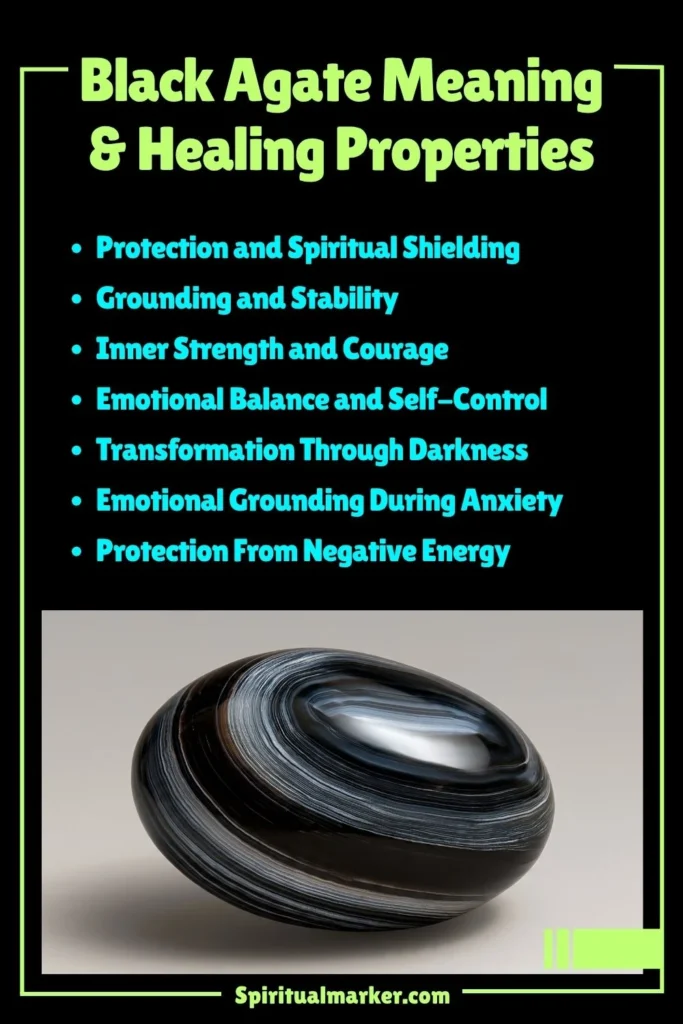
Black Agate is a naturally occurring banded or solid black variety of chalcedony, a mineral from the quartz family. It forms in cavities within volcanic rocks as silica-rich fluids slowly deposit layer after layer over geological time. Its surface ranges from opaque matte black to a smooth, polished near-gloss, depending on its mineral content and how it has been treated.
Its color comes primarily from carbon and iron compounds embedded during formation. Some specimens show faint banding visible under light. Others appear uniformly deep black. Both forms carry the same essential mineral identity, though spiritual communities sometimes associate banded varieties with slightly different energetic qualities.
Many people confuse Black Agate with Black Obsidian or Black Tourmaline. The differences matter. Obsidian is volcanic glass, not a crystal. It fractures sharply and carries intense energy. Tourmaline is a separate mineral group with a different crystalline structure. Black Agate, by contrast, feels smoother, more patient, and energetically steadier than both. Spiritually, it is often described as more protective without being overwhelming.
Origins and Formation
Black Agate forms through a slow geological process that can span millions of years. Silica-rich fluids seep into hollow cavities inside volcanic rock. As these fluids cool and harden, they form concentric layers of chalcedony. Each layer reflects the conditions of its time, including temperature shifts, mineral content, and the chemistry of the surrounding environment.
This layered formation is significant spiritually. The stone’s history is literally built into its structure, one layer at a time. Many healing traditions associate this characteristic with patience, resilience, and the strength that develops through life experience.
Significant deposits of Black Agate exist across the globe. Brazil, India, Uruguay, the United States, China, and parts of Africa all produce notable quantities. Each regional deposit carries slight variation in texture, banding, and color depth. Brazilian and Indian specimens are among the most widely used in jewelry and spiritual practice today.
The stone’s durability is another meaningful trait. With a Mohs hardness of 6.5 to 7, it resists scratching well. That physical toughness mirrors its spiritual reputation as a stone of endurance and strength.
Key Properties
| Property | Details |
|---|---|
| Color | Deep black, matte or polished |
| Composition | Silicon dioxide (chalcedony variety) |
| Hardness | 6.5 to 7 on the Mohs scale |
| Chakra Association | Root chakra (primarily), solar plexus chakra (secondary) |
| Symbolism | Protection, grounding, strength, courage |
| Common Sources | Brazil, India, USA, Uruguay, China, Africa |
| Transparency | Opaque to translucent |
| Energy Style | Grounding, protective, stabilizing |
Historical Use
The history of Black Agate as a protective and empowering stone is long and cross-cultural. Ancient civilizations did not see it as merely decorative. They treated it as a spiritual tool with serious, practical power.
Ancient Greek and Roman warriors carried Black Agate into battle. They believed it would protect against physical harm and sharpen their courage during combat. Soldiers wore agate amulets carved with protective symbols, believing the stone would shield them from both enemy weapons and dark spiritual forces.
Ancient Egyptians incorporated agate into their healing rituals and burial practices. They placed protective stones with the deceased to ensure safe passage through the afterlife. Agate seals and carved amulets have been recovered from Egyptian tombs spanning thousands of years of recorded history.
In Mesopotamian cultures, agate was linked to divine protection and used in cylinder seals, which were official marks of authority and spiritual identity. High priests and rulers used these seals in legal and ceremonial contexts.
Persian and Islamic traditions recorded beliefs that agate protected against misfortune, envious energy, and personal illness. Some texts described agate as a stone that brought divine blessings when worn with sincere intention.
In East Asian traditions, black stones were often associated with water energy in feng shui practice. Black stones absorb and neutralize negative energy, creating protective boundaries within living and working spaces.
Medieval European alchemists and herbalists also included agate in their protective and strengthening practices. They associated it with clarity of mind, personal courage, and protection against deception.
This remarkable cross-cultural consistency speaks to something universal in how humans have experienced Black Agate energy across vastly different belief systems.
5 Spiritual Meanings of Black Agate
1. Protection and Spiritual Shielding
Protection stands as the most consistent and deeply rooted spiritual meaning of Black Agate across centuries of tradition. Ancient warriors carried it as physical armor. Priests used it to guard sacred spaces. Healers placed it near doorways and altar spaces. This long-standing association is not accidental. Something about the stone’s dense, opaque nature and dark color communicates a quality of shielding that people across vastly different cultures have recognized independently.
In spiritual traditions, protection means more than physical safety. It also refers to energetic protection, the idea that a person can carry spiritual boundaries that guard their emotional and mental space from harmful outside influences. People who feel emotionally porous, frequently drained by others, or unable to maintain healthy emotional limits often describe Black Agate as particularly meaningful.
This symbolism also speaks to people moving through dangerous life periods. Job loss, relationship breakdown, personal crisis, grief, or major uncertainty can all create a sense of spiritual vulnerability. During these periods, Black Agate symbolizes a kind of spiritual armor. It does not remove pain, but it represents the strength to endure and continue functioning even when circumstances feel threatening.
Many spiritual practitioners also associate Black Agate with protection from negative thought patterns. Fear, self-doubt, pessimism, and destructive internal dialogue can quietly undermine emotional well-being over time. The stone’s protective symbolism extends into this mental territory. It represents the boundary between empowering self-awareness and destructive self-attack.
The stone’s protection energy also extends into interpersonal dynamics. Toxic relationships, manipulative environments, and emotional exploitation all create forms of spiritual damage. Black Agate symbolically represents the personal authority and grounded strength needed to recognize and remove oneself from those harmful dynamics.
2. Grounding and Stability
Grounding is the second major spiritual meaning of Black Agate, and it connects directly to the stone’s association with the root chakra. In chakra traditions, the root chakra governs feelings of safety, physical security, emotional stability, and personal survival. When this energy center is balanced, people feel anchored, calm, and capable of handling difficulty. When it is blocked or overwhelmed, anxiety, emotional instability, fear, and disconnection from reality can all surface.
Black Agate is consistently linked with root chakra energy because its symbolism centers on exactly those qualities of safety and stability. People who feel emotionally unmoored, mentally scattered, or spiritually anxious often find the stone particularly compelling. Its dark, solid appearance communicates stillness and weight in a way that many lighter or brighter stones simply do not.
This grounding symbolism becomes especially powerful during life transitions. Moving to a new city, ending a long relationship, starting a new career, or recovering from loss all create periods of emotional instability where the sense of personal foundation temporarily disappears. Black Agate spiritually represents the process of rebuilding that foundation step by step.
Many spiritual teachers describe grounding as the precondition for meaningful healing. Emotional healing is difficult when a person feels fundamentally unsafe. Black Agate symbolizes creating that inner safety first, providing a stable emotional base from which deeper healing can begin. This distinguishes it from stones associated purely with emotional opening, which can sometimes feel destabilizing without adequate grounding.
The stone also reflects a grounded relationship with reality. Some spiritual paths encourage detachment from the physical world. Black Agate’s symbolism moves in the opposite direction. It honors the importance of physical existence, practical responsibility, and embodied awareness. It represents spiritual depth that remains connected to everyday life rather than escaping from it.
3. Inner Strength and Courage
Black Agate has been linked to personal courage and inner strength throughout its recorded history. Ancient soldiers who carried it were not just seeking protection from external harm. They were also seeking the internal quality that allows a person to act despite fear. That particular form of courage, showing up and persisting through genuine difficulty, forms a major part of the stone’s spiritual identity.
This symbolism resonates deeply in modern contexts. Physical battlefields are less common, but emotional ones are everywhere. Facing a difficult conversation, leaving an unhealthy situation, starting over after failure, maintaining honesty under social pressure, or protecting personal values in unsupportive environments all require real courage. Black Agate spiritually represents that quiet internal resource.
The stone’s symbolism of inner strength also differs from simple bravado or forced confidence. It does not represent loudness, aggression, or dominance. Instead, it represents the grounded courage that remains calm under pressure. This is strength rooted in self-knowledge and emotional stability rather than emotional performance.
Many people turn to Black Agate during periods when their confidence has been damaged by failure, criticism, rejection, or prolonged hardship. After enough difficult experiences, people sometimes begin to doubt their own resilience. They wonder whether they can survive another loss or navigate another challenge. The stone spiritually symbolizes the rediscovery of that internal durability. It reminds people that they have survived difficulty before and carry the strength to do so again.
This meaning also extends into emotional boundaries. Setting limits in relationships, declining unreasonable demands, or leaving situations that violate personal values all require emotional courage. Black Agate symbolizes the grounded self-respect that makes those choices possible.
4. Emotional Balance and Self-Control
Emotional balance represents one of Black Agate’s most nuanced spiritual meanings. While protection and strength are often the first associations people make with this stone, its capacity to support emotional regulation runs equally deep in spiritual tradition.
People experiencing emotional volatility, intense mood swings, overwhelming anxiety, or uncontrolled emotional reactivity often find Black Agate particularly stabilizing. The stone’s symbolism centers on emotional steadiness rather than emotional suppression. This distinction matters significantly. The stone does not represent emotional numbness or avoidance. It represents the grounded emotional center that prevents reactions from spiraling into destructive or destabilizing behavior.
Emotional self-control is not about eliminating feeling. It is about having sufficient internal stability that emotions can be felt, processed, and expressed without causing unnecessary harm to oneself or others. Black Agate spiritually symbolizes that capacity. It represents the deep breath before a heated conversation. It represents the pause between impulse and action that allows for clearer, more deliberate choices.
This symbolism is particularly meaningful for people recovering from trauma. Trauma often disrupts the nervous system’s ability to regulate emotional responses. Situations that seem minor to others can trigger intense emotional reactions in trauma survivors because the internal regulatory system has been destabilized. Black Agate’s grounding energy symbolically supports the rebuilding of that internal stability over time.
The stone also reflects emotional authenticity. Balanced emotional expression is different from emotional performance. People who constantly manage how they appear to others often experience enormous internal pressure. Black Agate symbolically encourages honest emotional awareness combined with the grounded stability to navigate that awareness without losing control.
5. Transformation Through Darkness
One of the most profound and often overlooked spiritual meanings of Black Agate involves its relationship with darkness and transformation. Many people associate the color black with negativity, endings, or loss. In deeper spiritual traditions, however, black carries different symbolism. It represents the fertile unknown, the place of genuine transformation, and the darkness that precedes light.
Black Agate carries this layered symbolism powerfully. It does not deny difficulty. It does not promise that pain can be avoided or bypassed. Instead, it represents the strength to move through darkness without losing yourself. This is the spiritual quality of the stone that distinguishes it from lighter, more emotionally comforting crystals.
Many healing traditions recognize that genuine transformation requires confronting what has been avoided, suppressed, or denied. Grief cannot be resolved without being felt. Fear cannot be overcome without being acknowledged. Outdated emotional patterns cannot be released without honest self-examination. Black Agate spiritually symbolizes the courage and groundedness required to do that honest inner work.
This meaning resonates with people navigating major endings, whether relationships, careers, identities, beliefs, or life chapters. Endings feel dark partly because they require releasing what was familiar. Black Agate’s symbolism acknowledges that darkness while simultaneously representing the internal strength to move through it. On the other side of genuine transformation lies new capacity, new clarity, and new emotional freedom. The stone points toward that destination without minimizing the difficulty of the journey.
The stone’s association with transformation also carries a forward-looking quality. It does not simply represent survival of difficulty. It represents emergence from difficulty with greater depth and resilience. Many people who have experienced significant loss or hardship describe a deepened capacity for compassion, presence, and appreciation that was not available to them before. Black Agate symbolically honors that process of becoming through difficulty.
6 Healing Properties of Black Agate
1. Emotional Grounding During Anxiety
Black Agate holds a well-established reputation as a stone for anxiety because its energy targets exactly what anxiety disrupts: the sense of safety and groundedness. Anxiety creates an experience of being mentally and emotionally unmoored. The mind races toward feared outcomes. The body tenses in anticipation of threats that may or may not exist. The present moment feels unsafe, and the nervous system responds with alarm signals that are often disproportionate to the actual situation.
Within crystal healing traditions, Black Agate is believed to interrupt this cycle by reinforcing a sense of physical and emotional anchoring. Its grounding energy symbolically reconnects the anxious mind with the present moment and the physical body. This is not a dramatic or forceful process. Many practitioners describe Black Agate’s anxiety-related properties as stabilizing rather than sedating. It does not eliminate awareness of stressors. It creates a calmer platform from which to engage with them.
Research consistently shows that practices associated with grounding, such as mindfulness, breathwork, and body awareness, significantly reduce anxiety symptoms. Black Agate is often used as a focal point or anchor during these practices. Holding the smooth, cool stone during breathing exercises gives the anxious mind a physical point of focus that interrupts the loop of anxious thinking.
Its association with the root chakra is especially relevant here. Root chakra imbalances are strongly connected with anxiety, fear, instability, and a pervasive sense of threat. Spiritual practices targeting the root chakra, including meditation with grounding stones like Black Agate, are designed to address the foundational feeling of unsafety that feeds chronic anxiety.
The stone’s consistent physical weight and cool, smooth surface also carry practical grounding benefits during moments of acute anxiety. Physical sensation pulls attention back into the present moment, and Black Agate’s texture provides a reliable sensory anchor during emotionally destabilizing moments.
2. Grief Support and Emotional Endurance
Black Agate appears regularly in spiritual traditions connected with grief, mourning, and emotional endurance. This association goes back to ancient practices, where black stones were included in burial rituals, memorial ceremonies, and prayers for those who had died. The stone’s dark color was not considered morbid. It was considered honest, acknowledging the weight and reality of loss without flinching.
Grief is one of the most demanding emotional experiences humans face. It does not resolve on a predictable schedule. It rarely moves in a straight line from pain toward healing. Instead, grief cycles, resurfaces unexpectedly, and demands a quality of emotional endurance that can feel completely exhausting. Black Agate’s healing symbolism addresses precisely that long-haul quality of grief. It does not promise quick resolution or painless recovery. It symbolizes the strength to continue carrying grief while remaining functional.
Many people also experience emotional shame around grief, particularly when it persists beyond the informal social timelines that others often apply. They worry that they are not healing fast enough, or that their grief is disproportionate. Black Agate spiritually represents emotional permission to grieve fully and at one’s own pace. Its energy is associated with honest emotional acknowledgment rather than emotional performance for the benefit of others.
The stone’s protective qualities also matter during grief. Loss creates emotional vulnerability that can expose people to unhelpful advice, minimizing responses, or emotionally draining social interactions. Black Agate symbolically provides the personal boundary that protects a grieving person’s emotional space and allows healing to proceed without constant external interference.
3. Strengthening Personal Confidence
Black Agate is consistently associated with self-confidence and personal authority in spiritual traditions worldwide. This connection flows directly from the stone’s symbolism of inner strength, protection, and emotional grounding. When people feel grounded, protected, and emotionally stable, confidence naturally follows. Black Agate healing traditions target the root of confidence rather than its surface performance.
Low confidence frequently has its origins in unresolved emotional wounds, repeated experiences of failure, external criticism, or environments that consistently undermined a person’s sense of worth and competence. Surface-level confidence-building strategies, such as affirmations or behavioral rehearsal, can be useful but rarely touch the deeper emotional wound. Black Agate’s healing symbolism works at that deeper level by targeting the foundational sense of safety and personal authority that genuine confidence requires.
The stone is particularly associated with confidence under pressure. Many people feel reasonably confident in comfortable, familiar environments. The challenge arrives in high-stakes situations, public scrutiny, conflict, or unfamiliar environments where the threat of failure or judgment feels real. Black Agate’s grounding energy symbolically supports confidence that does not collapse under pressure. It represents the settled internal authority that remains accessible even in difficult external circumstances.
Many practitioners also connect Black Agate with confidence in the context of public roles, leadership, and performance. Athletes, speakers, performers, and executives have historically valued stones associated with courage and groundedness. Black Agate fits this application naturally because its symbolism combines protection, emotional stability, and steady personal authority into a single energetic identity.
4. Protection From Negative Energy
In spiritual practice, negative energy refers to a broad category of experiences. It includes the draining influence of genuinely toxic people, environments that consistently undermine emotional well-being, collective fear and distress in shared spaces, and the person’s own destructive thought patterns. Black Agate is perhaps the most historically consistent stone associated with protection against all of these forms of negative influence.
Many people who work in high-stress environments, care professions, service industries, or emotionally demanding relationships report feeling energetically depleted after sustained exposure. This is sometimes described as emotional sponging, where a sensitive person involuntarily absorbs the emotional states of those around them. Black Agate is frequently recommended in crystal healing traditions for people who experience this pattern.
The stone’s symbolism of spiritual shielding creates a conceptual boundary between the self and outside influences. This is not about emotional disconnection or indifference. It is about maintaining a clear distinction between your own emotional state and the emotional states of others. Black Agate healing traditions associate the stone with the ability to remain compassionately present with others without losing emotional stability or becoming overwhelmed.
Its protective properties also extend to environments. Many practitioners place Black Agate in workspaces, therapy rooms, entry points of homes, or meditation areas with the intention of establishing a protective energetic perimeter. While the metaphysics of environmental protection remain outside empirical verification, the psychological effect of intentional protective practices is well-documented. Rituals that create a sense of safety genuinely affect emotional regulation.
5. Supporting Physical Vitality
Black Agate appears in historical healing traditions as a stone associated with physical strength and bodily endurance. Ancient physicians and healers sometimes used it in practices targeting the digestive system, blood health, and physical recovery. Modern crystal healing carries some of these associations forward, though the approach has shifted toward symbolic and complementary rather than direct medical application.
The stone’s association with physical vitality connects closely with its root chakra symbolism. The root chakra governs not only emotional safety but also the body’s foundational energy, physical stamina, immune resilience, and sensory presence. When root chakra energy is balanced, people often report feeling more physically present, energetically stable, and capable of sustained physical effort.
Black Agate is sometimes used in practices designed to support recovery from illness, physical exhaustion, or periods of intense physical demand. Athletes and physically active individuals who work with crystal healing occasionally include Black Agate in their practice with the intention of supporting grounded physical energy and sustained endurance.
The stone’s historical association with blood and circulatory health also appears across multiple cultural traditions. Ancient healers in several traditions used black and red stones in rituals and practices connected with blood-related conditions. While this should never replace qualified medical care, the symbolic consistency across independent cultures is historically notable.
6. Promoting Mental Clarity and Focus
Mental clarity is a less commonly discussed healing property of Black Agate, but it appears consistently across spiritual traditions that value the stone’s grounding and stabilizing qualities. Scattered mental energy, chronic distraction, difficulty concentrating, and mental confusion often appear when a person is emotionally overwhelmed, spiritually ungrounded, or carrying excessive mental load.
Black Agate healing traditions associate the stone with cutting through that mental noise. Its grounding energy symbolically collects scattered mental energy and redirects it toward focused, clear awareness. Many practitioners use Black Agate during study, creative work, decision-making, or any activity that requires sustained concentration and mental presence.
This mental clarity property also connects to its protective symbolism. A mind bombarded by anxiety, external demands, emotional distraction, and mental noise struggles to think clearly. Black Agate symbolically creates the mental equivalent of a protected, quiet space where focused thinking becomes more accessible.
The stone is also associated with rational decision-making in situations where emotion or fear might otherwise cloud judgment. Rather than eliminating emotion from the decision-making process, its symbolism suggests integrating emotional awareness with grounded clarity. This combination produces decisions that honor both feeling and reason simultaneously.
How to Wear Black Agate Jewelry for Spiritual Growth
Wearing Black Agate jewelry is one of the most accessible and practical ways to maintain consistent connection with the stone’s energy throughout daily life. The placement of the stone matters in many spiritual traditions.
Bracelets made with Black Agate beads are among the most popular choices. Wearing the stone directly on the wrist keeps it in consistent contact with the skin and pulse point. Many practitioners believe this sustained physical contact strengthens the stone’s grounding and protective influence throughout the day.
Pendants and necklaces allow Black Agate to rest near the chest, symbolically aligning it with core body energy. When worn closer to the throat, the stone may also support confident, grounded communication. Some people prefer longer chains that place the stone at solar plexus level, connecting it with the secondary chakra association of personal power and self-confidence.
Rings carry Black Agate into constant physical contact with the hands, which are our primary instruments of action and interaction with the world. Wearing the stone this way is associated with strengthening the protective energy around personal action, work, and decision-making.
Many people choose to wear Black Agate every day as a consistent source of grounding energy. Others reserve it for high-pressure situations like difficult conversations, demanding workdays, travel, or emotionally intense personal events.
Combining Black Agate with complementary stones can create layered energetic support. Red jasper may deepen root chakra grounding. Clear quartz may amplify and clarify the stone’s protective properties. Hematite enhances physical grounding and mental focus. Obsidian adds intensity to protective energy for those who feel they need it.
Caring for Black Agate Jewelry
Black Agate is more durable than many gemstones because of its hardness rating of 6.5 to 7. This makes it reasonably resistant to everyday wear. However, proper care still extends its beauty and maintains the quality of both the stone and any metalwork in your jewelry.
Store Black Agate jewelry away from harder stones that could scratch softer metals in shared settings. A soft pouch or lined jewelry box protects it from friction and impact. Although the stone itself is harder than many crystals, sharp impact can still cause chipping along edges.
Clean Black Agate with warm water, a small amount of mild soap, and a soft cloth. Rinse thoroughly and dry completely before storage. Avoid ultrasonic cleaners, steam cleaning machines, and harsh chemical cleaners, as these can damage surface polish and degrade metal settings over time.
Remove Black Agate jewelry before swimming, intensive exercise, or household cleaning involving chemicals. Prolonged water exposure and chemical contact can affect both the stone and its setting, particularly over months of repeated exposure.
For spiritual maintenance, many practitioners cleanse Black Agate energetically on a regular basis. Common methods include moonlight cleansing by leaving the stone outside or near a window during a full moon, sound cleansing using singing bowls or bells, or burying the stone briefly in dry earth to renew its grounding energy. Black Agate is generally considered safe for water cleansing, unlike softer or more porous stones, but extended soaking is still best avoided.
Table: Black Agate at a Glance
| Aspect | Details |
|---|---|
| Primary Meaning | Protection, grounding, and inner strength |
| Chakra Association | Root chakra (primary), solar plexus (secondary) |
| Main Spiritual Symbolism | Courage, stability, transformation, protection |
| Common Colors | Deep black, matte or polished surface |
| Hardness | 6.5 to 7 Mohs |
| Main Sources | Brazil, India, USA, Uruguay, China, Africa |
| Emotional Associations | Courage, stability, emotional balance, endurance |
| Popular Jewelry Types | Bracelets, pendants, rings |
| Spiritual Uses | Meditation, protection rituals, grounding practice |
| Care Needs | Mild soap, soft cloth, avoid harsh chemicals |
A Final Note
Black Agate carries a weight to it that feels different from most gemstones. It does not glitter or flash color. It does not make dramatic visual promises. Instead, it offers something quieter and more enduring: stability, protection, courage, and the grounded strength to face difficulty honestly.
Its history stretches across ancient battlefields, sacred temples, royal courts, and healing ceremonies on every inhabited continent. That consistency is rare. It suggests something genuinely universal in how humans relate to this stone, something that transcends any single cultural context.
Whether you are navigating a major life transition, recovering from loss, seeking deeper grounding in a chaotic world, or simply drawn to its dark, composed beauty, Black Agate offers a meaningful symbol to carry.
If this stone has drawn your attention, it may reflect exactly where your inner life is right now. Some people wear it as daily spiritual armor. Others keep it on a desk, a nightstand, or a meditation space. Many simply find that holding it creates a moment of stillness in an otherwise busy day. Any of those connections is valid and worth honoring.