
You see a spotted lanternfly land in front of you. It is striking. It is oddly beautiful. And for a split second, you wonder if it means something. That feeling is not random. People across cultures and centuries have looked at insects and seen messages from the universe. The lanternfly is no different. Its vivid red underwings, its spotted outer pattern, and its ability to spread rapidly have made it one of the most talked-about insects of the modern era. But beyond the ecological conversation, many spiritually minded people are asking a deeper question: what does the lanternfly spiritual meaning really tell us?
The spotted lanternfly (Lycorma delicatula) is native to China, India, and Vietnam. It arrived in the United States around 2014 and has since spread across many states. While pest control agencies warn people to kill it on sight, spiritual seekers see something very different. They see a creature that carries transformation, duality, warning, and hidden beauty. Its arrival in your life, whether as a physical sighting or in a dream, can hold profound personal meaning.
This blog post dives deep into the spiritual symbolism of the lanternfly. You will learn what it means to see one, what spiritual traditions say about insects like this, and how this particular creature connects to themes of invasion, resilience, transformation, and awakening. Whether you are spiritually curious or deeply rooted in a faith tradition, you will find value in what follows.
Key Takeaways
Before going deeper, here are five important points about lanternfly spiritual meaning and symbolism:
- The lanternfly symbolizes duality. Its outer wings look plain and spotted, but its inner wings flash vivid red. This reflects the spiritual idea that true power lies beneath the surface.
- Seeing a lanternfly may be a spiritual warning. Its nature as an invasive species carries a message about boundaries, unchecked expansion, and the consequences of ignoring natural order.
- The lanternfly connects to themes of transformation and awakening. Like many insects, it passes through life stages that mirror the human spiritual journey.
- In Asian spiritual traditions, insects with vivid colors are often seen as messengers from the spirit world or ancestors communicating across the veil.
- Dreaming of a lanternfly can signal a hidden truth about to surface in your waking life. Pay close attention to what surrounds the insect in your dream.
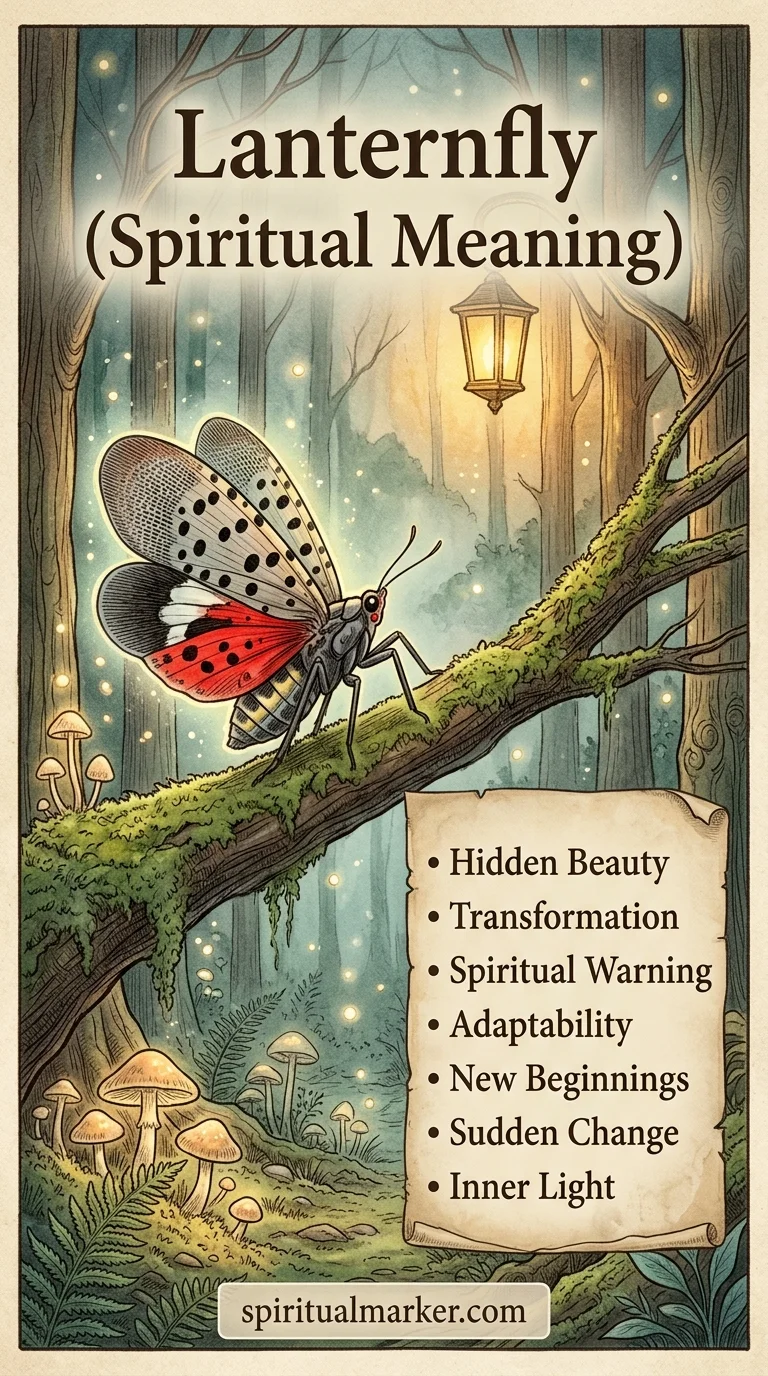
What Is the Spotted Lanternfly and Why Does It Hold Spiritual Weight?
The spotted lanternfly is a planthopper, not a true fly. It belongs to the family Fulgoridae. Its name comes from early naturalists who believed insects in this family had lantern-like projections on their heads. While the modern spotted lanternfly does not actually glow, its name alone carries a spiritual charge. A lantern is a symbol of light, guidance, and illumination across nearly every spiritual tradition on earth. The very name of this creature hints at something deeper.
Physically, the lanternfly is stunning. Its forewings are gray with black spots, giving it a camouflaged, subtle appearance. But when it spreads its wings, you see a burst of red, black, and white. This dramatic reveal is one of the most spiritually significant aspects of the creature. Many spiritual teachers and intuitive readers point to this characteristic as a core part of its symbolic message. What appears ordinary on the outside holds extraordinary energy within.
The lanternfly also feeds aggressively on plants. It weakens trees, destroys crops, and spreads in large groups. Spiritually, this behavior can be seen as a metaphor for energetic drain, toxic attachments, or the spread of negative patterns. The creature is not evil, but its behavior mirrors dynamics that many people recognize in their own lives and relationships. This is part of why the lanternfly spiritual meaning resonates so strongly with people who encounter it.
What Does Seeing a Lanternfly Symbolize or Represent?
When you see a lanternfly, the first spiritual impulse many people have is to pay attention. Animals and insects appearing in unusual or repetitive ways are often interpreted as spiritual signs or omens. The lanternfly, with its eye-catching appearance and bold behavior, is particularly hard to ignore. Spiritually aware people tend to read its presence as a direct message from the universe or their higher self.
One of the most common interpretations is that the lanternfly signals hidden truths coming to the surface. Think about its wings. The outside is muted and spotted. The inside is vivid and alarming. When you see this insect, it may be reminding you that something in your life is not what it appears to be. A person, a situation, or even a belief system may be hiding its true nature. The lanternfly’s dramatic wing reveal says: look deeper, look beyond the surface.
Another spiritual interpretation focuses on its invasive nature. The lanternfly does not belong in the ecosystems where it now thrives. It arrived, spread, and took over. Spiritually, this can mirror what happens when foreign energy, toxic people, or unhealthy habits enter your life. They can feel harmless at first. Over time, they consume your vitality. Seeing a lanternfly might be a spiritual nudge to audit what is draining you and taking up space without permission.
At the same time, many spiritual readers also see the lanternfly as a symbol of resilience and adaptability. This insect survived long ocean journeys. It adapted to entirely new climates. It thrived against all odds. If you are going through a period of displacement, change, or uncertainty, the lanternfly may be appearing to say: you will adapt, you will endure.
7 Spiritual Meanings of the Lanternfly
1. Hidden Beauty and Inner Power
The most immediate spiritual meaning of the lanternfly is hidden beauty. You look at it and see spotted gray wings. It looks almost plain. Then it opens those wings, and you see the flash of deep red and bold black borders. That transformation is deeply symbolic. Many spiritual traditions teach that true power is not worn on the outside. It is the quiet person in the room who carries the most wisdom. It is the seed underground that holds the entire tree within it.
The lanternfly embodies this truth visually. Its camouflaged exterior protects it. Its brilliant interior is its actual nature. When this insect appears to you, it may be asking a pointed question: are you hiding your true power? Are you playing small to avoid attention or judgment? The red wings are not accidental. Red is the color of vitality, passion, and sacred life force in nearly every spiritual tradition from Hinduism to Native American practices.
This meaning extends beyond personal confidence. It also speaks to the hidden value in overlooked things. A person others dismiss, a path that looks unremarkable, a quiet calling that you keep pushing aside. The lanternfly says: do not judge by the outer shell. The most powerful thing in front of you might be the one that looks the most ordinary right now. Beauty and purpose are not always immediately visible. They reveal themselves in their own time.
On a deeper energetic level, the lanternfly’s hidden wings also speak to dormant spiritual gifts. You may carry abilities, intuitions, or creative power that you have not fully activated. The sudden flash of color when the lanternfly spreads its wings mirrors the moment when a spiritual gift breaks through into the open. Something that was always there suddenly becomes impossible to ignore. This is not a warning. It is an invitation to let your inner light become visible.
2. A Warning About Energetic Drain
The spotted lanternfly feeds on over 70 species of plants. It weakens trees, damages grapevines, and can kill young saplings. This feeding behavior is one of the most spiritually loaded aspects of the creature. When the lanternfly appears in your life, it may carry a very direct spiritual warning: something or someone is feeding on your energy. This message is not about fear. It is about awareness.
Many spiritual traditions recognize the concept of energy vampires, people or situations that consume your vitality without giving anything back. They do not always do this with bad intentions. Sometimes they are struggling themselves. But the result is the same. You feel drained, depleted, and weaker after time spent with them. The lanternfly, as a creature that weakens its host plants, mirrors this dynamic almost perfectly. Its spiritual message here is a call to protect your energy.
The lanternfly also produces a sticky substance called honeydew that coats everything around it and causes further damage. Spiritually, this reflects the way certain toxic dynamics leave residue. Even after the draining person or situation is gone, their effects linger. You may still feel the weight, the self-doubt, or the emotional residue. The lanternfly’s presence can be a signal to do the inner work of cleansing, not just removing the source but actively clearing what was left behind.
This meaning also applies to habits and mental patterns. Sometimes we are our own energetic drain. Overthinking, self-criticism, and fear-based decision-making can all function like a lanternfly on your own vitality. They feel familiar. They blend in. But they slowly weaken the tree. The spiritual message here is to audit your inner landscape with the same honesty you would apply to external relationships.
3. Transformation and Life Stages
Like many insects, the lanternfly goes through distinct life stages. It begins as an egg mass, hatches into a nymph, passes through four nymph stages, and finally becomes a fully winged adult. This progression holds deep spiritual symbolism of transformation. Every stage looks completely different from the last. The creature is unrecognizable from one phase to the next. Many people going through major life changes, spiritual awakenings, or personal reinvention find this resonates deeply.
The nymph stage of the lanternfly is particularly striking. Early nymphs are black with white spots. Later nymphs develop striking red patches. This color shift from black to red carries powerful symbolism. In many spiritual frameworks, black represents the void, the unknown, or the phase of rest and gestation. Red represents emergence, passion, and the active claiming of life. The lanternfly’s own color journey mirrors the movement from spiritual dormancy to full awakening.
If you are in a season of waiting, questioning, or feeling like you are still a “nymph” in your own story, the lanternfly’s transformation message is particularly relevant. You may not look like your final form yet. The most dramatic and beautiful stage of your life may still be ahead. Growth is not always fast or visible. Some of the most powerful spiritual transformations happen beneath the surface before they burst into full color.
The lanternfly also sheds its skin multiple times before reaching adulthood. In spiritual language, shedding skin is one of the oldest symbols of renewal. You release the old to make space for the new. Each shedding represents a layer of identity, fear, or limitation that no longer serves you. Seeing a lanternfly during a period of major personal change may be affirming that your current shedding is necessary, right, and spiritually aligned.
4. Duality and the Shadow Self
The duality of the lanternfly is one of its most spiritually compelling features. Outwardly, it appears harmless and almost forgettable. Inwardly, it is destructive and dominant. This paradox speaks directly to Carl Jung’s concept of the shadow self, the parts of us we hide or deny because they feel unacceptable. The lanternfly’s two faces, the camouflaged outer and the vivid inner, reflect the human experience of holding contradictions.
Spiritually, duality is not something to fear. It is something to integrate. Every person carries light and shadow. Denying the shadow does not eliminate it. It simply drives it deeper, where it operates without your awareness. The lanternfly, as a symbol, may be inviting you to look honestly at the parts of yourself you keep hidden. The parts that feel too intense, too needy, too angry, or too ambitious for polite display. Integration of the shadow brings wholeness, not destruction.
The lanternfly also represents the duality of beauty and harm existing simultaneously. It is genuinely beautiful. It also genuinely causes damage. Most people and situations in life carry this same complexity. Someone can love you and also hurt you. A habit can bring you pleasure and also erode your health. The lanternfly teaches you to hold complexity without collapsing into either idealization or demonization. Spiritual maturity means seeing both sides clearly.
In certain Eastern spiritual traditions, this kind of duality is represented by the yin-yang symbol. Equal parts of dark and light, each containing a seed of the other. The lanternfly’s outer and inner wings tell this same story in biological form. Its spiritual lesson is that wholeness requires acknowledging both aspects of any person, situation, or spiritual truth you encounter.
5. Boundaries, Invasion, and Sacred Space
The lanternfly is defined by its invasion. It crossed oceans. It entered territories where it did not belong. It disrupted ecosystems that were functioning well without it. This is one of the sharpest and most direct spiritual meanings the lanternfly carries: a message about boundaries and what happens when they are not maintained. Whether you are struggling with someone overstepping your personal limits or a situation encroaching on your peace, the lanternfly speaks directly to this theme.
In spiritual practice, maintaining sacred space is considered essential for growth and well-being. Sacred space can be physical, like your home or your body. It can also be energetic, like your emotional environment, your time, and your mental focus. When the lanternfly appears, it may be highlighting that your sacred space has been compromised. Something has moved in without invitation and is beginning to take hold. The spiritual call is to reassert your boundaries with clarity and conviction.
The lanternfly’s invasion also carries a message about collective responsibility. Its spread happened because of human activity. It hitchhiked on shipping containers and vehicles. People unknowingly carried it from place to place. Spiritually, this mirrors the way we sometimes pass on unhealthy patterns, wounds, or energy to others without realizing it. The message is not guilt. The message is awakening to the impact of unconscious behavior and choosing to act with greater awareness.
When you actively work to remove a lanternfly from a space it is harming, the spiritual parallel is powerful. It represents the conscious choice to protect what matters. To say: this does not belong here, and I am taking action. This takes courage. It takes discernment. The lanternfly as a spiritual symbol honors that courage and reminds you that protecting sacred space is an act of love, not aggression.
6. Resilience and Unlikely Survival
Whatever you think of the lanternfly ecologically, its survival story is remarkable. It traveled thousands of miles across an ocean. It landed in a completely foreign environment. It faced predators, chemicals, and coordinated human efforts to eliminate it. Yet it kept expanding. This resilience is a genuine spiritual teaching, even if the lanternfly brings challenges along with it. Survival in the face of overwhelming opposition is always a spiritual story worth noting.
For people going through extreme hardship, displacement, or life circumstances that feel impossibly foreign and hostile, the lanternfly’s resilience carries real comfort. You may feel like you do not belong where you are. You may feel like everything around you is trying to push you out. The lanternfly says: you can adapt, you can persist, you can find footing in unfamiliar ground. This is not a license for recklessness. It is a reminder that human beings, like this insect, carry extraordinary capacity to survive and even thrive in new conditions.
The lanternfly also reproduces rapidly. A single egg mass can contain 30 to 50 eggs. Spiritual abundance is one reading of this. When you align with your purpose and plant yourself in the right environment, growth can be exponential. The universe does not hold back on abundance for those who are aligned. The lanternfly’s reproductive power, viewed through a spiritual lens, speaks to what becomes possible when you stop limiting your own expansion.
This meaning of resilience also speaks to spiritual survivors. People who have been through trauma, loss, or profound disruption and who, against all odds, are still standing. If you have watched others doubt you, dismiss you, or actively work against your growth, the lanternfly appears as a fierce and unlikely ally. It has been hunted, sprayed, and stamped upon. It is still here. And so are you.
7. Light, Illumination, and Spiritual Awakening
The very name “lanternfly” holds a spiritual promise of illumination. A lantern provides light in the dark. It guides travelers on unfamiliar roads. It signals the presence of life in empty spaces. Even though the modern spotted lanternfly does not literally glow, its name carries the spiritual DNA of every lantern-bearing symbol across human history. Many cultures have used light as the primary metaphor for spiritual awareness, divine presence, and awakening consciousness.
In Buddhist tradition, enlightenment is described as a light turning on in a previously dark room. The light does not create anything new. It simply reveals what was always there. The lanternfly, with its name rooted in lantern-bearing symbolism, carries this same energy. When it appears in your life, it may be signaling that a period of greater clarity is approaching. Something that confused you will become clear. Something that was hidden will become visible. The lights are coming on.
The lanternfly’s vivid red inner wings also connect to fire symbolism, one of the oldest metaphors for spiritual awakening across cultures. Fire transforms. It purifies. It generates both warmth and danger. Many spiritual traditions speak of a sacred fire within the soul that, once ignited, changes everything. The red flash of the lanternfly’s wings mirrors this inner ignition. You have carried this fire within you. The lanternfly appears to signal that it is time for that fire to be seen.
Finally, the lanternfly’s emergence as a widely discussed and highly visible insect in modern times is itself spiritually significant. This creature arrived in an era of rapid global change, increasing ecological awareness, and collective spiritual questioning. Many spiritual teachers see its mass appearance as a collective symbol for the current age. A time when what was hidden is being revealed, when invasive patterns are being named and confronted, and when individuals are being called to awaken, illuminate, and transform.
Lanternfly Symbolism Across Cultures and Spiritual Traditions
The lanternfly originates in China, India, and Vietnam, three cultures with extraordinarily rich traditions of insect symbolism. In Chinese spiritual culture, insects are rarely seen as mere pests. They carry meaning, omens, and ancestral messages. The cicada, a close relative of the lanternfly’s broader insect family, is one of the most revered symbols in Chinese tradition. It represents immortality, renewal, and spiritual transformation. The lanternfly, emerging from the same cultural soil, inherits some of this symbolic weight.
In Chinese folklore, brightly colored insects are often considered messengers from ancestors. When a visually striking bug appears unexpectedly, it may be carrying a communication from someone who has passed on. The lanternfly’s red and black coloring, both significant colors in Chinese spiritual practice, gives this interpretation additional weight. Red in Chinese culture is the color of good fortune, protection, and vital energy. Black represents the depth of wisdom and the unknown. Together, these colors suggest a message that combines warning with blessing.
In Vietnamese spiritual tradition, nature is deeply intertwined with spiritual life. Animals and insects that arrive unexpectedly are often read as signs from the spirit world or as signals about upcoming life events. The lanternfly’s dramatic appearance, especially its sudden wing reveal, would be interpreted as a message demanding attention. Vietnamese spiritual practice emphasizes the importance of listening to nature as a living scripture, always communicating, always pointing toward truth.
In Indian spiritual traditions, particularly those rooted in Hinduism, every creature is considered a form of the divine. The concept of Brahman, the universal consciousness, is said to exist within all living beings. An insect is not lesser than a human in spiritual reality; it is simply a different expression of the same divine source. The lanternfly, with its striking beauty and its complex ecological role, would be seen through this lens as another face of the divine wearing the costume of nature. Its presence invites reverence, not revulsion.
Lanternfly Symbolism in World Mythologies
While the spotted lanternfly is not ancient enough to have its own mythology, insects with similar characteristics appear throughout world mythologies in ways that shed light on its symbolic meaning. The broader family of planthoppers and fulgorids, known for their ornate and sometimes luminescent appearances, has inspired reverence in many cultures. The lanternfly draws on this deep well of insect mythology.
In ancient Egyptian mythology, the scarab beetle was one of the most sacred symbols in existence. It represented the sun’s movement across the sky, the cycle of death and rebirth, and the transformative power of the divine. While the lanternfly is far from a scarab, the broader tradition of finding profound spiritual meaning in insects applies. Egyptians understood that small creatures could carry enormous cosmic significance. The lanternfly fits within this ancient understanding.
In Native American traditions, insects often serve as messengers between the human world and the spirit world. Many tribes hold specific insects in sacred regard, seeing them as carriers of medicine, teaching, or warning. The lanternfly, as an insect that arrives suddenly, spreads widely, and demands attention, would be read within many Native frameworks as a significant omen. Its red coloring would connect it to sacred life force and the south direction on the medicine wheel, associated with passion, growth, and the warmth of summer.
In Greek and Roman mythologies, insects were associated with the soul. The word “psyche” in Greek means both “soul” and “butterfly,” linking winged insects directly to the human spirit. The lanternfly, as a winged insect with a dramatic inner reveal, carries echoes of this ancient connection. Its wings, especially the red inner wings that only appear in flight or when threatened, could be read as the soul being revealed under pressure, showing its true colors only when pushed to its edge.
The Spotted Lanternfly as a Spiritual Messenger: Color Symbolism
Color is one of the most powerful languages in spiritual symbolism. The lanternfly carries three primary colors across its body and wings: gray, black, and red. Each of these colors carries centuries of spiritual meaning across cultures and traditions. Reading the lanternfly’s color palette spiritually gives you one of the richest layers of its overall message.
Gray is the color of transition, neutrality, and the space between worlds. It is neither black nor white. Spiritually, gray represents the liminal space, the in-between moments where one phase of life is ending and another has not yet begun. The lanternfly’s gray outer wings, the face it shows to the world before it opens up, symbolize this liminal state. If you are in a period of transition, uncertainty, or waiting, the gray wings speak directly to your current season. You are between chapters, and that is exactly where you are meant to be right now.
Black, as seen in the spotted pattern and the border of the inner wings, represents depth, mystery, and the fertile void. In spiritual terms, black is not a color of death or negativity. It is the color of the rich soil from which all growth emerges. It is the darkness of deep space where stars are born. The black markings on the lanternfly point to hidden depths, ancestral wisdom, and the power of the unseen. What you cannot see right now is still real. What is working beneath the surface will eventually emerge.
Red is perhaps the most spiritually charged color on the planet. Across virtually every culture, red represents life force, passion, danger, protection, and sacred power. In Hinduism, red is associated with the goddess Durga and the power of the divine feminine. In Christianity, red represents the blood of sacrifice and the fire of the Holy Spirit. In Chinese culture, it is the ultimate symbol of blessing. The lanternfly’s red inner wings carry all of this meaning. When those red wings flash, the spiritual message is unmistakable: power is present, attention is required, and something sacred is demanding to be seen.
Lanternfly and Biblical Meanings
The Bible does not mention the spotted lanternfly by name. However, insects carry significant spiritual weight throughout scripture, and the themes embodied by the lanternfly appear repeatedly in biblical texts. Reading the lanternfly through a biblical lens reveals layers of meaning that are especially relevant for Christian spiritual seekers.
The most obvious biblical parallel is with locusts. In the Book of Exodus, locusts represent one of the ten plagues of Egypt. They arrived in massive swarms, consumed everything in sight, and left devastation behind. The lanternfly, as a destructive invasive species that arrives in large groups and damages crops and trees, carries this same energy. Biblically, plagues of insects were understood not as random events but as divine communications. They carried messages about judgment, consequence, and the need for change.
In the Book of Joel, locusts are described with almost apocalyptic power: “a great and powerful army has come, such as never was in ancient times nor ever will be in ages to come” (Joel 2:2). The spiritual significance here is not about doom. It is about the call to attention, repentance, and return to what is sacred. When something arrives in force and causes disruption, the biblical response is not to panic but to ask: what is this revealing, and what change is being called for?
The lanternfly also connects to the biblical theme of light in darkness. Jesus declared in John 8:12, “I am the light of the world. Whoever follows me will never walk in darkness, but will have the light of life.” A creature called “lanternfly,” even in its secular context, carries the resonance of light-bearing. For Christian spiritual seekers, the lanternfly’s name and vivid inner illumination may serve as a reminder that light is always present, even when the outer appearance seems dull or unremarkable.
The concept of stewardship in Genesis also becomes relevant here. Humanity was given responsibility over the earth and its creatures. The lanternfly’s ecological destruction, and the human role in spreading it, can be read as a modern parable about stewardship. When we fail in our care for the natural world, consequences follow. The biblical message embedded in the lanternfly’s story is one of responsibility, accountability, and the call to tend what we have been given.
Dreaming About a Lanternfly: Spiritual and Psychological Meanings
Dreams are one of the oldest channels of spiritual communication across virtually every culture. When you dream of an insect as visually striking as the lanternfly, it is rarely insignificant. The dream world operates through symbols, and the lanternfly brings a rich set of symbolic possibilities into the sleeping mind. The context of the dream, what the lanternfly is doing, where it appears, and how you feel in the dream, all shape the meaning.
If you dream of a lanternfly landing on you, this is one of the most personal and direct versions of the dream. Something is attaching itself to your energy. It may be a thought, a person, a fear, or a pattern. The dream is asking you to look at what is currently clinging to you and consider whether it belongs there. A lanternfly landing on you can also represent a spiritual message being delivered specifically to you, a communication meant only for your awareness.
Dreaming of a swarm of lanternflies suggests an overwhelming force in your waking life. This might be external, like a stressful work environment or a relationship that has taken over your emotional space. It might also be internal, like a flood of anxious thoughts or an obsessive pattern consuming your mental energy. The swarm in the dream is your subconscious communicating the scale of what you are dealing with. The spiritual message is to take this seriously rather than minimizing it.
If you dream of a lanternfly opening its wings and revealing the red, this is one of the most spiritually charged versions of the dream. Something hidden is about to be revealed. A truth you have been keeping from yourself, or that others have been keeping from you, is ready to surface. The red wings in the dream signal that this revelation carries significant emotional intensity. It will demand your full attention. The spiritual message is to prepare yourself for a truth that changes things.
Psychologically, dreaming of invasive insects can also reflect feelings of being overwhelmed, displaced, or under threat. These are not signs of weakness. They are your psyche processing real life pressures. Combined with the spiritual layer, these dreams invite both practical action and inner reflection. Ask yourself what feels invasive right now. Then ask what hidden beauty or unexpected message might be traveling alongside that challenge.
What Does It Mean When a Lanternfly Crosses Your Path?
In many spiritual traditions, an animal or insect crossing your path is considered one of the clearest forms of spiritual communication. The lanternfly crossing your path combines all of its symbolic meanings into a single, pointed moment. You were walking your road. This creature appeared. The universe placed it in your line of sight. The question is: what message was it carrying?
The most common interpretation among spiritual readers is that a lanternfly crossing your path is a call to slow down and pay attention. Something in your life requires a deeper look. You may be moving through your days on autopilot, ignoring a quiet but persistent signal. The lanternfly is not quiet. It is visually striking. It does not allow you to look away easily. This is intentional. The spiritual message embedded in this crossing is: stop, see clearly, do not look away from what is in front of you.
If the lanternfly spreads its wings as it crosses your path, the message becomes even more specific. A revelation is imminent. Something that has been hidden, whether a truth about someone in your life, a fact about a situation you are in, or an aspect of yourself you have been avoiding, is about to come into full view. The red wings are the universe’s way of saying: this is important, this cannot be ignored, pay attention to what comes next.
Alternatively, a lanternfly crossing your path may signal that you are about to enter a new territory. Just as the lanternfly moves into new ecosystems, you may be on the verge of a new chapter, a new environment, or a new phase of your spiritual journey. The transition may feel unfamiliar, even uncomfortable. But the lanternfly’s own story reminds you that new ground can become home, even when it did not feel that way at first.
The Lanternfly as a Totem or Spirit Animal
In shamanic and animist traditions, every living creature has the potential to serve as a totem or spirit animal. A totem is a spiritual companion or guide that carries specific teachings for the person it connects with. If you feel a strong and persistent connection to the lanternfly, this may indicate that it is one of your spirit guides or totem creatures for this season of your life.
People with the lanternfly as a totem tend to carry a striking duality in their own personalities. They often appear reserved or understated in their everyday presentation. But underneath that calm exterior, they carry enormous depth, passion, and intensity. They have a tendency to reveal their full nature only when the moment calls for it. They do not perform for audiences. They save their true color for when it counts.
Lanternfly totem people are also often highly adaptable survivors. They have likely been through major upheaval, displacement, or repeated reinvention. They know what it is to start over in unfamiliar territory. And they know, from hard-won experience, that they can make a life wherever they land. The lanternfly totem strengthens resilience, resourcefulness, and the refusal to be eliminated by circumstances that would crush lesser commitments.
If the lanternfly is your spirit guide, it also challenges you to confront your own invasive patterns. Just as the lanternfly’s survival comes at a cost to the ecosystems it enters, people with this totem must regularly examine whether their own drive and adaptability is serving the greater good or consuming the resources of those around them. The lanternfly totem demands radical self-honesty alongside fierce resilience.
A Final Note
The lanternfly spiritual meaning is far richer than its reputation as a pest suggests. This creature carries layers of symbolic power that speak to some of the deepest themes in human spiritual experience. Hidden beauty, duality, transformation, boundaries, resilience, and the promise of illumination are all woven into its remarkable form. When you encounter a lanternfly, whether in waking life, in a dream, or even in an image that catches your eye, you are not just seeing a bug. You are receiving a message.
The lanternfly asks you to look past the surface. It asks you to examine what is draining your energy and to protect your sacred space. It invites you to honor the beauty of your own hidden depths. It honors your resilience through displacement and change. Its arrival in the modern world, in this exact era of global transformation and collective awakening, is not a coincidence that spiritual seekers should dismiss. Pay attention to what shows up in your life with this much visual intensity.
If you have been seeing lanternflies repeatedly, you might want to sit quietly and ask yourself which of its seven spiritual meanings resonates most. You could also begin a spiritual journal to track recurring animal or insect encounters, noting the circumstances and what was happening in your life at each sighting. Many people find that keeping a dream journal alongside these observations reveals patterns of communication that the rational mind alone would never notice. You may also find value in working with a spiritual director, shamanic practitioner, or intuitive guide who can help you interpret these signs within the context of your own life story. The lanternfly has shown up. The next move is yours.