Have you ever stepped outside at night and felt the moon pulling at something deep inside you? You are not imagining it. For thousands of years, humans across every continent have looked up at the moon and felt a connection that went far beyond science or astronomy. The moon has always been more than a celestial body. It has been a mirror, a messenger, and a sacred symbol of the rhythms that govern all of life.
Among the moon’s many phases, the gibbous moon is one of the most spiritually charged and least talked about. Most people know the full moon or the crescent. Few pause to consider the profound power that lives in the waxing gibbous and the waning gibbous phases. These two phases sit on either side of the full moon, each carrying its own distinct energy, lesson, and spiritual invitation.
The waxing gibbous moon spiritual meaning speaks of refinement, anticipation, and building momentum toward your goals. The waning gibbous moon spiritual meaning, on the other hand, calls you to release, share gratitude, and shed what no longer serves you. Together, they form a complete spiritual story of effort, fulfillment, and graceful letting go. In this post, you will get a deep, comprehensive look at what both phases mean spiritually, symbolically, culturally, biblically, and even in your dreams.
Key Takeaways
- The waxing gibbous moon represents focused effort and refinement. This phase arrives just before the full moon and spiritually encourages you to fine-tune your intentions, push through resistance, and prepare for a breakthrough.
- The waning gibbous moon, also called the Disseminating Moon, calls for gratitude and release. After the peak of the full moon, this phase urges you to share your wisdom, let go of control, and begin the inward journey of reflection.
- Both gibbous phases hold powerful energy for transformation. They represent the space between extremes. Spiritually, they teach you that growth and release are both sacred acts worthy of your full attention.
- Ancient cultures and world religions recognized the gibbous moon’s significance. From Egyptian lunar worship to biblical references, the gibbous moon was never seen as “just another phase.” It held ceremonial, prophetic, and healing meaning across traditions.
- Dreaming of a gibbous moon carries potent spiritual messages. A waxing gibbous in your dream signals readiness, ambition, and nearing success. A waning gibbous dream often points to wisdom you are ready to pass on, or burdens you are ready to set down.
What Is a Gibbous Moon and Why Does It Matter Spiritually?
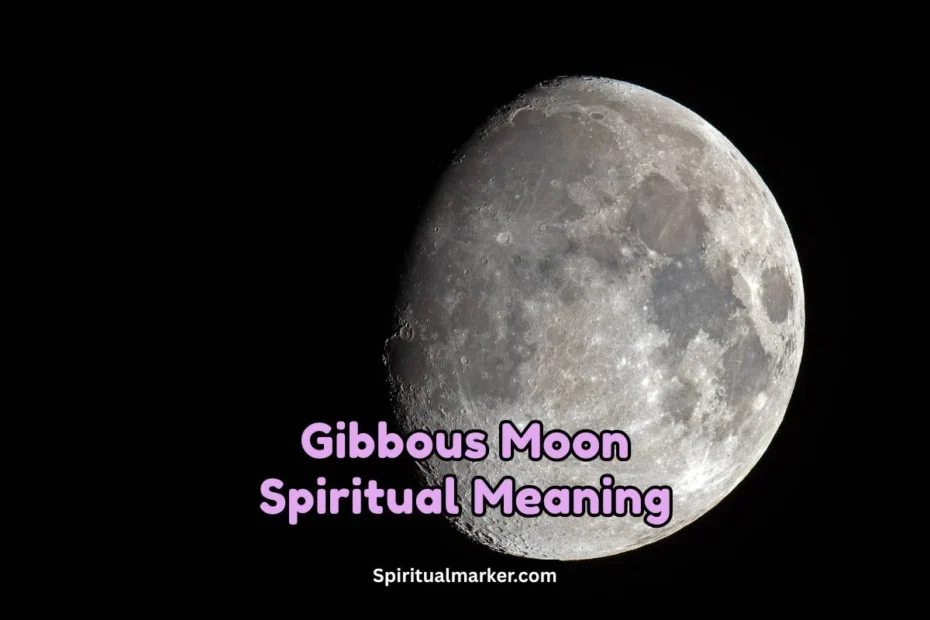
The word “gibbous” comes from the Latin gibbosus, meaning “humpbacked.” It describes the moon when it is more than half illuminated but not yet fully lit. A gibbous moon occurs twice in each lunar cycle. The first is the waxing gibbous, which appears between the first quarter and the full moon. The second is the waning gibbous, which appears between the full moon and the third quarter.
Astronomically, the gibbous phases simply describe how much of the moon’s surface reflects sunlight toward Earth. Spiritually, though, they represent something far richer. These phases sit in the space of almost. The waxing gibbous is almost full. The waning gibbous is almost back to half. That liminal space is where spiritual energy often runs the deepest.
Many spiritual traditions teach that it is not the peaks but the transitions that carry the most growth. The gibbous moon lives in transition. It holds tension, momentum, and meaning. It reminds you that the journey between beginnings and endings is not empty. It is full of sacred possibility. This is exactly why the waxing and waning gibbous moon spiritual meaning deserves serious attention from anyone walking a conscious spiritual path.
What Does Seeing a Gibbous Moon Symbolize or Represent?
When you look up and see a gibbous moon glowing in the night sky, you are witnessing a powerful symbol of nearness. It is close to its peak but not there yet. Or it has just passed its peak and is now returning home. Both states carry deep symbolic weight in spiritual traditions worldwide.
Seeing a waxing gibbous moon is widely considered a sign to keep going. You are closer than you think. Your intentions are building charge. The universe is aligning circumstances in your favor. Many spiritual practitioners use this phase to intensify their focus and double down on their intentions. It is the cosmic equivalent of the final stretch in a race.
Seeing a waning gibbous moon signals a time of sharing, releasing, and integrating. You have reached the peak. Now the wisdom you gathered must be given form, shared with others, or released from your grip entirely. Holding too tightly to what has already peaked creates stagnation. The waning gibbous gently calls you toward gratitude and graceful release.
Both phases also symbolize the concept of persistence through imperfection. The gibbous moon is not perfectly round. It is slightly uneven, slightly incomplete, yet radiant and powerful. This is a profound spiritual lesson. You do not have to be perfect to shine brightly. You do not have to be fully whole to be fully meaningful.
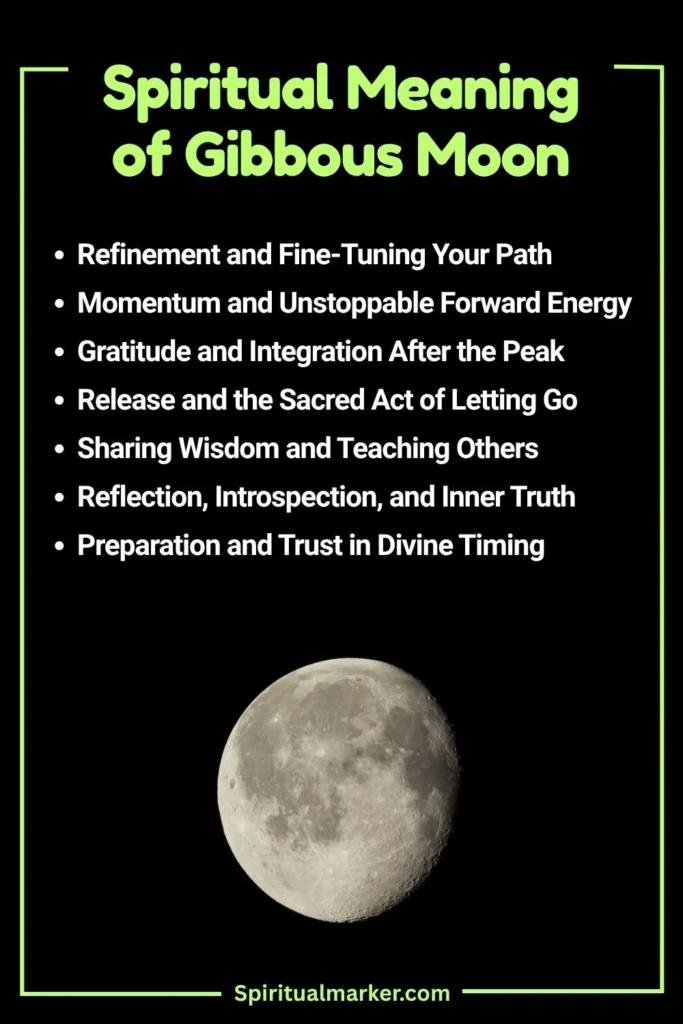
7 Spiritual Meanings of the Waxing and Waning Gibbous Moon
1. Refinement and Fine-Tuning Your Path
The waxing gibbous moon is the phase of refinement. You have already set your intention at the new moon. You have taken action through the first quarter. Now, with the full moon just days away, the waxing gibbous asks you to refine your approach. This is not the time to start over. It is the time to adjust, polish, and sharpen what you have already begun.
Spiritually, refinement is one of the most sacred acts a soul can perform. Gold is not pure when it first comes from the earth. It goes through fire and pressure to become the treasure it is meant to be. The waxing gibbous moon holds that fire. It challenges you to look honestly at your progress and ask: What needs to be adjusted? What is working? What is not? These are not comfortable questions, but they are necessary ones.
Many spiritual teachers connect this phase to the idea of discernment. The waxing gibbous asks you to separate what truly aligns with your highest good from what only appears to. This is a deeply internal process. The energy of this phase supports introspection, journaling, meditation, and honest self-assessment. Use it to clarify, not to abandon your goals.
Practically, this can look like revising a creative project, having a difficult but necessary conversation, or releasing a fear that has been holding you back from your breakthrough. The waxing gibbous moon supports all of these acts. It is the spiritual tuning fork that aligns your efforts with your highest purpose before the full moon arrives to illuminate everything.
2. Momentum and Unstoppable Forward Energy
One of the most powerful aspects of the waxing gibbous moon spiritual meaning is the energy of momentum. This phase carries an almost palpable sense of forward motion. Things are building. Energy is accumulating. The full moon’s illumination is approaching fast. Spiritual traditions from astrology to shamanism recognize this as one of the most energetically charged periods in the entire lunar cycle.
In many indigenous traditions, the waxing gibbous moon was the signal to begin the final preparations for ceremonies, harvests, or community gatherings. The timing was intentional. The growing light amplified the power of any focused action taken during this period. This is not coincidence. It reflects a deep understanding of lunar energy as a magnifier of human intention.
This momentum energy also carries a warning. If you are pursuing something that does not truly align with your authentic self, the waxing gibbous will often reveal that misalignment with increasing force. You may feel restless, frustrated, or blocked. This is the moon’s energy pushing you to course-correct before you reach the full moon and see the full truth of where your path has led you.
The spiritual invitation here is clear. Use this surging energy deliberately. Focus it on what matters most. Resist the temptation to scatter your energy across too many directions. The waxing gibbous rewards those who concentrate their will and act with purposeful intensity. It is the phase of the spiritual athlete, sprinting toward the finish line.
3. Gratitude and Integration After the Peak
When the moon shifts from full to waning gibbous, the energy changes dramatically. The peak has passed. The revelation has arrived. Now comes something equally sacred: gratitude. The waning gibbous moon, also beautifully called the Disseminating Moon, spiritually invites you to sit with what you have received and give genuine thanks for it. This is not passive appreciation. It is an active spiritual practice.
Gratitude is one of the most potent spiritual frequencies available to human beings. Multiple studies in positive psychology, including research by Dr. Robert Emmons of UC Davis, have shown that regular gratitude practice measurably increases wellbeing, reduces stress, and deepens a sense of spiritual connection. The waning gibbous moon is the universe’s invitation to practice this deeply.
Integration is equally important during this phase. Integration means taking the insights, lessons, and experiences of the full moon and weaving them into your daily life. Many people experience powerful emotional or spiritual revelations at the full moon but quickly return to old patterns without pausing to integrate what they received. The waning gibbous holds space for that integration process.
During this phase, spiritual practitioners often keep gratitude journals, perform thanksgiving rituals, or spend extra time in prayer and meditation. These practices align naturally with the waning gibbous energy. They help you anchor the wisdom you have gained and prepare you for the next cycle of intention-setting that begins at the new moon.
4. Release and the Sacred Act of Letting Go
The waning gibbous moon spiritual meaning is deeply tied to the art of release. As the moon sheds its light night by night, it models one of the most challenging and important spiritual practices known to humanity. Letting go. This phase asks you to identify what you have been holding too tightly and begin the process of releasing it with grace and intention.
Releasing does not mean giving up. It means trusting that the universe can handle what you cannot control. Many spiritual teachers, from Buddhist monks to Christian mystics, teach that attachment is the root of suffering. The waning gibbous moon provides a natural, cyclical opportunity to practice non-attachment. Each night as the moon grows slightly smaller, you are invited to release a little more of what weighs you down.
This release can take many forms. It might mean releasing resentment toward someone who hurt you. It might mean letting go of a story you have told yourself about why you are not capable of achieving your dreams. It might mean releasing physical clutter from your home or emotional clutter from your heart. All of these forms of release resonate with the waning gibbous energy.
Many spiritual traditions perform release rituals during the waning gibbous phase. These might include writing what you wish to release on paper and burning it, performing a cleansing bath with salt water, or spending time in prayer specifically asking for help in releasing what you cannot let go of alone. The waning gibbous moon supports all of these practices with its steady, gentle outward-flowing energy.
5. Sharing Wisdom and Teaching Others
The Disseminating Moon, another name for the waning gibbous, carries the energy of spreading knowledge. After the revelation of the full moon, you hold something valuable. You have received insight, clarity, or breakthrough. The waning gibbous spiritual energy calls you to share it. Teaching, writing, speaking, and mentoring all align naturally with this phase.
In many ancient cultures, this was literally the time when elders gathered the community around the fire after harvest celebrations to share stories, wisdom, and teachings. The bright-but-not-full moon provided enough light for outdoor gatherings. More importantly, the spiritual energy of the phase supported the transmission of wisdom from one generation to the next.
You do not have to be a teacher by profession for this meaning to apply to you. Each person carries wisdom that is unique and irreplaceable. Your lived experience, your hard-won lessons, your particular way of seeing the world: these are gifts. The waning gibbous moon calls you to stop hoarding your insights and start sharing them. A conversation, a social media post, a letter to a friend: all can be acts of dissemination.
This phase also supports communication of a deeper kind. If there are truths you have been afraid to speak, conversations you have been avoiding, or creative work you have been keeping hidden out of fear, the waning gibbous provides powerful spiritual support for bringing those things into the light. The energy of this phase rewards vulnerability, authenticity, and generous sharing.
6. Reflection, Introspection, and Inner Truth
Both the waxing and waning gibbous phases support deep introspection, but in different ways. The waxing gibbous invites inward reflection in the service of refinement. You look inside to improve your outer actions. The waning gibbous invites inward reflection as a destination in itself. You look inside simply to know yourself more fully.
The waning gibbous is one of the most powerful phases for shadow work. Shadow work, a concept popularized by psychologist Carl Jung, involves examining the parts of yourself that you have hidden, denied, or suppressed. These hidden parts do not disappear when ignored. They influence your behavior, your relationships, and your spiritual life from beneath the surface. The waning gibbous moon creates a safe, gentle container for beginning to look at these aspects of yourself.
Spiritually, many traditions teach that self-knowledge is the foundation of all wisdom. The ancient Greek maxim “Know thyself” inscribed at the Temple of Apollo at Delphi points to this truth. You cannot fully know the divine if you do not know yourself. The waning gibbous moon supports this inward journey. It asks you to be honest with yourself about your fears, your wounds, your patterns, and your potential.
During the waning gibbous phase, meditation, dream journaling, therapy, and contemplative prayer are especially potent practices. The energy of this phase amplifies whatever you turn inward. It rewards honesty and courage in self-examination. The more honestly you look at yourself during this time, the more clarity you carry into the next lunar cycle.
7. Preparation and Trust in Divine Timing
The final, overarching spiritual meaning that threads through both gibbous phases is the theme of trust. The waxing gibbous asks you to trust that your efforts are building toward something real and meaningful. The waning gibbous asks you to trust that what you are releasing will make space for something better. Both phases, in different ways, call you to surrender to divine timing.
Trust is one of the most difficult spiritual lessons for modern people. Living in a culture that worships speed, control, and instant results makes it genuinely hard to trust a slower, cyclical rhythm. The moon does not rush. It does not skip phases. It does not try to reach the full moon faster than its natural pace allows. Each phase is honored in its fullness before the next begins. This is a profound spiritual model for how to live.
Many spiritual traditions, including Christian mysticism, Taoism, and indigenous lunar wisdom, emphasize that the divine works in cycles, not in straight lines. The gibbous moon teaches you to stop fighting the natural timing of your life. Not every season is a season of action. Not every season is a season of rest. The ability to read which season you are in and move with its energy rather than against it is a form of profound spiritual maturity.
During the waxing gibbous, trust the process you have set in motion. During the waning gibbous, trust that what has already arrived is enough and that what is leaving was meant to go. In both phases, the moon invites you into a deep, abiding faith that the universe is conspiring in your favor, even when the picture is not yet complete.
Gibbous Moon Meaning and Symbolism Across Cultures and Religions
The moon has been a central spiritual symbol in virtually every human culture that has ever existed. The gibbous phase, in particular, held specific significance in many traditions because of its proximity to the full moon. It was seen as the moment of greatest anticipation before revelation, or the moment of sacred return after illumination.
In ancient Egypt, the moon was associated with Thoth, the god of wisdom, writing, and magic. The gibbous moon’s position so close to fullness was seen as Thoth approaching his peak of wisdom. Egyptian priests conducted specific rituals during the gibbous phases, believing that magical workings performed in this liminal space between half and full carried extraordinary power. The gibbous moon was the time to set sacred intentions with maximum force.
In ancient China, lunar worship was deeply integrated into agriculture, medicine, and spiritual life. The waxing gibbous was considered an especially auspicious time for beginning projects, signing agreements, and making significant decisions. The nearly full moon symbolized prosperity approaching its peak. Chinese lunar medicine also recognized the waning gibbous as a time when the body’s energy (Qi) began its inward movement, making it ideal for rest, reflection, and gentle healing practices.
In Hinduism, the lunar calendar (Panchang) governs nearly all aspects of sacred life. The day of the waxing gibbous moon falls in what is called Shukla Paksha, the bright fortnight. This period is considered highly auspicious for spiritual practices, worship, and new undertakings. The waning gibbous falls in Krishna Paksha, the dark fortnight, which is associated with introspection, ancestor reverence, and spiritual discipline.
In Islamic tradition, the lunar calendar governs the timing of all major religious observances, from Ramadan to Hajj. While Islam does not assign specific spiritual meanings to individual moon phases in the same way that some traditions do, the moon itself is explicitly mentioned in the Quran as a sign of God’s creation and a means of reckoning time (Quran 10:5). Many Muslim scholars have written about the spiritual lessons embedded in the moon’s cycle of growth and return.
In Celtic spirituality, the gibbous moon held a place of honor in the sacred lunar calendar. The nearly full moon was the time of the “Bright Mother,” a period of fierce creative power and protective energy. Celtic festivals often aligned with gibbous phases rather than the exact full moon, recognizing that the energy was already cresting before the literal peak arrived. The waning gibbous was associated with the Crone, the wise elder archetype who holds the knowledge accumulated through an entire cycle.
Gibbous Moon Symbolism in World Mythologies
Mythology offers some of the richest language for understanding the spiritual meaning of the gibbous moon. Ancient storytellers used myth not to explain the inexplicable with literal fact, but to convey deeper truths about the nature of life, the cosmos, and the soul. The gibbous moon appears, directly or symbolically, in myths across many cultures.
In Greek mythology, the goddess Selene drove her silver chariot across the night sky, pulling the full moon in its radiant glory. The waxing gibbous period was described as Selene approaching her full power, her chariot gleaming brighter each night. Greek poets saw this phase as the goddess herself building toward her most powerful expression. The waning gibbous was her graceful departure, her chariot dimming as she returned from the heights of her power to rest and prepare for the next cycle.
Artemis, the Greek goddess of the hunt, was also strongly associated with the moon. Her domain was the wilderness, the night, and the liminal spaces between civilization and the unknown. The gibbous moon, neither half nor full, existed precisely in that liminal space. Artemis symbolized the fierce, focused energy needed to pursue your goal with precision. Hunters in ancient Greece would often set out on waxing gibbous nights, believing the goddess’s power was nearly at its peak and would guide their aim.
In Norse mythology, the moon was personified as Mani, a young man who drove the moon chariot across the sky. The waxing gibbous was understood as Mani’s chariot rushing forward, pursued by the wolf Hati who perpetually chased the moon. This chase mythology encodes a deep spiritual truth: there is always something chasing the light. Progress is never achieved without resistance. The waxing gibbous symbolizes pressing forward despite the forces that would slow you down.
In Aztec mythology, the moon was associated with Tecuciztecatl, a proud god who became the moon after hesitating to throw himself into the sacred fire. The myth teaches that the moon shines less brightly than the sun because Tecuciztecatl acted from pride rather than pure sacrifice. The gibbous moon, in this context, symbolizes the nearly-but-not-quite nature of half-hearted action. Full spiritual power requires full commitment. The waxing gibbous serves as a reminder to give your whole self to what matters most.
Waxing Gibbous Moon Spiritual Meaning: A Deeper Look
The waxing gibbous moon spiritual meaning deserves its own dedicated section because this phase is one of the most energetically potent periods in the entire lunar cycle, yet it receives far less attention than the new or full moon. This is a mistake that many spiritual practitioners eventually correct as they deepen their lunar practice.
Energetically, the waxing gibbous feels like the moment just before a wave crests. Everything is building, surging, pressing forward. This energy is excellent for manifesting, healing work, and intensifying spiritual practices. If you have been doing affirmations or visualizations, the waxing gibbous dramatically amplifies their potency. Your subconscious mind is especially receptive during this phase to the suggestions and images you feed it.
This phase is also powerfully associated with persistence. Many people start strong at the new moon and fade by the first quarter. The waxing gibbous moon is for those who kept going. It rewards the consistent, the disciplined, and the spiritually courageous. If you have been showing up for your goals day after day without yet seeing the full fruits of your labor, the waxing gibbous is your sign that the harvest is near.
Physically, many people report feeling increased energy, vivid dreams, and heightened intuition during the waxing gibbous phase. This is not imagination. Scientific research has noted changes in human sleep patterns that correlate with lunar phases. Spiritually, heightened intuition during this phase is your inner guidance system working in harmony with the moon’s energetic frequency. Trust what you feel strongly drawn toward during the waxing gibbous. It is often pointing you directly toward what you need most.
Waning Gibbous Moon Spiritual Meaning: A Deeper Look
The waning gibbous moon spiritual meaning is rooted in the beautiful, bittersweet energy of what comes after the peak. The full moon has blazed. Revelations have arrived. Now the gentle dimming of the waning gibbous begins. This is not a diminishment. It is a deepening. The energy moves from outward radiance to inward wisdom.
One of the most important spiritual lessons of the waning gibbous is learning to honor completion. Western culture tends to treat endings as failures. We resist them, deny them, and often try to force situations to continue past their natural conclusion. The waning gibbous moon models a different way. It does not resist its own dimming. It completes its cycle with the same grace and dignity with which it began. Watching the moon do this night after night is its own form of spiritual teaching.
The Disseminating Moon energy is also connected to service. Having received wisdom and abundance at the full moon, the waning gibbous asks: How will you use what you have received to serve others? This is the moon phase of the teacher, the healer, the mentor, and the creative sharer. It supports all acts of generous giving, whether that is time, knowledge, creative work, or simply presence.
The waning gibbous is also the ideal time for clearing and cleansing rituals. Smudging your home, clearing your crystals, decluttering physical spaces, and releasing energetic ties to people or situations that drain you: all of these practices are amplified by the waning gibbous energy. The decreasing light supports a natural movement toward clearing and making space for what the coming new moon will bring.
Gibbous Moon Biblical Meaning and Significance
The Bible does not use the term “gibbous moon” directly. However, the moon appears throughout both the Old and New Testaments as a sign of God’s creative power, his faithfulness, and the sacred ordering of time. When you read these passages with an awareness of the lunar cycle, the gibbous phases take on rich biblical meaning.
In Genesis 1:14, God declares: “Let there be lights in the vault of the sky to separate the day from the night, and let them serve as signs to mark sacred times, and days and years.” The moon is specifically created as a sign. Every phase, including the gibbous, participates in this divine signaling function. The waxing gibbous, building toward the full moon, can be seen as creation building toward its full expression of divine glory. The waning gibbous, returning from fullness, reflects God’s faithfulness in the cycle of completion and renewal.
Psalm 104:19 states: “He made the moon to mark the seasons; the sun knows when to go down.” The gibbous moon, marking time between quarter and full, participates in this divine rhythm of seasons. Many biblical scholars note that the Passover and other major Jewish feasts were deliberately scheduled around the full moon, meaning the waxing gibbous was the period of final preparation before the sacred feast arrived. This gives the waxing gibbous a deeply biblical meaning of holy anticipation and readiness.
In Revelation 12:1, a woman clothed with the sun and standing on the moon appears as a powerful symbol. While this vision is subject to various interpretations, many biblical commentators see the moon beneath her feet as representing the cyclical, temporal realm being brought under divine sovereignty. The gibbous moon, living in the tension between phases, beautifully reflects the biblical theme of already but not yet: the kingdom of God already present but not yet fully revealed. The waxing gibbous embodies the Christian experience of living in hopeful anticipation. The waning gibbous embodies the grace of stewarding what God has already given.
The concept of the Sabbath in scripture also connects powerfully to gibbous moon spirituality. The Sabbath is a divinely mandated pause between periods of work and rest. The waxing gibbous is the final push of spiritual work before the full moon Sabbath of illumination. The waning gibbous is the sacred rest and integration that follows. Both honor the biblical rhythm of work, revelation, and renewal.
How to Work with Gibbous Moon Energy in Your Spiritual Practice
Knowing the waxing and waning gibbous moon spiritual meaning is valuable. Knowing how to actively work with that energy is transformative. The gibbous phases are not passive events you simply observe. They are active invitations to deepen your spiritual practice in very specific ways.
During the waxing gibbous, your spiritual practice should intensify. This is the time to increase the frequency and depth of your meditation, prayer, or affirmation practice. Whatever intention you set at the new moon, return to it during the waxing gibbous with fresh eyes. Ask yourself whether your actions have truly aligned with that intention. Where you find gaps, close them with decisive, focused action. Write in your journal with specificity: what have you built so far, and what final adjustments do you need to make?
Crystal work during the waxing gibbous benefits enormously from using stones associated with amplification and clarity. Clear quartz, citrine, and labradorite all resonate strongly with waxing gibbous energy. Place them on a windowsill to charge in the growing moonlight. Carry them with you as anchors for your intensifying intentions. Sound healing, particularly with singing bowls or tuning forks, is also exceptionally powerful during the waxing gibbous. The vibrations carry farther and penetrate deeper during this energetically charged phase.
During the waning gibbous, shift your spiritual practice toward gentleness, gratitude, and release. Begin each morning with a written gratitude practice. Thank the universe specifically for what arrived during the full moon, even if it came in unexpected forms. Release rituals are particularly potent during this phase. Write what you wish to release on a piece of paper, speak it aloud, and then burn, bury, or release it to flowing water. Black tourmaline, obsidian, and selenite crystals support the clearing and releasing energy of the waning gibbous beautifully.
Both gibbous phases benefit from spending time outdoors under the actual moonlight. This is not merely symbolic. Research published in the journal Current Biology found that lunar cycles measurably affect human sleep and physiology. Sitting under the gibbous moon, breathing its light in consciously, and setting clear intentions or gratitudes creates a direct energetic connection with the lunar cycle that amplifies all other spiritual practices you engage in during this time.
Dreaming About the Gibbous Moon: Spiritual and Psychological Meanings
Dreams involving the moon are among the most archetypal and spiritually significant dream experiences a person can have. When the moon in your dream is specifically in its gibbous phase, the symbolic meaning becomes even more precise and personally relevant.
Dreaming of a waxing gibbous moon is one of the most encouraging dream signs you can receive. It typically signals that you are very close to a breakthrough in your waking life. Something you have been working toward, whether in your career, relationships, spiritual growth, or creative life, is nearly ready to manifest fully. The dream is your subconscious confirming what your conscious mind may still doubt. Keep going. The fruit is almost ripe.
A waxing gibbous dream can also indicate that you are being called to make one final adjustment before a major transition arrives. Pay attention to the emotional tone of the dream. If the gibbous moon in your dream feels warm and inviting, the message is simple encouragement. If it feels urgent or tense, your subconscious may be alerting you to something that still needs your attention before the breakthrough can fully arrive.
Dreaming of a waning gibbous moon carries a different but equally meaningful message. This dream often appears when you are entering a period of integration after a significant life change or achievement. Your psyche is processing what happened and beginning the work of making meaning from it. A waning gibbous dream is your inner wisdom telling you: slow down, reflect, and honor what you have been through.
Psychologically, Carl Jung wrote extensively about the moon as a symbol of the unconscious mind. In Jungian dream analysis, a gibbous moon often represents the unconscious at a highly activated state, nearly but not fully illuminated. This means hidden knowledge, repressed emotions, or unrecognized talents are very close to the surface of awareness. A gibbous moon dream may be an invitation to look more carefully at what is trying to emerge from the depths of your psyche.
From a spiritual perspective, many traditions teach that the veil between the conscious world and the spirit world is thinner during gibbous moon phases. Dreams during this time are often especially vivid, symbolic, and message-laden. Keep a dream journal during both gibbous phases of each lunar cycle. Over time, you will notice patterns in the guidance your dreams offer during these specific phases. This practice alone can transform your relationship with the moon and with your own inner wisdom.
If you dream of a gibbous moon reflected in water, this adds another layer of meaning. Water in dreams symbolizes the emotional and unconscious realms. A gibbous moon reflected in still water suggests that your nearly-complete insight is also being reflected back through your emotions. Pay attention to how you feel in the days following this dream. Your emotional body is receiving important information that your rational mind may not yet be ready to process.
The Gibbous Moon and the Feminine Divine
Across virtually all spiritual traditions, the moon is associated with the feminine divine. This is not a literal statement about gender but a recognition of the archetypal feminine qualities the moon embodies: receptivity, cyclical renewal, intuition, nurturing, and the wisdom that comes from deep inner knowing. The gibbous phases hold specific expressions of the feminine divine that deserve recognition.
The waxing gibbous corresponds to the archetype of the Mother approaching the fullness of her power. In triple goddess traditions, which include the Maiden, Mother, and Crone, the waxing gibbous is the Mother in her almost-fullness. She is fertile, powerful, and fiercely creative. She is not yet at the peak of her expression, but her potential is overwhelming. The energy of this phase supports creativity, nurturing, protection, and the fierce commitment of bringing something important into the world.
The waning gibbous begins the transition toward the Crone archetype. The Crone is not a diminished figure in feminine spirituality. She is the wisest of the three. She has lived through the Maiden’s innocence and the Mother’s power. Now she carries the distilled wisdom of both. The waning gibbous is where the Mother begins to become the Crone: she does not lose her power but transforms it into wisdom, depth, and the capacity for profound compassion born of real experience.
Gibbous Moon and Astrology: What Your Moon Sign Reveals
In astrology, the moon moves through all twelve zodiac signs during its monthly cycle. The sign the moon occupies during the gibbous phases adds a specific flavor to the spiritual energy available during those days. If you are born under a gibbous moon (meaning the moon was in its waxing or waning gibbous phase on your birthday), this placement carries significant meaning for your personality and spiritual path.
People born under a waxing gibbous moon are often described as natural refiner-types. They possess a keen eye for imperfection and a deep drive to improve, polish, and perfect whatever they commit to. They are highly analytical, deeply intentional, and often have strong inner pressure to live up to their own high standards. Their spiritual path involves learning to trust their process and recognize that refinement itself is a form of excellence, not merely a means to it.
People born under a waning gibbous moon (the Disseminating Moon) are often natural teachers, communicators, and sharers. They feel a powerful inner compulsion to pass on what they have learned. They are often gifted writers, speakers, counselors, or community builders. Their spiritual path involves learning to share from a place of abundance rather than urgency, and to trust that their unique wisdom is genuinely needed by others.
The zodiac sign the moon occupies during any given gibbous phase also shapes the energy available to everyone, not just those born under that phase. A waxing gibbous in Aries brings fiery, bold, action-oriented momentum. A waxing gibbous in Virgo amplifies the already refinement-focused energy of the phase, making it ideal for detailed, meticulous work. A waning gibbous in Pisces deepens the introspective, mystical qualities of the phase, supporting spiritual healing and compassionate release. Tracking the moon’s sign during each gibbous phase allows you to tailor your spiritual practice with precision.
A Final Note
The waxing and waning gibbous moon spiritual meaning is far richer than most people ever realize. These are not minor phases to scroll past in your lunar calendar. They are potent, layered, and deeply instructive phases that offer some of the most nuanced spiritual guidance of the entire lunar cycle.
The waxing gibbous reminds you that the final stretch before your breakthrough is sacred. Do not rush it, and do not give up during it. The refining fire of this phase is preparing you for the full revelation that comes at the moon’s peak. The waning gibbous reminds you that what comes after the peak is equally sacred. Integration, gratitude, sharing, and releasing are not afterthoughts. They are the roots from which the next cycle of growth will grow.
If you are new to working with lunar energy, the gibbous phases are actually ideal entry points. They are long enough to work with consciously, energetically distinct enough to feel clearly, and spiritually rich enough to sustain a lifetime of practice. Consider starting a lunar journal this month. Track how you feel during each gibbous phase, what insights arise, what you feel drawn to release, and what feels ready to be shared. Over time, the moon will become one of your most trusted spiritual guides.
You do not have to be a seasoned mystic to benefit from gibbous moon wisdom. You only need to be willing to look up, pay attention, and trust that the universe speaks in rhythms as ancient and reliable as the moon itself. The light is always building and always returning. You are always in exactly the right phase of your own becoming.