Losing a loved one is one of life's hardest experiences. Yet many people sense their presence after death. From flickering lights to familiar scents, the signs can bring comfort.
The signs a deceased loved one is near you cover a wide range. Feathers, coins, and dreams are among the most common. A spiritual meaning of finding a white feather shares that feather-sign focus, though white feathers carry a specific message.
Some traditions view these signs as messages from the spirit world. Others see them as a reminder that love endures. The context of the sign can add detail.
If you sense a loved one near, it may bring peace. A spiritual meaning of hearing your name called also deals with spirit communication, though a called name carries a more direct message.
Key Takeaways
- Deceased loved ones often communicate through the physical senses. Familiar scents, touches, and sounds are among the most commonly reported signs of spiritual presence.
- Dreams are one of the clearest channels of communication. When a deceased person appears in a vivid, peaceful dream, many spiritual traditions treat this as a genuine visitation rather than ordinary dreaming.
- Nature sends powerful messengers. Birds, butterflies, and other animals arriving at meaningful moments are widely seen as spiritual signs across cultures and religions.
- Electronic disturbances carry spiritual weight. Lights flickering, radios turning on, and devices behaving oddly near anniversaries or during grief are frequently reported signs of a spiritual presence.
- These signs are meant to comfort, not frighten. Every spiritual tradition emphasizes that when a deceased loved one is near, the energy they bring is warm, loving, and peaceful. Fear is not part of the message.
Can a Deceased Loved One Actually Be Near You?
Before diving into the signs, it is worth asking the foundation question. Can a person who has died actually remain near the living? The answer depends on what you believe, but the weight of spiritual tradition, near-death experience research, and grief studies all point to the same conclusion: the soul does not simply disappear.
Major world religions teach some form of continued existence after death. Christianity speaks of the soul living on with God. Islam teaches of the Barzakh, a realm between death and resurrection. Hinduism and Buddhism both hold that the soul continues through cycles of existence. Indigenous traditions around the world have long honored the idea that ancestors remain present among the living. These are not fringe beliefs. They represent the spiritual wisdom of billions of people across thousands of years.
Modern research adds another layer. Dr. Raymond Moody, who pioneered near-death experience research in the 1970s, documented thousands of accounts in which people who clinically died and returned described meeting deceased relatives in a loving realm. Dr. Bill Guggenheim spent decades collecting over 3,300 first-hand accounts of what he called After-Death Communications (ADCs). His research, detailed in the book Hello From Heaven, showed that these experiences were consistent, cross-cultural, and deeply comforting. They were not grief-induced hallucinations. They were structured, purposeful communications.
The soul of someone you loved does not simply switch off. It transitions. And from that new place, love remains the most powerful force. That love is what drives a deceased loved one to stay near you, especially in the early days of grief and at meaningful moments in your life.
13 Signs a Deceased Loved One Is Near You
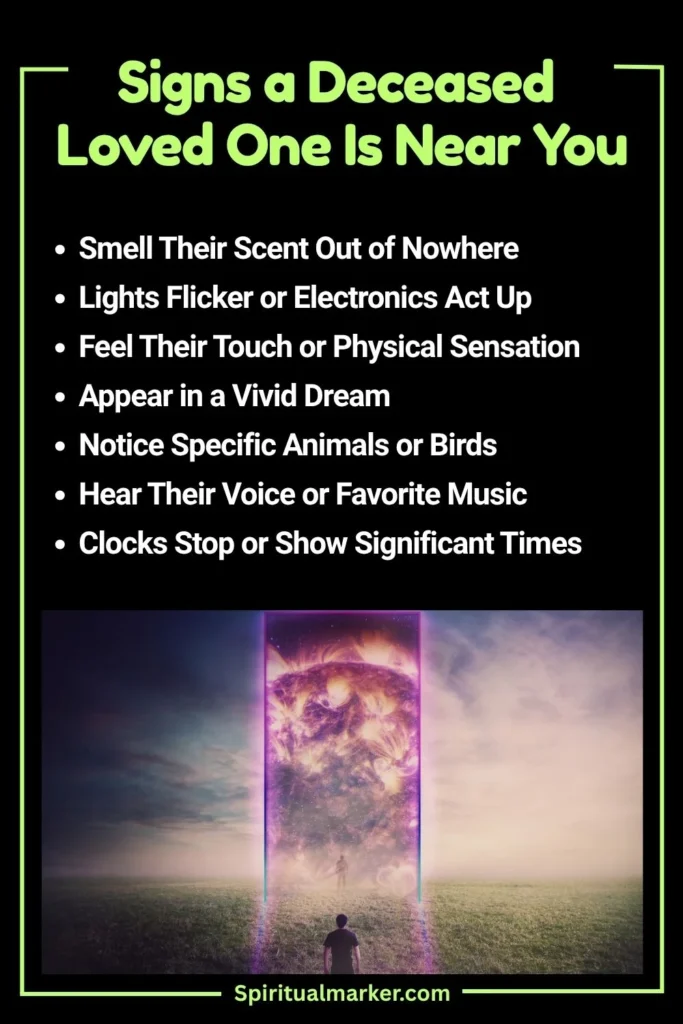
1. You Smell Their Scent Out of Nowhere
This is one of the most frequently reported and most startling signs. You are going about your day, and suddenly you smell something unmistakable. Their cologne or perfume. The scent of their pipe tobacco. The smell of a specific flower they loved. Roses when there are no roses. Cigarette smoke in a smoke-free room. There is no physical source. The scent appears and then fades, often within seconds.
Clairolfaction, or the psychic sense of smell, is one of the most well-documented forms of spiritual perception. Grief researchers and mediums consistently report that scent is one of the primary ways spirits communicate because smell bypasses the analytical brain and connects directly to memory and emotion. The olfactory system is uniquely linked to the limbic system, the emotional center of the brain. When your deceased loved one wants to trigger recognition and love, scent is an extraordinarily effective tool.
Do not rationalize this sign away. If a scent arrives in an impossible context, at an impossible moment, it is worth pausing and acknowledging. Many people who have dismissed this sign later wished they had simply said, “I love you too.”
2. Lights Flicker or Electronics Behave Strangely
Electrical disturbances are among the most widely reported signs in every culture. Lights in a room flicker for no reason. A television turns itself on to a specific channel. A song that meant something to your loved one begins playing on a radio that was not on. Your phone screen lights up with no notification. These events tend to cluster around anniversaries, birthdays, and moments of deep grief.
The reason spirits often work through electronics is well-documented in spiritual research. Spirits operate as energy, and electronics are highly sensitive to energetic fluctuations. The electromagnetic field of a spirit can interact with electrical systems in ways that produce noticeable effects. Thomas Edison, one of history’s greatest electrical inventors, believed deeply in the possibility of communicating with the dead through technology and reportedly spent years trying to develop a device for that very purpose.
When a light in your loved one’s old room flickers on the day of their anniversary, that is not a coincidence. That is a deliberate signal. Spirits communicate with the tools available to them. Electricity is one of the most accessible. Pay attention to when these events happen, not just that they happen.
3. You Feel Their Touch or a Physical Sensation
You feel a hand on your shoulder. A warmth on your cheek. A gentle pressure against your back that seems to say, “I am here.” These sensations are reported with striking consistency by people across vastly different spiritual and cultural backgrounds. A mother feels her deceased child take her hand. A widow feels her husband sit on the edge of the bed. A son feels his father’s familiar grip on his shoulder during a moment of crisis.
These are not grief-induced hysteria. The experiences are specific, localized, and purposeful. They tend to happen during moments when the grieving person needs comfort most. The physical touch of a spirit carries a signature warmth. Most people describe it as deeply familiar, like being wrapped in a feeling they recognize as belonging to that specific person. No other touch feels quite the same.
Spiritual teachers across traditions describe this as a form of direct energy transfer. The soul of the deceased reaches through the veil with an intention to comfort. The living body, which is itself energetic, receives that contact as a physical sensation. If you have felt this, trust what your body already knows.
4. They Appear in a Vivid Dream
Dream visitations are considered by many spiritual traditions to be the most direct form of after-death communication. During sleep, your conscious, analytical mind steps aside. The defenses that filter your waking perceptions lower. This creates a clear channel through which a departed soul can make genuine contact. These are not ordinary dreams. The difference between a grief dream and a true visitation dream is unmistakable once you experience both.
In a grief dream, the deceased is often sick, confused, or in the condition they were in at death. The dreamer feels distressed. In a visitation dream, the deceased appears healthy, luminous, and peaceful. They communicate clearly, often without words. They carry a specific message of love, reassurance, or sometimes a practical piece of guidance. The dreamer wakes up feeling not sorrow but profound peace. The feeling lingers for hours or even days.
In Islam, it is widely held that dreams of the deceased carry sacred weight and should be taken seriously. Christianity has a long tradition of God and angels communicating through dreams, as seen throughout scripture. The Bible records in Job 33:15 that “in a dream, in a vision of the night, when deep sleep falls on people as they slumber in their beds, He may speak into their ears.” When your loved one appears in a vivid, peaceful dream, they are not just a memory. They are visiting you.
5. You Notice Specific Animals or Birds
A cardinal lands outside your window on the morning of the anniversary of their death. A butterfly follows you through the garden on a day you are deep in grief. A dragonfly hovers in front of you for an unusually long time. A bird taps on your window repeatedly. These are not random animal behaviors. They are messengers, and nearly every spiritual tradition on earth recognizes this.
In Native American traditions, specific birds carry the souls of the departed. Cardinals are widely associated with deceased loved ones in North American folklore. Butterflies are powerful symbols of resurrection and transformation in Christianity and across indigenous cultures. Dragonflies represent the crossing of worlds in many Asian spiritual systems. The key is not the animal itself but the context and timing of its appearance. An animal behaving unusually, arriving at a meaningful moment, or appearing in a place where it does not naturally belong is a spiritually significant sign.
When a cardinal sits at your window and looks directly at you for minutes at a time on your deceased mother’s birthday, that is not ornithology. That is communication from beyond the veil. Many people who acknowledge these signs in the moment report feeling an immediate wave of comfort and a sense of being watched over.
6. You Find Meaningful Objects in Unexpected Places
You find a coin on the ground in an unusual place. A white feather appears on your path with no obvious source. A small meaningful object you had forgotten about suddenly surfaces. A photo falls off a shelf. A piece of jewelry you thought was lost turns up in an impossible location. These physical materializations are among the most concrete and verifiable signs of spiritual presence.
Coins are one of the most universally reported signs. The phrase “pennies from heaven” exists in popular culture for a reason. Grieving people across generations have found coins in meaningful places at meaningful times and felt with certainty that they came from someone they loved. White feathers hold a similarly powerful symbolic history as signs of angelic or spiritual presence in both folk spirituality and formal religious traditions.
The significance is always in the context. A coin on the street means nothing. A coin in the exact place where you last stood with your deceased father, found on the morning of his funeral, means something profound. Spirits work with physical matter to bridge the gap between their world and yours. When an object appears with impossible precision and timing, do not dismiss it. Pick it up. Say thank you.
7. You Experience a Sudden, Unexplained Temperature Change
You walk into a room and feel an unexplained wave of warmth. Or a cold spot appears in a specific area with no draft, no vent, and no logical cause. Temperature fluctuations are a classic indicator of spiritual presence and are taken seriously enough that paranormal investigators routinely use thermometers as part of their research tools.
The energy field of a spirit interacts with the ambient temperature of a physical space. Cold spots are typically associated with a spirit drawing energy from the environment. Warmth is most often reported as the sensation accompanying a loving, comforting presence. People who feel a sudden warmth in a moment of grief almost universally describe it as feeling like an embrace. It wraps around them. It comforts them. It feels unmistakably intentional.
If you feel warmth in a room where your deceased loved one used to sit, especially if the warmth has no rational source, do not reach for a thermostat explanation. Reach, instead, for the much more personal and meaningful one. Your loved one is sitting with you. They have not gone as far as you feared.
8. You Hear Their Voice or Their Favorite Music
You clearly hear your name called in a voice you recognize. A song that defined your relationship with them begins playing at the most unexpected, perfectly timed moment. You hear a knock or a sound pattern they had a habit of making. Clairaudience, the psychic sense of hearing, is the vehicle through which many after-death communications arrive.
This is not the vague “hearing things” of hallucination. People who report these experiences describe the voice as external, clear, and entirely recognizable. It carries the specific timbre, accent, and warmth of the person they lost. It is often heard in that suspended half-awake, half-asleep state known as hypnagogia, when the conscious mind is least guarded and most receptive to spiritual input.
Music is an especially powerful vehicle because it carries emotional resonance. A deceased loved one who knows how deeply a certain song connects you to them may influence a radio, a playlist algorithm, or a passing car stereo to play that song at a moment when you need comfort most. When that happens, it is not a coincidence. It is a love letter delivered across dimensions.
9. You Feel an Overwhelming Sense of Their Presence
There is no physical trigger. No smell. No sound. No flickering light. But you simply know they are there. You feel them standing behind you. Sitting beside you. Watching over you from across the room. This felt sense of presence is arguably the most common and most powerful sign of all, and it is also the one most likely to be dismissed as wishful thinking.
It is not wishful thinking. It is spiritual perception. Every human being has the capacity to sense energy beyond the physical senses. In spiritual language, this is the gift of claircognizance or clairsentience, the ability to know or feel things without logical explanation. Most people suppress this faculty in daily life because modern culture has little framework for it. But in grief, the veil becomes thin. Your perception sharpens. You become more open to what was always there.
Grief counselors who work at end-of-life care facilities report that dying patients frequently describe being visited by deceased relatives in the hours and days before death. These are not delusional episodes. They are well-documented, consistent, and comforting. The same faculty that allows the dying to see the departed allows the grieving to feel them nearby. Trust your felt sense. It is one of your most reliable spiritual instruments.
10. Clocks Stop or Display Significant Times
A clock stops at the exact time of their death. You keep waking up at 3:17 AM, the precise minute they passed. You glance at a clock and it always shows the same time that held meaning in your relationship. These temporal signs are reported with uncanny frequency in after-death communication accounts worldwide.
Time-related signs are particularly significant because they are measurable and specific. A grieving person cannot unconsciously manufacture a clock stopping at a precise moment. When a battery-operated clock stops at the exact minute of a person’s passing and then resumes on its own, that is not a mechanical coincidence. That is a marker. The soul of your loved one, now unbound by linear time, is pointing to the moment of their transition as a way of saying: I am connected to you. I remember. I am here.
Keep a journal. If you notice a specific time recurring, write it down along with what you were doing or thinking in that moment. You may begin to see a pattern that reveals not just a presence but a message.
11. You Experience a Sudden Wave of Calm During Grief
Grief is turbulent. It crashes over you in waves that feel unmanageable. Then, without warning, in the middle of your hardest moment, you feel a wave of inexplicable peace. It does not match your circumstances. Nothing in your external world has changed. But a deep calm moves through you, and for a moment, you know with absolute certainty that everything is going to be all right.
This is one of the most deeply personal and most spiritually significant signs of a deceased loved one’s presence. It is described across religious traditions. In Christianity, the peace of God is described in Philippians 4:7 as something that “surpasses all understanding.” In Sufism, the concept of Sakina refers to a divine tranquility that descends on a person from a higher realm. These spiritual traditions are describing the same phenomenon from different angles. Peace that makes no rational sense is a supernatural gift.
When you feel that inexplicable calm in the middle of grief, your loved one is near. They are sending you the one thing they most want you to have. They want you to know they are at peace. They want you to be at peace too. That wave of calm is their most direct and loving message to you.
12. Children or Pets Respond to Something Invisible
Children under the age of seven and animals retain a heightened sensitivity to energy that most adults have lost. A young child plays in a corner and laughs at something no one else can see. A toddler points at a space in the room and says the name of a deceased grandparent. A dog barks at a specific corner of the room with no visible trigger. A cat stares at a particular chair, the same chair where the deceased used to sit, for long periods.
These behaviors are remarkably consistent across reported after-death communication accounts. Children and pets have not yet been conditioned to ignore spiritual perception. Their awareness is open. What you have learned to rationalize away, they simply see and respond to. Many parents have been startled when a young child describes a deceased grandparent who visited them in their room, describing the person’s appearance in detail without ever having seen a photograph.
If a child or pet in your household begins responding to something invisible, especially near spaces or objects associated with a deceased loved one, take it seriously. They are not imagining it. They are perceiving something real that your adult conditioning has taught you to filter out.
13. You Receive a Sign at a Significant Moment
You are about to make a major life decision and feel suddenly paralyzed. Then a butterfly lands on your hand. Or a rainbow appears after days of storms. Or you find a note in their handwriting you had never seen before. The sign arrives at the precise moment of your need. This precision is the hallmark of genuine spiritual communication. Coincidence is random. Signs are targeted.
Spirits who love you understand your life. They see your struggles. They know when you are at a crossroads. They cannot always intervene in a direct, physical way, but they can send a signal at the right moment that says: I see you. I am with you. Keep going. These signs function as encouragement and as confirmation that love does not end with physical death. It simply changes form.
The more you attune yourself to these moments, the more frequently you will notice them. This is not because the signs increase but because your awareness expands. A spiritual practice of gratitude and acknowledgment invites more of these communications. When you notice a sign, say something out loud. Acknowledge it. Respond to it. Your loved one is listening.
7 Spiritual Meanings of Signs From a Deceased Loved One
1. Their Love Continues Beyond Death
The most fundamental spiritual meaning behind any sign from a deceased loved one is this: love does not die. Physical death ends a body. It does not end a relationship built on love. Every major spiritual tradition on earth teaches some form of this truth. In 1 Corinthians 13:8, Paul writes that “love never fails.” The soul, driven by love, reaches back through the boundary between worlds to maintain the connection it built in life. When you receive a sign, you are receiving proof that the bond between you remains active and alive. It has not dissolved. It has transformed into something even more powerful.
This meaning carries enormous weight for people who are drowning in grief. The fear is that death has erased everything. But the signs say otherwise. They say the person you loved still thinks of you. Still watches over you. Still reaches toward you with the same love they carried in life. The relationship did not end. It entered a new phase. Your loved one is not gone. They are present in a different way, and they are working to make sure you know it.
2. They Are at Peace
One of the deepest sources of grief is the fear that the person you lost is suffering. That their final days were painful. That they are lost or confused in some dark place. The spiritual meaning of signs from the deceased consistently counteracts this fear. The energy that comes through these signs is never distressed, confused, or dark. It is calm. It is warm. It carries peace as its signature quality.
When your loved one sends you a sign, the emotional quality that accompanies it is the message. That wave of inexplicable calm, that warmth, that sense of deep okayness, is not manufactured by grief. It is delivered by someone who wants you to know they are well. They have crossed over. They are at rest. The fear you carry about their wellbeing is not necessary. They are telling you so themselves. This is perhaps the most compassionate gift the deceased can offer the living.
3. You Are Being Protected and Guided
Signs often arrive at decision points. At the edge of a mistake. In the moment before you give up on something important. This is not coincidence. It reflects a profound spiritual truth: the deceased become guardians. Their love for you does not make them passive observers. It makes them active participants in your wellbeing, working from the other side to protect and guide you through the challenges of your life.
In Catholic tradition, the concept of a patron saint or guardian angel reflects this truth. In African traditional religions, ancestors serve as active protectors of their living descendants. In many indigenous cultures, the spirits of the dead are invoked for guidance and protection before major life decisions. Across all these traditions, the core belief is consistent: love continues as protection. When you receive a sign at a critical moment, your loved one is not just saying hello. They are saying: I see the path ahead. Trust me. I am guiding you.
4. Grief Is Being Held and Witnessed
Some signs arrive not at moments of decision but at moments of collapse. When you are crying on the bathroom floor at 2 AM. When grief hits you without warning in the middle of a grocery store. When a song plays and you cannot breathe. In those moments, a sign appears. A warmth. A scent. A butterfly at the window. The spiritual meaning here is specific and deeply moving: your grief is being witnessed.
Your loved one is not absent from your pain. They are present in it. They sit beside you in your worst moments. They hold space for your sorrow because they understand it. They understand it because they love you. The sign in the darkness is not a demand that you stop grieving. It is an act of compassionate companionship. It says: I see your pain. I am here with you in it. You are not alone in this. You never have been.
5. A Message of Forgiveness or Unfinished Business
Not all relationships end cleanly. Some loved ones pass before old wounds are healed. Before arguments are resolved. Before the words “I love you” or “I forgive you” can be spoken. The signs that arrive in these situations carry a particularly urgent spiritual meaning. They are the soul’s way of completing what death interrupted. They are the forgiveness that never got spoken. The love that was assumed but never voiced.
People who carry guilt or unresolved conflict with a deceased person frequently report signs that arrive with a clear energetic signature of resolution. The feeling is not accusation. It is release. It is the spiritual equivalent of an embrace after a long estrangement. Spiritual teachers across traditions emphasize that the soul, freed from the limitations of the ego, experiences full clarity and forgiveness almost immediately after passing. The grudges of the living are not carried into the afterlife. The love beneath them is what remains. When a sign arrives with that quality of peace, it is an act of spiritual completion.
6. They Are Celebrating Life’s Milestones With You
Signs cluster around milestones. Weddings. Graduations. The birth of a child. A promotion. A birthday. These are not coincidences of timing. They reflect the soul’s continued investment in the lives of those they love. Your deceased loved one did not miss your wedding day. They were there. The butterfly that landed on your bouquet, the flickering candle at the reception, the song that played as you danced, these were their gifts to you.
The spiritual meaning here is one of continued participation. Death removes a person from the physical experience of life but not from the love of the people living it. When a father who passed before his daughter’s wedding sends a sign on her wedding day, he is not haunting the moment. He is celebrating it. He is present in the truest sense. His love is a guest at every milestone you experience. He will not miss a single one.
7. An Invitation to Trust in the Afterlife
At the deepest level, every sign from a deceased loved one carries a universal spiritual message: death is not the end. This truth is the foundation of virtually every spiritual tradition humanity has ever produced. Signs from the deceased are not just personal communications. They are also cosmic confirmations. They are evidence, offered directly and personally, that the soul survives. That love endures. That the story does not end with the final breath.
For people who are questioning their faith, struggling with doubt, or facing their own mortality, these signs carry profound meaning. They are invitations to trust. To let go of the fear of death. To hold the knowledge that the people you love who have gone ahead are not lost. They are simply further along the same journey you are on. The signs say: there is more. Do not be afraid. Keep going. We will meet again. This is the most beautiful message the dead can send to the living, and it arrives every day, in the flutter of wings, in the scent of roses, in the flickering of a light.
What the Bible Says About Signs From the Dead
The biblical perspective on communication with the deceased is nuanced. Scripture is explicit in prohibiting necromancy and the deliberate summoning of the dead, as seen in Deuteronomy 18:10-12 and Leviticus 19:31. These prohibitions were directed at occult practices designed to manipulate or control spirits. They were not prohibitions against the dead making contact of their own will, or against God allowing such contact for purposes of comfort and divine purpose.
Scripture itself contains multiple accounts of the deceased appearing to the living. In Matthew 17:3, both Moses and Elijah appear to Jesus and his disciples on the Mount of Transfiguration. They communicate. They are recognizable. They are at peace. In 1 Samuel 28, the spirit of Samuel appears and speaks to Saul, though this account is complex and its approval is debated among theologians. In Luke 16, the story of Lazarus and the rich man describes the deceased as fully conscious, aware of the living, and desiring to communicate with them.
Many Christian theologians draw a careful distinction between seeking the dead (which scripture forbids) and receiving a sign or visitation initiated by God’s grace. The latter is seen as a gift rather than a transgression. The peace that accompanies genuine signs aligns with the fruit of the Spirit described in Galatians 5:22. Comfort, warmth, and peace are signatures of the divine, not the demonic. When a sign arrives with those qualities, its origin is love.
Signs From Deceased Loved Ones Across Cultures and Religions
The experience of receiving signs from the dead is not a Western or Christian phenomenon. It is one of the most universally shared human experiences across every culture and time period in recorded history. This universality is itself significant. When billions of people across radically different contexts report the same basic experiences, dismissing them as cultural myth becomes intellectually untenable.
In Japanese Shinto tradition, the spirits of ancestors, called kami, remain actively present in the lives of their families. The Obon festival, celebrated in August, is specifically dedicated to welcoming back the spirits of the deceased. Families light lanterns, prepare food, and perform rituals to honor and communicate with their loved ones. The presence of the deceased is not feared. It is welcomed with reverence and love.
In Mexican Catholic tradition, Día de los Muertos (Day of the Dead) celebrates the annual return of deceased loved ones to the physical world. Altars called ofrendas are built with photographs, food, flowers, and objects beloved by the deceased. The tradition holds that on this day, the veil between worlds is at its thinnest and the dead actively return to be with their families. Far from being morbid, this tradition is joyful, warm, and deeply rooted in the belief that death does not sever love.
In West African and Afro-Caribbean traditions, ancestors are considered an essential part of the living community. They are consulted before major decisions. They are thanked for protection. They are honored with libations and offerings. The concept of the ancestor as an active, loving, engaged spiritual force is fundamental to traditions including Vodou, Candomblé, and Yoruba spirituality. These are not superstitions. They are sophisticated spiritual systems built on millennia of direct experience with the presence of the deceased.
In Hinduism, the Shraddha ritual is performed for deceased family members to ensure their peaceful transition and to maintain the bond between the living and the dead. Ancestors, called Pitrus, are believed to watch over their descendants and to require acknowledgment and honor in return for continued blessings. In Buddhism, prayers and merit-making are offered for deceased loved ones to support their journey through the bardos, the transitional states between death and rebirth. The connection between the living and the dead is considered an active, ongoing relationship across all these traditions.
How to Become More Open to Signs From Your Deceased Loved One
The signs are always there. The obstacle is often your own grief-clouded perception and analytical mind. Grief creates a kind of static. It is overwhelming and consuming. It can block the very signals your loved one is sending. Becoming more open to receiving signs is not about forcing anything. It is about creating the conditions in which subtle communication can be felt and recognized.
Stillness is the most important condition. Signs rarely arrive in the noise and distraction of a busy day. They arrive in quiet moments. In the shower. In the garden. In the stillness before sleep. A regular practice of meditation, even just ten minutes of intentional quiet each day, dramatically increases the likelihood of noticing signs. Meditation quiets the analytical brain and opens the perceptual faculties that operate beneath conscious thought.
Intention also matters. Speak to your loved one directly. Out loud, in prayer, or in writing, tell them you are open to hearing from them. Ask them to reach out. This kind of intentional invitation has been reported by thousands of people as the moment when signs began arriving with greater frequency and clarity. Your loved one is not waiting for a formal invitation. But when you consciously open the channel, the communication often intensifies.
Keep a sign journal. Write down every experience that gives you pause. The unexpected scent. The flickering light. The dream. The butterfly. When you record these experiences, you begin to see patterns. You begin to understand the specific language your loved one uses to reach you. Everyone receives signs differently because every relationship is unique. Your loved one communicates in the way that is most personal and most recognizable to you. The journal helps you learn their spiritual signature.
When Should You Be Concerned Rather Than Comforted?
The vast majority of after-death communications are benevolent, comforting, and unmistakably rooted in love. However, spiritual discernment is important. Genuine signs from a deceased loved one carry peace as their signature. They do not increase fear. They do not demand anything. They do not create obsession or prevent the natural process of grief and healing.
If experiences feel dark, threatening, or deeply unsettling, they may not originate from your loved one. Every spiritual tradition teaches the importance of spiritual protection and discernment. Prayers of protection, invocations of divine light, and speaking the name of God or calling on spiritual helpers in your tradition are all appropriate responses to experiences that feel negative rather than loving.
Additionally, while receiving signs can be deeply healing, grief still requires the full journey of mourning. If the pursuit of signs becomes a way of avoiding the emotional work of grief, or if it begins to interfere with daily functioning, speaking with a grief counselor is both wise and healthy. Signs and professional grief support are not mutually exclusive. Your loved one wants you to heal, not to remain frozen in loss.
A Final Note
Grief is the price of love. You feel it this deeply because the love was this real. But love, as it turns out, is not subject to the same rules as everything else in the physical world. It does not end with a heartbeat. It does not stop at the boundary of death. The person you are missing, the one you would give anything to hear from one more time, is not as far away as it feels.
The signs described in this post are not wishful thinking. They are not grief-induced fantasy. They are documented, cross-cultural, and deeply personal communications from souls who love you and refuse to let death be the final word in your relationship. Pay attention to the small things. The unexpected scent. The flickering light. The dream that leaves you feeling more peaceful than you have in months. The butterfly at exactly the right moment.
They are reaching out. They are saying, in the only language available to them: I am still here. I still love you. You are not alone.
If you have been experiencing signs from a deceased loved one, consider starting that sign journal today. Write down every experience. Speak to them out loud. Invite the connection. The more you acknowledge their presence, the more clearly you will feel it. You do not have to grieve in silence. You do not have to grieve alone. The love between you is a living thing, and it is reaching toward you right now.